Luc Learns to Share

by Melodie Miller © 2024
Le titre de mon histoire est Luc Apprend à Partager. Cette histoire est une lecture pour débutante français. Je suis débutant dans l’apprentissage du français.
The title of my story is “Luc Learns to Share.” This story is beginning French reading. I am a beginner in learning French.
Luc est le personnage principal du histoire. Il a dix ans. Il est un souris grise et brun.
Luc is the main character of the story. He is 10 years old. He is a grey and brown mouse.

The image of Luc is generated by Microsoft Copilot (Melodie Miller / AI Prompt Engineer)
La région de mon histoire est la Suisse, dans la ville de Berne.
The region of my story is Switzerland, in the town of Berne.

The image of Luc’s village is generated by Microsoft Copilot (Melodie Miller / AI Prompt Engineer)
La famille de Luc est très grande.
The family of Luc is very big.

The image of Luc’s family is generated by Microsoft Copilot (Melodie Miller / AI Prompt Engineer)
Le père de Luc est professeur. Le père de Luc lui a appris à partager.
The father of Luc is a professor. The father of Luc taught him to share.

The image of Luc’s father is generated by Microsoft Copilot (Melodie Miller / AI Prompt Engineer)
La mère de Luc est professeur. La mère de Luc lui a appris à partager..
The mother of Luc is a professor. The mother of Luc taught him to share.

The image of Luc’s mother is generated by Microsoft Copilot (Melodie Miller / AI Prompt Engineer)
Et son village aime partager avec tout le monde.
And his village likes to share with everyone.
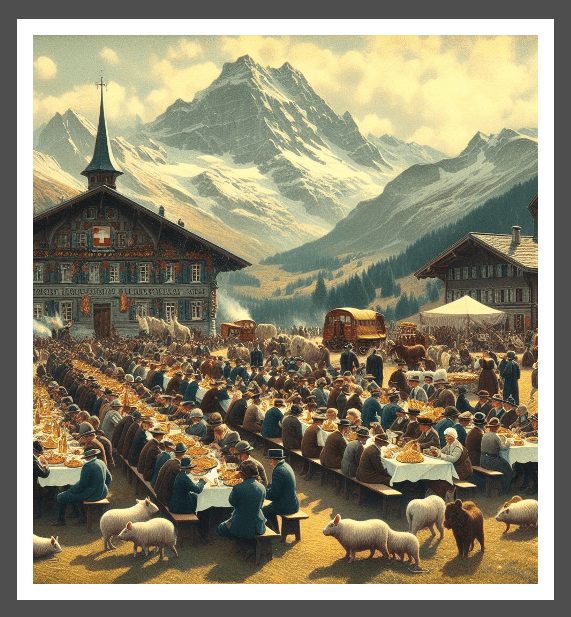
The image of Luc’s village is generated by Microsoft Copilot (Melodie Miller / AI Prompt Engineer)
Mais, Luc n’aimait pas partager. Alors, Luc est allé dans la grande ville.
But, Luc did not like to share. So, Luc went to the big city.

The image of Luc in the big city is generated by Microsoft Copilot (Melodie Miller / AI Prompt Engineer)
Sa famille était triste.
His family was sad.
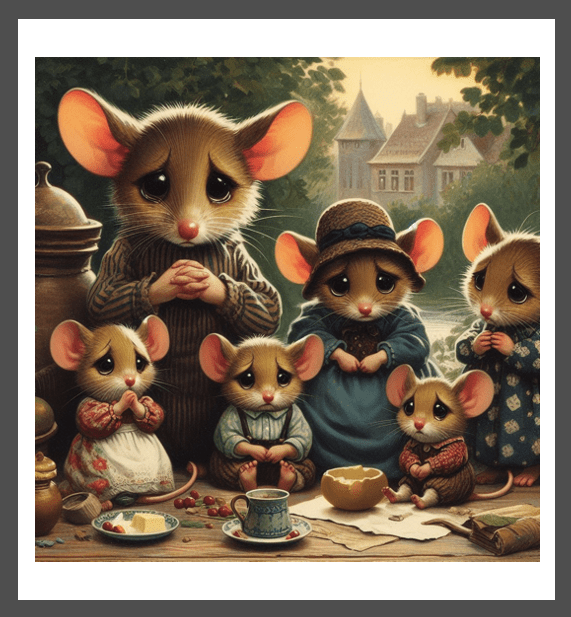
The image of Luc’s family is generated by Microsoft Copilot (Melodie Miller / AI Prompt Engineer)
Mais, Luc est heureux. Il rêve de ne pas partager sa nourriture.
But, Luc is happy. He dreams of not sharing his food.
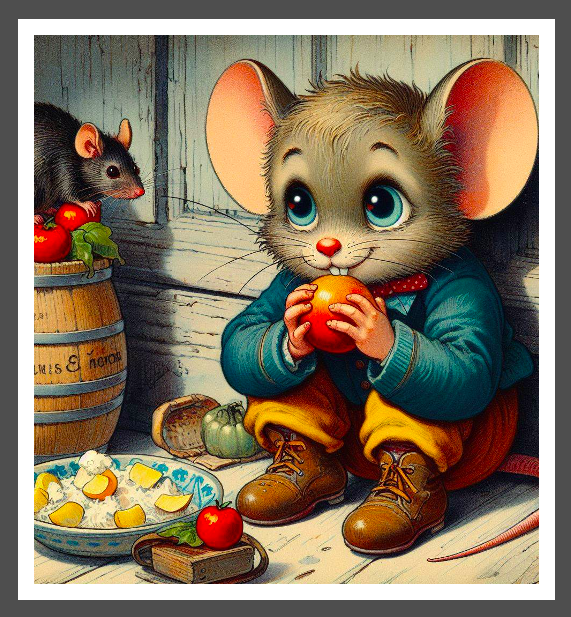
The image of Luc is generated by Microsoft Copilot (Melodie Miller / AI Prompt Engineer)
Il rêve de manger tout le fromage seul.
He dreams of eating all the cheese alone.
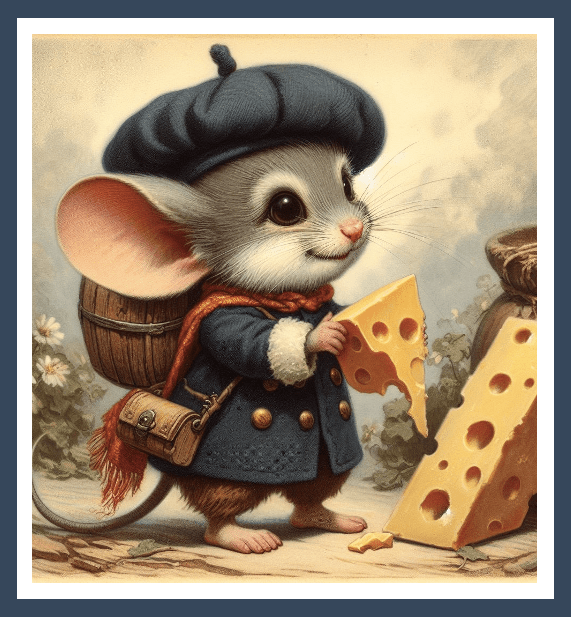
The image of Luc is generated by Microsoft Copilot (Melodie Miller / AI Prompt Engineer)
Il pense qu’il y a beaucoup de nourriture dans la grande ville.
He thinks that there is a lot of food in the big city.
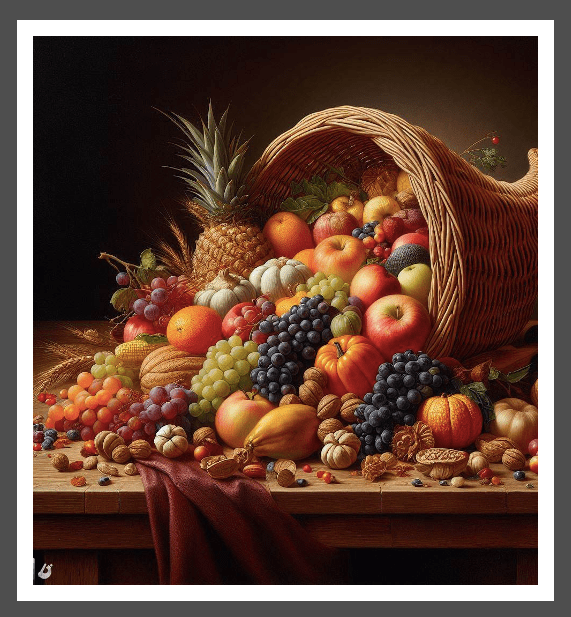
The image of Luc’s imagination of food in the big city is generated by Microsoft Copilot (Melodie Miller / AI Prompt Engineer)
Mais, quand Luc est allé au magasin pour trouver de la nourriture, un homme l’a chassé. L’homme n’aimait pas avec Luc.
But, when Luc goes to the store to find food, the man chases him. The man did not like to share with Luc.
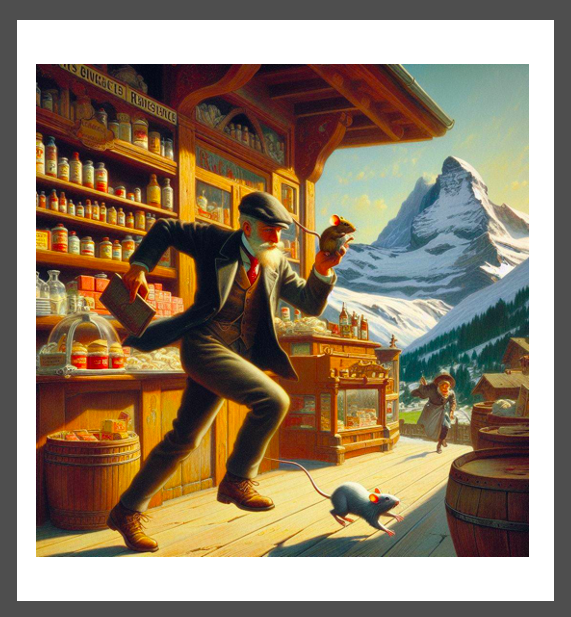
The image of Luc and the store keeper is generated by Microsoft Copilot (Melodie Miller / AI Prompt Engineer)
L’homme dit “Pas de souris autorisée.”
The man says “No mice allowed.”

The image of Luck and the “No Micse Alowed” is generated by Microsoft Copilot (Melodie Miller / AI Prompt Engineer)
Luc a appris qu’il doit partager pour avoir des amis.
Luc learns that he must share to have friends.

The image of a sad Luc is generated by Microsoft Copilot (Melodie Miller / AI Prompt Engineer)
Luc a appris à aimer partager parce que qu’il adore ses amis.
Luc learns that he likes to share because he loves his friends.

The image of Luc is generated by Microsoft Copilot (Melodie Miller / AI Prompt Engineer)
-
Sunflower Farms: Radio Script
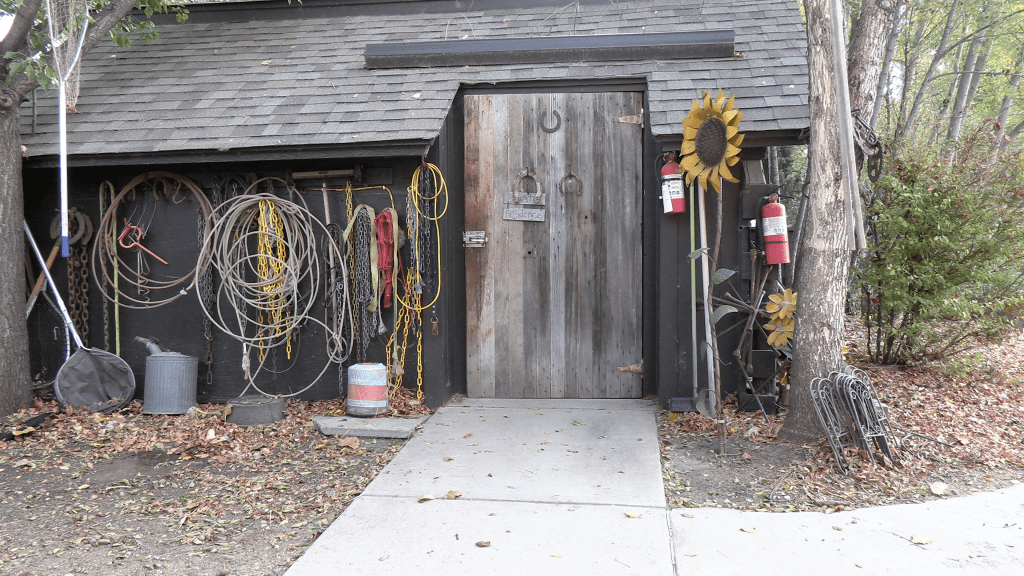
Sunflower Farm, Longmont Colorado (Melodie Miller / Photographer)
-
Super-Frog Saves Tokyo: A Classical Dream Vision Narrative
An analysis of Haruki Murakami’s Super-Frog saves Tokyo written by Melodie Miller.
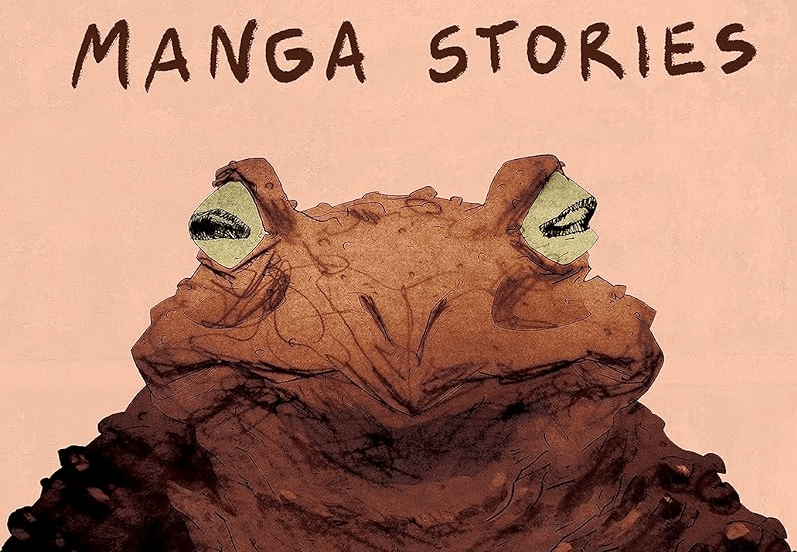
Super-Frog Saves Tokyo illustration by PMGL (Courtsey of Amazon Books)
Haruki Murakami was born in Kyoto in 1949 and now lives near Tokyo. His work has been translated into more than fifty languages.
- https://en.wikipedia.org/wiki/Haruki_Murakami
- https://en.wikipedia.org/wiki/Drive_My_Car_(film)
- Norwegian Wood (1987)
- The Wind-Up Bird Chronicle (1994–95)
- Kafka on the Shore (2002)
- 1Q84 (2010)
- Men Without Women (2014)
- The Elephant Vanishes (1993)
-
The Story of the Western Wing: Breaking Tang Tradition
The West Wing, a play written by Wang Shifu (1250-1300) in the Yuan Dynasty.

Scenes from The Story of the Western Wing, National Museum of Asian Art (Courtesy of The Smithsonian)
-
The Story of Ying-ying: Strange Love
A timeless story of love where social expectations conflict with personal desires.
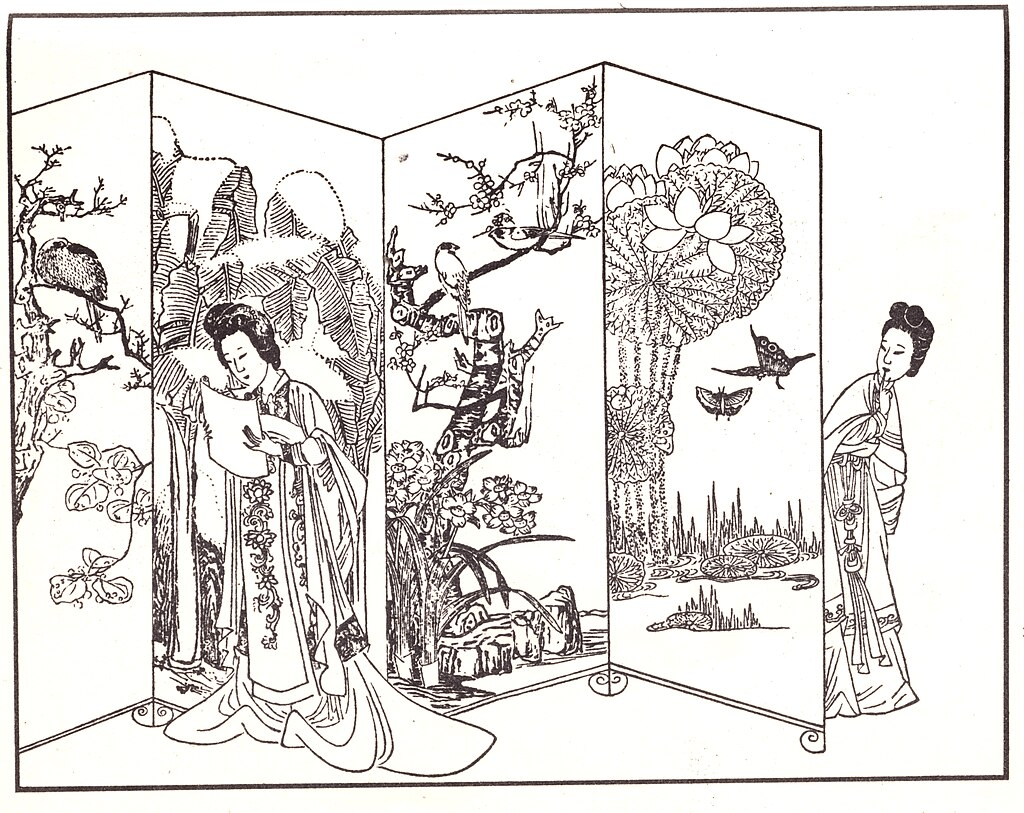
Scene from Romance of the Western Chamber, an opera inspired by the story of Ying-ying (Illustration of act 10 courtesy of Wikipedia.org)
-
Humans are Synonymous with Monsters in “Monster Takes a Bride” (1807), Ikku Jippensha

Original 19th century Japanese Woodblock Print The Monster Takes a Bride, 1886
-
Syntax in Shakespeare’s Sonnet 20 “A women’s face with nature’s own hand painted”
An exploration of the poet’s depiction of nature and beauty.

The Chandos portrait is an oil painted portrait thought to depict William Shakespeare (1564–1616). Painted between 1600 and 1610, it may have served as the basis for the engraved portrait of Shakespeare used in the First Folio in 1623. Attributed to John Taylor. (Courtesy of Wikipedia.org)
Read more about Shakespeare’s Sonnet 20 “A woman’s face with Nature’s own hand painted”
-
The Frozen Castle, a Murderous Tale

The Frozen Castle created in Microsoft Copilot by Melodie Miller
-
A Sublime Experience
Waiting for the the last ferry in a dark, wet abandoned parking lot in the far Northwest.

The sublime and disruptive aesthetics of winter in the Northwest. Image generated by CoPilot designed by Melodie Miller.

A sublime ferry crossing the Puget Sound on a Northwest winter night. Image generated by CoPilot designed by Melodie Miller.

A sublime drive home after crossing Puget Sound on a Northwest winter night. Image generated by CoPilot designed by Melodie Miller.
-
The Elbow Room
Melodie Miller ©
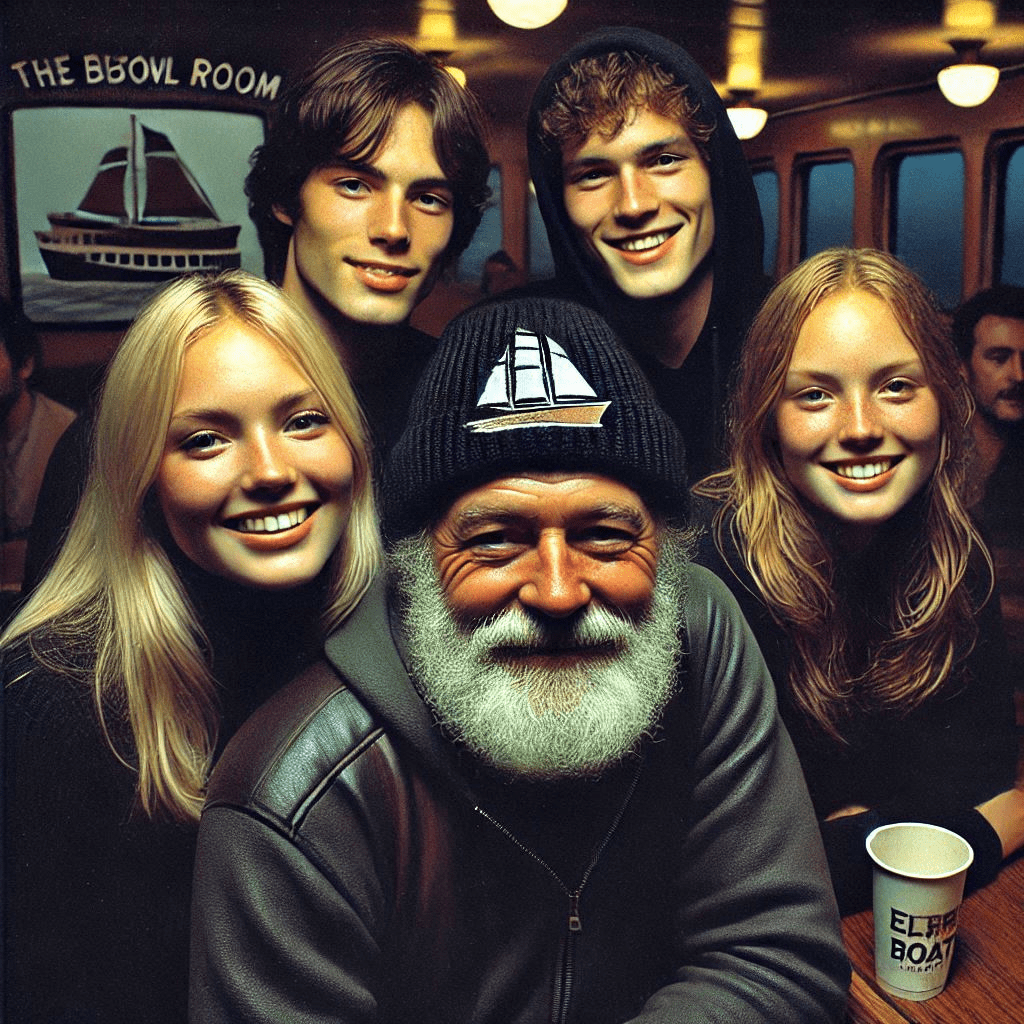
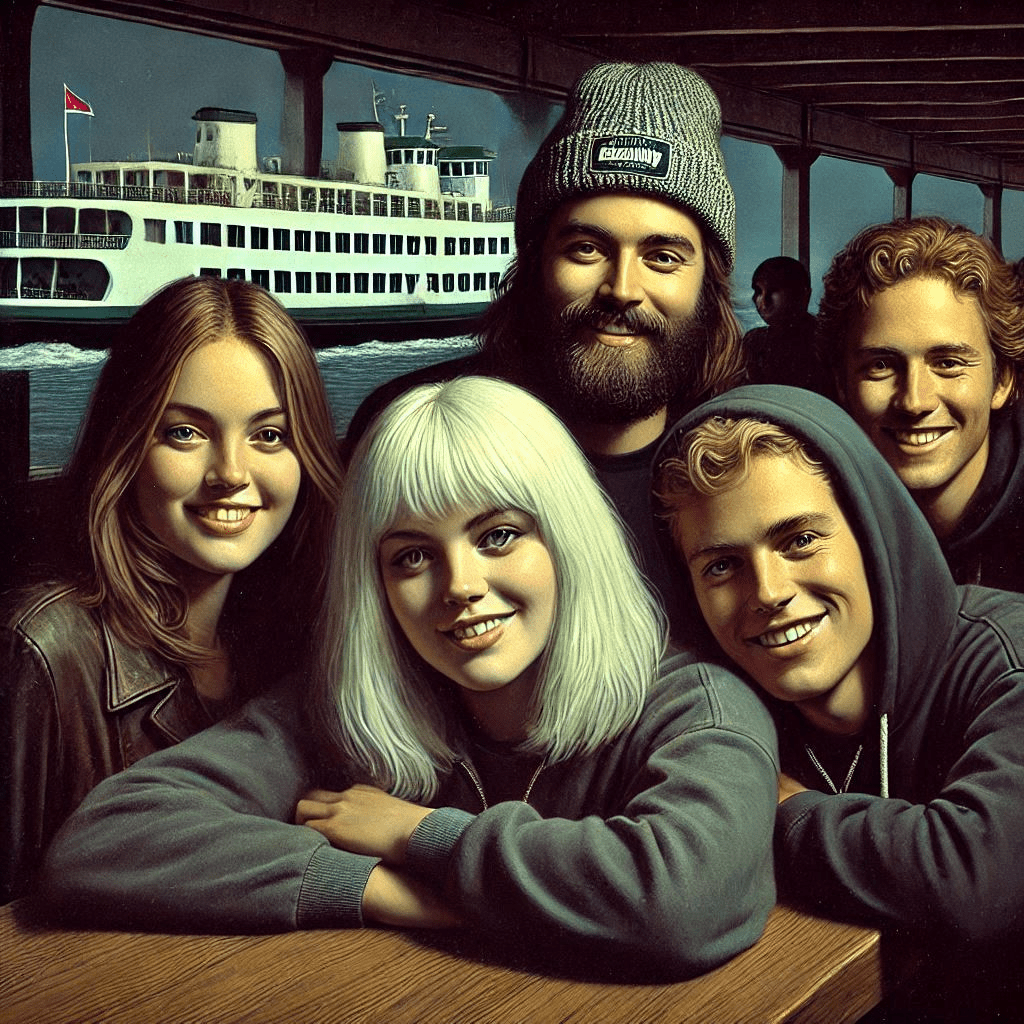
The Elbow Room is a situational comedy series set in 1984 at the birth of tech in Seattle, Washington. The Elbow Room is a fictitious bar on a Washington State Ferry where young commuters hang together during their battle to and from Bainbridge Island to their jobs in Seattle. Their friendships exist only inside the world of their commute and every effort is made to keep their personal lives separate from their ferry boat adventures.

-
Colorado Funds Affordable Housing but Not All Home Buyers Qualify
The term “starter home” has a new meaning. The average price of a home in Boulder jumped from $166,000 in 2000 to $966,000 in 2025. Boulder’s cost of living is 41% higher than the national average. This means a dozen eggs that costs $4 in Jackson, Mississippi, will cost $5.64 in Boulder, Colorado. What does that mean for housing?
The median sale price of homes in Boulder County, Colo. in 2024 was $970,000, according to Zillow.com. To match a house payment with the average rental price of $2,300 per month, a buyer needs $725,000 for a down payment.
With a median household income of $84,840 and expenses of $77,280 yearly, an excess of $7,560 per year will require ninety-five years to save the downpayment.

Zillow.com Boulder Housing Market Overview 2023 – 2024 – accessed Jan. 3, 2025
The Common Sense Institute of Colorado reported in January of 2023 that voters passed Proposition 123 with a 54 percent majority to fund affordable housing programs statewide.

Data USA. Adobe Express. (Melodie Miller / Creator)
Data USA reported similar data for Boulder, Colorado, in 2022, with a higher median household income of $99,700 and a lower median property value of $671,100. This additional $14,860 yearly income means a buyer could buy a house in 25 years.
However, according to Pro Builder, housing prices in Boulder increased 121% or $107 per day between 2015 and 2025. If prices continue to rise at that rate, a future buyer’s goal becomes non viable.

State Senator Dylan Roberts – Colorado Senate Democrats (Photographer / Uncredited)
“During my time in the state senate, I have been trying to find ways to lower the cost of living,” Senator Dylan Roberts said, “and this starts first and foremost with housing.”

Common Sense Institute Colorado Jan. 30, 2023
Proposition 123 dedicated a total of $290 million toward housing equity in the first year. Willoughby Corner at 120th and Emma Street in Lafayette is part of the Boulder County Housing Authority (BCHA) 400 affordable housing project using some Proposition 123 funding.

https://www.pinkardbuilds.com/expertise/affordable-housing-construction
“It takes a lot of funding. It takes federal funding, state funding, and a lot of it is funded by the low-income housing tax credits,” Bill Cole, housing partnership and policy manager for Boulder County. “It’s a federal program run through the state.”
According to Cole, the Willoughby Corner construction takes three phases. The first phase is 90 units of senior housing. The second phase is multifamily apartments totaling 200 units. “The third phase is actually going to be homeownership opportunities, townhomes, about 80 units,” Cole said. All units except the senior housing have a waiting list.

willoughby-corner-open-house-presentation-7-26-23 PDF (assets.bouldercounty.gov)
Boulder County’s affordable housing imposes income limits that exclude many people from government benefits. The average Boulder County resident earning a salary of $84,840 will not qualify for this benefit.

Boulder County Rent and Income Limits – Willoughby Center
Some potential home buyers find that there is no solution for home ownership. These buyers earn more than the income base to qualify for affordable housing but do not earn enough to make a substantial down payment.
“With 6% interest rate right now, how does a new home buyer afford that?” Boulder County realtor Ernie Sica said. “They have to have a really substantial income. That is really hard.”
With a mandatory high down payment, future homeowner Elena Sedin said, “My parents are already paying for my college. They can’t help me buy a house.”
According to Cole, those individuals who qualify for affordable housing should “Look at Prop 123. There’s gonna be a lot of the state funding for the foreseeable future,” Cole said. “Boulder County plans to build multifamily, senior and single-family developments as it tries to “increase the housing in the city of Boulder.”
-
The Decline of Hunting in the U.S. and the Threat to Wildlife Conservation
According to the archeological dating of the Morocco Jebel Irhoud animal fossils and the Homo sapiens who ate them, humans have hunted game animals for over 300,000 years. Although humans are omnivores, they did not start farming until 23,000 years ago, according to the Ohalo II archaeological site in Israel. This means that humans needed to hunt for 277,000 years for food security.
Kelly Maher, an avid Coloradan hunter and mother, said part of her family ethic is “we hunt to eat and we eat what we hunt.” During the Covid 19 shutdown, her family ate deer meat stored in the freezer from the previous hunting season. Maher said she believes hunting is a core part of “understanding our place in the world.”
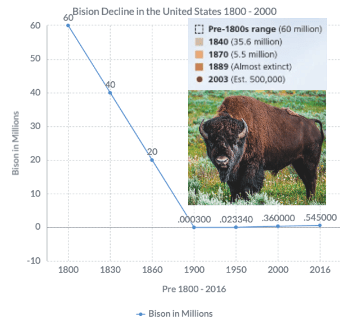
Data from All About Bison. https://allaboutbison.com/national-mammal/
American wildlife suffered at the end of the nineteenth century from mismanagement, according to the Audubon Society. The bison population had diminished from 60 million to 300 in 100 years due to lack of management and overhunting according to All About Bison. Together, President Theodore Roosevelt, George Bird Grinnell and John Muir along with the Audubon Society, established a conservation movement to preserve nature.
Roosevelt, the “conservation president,” used his authority in 1906 to protect public lands and wildlife by creating the United States Forest Service (USFS). This service established 150 national forests and 18 national monuments through the American Antiquities Act. This act protected over 230 million acres of open public space for citizens of the United States use.
With the advent of city living, increased public criticism, and reduced barriers to food security, hunting has declined in the United States. The decline of hunters is problematic state-wide for wildlife conservation efforts that depend on funding from hunting license sales.

Source: 2020 U.S. Census Demographic – City density
According to Wildlife for All, between 1960 and 2020, hunting license sales increased by 2 million or 13.5 percent. The U.S. Census Bureau (USCB) reports that the population increased by 152 million or 84 percent. Although the number of hunters increased, it dropped from 7.8 percent of the population in 1960 to 4.8 percent in 2024.
The U.S. Fish and Wildlife Service manages nationwide conservation funding through the collection of hunting license revenue and firearms and ammunition excise sales tax from each state. The funding is distributed back to the state parks and wildlife departments that manage public land conservation and animal populations.

Sources: U.S. Census Bureau. Wildlife for All. U.S Fish and Wild Life Service Hunting licenses issued between 1960 and 2020 compared to the U.S. population.
“There are 180 hunting units that Colorado has divided into Game Management Units (GMUs),” Cody Heneghan, a hunt planner for Colorado Parks and Wildlife said. “These units designate which part of the state your particular license permits you to hunt in.”
Hunting licenses for Colorado’s Western GMUs with higher elk populations are in high demand with a limited number available per year. A hunter must apply for these types of licenses through a “big game draw,” or purchase a leftover license after the draw if one is available.
“I’m not hunting as much now because the last time I bought a license, it was in a unit with a low population and I didn’t get an elk that time,” Wally Light, a 21-year-old hunter said. “It was a lot of work without a payoff. It didn’t seem worth it.” According to Colorado Parks and Wildlife, the Federal Bureau of Land Management (BLM) manages 8 million acres of public land in Colorado. However, non of the 23,000 acres of open space and trails in rural Pitkin County are open for hunting. Open space hunting in Pitkin County Colorado is prohibited according to the Pitkin County Open Space and Trails program. However, private land is huntable with permission.
But private land is diminishing. In January, Pitkin County Open Space and Trails Board voted unanimously to purchase 650 acres of private land in upper Snowmass Creek Valley to reclassify it to BLM open space.
According to wildlife advocates, limiting hunting units in Colorado become problematic for wildlife management. “Management of ecosystems is important,” Maher said. “By virtue of the fact that humans are here, we must manage this system” to ensure the well-being of animals and the environment.
Between 1970 and 2000, hunting license sales revenue increased from $600 million to $1.1 billion according to The U.S. Fish and Wildlife Service reports. However, revenue remained stagnant over the next two decades.

Sources: U.S. Fish and Wildlife Service. Congressional Research Service. Hunting license sales revenue and federal excise tax collected equally $2.2 billion in 2024.
Data from the Congressional Research Service reports that between 2017 and 2022, excise tax collected from the sale of firearms increased from $600 million (inflation adjusted) to $1.1 billion due to increased sales during the pandemic but not to sales for hunting equipment. However, funding from the U.S. Congress has decreased since 2015.
Hunting is an integral part of maintaining a stable deer and elk population. Lands maintained by hunting license revenues distributed by the U.S. Fish and Wildlife Service are more likely to support natural wildlife.
The “availability of food sources in the wilderness is a factor in monitoring the population,” wildlife advocate Mark Surls said. This becomes a closed-loop, sustainable ecosystem.
The U.S. Fish and Wildlife Service operating budget, is partially funded through congressional appropriations. In 2024, the operating budget was $4.1 billion with $1.722 billion allocated by the government and the balance coming from grants, excise tax revenue and hunting license sales.

Sources: Congressional Research Service Funding requested to manage Fish and Wildlife Services, and congressional funding enacted to finance conservation in all 50 states and 16 territories.
Public opinion contributes to the hunter’s image in the U.S. On Nov. 5, voters were given a choice through “Cats Aren’t Trophies” Proposition 127 to decide whether Colorado Parks and Wildlife would continue to manage the mountain lion population by issuing hunting licenses.
“Hunting deer is fair chase,” wildlife advocate Carol Monaco said. But hound hunting “mountain lion is cruel.” It isn’t helping anyone and “very few big cats are dressed for consumption. We need to learn to coexist with wildlife.”
Surls advocates that hound hunting is unethical and should be removed from the hunting license options because “it gives our hunters a bad name for violations of fair chase,” integrity in hunting.
Some critics combine hunting for food with “trophy hunting.” Trophy hunting is hunting wild animals for sport and keeping body parts for display, not food. Mesa County Commissioner Cody Davis commented that this type of rhetoric is needless with an “end route to limit hunting” and “trophy hunting is already illegal in Colorado.”
Proposition 127 aimed to remove mountain lion population management from the Colorado Parks and Wildlife. In Nov. 290,000 voters rejected the proposition. In a compromising effort at a public engagement meeting critics of mountain lion hunting demanded that “guaranteed kill” be removed from hunting outfitter’s advertising because it is illegal in Colorado and a violation of CPW’s policy.

Source: Ballotpedia Colorado Proposition 127 to Prohibit Hunting of Mountain Lion was rejected by Colorado voters, allowing Colorado Parks and Wildlife to continue managing the population.

Source: Ballotpedia. Colorado Proposition KK, Excise Tax on Firearms was passed by Colorado voters, adding 6.5% excise tax to firearms and ammunition sales.
“We want to work with Colorado Parks and Wildlife,” Monaco said, “in every way so they can do their job” managing wildlife population.
As hunting license sales decrease, U.S. Fish and Wildlife Service funding must be replaced with a new source. Hunting licenses are an important source of revenue.
“Colorado Parks and Wildlife are brilliant at managing the wildlife population and it should stay that way. It is a scientific method of conservation,” Davis said
-
My Glamorous Career: A Memoir of Designing for U.S. Special Forces
This story is creative non-fiction about a designer who worked with U.S. Special Operations troops to create the perfect clothing to hunt for Osama bin Laden in the Hindu Kush mountain range between Afghanistan and Pakistan. This real project was completed in 2003. Bin Laden was killed on May 2, 2011.
While the events and core truths are based on real experiences, some details may have been altered. This includes names, identifying characteristics, and sometimes even timelines. These changes protect privacy or enhance the narrative. Any resemblance to places, real people, or situations is not intended to be exact.
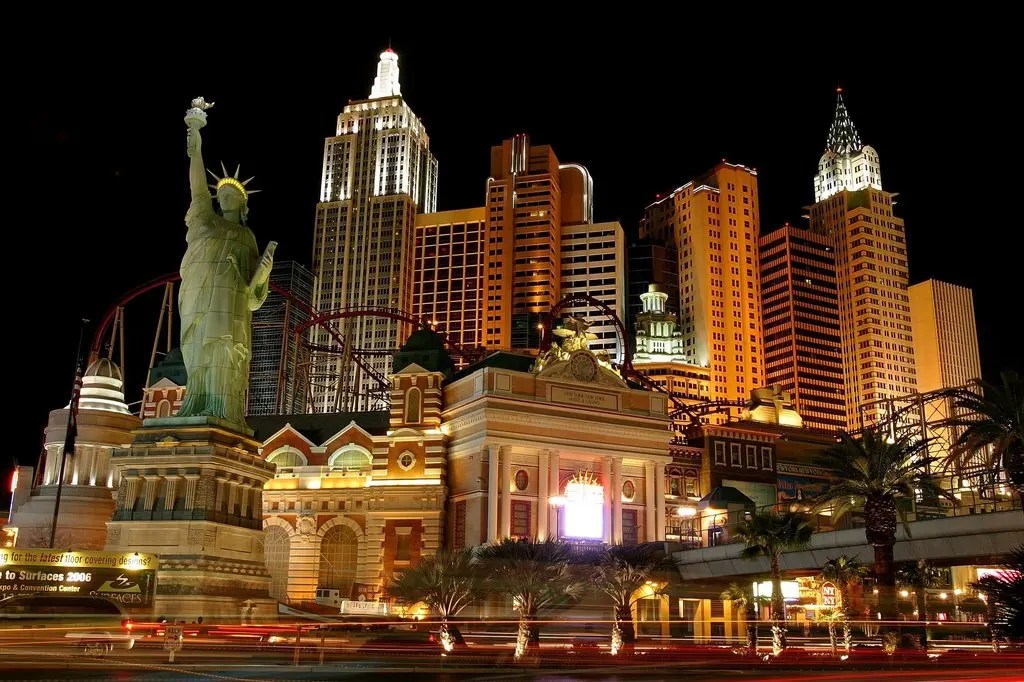
The New York-New York Hotel and Casino in Las Vegas, Nevada is home to a miniature Statue of Liberty replica. (Photo courtesy of Ethan Miller/Getty Images)
I was willingly recruited into the world of covert operations by a special operations officer dressed all in black. It happened at the Las Vegas Convention Center. Any fan of “Casino” or “The Godfather” would rather meet the mob bosses, Sam Rothstein and Michael Corleone, than Joubert of “Three Days of the Condor” or Jason Bourne, the trained assassins. At least the Rothstein and Corleone characters embraced brotherhood like a family of gorillas. As long as you never refused an offer, they would always make room for compromise. But assassins are a different kind of animal. With assassins, things are over before you know what happened. You never see them coming. Like mountain lions, assassins hunt alone. Assassins do not negotiate. On that day in Las Vegas, I met an assassin.
Disguised as a procurement officer for the army, the assassin dressed impeccably in the best-selling and most important color in any apparel collection: black. I thought I was meeting a fellow couturier. With the erroneous belief that clothes make the man, I started the project thinking I was working with a compadre; better yet, a man who knew how to dress.

Microsoft Copilot Image generated by Melodie Miller
This misconception filled me with a false sense of security. I thought this would bridge the gap between me, the designer, and Eddie, the government-sanctioned hitman. I knew he would be ‘pack’n.’ I wasn’t afraid of guns; I grew up in a family of hunters. Still, I hoped I wouldn’t become the prey.
It all started at 8:45 a.m. Eastern Standard Time on that fateful morning in September 2001, when I woke from a dream where red balls of fire chased me down an endless hallway. When I turned on the television and saw the burning tower in New York City, my dream made sense.
I didn’t know it yet, but life would never be the same. The next thing I knew, I was in Las Vegas on a sweltering January day in 2002, when the country still shared a collective fear that a terrorist could be their neighbor, living on their street and be attending flight lessons at their municipal airport, preparing for another attack.
“How did I get here,”[1] I asked myself, “by letting the days go by without thinking, pursuing the American dream, and designing clothing for the self-absorbed,” I said.
Walking through the casino, I watched as gamblers followed the president’s advice to “enjoy life,”[2] so they headed to the slots and blackjack tables. Spending their money on entertainment helped them forget about the problems of the world. But I was not enjoying myself. I was working.

Microsoft Copilot Image generated by Melodie Miller
Leaving the casino, I took the long, hot walk from my hotel along the Boulevard, which seemed to become longer and warmer as I passed the miniature replica of the Statue of Liberty. I wondered if freedom, like the statue, would shrink following the attack on New York City.
Congested with noisy taxis, people rushing to their gambling destinations, and neon lights flashing at all times of the day and night, Vegas epitomized the ideal of the U.S.A.: get rich and fast if possible. The ground seemed to radiate beneath my feet as if the heat came from the underworld. I felt like I was walking on red-hot lava.
I thought, have I “found the ‘cost of freedom” [3] buried in my soul?

Microsoft Copilot Image generated by Melodie Miller
Ignorant of the danger ahead, I continued moving forward. The odor of hot oil mixed with concrete filled the air as I convinced myself I believed in the pledge of allegiance to the republic that had sheltered me all my life. But actually, I needed the money, so I kept walking toward the meeting. I was sweating, and moisture under my arms dripped down my skin, inside my crisp white business shirt, pooling at the belt buckled tightly at my waist.
I reached the stairs to the convention complex and looked up at the building towering over me like a colossal statue of Commodus, the blood sport-loving emperor of Rome who was assassinated by his gladiator trainer.
“One can never be too careful,” I thought.
The Greek columns seemed to be holding up my world. They reminded me that even a military power like the great Roman Empire did not guarantee eternal supremacy. This is true even for a country like America. The gargantuan doors seemed to suck me into the maze-like complex. The oversized tiger statues that flanked the doors looked at me with large, hungry eyes.
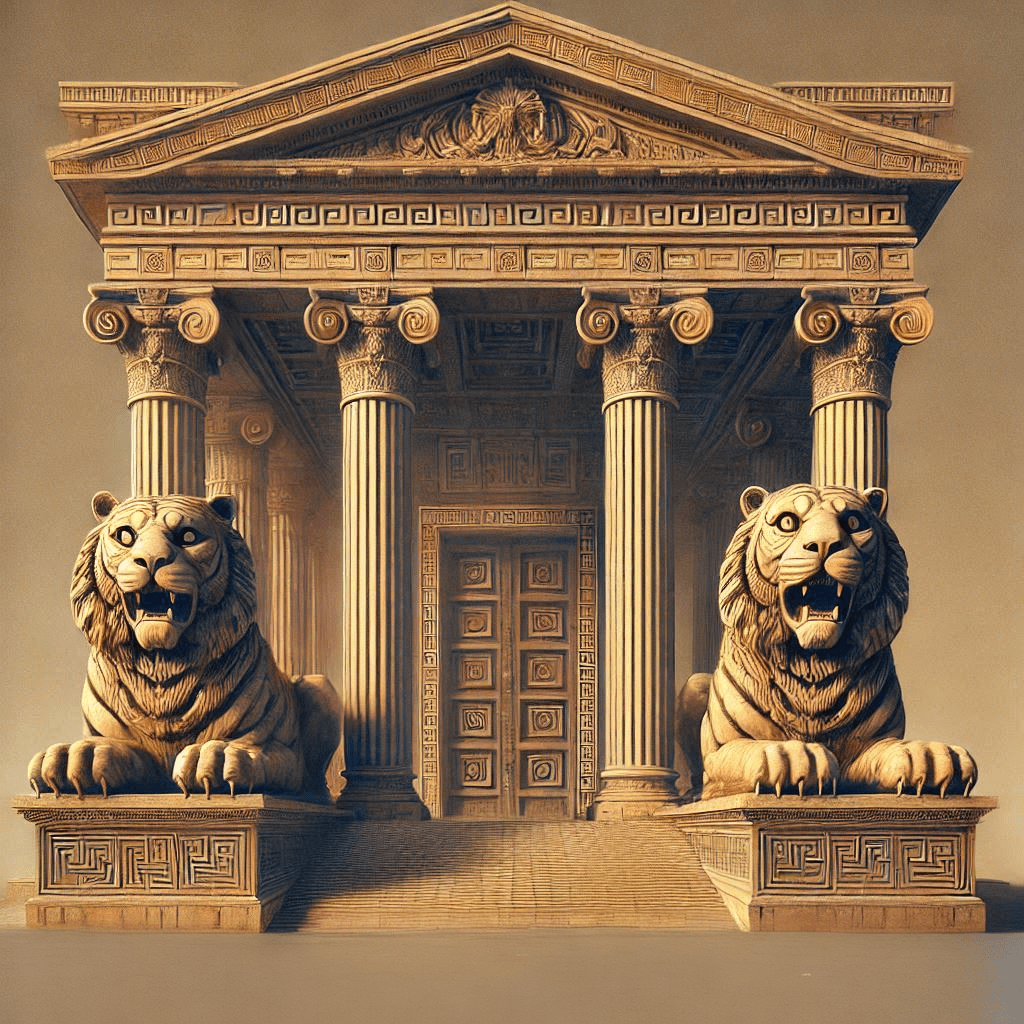
Microsoft Copilot Image generated by Melodie Miller
I entered the convention hall and temporarily disappeared into the self-induced state of Vegas coma, where no clocks, windows, or daylight existed. I began to lose track of the time of day, leaving my old life behind outside the doors that closed slowly behind me, and I wondered if the gods would “shed their grace”[4] on me.

Microsoft Copilot Image generated by Melodie Miller
The grandeur of the oatmeal-colored walls towered above me like ramparts of granite, and the cornfield maze hallways seemed to intentionally distort my location, as if I were walking in a field of “amber waves of grain.”[5] I continued moving forward as if the meeting beckoned with a silent signal, “Walk this way.” The artificially bright and ominously cavernous room mocked the “purple mountains’ majesty”[6] with massive signage overhead like “star-spangled banners” [7] precariously hanging from the sky.


Outdoor Retailer set up (Photograph courtesy of Outdoor Retailer)
The names on the signage represented capitalism in the outdoor industry whose canons preached verses of optimism for the planet’s soul. In reality, most of their products’ raw materials came from petroleum and polluted the planet, like every other industry on earth. “Just do it,”[8] “Never Stop Exploring,”[9] and “Reject Fast Fashion”[10] are not words to live by; they merely exchange one narrative for another.

Outdoor Retailer set up (Photograph courtesy of Outdoor Retailer)
The truth is, there’s no way to make consumer products without polluting the earth; it’s still a rose that stinks, no matter its name or slogan.
The hallways, filled with gas-powered forklifts, raced sinisterly down the aisles, transporting large, hazardously sized crates to locations marked by a small white number painted on the concrete floor. The crates that could instantly crush a human sat twelve feet in the air, precariously positioned atop the forklifts, as they sprinted down the aisles toward their temporary plot of “land of the free.”[11]

Microsoft Copilot Image generated by Melodie Miller
The crates held the makings of houses where no one would ever live. Two-hundred-thousand, four-hundred-thousand, and six-hundred-thousand-dollar homes were used for four days, twice a year, and no one even slept there.
These were not the homes of the brave[12], instead; they were temporary day quarters for the famous brands and sales representatives to sell their wares to professional buyers who then sold the goods to the consumers who had more money than they would ever spend.
Along the cavernous compound walls, numerous oversized garage doors stood wide open, letting warm air in and allowing the cold air out.
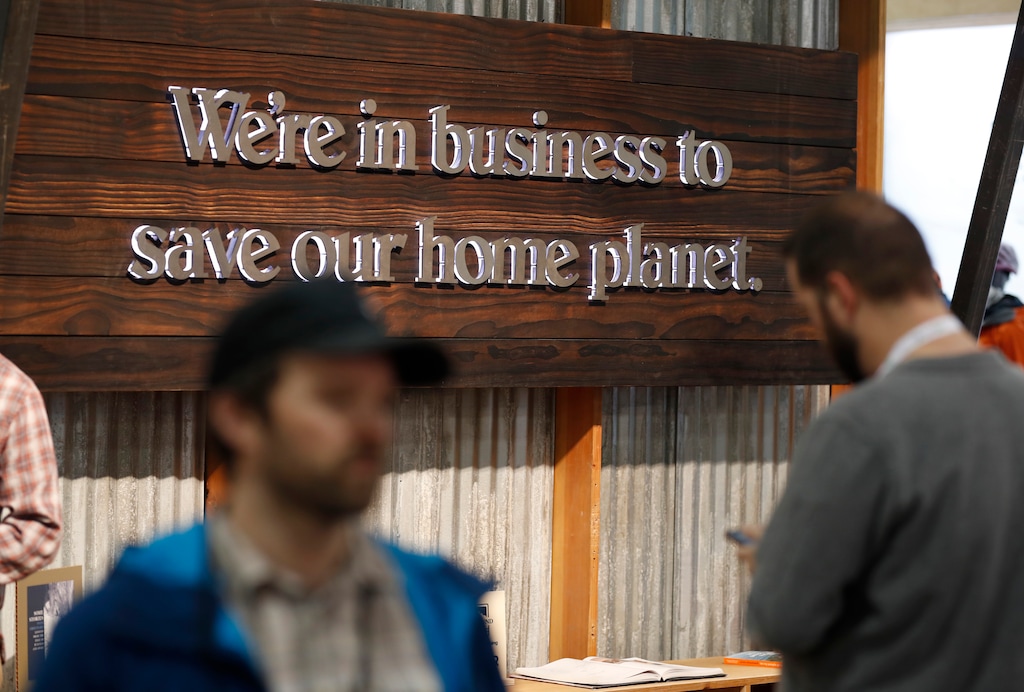
The Outdoor Retailer trade show returns to Salt Lake City Utah. (Photograph courtsey of Salt Lake Tribune)
The outdoor industry collectively claims they will save the planet by building the best products yet cause no unnecessary harm.
We will “use business to inspire and implement solutions to the environmental crisis,”[13] one leader who will go unnamed said. ‘Then close the damned garage doors and stop wasting the energy that is producing this air conditioning,” I thought.
As I walked to meet my contact, I thought, “maybe he’s short,” or “handsome” like Matt Damon’s character in “Bourne Identity”. Or, maybe he’s “scary,” like a special operations soldier.
I arrived at a small, unmarked booth, unencumbered with slogans or signage. I met the man dressed all in black.
“I am a procurement officer,” he said.
‘That’s strange, I thought, I was told he was a special operations officer.”
The “procurement” officer was freshly shaven and smelled of clean soap. He was much younger and smaller than I had expected. He never stood up from his chair.
He ran the back of his hand seductively down his smoothly shaven muscular cheek. He told me he had just cleaned up after his workout.
‘Cleaned up after work, that doesn’t sound good,” I thought.
He stuck his hand out and said, “I’m Michael, but everyone calls me Bengal. You can call me Bengal.”
“OK, like the cat?” I asked.
“Yes, actually like the tiger.”
And without taking a breath, he launched into describing the army assignment.

“The army has a classified mission. If you accept it, you will work on a need-to-know basis,” Bengal said.
“OK,” I said, thinking this must be a cosmic joke.
“Your mission, if you accept it,” he said.
Was he practicing his lines for the next “Mission Impossible” movie, or did he talk this way? I pretended to understand what the hell he was referring to regarding “on a need-to-know basis.”
I thought, ‘Well, I’ll need to know your physical measurements if you expect me to fit you with clothing.’

Sept. 11, 2001 airplane attacks on the Twin Towers (Dan Howell Phtographer / Shutterstockcom)
“I am allowed to share just a bit with you,” Bengal said. “The mission will occur in a frigid, mountainous place. We will be hunting the man linked to something in New York City.” “I can’t tell you anything more.”
“The attack on September eleventh,” Bengal whispered.
“Oh,” I said. This time I understood perfectly well who Bengal was referring to.
‘Shit,’ I thought. ‘Now Jason Bourne has shared the biggest secret in the world with me.
“We need warm clothes for the troops to wear to catch this guy. We need you to build them for us,” Bengal said. “Can you do that?”

Osama bin Laden. (Photograph courtesy of The Associated Press)
“Of course,” I said, “that’s what I do, but actually, I design them.”
“What’s the difference?” Bengal asked.
That question frightened me more than realizing his Glock was hidden in his gym bag under the table. Now I realized he was wearing black as a symbol of the covert nature of his profession, not because he was a fellow couturier. He didn’t understand the apparel industry and that made my job more dangerous.
“Think about the money,” I said to myself, “you can do this.”
“How soon can you get to Natick?” Bengal asked.
“Soon?” I asked.
__________________________________________

Seattle Tacoma Airport to Boston Logan Airport flight route (Image courtesy of Direct Flights.com)
It was a long flight “from sea to shining sea”[14], the night I flew from Seattle to Boston. Actually, the lyrics should go ocean to ocean or in this case, “from Puget Sound to Massachusetts Bay,” but this isn’t a geography class.
I arrived late and was the last person to pick up my rental car before the office closed. The ice-cold evening was moonless and black, sporting the best-selling color in fashion; maybe things are going my way. I walked alone through the parking garage searching for my car, looking side to side hoping no one would jump out and grab me.
As I climbed into the unfamiliar vehicle, the parking garage echoed a reminder that I was alone on this mission and I had accepted it, knowing full well the dangers. I fumbled for the overhead light and quickly surveyed the location of the crucial instruments to navigate my drive to the hotel.

Black Ice (Photo courtesy of Wikipedia.com)
The roads were covered with splotches of thin black ice. I recalled the time the family station wagon spun a complete 360 degrees on the road to Skykomish. My mom simply righted the car and continued driving without saying a word while the kids screamed in terror.
I drove alone on the snowy road to the small town that housed the military base. I was feeling apprehensive about the trip. The project was clandestine, and I had never held a gun. Shooting a gun was something I had never done. Not that I would be expected to participate in the mission; it’s just that guns are known to kill people, and now I would be close to the people who did that sort of thing.
I checked into the hotel and climbed into the bed with crisp, fresh, white sheets that smelled of bleach. No chemicals were strong enough to clean away the reality of the task I’d taken on and I restlessly fell to sleep.
The next morning came fast. It left me groggy at the “dawn’s early light”[15]. I rushed to get dressed, feeling unsure of myself and what to wear. I decided to wear black; how could I go wrong in black?
I covered my head with a baseball cap sporting a U.S.. Army chenille patch of red, white and blue and headed out the door. I was told to be in the hotel lobby at 0800. The message was, ‘he would find me.’ The written communication said a “special operations soldier will contact you at the hotel.” This gave me visions of a six-foot-four-inch, linebacker-sized man.
I allowed my libido to get the best of me for a brief moment. However, to my disappointment, a small figure approached me. He stood five feet four inches tall and was slightly hunched at the shoulders. He had a hyena’s face and smiled with a deceptive sneer. He, too, was dressed all in black, including his baseball cap, large combat boots, and wraparound Ray-Ban sunglasses. It was eight in the morning and it wasn’t sunny outside.

Microsoft Copilot Image generated by Melodie Miller
“You can tell everything about a subject by looking into their eyes,” he said, “that’s why I always wear your Ray-Bans.”
I wondered how he recognized me through his shades when we had never met before this moment and the idea triggered an adrenaline rush, making my heart race and I began to sweat.
“Did they already have a file on me?” I thought. bl
Then I remembered reading a scientific study about the smell of fear and struggled to calm my mind with the type of deep, long breaths I’d learned in yoga practice. I knew that animals could smell fear and I wondered if he had sniffed the panic dripping under my clothes. I pulled my sunglasses from my purse and covered my eyes.
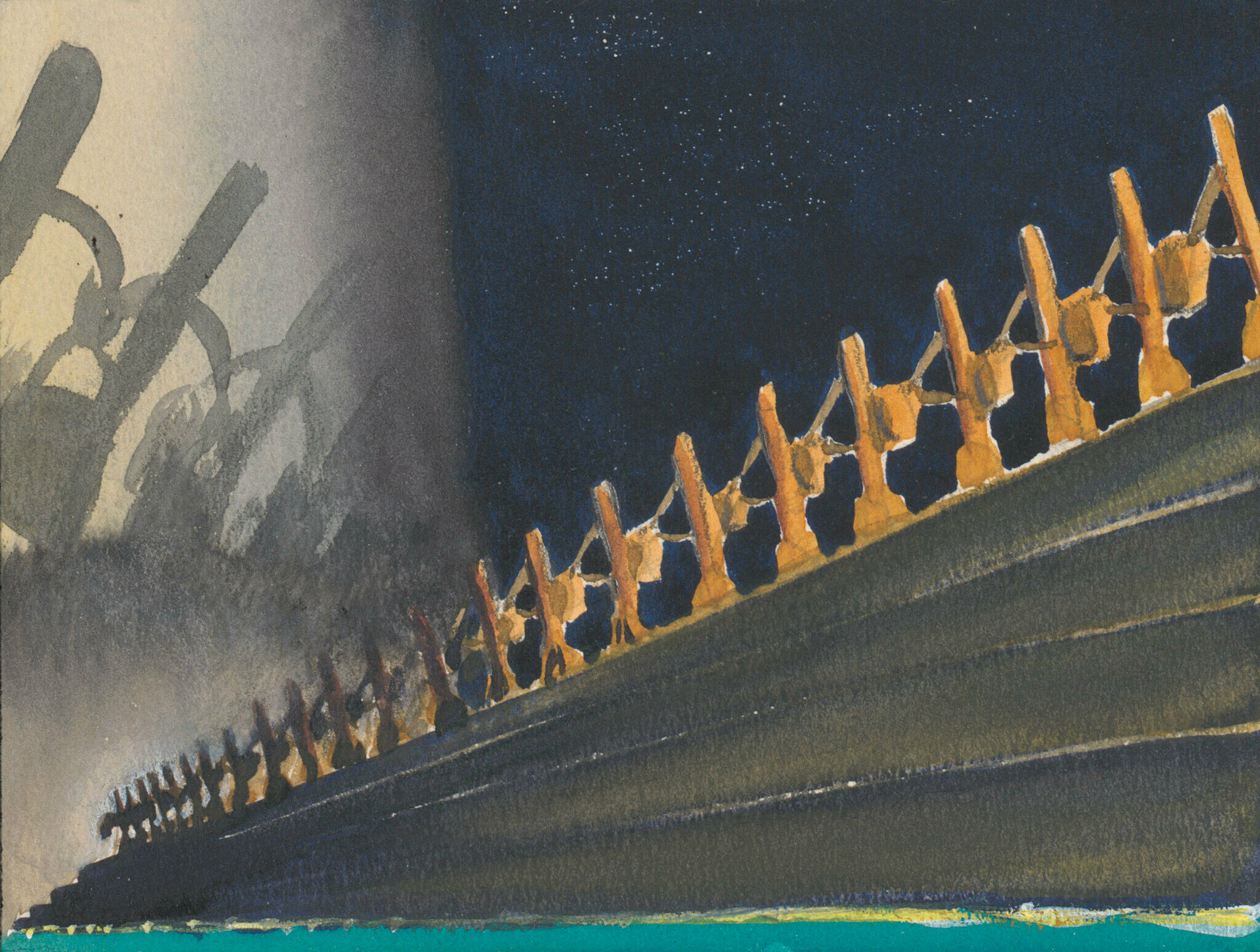
Walt Disney’s Fantasia (1940 film) (Photograph courtesy of The Whitney Museum)
My contact signaled a command. He ordered me towards the exit with his short, gloved pointer finger. I felt as if the evil sorcerer from Fantasia had taken me under his powers like Sorcerer’s Apprentice Mickey Mouse’s marching brooms. . My hyena-like handler’s power pulled me through the revolving glass doors. I stepped out into the below-zero-degree morning.

SUV similar to the Tour de (special force: How the Army and Chevy team up on the front lines by Kirk Bell (Motor Authority. 2017 Chevrolet Tahoe and Suburban Midnight Editions at The Range Complex in Raleigh, North Carolina) (Image generated with Microsoft Design / Melodie Miller AI Graphic Engineer)
Feeling like the protagonist in a Disney movie, I floated towards the oversized, black S.U.V. that awaited us. Nearly invisible patches of black ice covered the concrete, and I felt encouraged that I could still recognize reality. Trying to act casual, I asked my contact about his position in the army and he answered without hesitation.
“I’m a sniper, and I’m good. I never miss and I always win.” He said arrogantly, like he was bragging about being an Olympic gold medal winner.
My mind began to fight itself with crazy ideas as I realized I was climbing into the black S.U.V. with a trained killer.
“Don’t worry, we’ll take care of you.”
I hadn’t said I was worried, and I didn’t like the idea of being “taken care of” by a professional hitman who was trained by the U.S. military. But I reminded myself again that the Army’s “C-notes” were just as honest as any other client’s money and, what’s more, the government paid on time.
I climbed into the imposing, blacked-out, windowed Chevrolet Suburban and slid across the frigid leather seat. I was aware that I could see out of the S.U.V., but no one could see in. I buckled the hard metal seat belt and cinched it tightly around my small waist. I looked to my right side and there lay a long scarf, handwoven in a distinctive Afghan tribal plaid pattern. I recognized the scarf as one used for wrapping a turban. It had a slight musky odor and as I looked closer, I could see that it was dirty and stained.

Microsoft Copilot Image generated by Melodie Miller
The sniper reached his hand back from the front seat and said, “I’ll take that scarf. My buddy sent that to me from Afghanistan. He said, “The guy won’t be needing it anymore.” This was followed by a short burst of hyena-sounding laughter. When he touched the scarf, the sniper grew agitated and felt compelled to share his story. I envisioned that he had pulled the sword from the stone, seemingly empowered as a knight, beyond reproach, entitled to kill for his kingdom.
“You’re probably wondering how I got my hands on that Afghani scarf?” he said.
“Well, OK, how?” I said reluctantly.
“Like I said. The guy didn’t need it anymore and my buddy borrowed it, so to speak, permanently,” the handler said and laughed again.
Isn’t that what he just told me, I thought. I remained silent, instinctively understanding that, like the spinning car, nothing good could come of where this story was going. But he pivoted to a different topic, which at first seemed like a good move but then reality went from sitting in the back of an S.U.V. driven by a trained assassin to the confessionals of a hit man.
“You’re probably wondering how I became a sniper.” He offered eagerly.
The words of my mother ran in my ears “If it’s not nice, don’t say anything at all.” I did not respond.
“I was eighteen years old and arrested for stealing a car. This time I knew it would be prison, not juvie detention. I told my attorney that I liked guns and was a perfect shot with an automatic rifle and we made a deal with the judge. The judge offered: “Prison or the Army?” I accepted the U.S. Army’s offer, and here I am, killing bad guys for my country, and I now I own my car.”
The S.U.V. raced down the small-town highway to the Natick Army Base. We passed Wellesley College, my step-aunt Helen’s alma mater and my resentment boiled irrationally as I thought about the one million dollars she had given to the college. Had she given me some of that million dollars, I wouldn’t have taken this dangerous job. I reminded myself that she didn’t give any of her money to humans, only institutions like the Seattle Opera House and the Huntington’s Foundation, and that seemed to comfort my foolish subconscious mind, at least temporarily. Besides, we weren’t really family; she was my step-aunt, and I doubt she even remembered my name on the day she died.
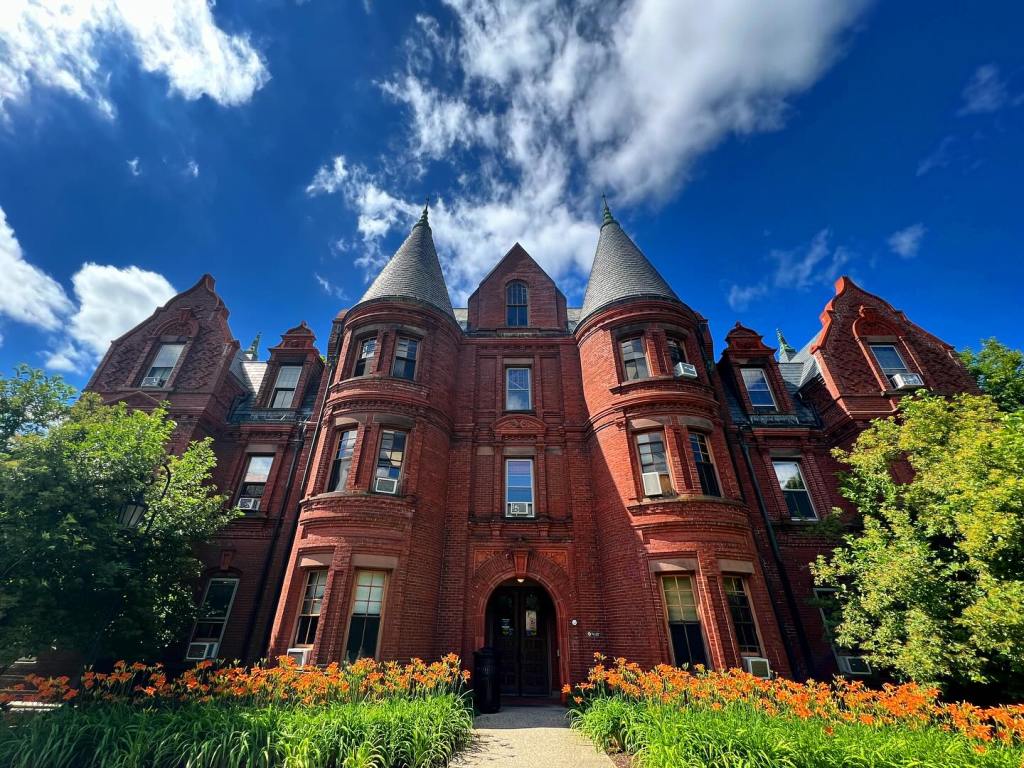
Billing Hall, Wellesley College, Wellesley, MA (Photograph courtesy of Wellesley College)
The S.U.V. approached the gated entrance to the military base, and the sniper automatically rolled down all the windows.
“I need you to hand me your identification and exit the car,” the guard said.
I reached for my wallet nervously, pulled out the cards, shuffled through them to find my driver’s license, and handed it to the guard. He scanned my license in a daunting manner, looked at me, asked me to remove my hat, and looked back at the license.
“I’ll need to see your passport,” the guard said, “and get out of the vehicle.”
“Oh, yes, of course,” I said and reached back into my purse.
I handed my passport to the guard and began to climb out, but I was escorted from the back of the S.U.V. and stood in the freezing rain while two other guards ran two bomb-detecting wands under the body of the car, while a third guard examined the undercarriage with a mirror. I watched the men examine the SUV while a fifth guard physically patted me down.
“Open the trunk,” the fifth guard said, “and open your luggage.”
The guard emptied my luggage and rummaged through my intimate belongings with the unfamiliar hands of a stranger wearing an automatic rifle over his shoulder. I looked around and noticed there were no other women in sight.
My gaze shifted toward the sky but stopped at the top of the fence surrounding the base. At the highest point on the chain-linked fence sat a wildly bundled layer of barbed wire, stacked one foot tall like the topping of a vicious birthday cake.
The guard reached out his hand slowly towards me, offering my ID. He looked me in the eyes and said softly, “I see your birthday is nine eleven; that sucks. You’re free to go. Have a nice day.”

Hindu Kush Mountain Range. (Explorerweb. Photo Courtesy of Tirich Mir. Photo: Abdul Rehman Joyia)
I emerged from the designated quarantine area sanctioned as a military contractor, hired to design clothing for the Special Operations Joint Services to keep them warm in the Hindu Kush mountain range of Afghanistan as they hunted the suspected perpetrator of the attack in New York City on the twin towers on Sept. 11, 2001.
The sniper and recruiter were my entry into the dark world of covert military operations and the men who carried out their missions. I learned that Special Operations Forces consisted of an atypical type of person, like the hyena man and Mr. Bengal, selected for their unique emotional traits and distinctive temperaments. They were fiercely loyal to each other and their country and slightly paranoid. They were trained in highly choreographed scenarios to extract and kill, and they were now my clients and I their collaborator.
Standing on the Natick military base, I became overwhelmed with anxiety, conflicted by my ideology and the compromising nature of secrecy. In a split second, I rationalized that even professionally trained military killers deserved clothes that would keep them warm.
I had an important job to do for my country, which meant turning camo into fashion and I would find a way to adapt. I hoped the Glocks would remain concealed.

Natick Soldier Systems Center, Natick, Massachusetts. The U.S. Army Natick Soldier Systems Center (NSSC) is a Department of Defense (DoD) installation with the mission to protect and sustain America’s military forces. NSSC is responsible for the technology, research, development, engineering, fielding, and sustainment of our military’s food, clothing, shelters, airdrop systems, and Soldier support items
My skills were procured by the Special Operations Office and like any true American, I needed the paycheck, so I accepted the mission.
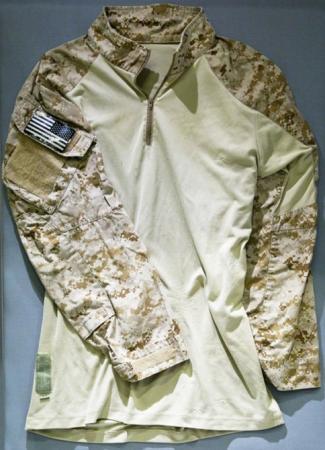

Rob O’Neill, DEVGRU SEAL, Crye shirt. 911 Memorial Museum, New York City, New York (Melodie Miller, original designer) (Photographer Kristy Leibowitz)
- https://home.army.mil/natick/my-fort/newcomers
- https://www.911memorial.org/connect/blog/museum-unveils-exhibit-exploring-raid-bin-ladens-compound
[1] Eno, Brian. Frantz, Christopher. Byrne, David Byrne. Harrison, Jerry. Weymouth, Tina. “Once In a Lifetime.” Warner Chappell Music, Inc, Universal Music Publishing Group
[2] Bush, President George W. “Airline Safety,” The Washington Post. 27 September 2001.
[3] Stills, Steven. “Find the cost of Freedom,” B-side to “Ohio.”
[4] Bates, Katharine Lee. “America the Beautiful.” 1893.
[5] Bates.
[6] Bates.
[7] Key, Francis Scott. “The Star-Spangled Banner.” 14 Sept 1814.
[8] Nike. 1988.
[9] The North Face. 1990.
[10] Patagonia. 2018.
[11] Key.
[12] Key.
[13] Anonymous.
[14] Bates.
[15] Key.
-
A satirical description of K. Marx School of Business, MBAC 61984 Course Syllabus
Satire
When did higher education become the enemy? This is a fictional breaking news release that relays the satirical course syllabus at a fictitious Marxist business school. This satire is written in response to commentaries claiming that Marxist culture is prevalent on U.S. college campuses.
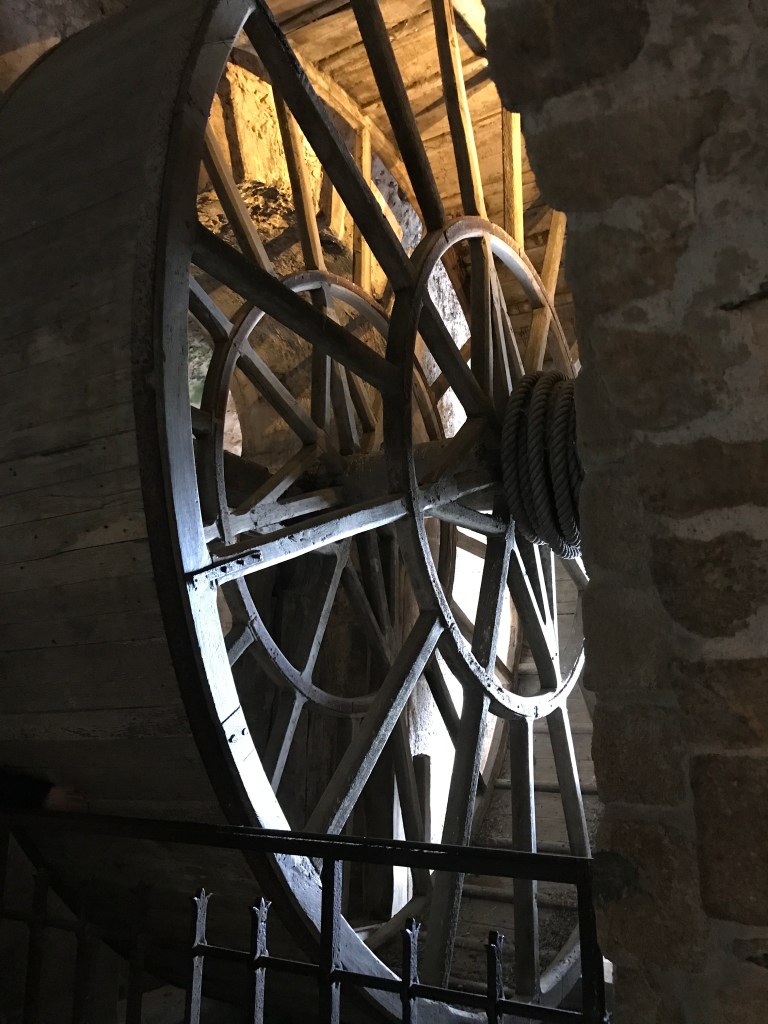
BREAKING NEWS: Underground Marxist School of Business syllabus discovered in bike satchel of arrested political dissident. Mother claims “Literary Theory and Critical Thinking studies are turning my child into a monster.” Infiltration of Marxism on college campuses proven.
Course Syllabus
MBAC 61984 Business Strategy – Innovative Management of “Profit and Means of Production”
Restricted to The Vanguard members and Master of Business Administration Candidates dedicated to overthrowing the bourgeoisie capitalist class.
Location: “SIBERIA, Gulag 13,” in the Basement of Hellems Arts and Science Building
Class Time: 12:00 PM – 12:50 PM
Instructor: Ivan T. Errible
Office Hours: Mondays after dark
Email: commi@KMSB.eduInstructors Statement: Class struggle between the bourgeoisie capitalist and the worker stands as an iconic representation of human existence as illustrated by the continuous battle concerning the owners of the means of production and the labor power. Marx tells us that “work, thrift and greed are […] (the capitalists) three cardinal virtues,”[1] and hording is their primary goal. Workers do not own the tools or means of production. Therefore, this is an essental element in gaining control of both the labor time and surplus labor time, stripping the bourgeoisie of charms of creating profit out of nothing.
When the KMSB graduate worker emerges into the capitalistic business world, it may be difficult to find comrades in arms who will join the movement against the exploitation of the proletariat. However, as a future “leader” of the Vanguard,[2] it will become increasingly important to recognize the exploited workers through group meetings and demonstrate the opportunities by which the means of their profit can be reclaimed. This class intends to teach student comrades how to infiltrate privately owned enterprises, furthering the initial stage in the Vanguard movement.
Upon graduation from this course, students will have the skills to influence workers actions by guiding them through the process of reclaiming the “Surplus Value” of their labor through transitioning privately owned tools and factories, to a lasting state-run, ruling proletarian party with nationalized ownership of the means of production
This class intends to teach student comrades how to infiltrate privately owned enterprises, furthering the initial stage in the Vanguard movement. Upon graduation from this course, students will have the skills to influence workers actions by guiding them through the process of reclaiming the “Surplus Value” of their labor through transitioning privately owned tools and factories, to a lasting state-run, ruling proletarian party with nationalized ownership of the means of production.
[1] Das Kapital, Vol 1, Part 1, Chapter 2
[2] The Vanguard: the non-profit corporation of the KMSB proletariat movement, dedicated to avoiding taxes and operating with the use of free labor, donations from guilt ridden capitalists and state supported educational funding.
You may find, at times, that the origins of your ivy league social class lingers and unduly attempts to influence your path, however, do not let these past systems of thought conflict with the goals of the Vanguard. The Vanguard recognizes that the organization of capitalism, as Marx tells us is “vampire-like ,(and) lives only by sucking living labor,”[1] therefore it seems to muddle the socialists thinking. Believe me when I say your role in the movement will put a stake through the heart of capitalism by expanding democratic centralism and rule by all.
Additionally, through service to the philosophy of Marxism and the dictatorship of the proletariat, students in pursuit of eliminating growth and profit from the corporate structure will find this class leads to a full understanding of how to take control of the means of production by the newly established worker run apparatus.
Course Description: This course introduces students to the techniques of understanding reality, thoughts and emotions through the philosophy of Dialectical Materialism and the understanding of nature as a whole. Student struggles will be observed by the classroom collective and will be discussed in a joint ownership atmosphere with other students.
This course may not be taken concurrently with MBAC 71984 or 81984 and may not be repeated. A grade of “D” or higher in MBAC 61984 is a prerequisite for subsequent advancement in the Vanguard movement.
Required Texts and Materials:
Karl Marx, Das Kapital (1867),Engles, Marx, Communist Manifesto (1848),Kim Jung-un, Perfect Brilliance: How to Starve the Populus to Garner Loyalty
Office Hours: 1:30 am -4:30 am on Mondays located in Gulag 14, Hellems Basement (go down the east-west stairs until you reach the basement and turn left and walk in a circle until you hit the brick wall at the end of the hall). If you cannot make these hours, remember that increases in productivity results from cooperation, therefore these hours work for everyone.
Grade Distribution:
Agitating: 10%
Participation / Dissent: 25%
Book Burning: 40%
Recruiting: 25%Course Requirements:
Agitating Workshops: Probably the stuff you’re here for. We will perform agitating workshop readings, followed by play acting on a daily basis. You shall learn the exact words to use to gas light a crowd and cause law abiding citizens to act against their better judgement.
Each workshop will be done in groups where individuals will receive constructive critique of their power of persuasion and each round’s requirements will be provide on the day of practice. The grades for these practice trainings will be based on how quickly a student can agitated another student.
Participation / Dissent: You are required to do three participation and dissent activities and you will be given a chance to lead your own agitation rally. The length and location of the rally will be determined by the instructor. Whether the rally concerns disrupting the state apparatus or boycotting labor factories, dig in and try to find out what makes descension work. Do your best to be analytical. Outside academic cited sources should be used and are required.
[1] Das Kapital, Vol 1, Part 3, Chapter 10
Book Burnings: Most homework in this class will take the form of book burnings, particularly texts on democracy, freedom of speech, property ownership and voting rights. The specific book burnings will pertain to a counterrevolutionary piece we read that day. Your instructor may give you a creative prompt, something analytical to provide a catalyst for that day’s discussion and inspiration to begin the bonfire activities. I grade these activities on the basis of satisfactory completion of a collection of citywide book burning results.
Recruiting Activities: At times we’ll practice recruiting activities in class, to mainly test a few strategies and get us into the mood for the next event. Occasionally you will be asked to take home and flesh out your strategies, in which case they ought to be planned in great detail and executed in secrecy.
Final Portfolio: You will construct a final protest rally plan and recruit participants.
Attendance, Punctuality and Late Work: Successful work in the K. Marx School of business is dependent upon regular recruitment of comrades to support the plight of the proletariat worker. Students who are unavoidably absent should make arrangements with the collective to make up the time missed. Failure to attend class and activities regularly may result in receipt of an F in a course and food sanctions for you and your family.
Plagiarism: Everything you will need to know will be read in Das Kapital and the Communist Manifesto whose texts are well known. Plagiarism is not possible when only two books exist.
Policies, Accommodations for Disabilities: If you qualify for accommodations because of a disability, do not bother submitting an accommodation letter because it has already been predetermined that accommodations based on documented disabilities in the revolutionary environment automatically disqualify comrades from leading teams.
Religious Holidays: God does not exist.
Honor Code: All students enrolled in a KMBS course are responsible for knowing and adhering to the Honor Code of Das Kapital and the Communist Manifesto. Violations of the policy may include: praying, reading other books, thinking your own thoughts, lying about your thoughts, not accepting a bribery offer, refusing to threaten new noncompliant recruits, unauthorized access to alternative reading materials, dishonest clicker fraud, executing the same or similar agitation rally’s in more than one city without permission from the course instructors and most importantly, an unwillingness to inform on personal friends who own the means of production.
All incidents of misconduct will be reported to gulag guards who have a sixth-grade education and who happily bully any and all human beings, including women, children and infants.
Students who are found responsible for violating the Das Kapital and the Communist Manifesto integrity policies will be subject to death by poison.
Discrimination & Sexual Harassment: The KMSB remains committed to fostering intolerant acts of misconduct on the bourgeois class which includes assault, harassment, and stalking owners of means of labor. Individuals who believe they have been subject to retaliatory actions from a bourgeois owner of means of labor should report the incident to the Institutional Institute of Impartiality and Obedience (IIIO) and punitive action will be taken secretly in the dark of night.
Class Schedule
Subject to change based on classroom progress. Changes will be noted in class.Week One
M. 8/27 – Introduction/Syllabus – Read syllabus out loud and sign a pledge of silenceW. 8/29 – Direct Struggle
Have Read: Marx Das Kapital, Section 1 (all), Section 2 (all)
+ Marx “Letter from Marx to Engels” (1867).
+ Anonymous Proletariat’s “Grief and How to Project Your Failings onto Others”F. 8/31 – Division of Labor
Have Read: “Ford and the Assembly Line,” Chapter 3 (pg. 55-61) (Canvas)
+ Gehring, “The Use of Force and Dogma”
+ Stalin, “How to Talk to a Worker”Week Two
M. 9/3 – LABOR DAY, NO CLASS, “The instrument of labor (in) the form of a machine […] becomes a competitor of the worker,”[1] therefore, burn a factory today.W. 9/5 – Production, Distribution and Consumption
Have Read: Henry Ford’s, People as Machines, Chapter 6 (pg. 167-175)
+ Walt Disney, Building a Psychological Utopia, (How to fool all the people all of the time.)
+ Tolkien’s The Hobbit, Ch. 1 (How to recruit the unwilling with false promises.)F. 9/7 – Consumption
Have Read: George Wallace’s “Incarnations of the Burned Worker” (179-181)
+ Poe’s “Tell Tale Heart,” (How to hide victims of book burnings.)Week Three
M. 9/10 – The Antithesis of Use Value and Exchange Value
Have Read: Hapsburg “The Czar’s Ghosts and their Jewels” (Lessons in how to use the trappings of the bourgeois to fund propaganda and agitation.)
+ Marx “The Poverty of Philosophy” (1847)W. 9/12 – Democratic Centralism
Have Read: Das Kapital, Section 1 and 2, (again), (This is the most important page in the book.)
+ Poe’s “The Fall of the House of Usher,” (Lessons in how to drive bourgeois friend’s mad.)F. 9/14 – Workshop Preparation (Wear clothes and shoes you are willing to burn.)
Turn in: FIRST BOOKBURNING REPORT
[1] Das Kapital, Vol 1, Part 4, Chapter 15
Week Four
M. 9/17 – Religion and Wives Tales (Reasons to not waste time reflecting on spiritual ideals.)
Have Read: Moscow Institute of Scientific Atheism, Chapter 9 (Pg. 1)+ Lenin’s “How Religion Deprives People of “I” (Canvas)
Week Five
M. 9/24 – Group Agitation Workshop (Bring tools of disruption, e.g. baseball bats, hammers.)
Have Read: Das Kapita,l Chapter 1, (again)+Kim Jong-un’s Propaganda and Misinformation Handbook
Turn in: Agitation and Propaganda Rally Agenda, first draftFINALS WEEK
Submit Agitation and Propaganda Rally Operation, final Time/Place TBD.Click these links to understand how Marxism and Marxist terms are used in the media.
- https://www.theguardian.com/news/2015/feb/18/yanis-varoufakis-how-i-became-an-erratic-marxist
- https://www.heritage.org/progressivism/commentary/the-root-cause-the-insanity-college-campuses-older-you-may-think
- https://alyesque.medium.com/the-university-is-not-our-friend-2e6dfdecf0bc
- https://www.cla.purdue.edu/academic/english/theory/marxism/terms/
-
The Nationless State of Junktopia
A reimagining of Chris Marker’s Junkopia, short film shot in the Emeryville Mudflats of northern California. Story written by Melodie Miller.
I walked with hesitation down the path towards the Junktopia Alter, a place of worship that guarded The Great Bridge.

From Junkopia – A short film by Chris Marker | Courtesy of Criterion and Youtube
A montage of artifacts walked the pathway without moving a muscle. The longitude and latitude flashed transparently in the heads-up display of my spectacles.
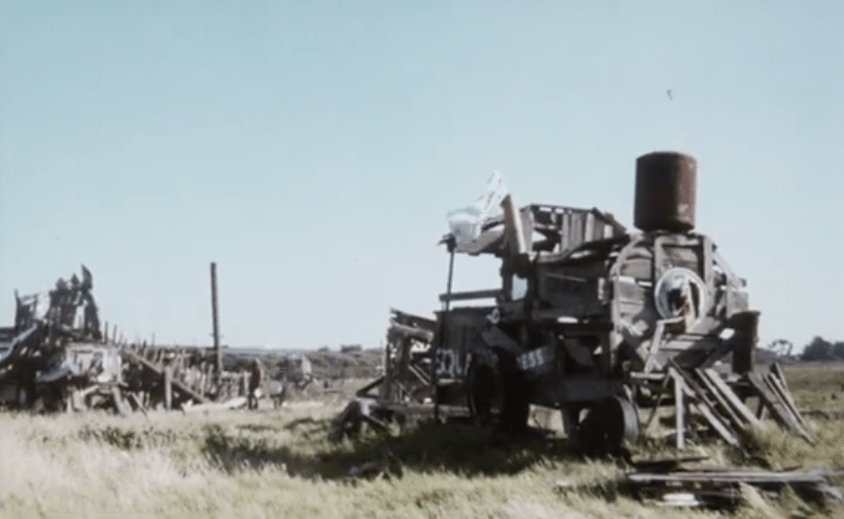
From Junkopia – A short film by Chris Marker | Courtesy of Criterion and Youtube
I imagined the smell of lavender hovering in the bay.
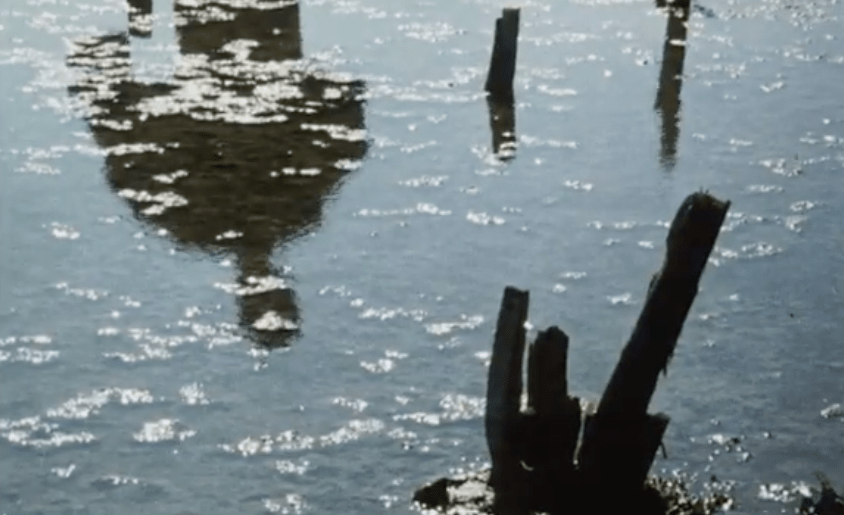
From Junkopia- A short film by Chris Marker | Courtesy of Criterion and Youtube
In the distance the Bridge stood colorless, in need of recognition of its emptiness.

From Junkopia- A short film by Chris Marker | Courtesy of Criterion and Youtube
The memory hurled me to the day The Great Bridge almost collapsed.
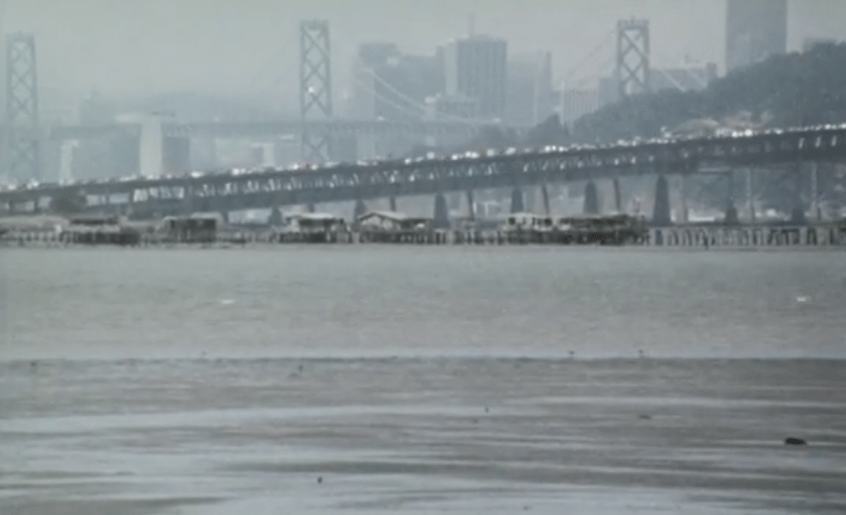
From Junkopia – A short film by Chris Marker | Courtesy of Criterion and Youtube
The eyes of the unconscious biplane looked oppositionally at the myopic cockatoo that sat on my shoulder.

From Junkopia- A short film by Chris Marker | Courtesy of Criterion and Youtube
My bird recognized the fascist symbol painted on the wheel of the biplane as a warning to go no further.
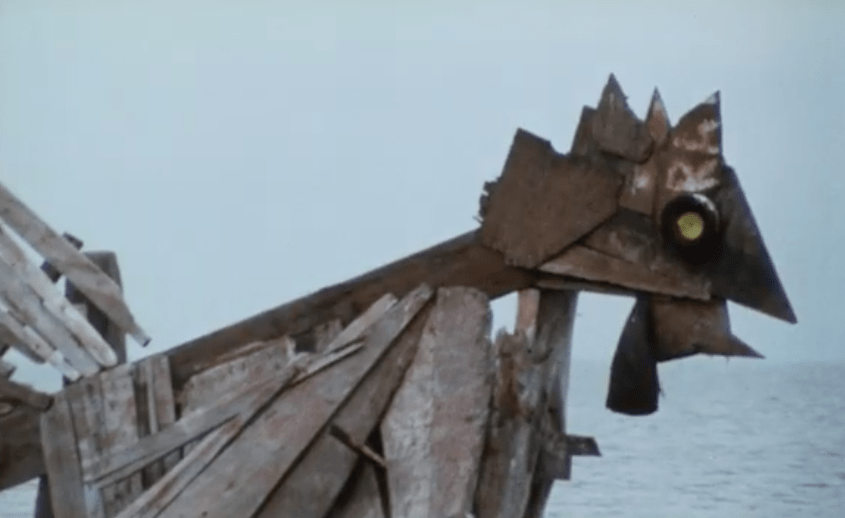
From Junkopia- A short film by Chris Marker | Courtesy of Criterion and Youtube
My amygdala said “Run!” but I persisted onward.
In the distance the Junktopia Alter remained its original color of distressed and burnt Tuscany auburn; looking like it was primed for a top coat of blood red paint.
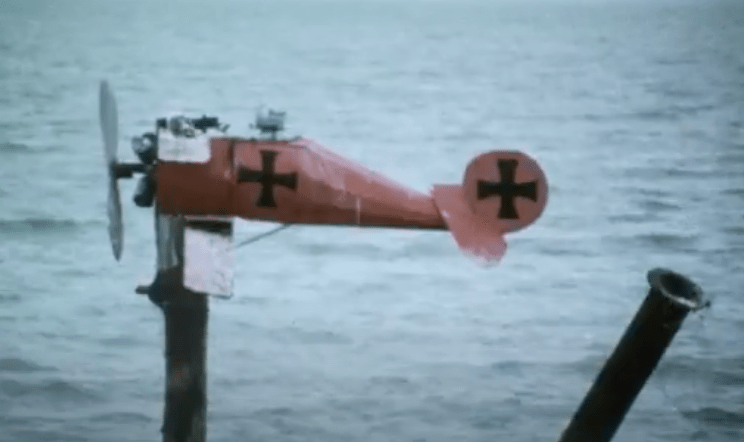
From Junkopia – A short film by Chris Marker | Courtesy of Criterion and Youtube
I thought of Catch 22 and its airplane that flew detached from the war without Yossarian on board who was long dead as a character and forgotten by middle school teachers and students.
Along the path, a false messiah perched in a lifeless tree called to me longingly, beckoning for an apostle to gather a flock of followers.

From Junkopia – A short film by Chris Marker | Courtesy of Criterion and Youtube
Her fuchsia and dark black mesh wings, torn and ravaged, desperately flapped in the turbine powered mechanical wind of capitalistic rule dominating the newly formed nationless state of Junktopia.
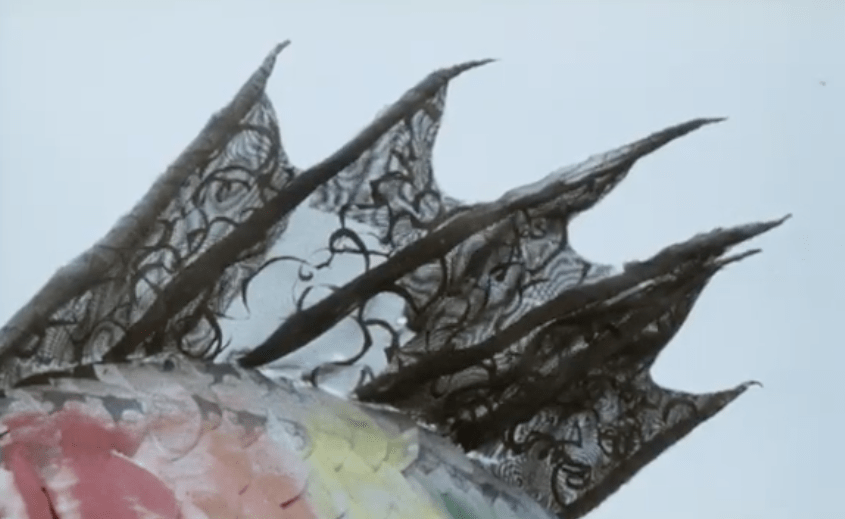
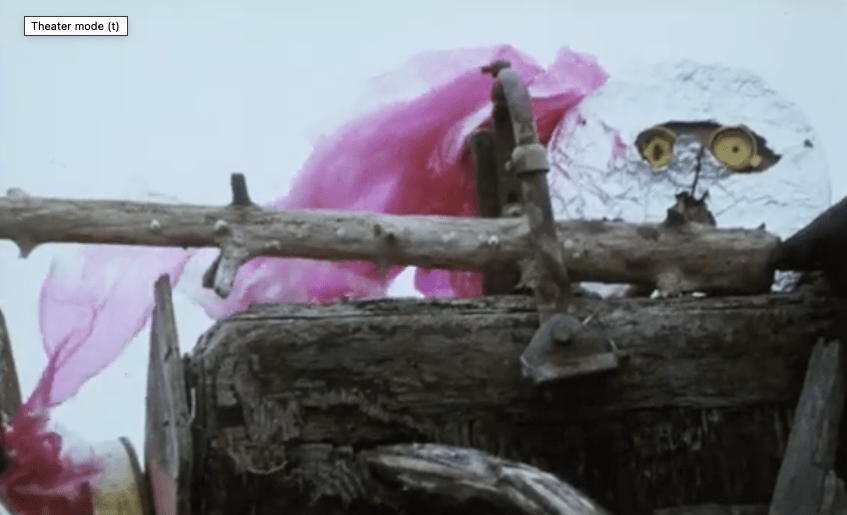
From Junkopia – A short film by Chris Marker | Courtesy of Criterion and Youtube
In the distance, the lime, swampy grasslands filled with abandonment stood as shelter for the birds that no longer could fly. The decibels soaring from the speakers increased, projecting the vibrational reminiscence of the biplanes menacing history preparing to drop its deadly cargo on the unsuspecting living things resting below.

From Junkopia – A short film by Chris Marker | Courtesy of Criterion and Youtube
I approached the alter and the vacant, ornamental glass bottles that guided the unlighted path began to shatter from the sonic sounds spilling overhead, the speakers positioned ubiquitously on the bridge.
Jagged fragments threatened my jugular while the unsympathetic marsh called to me with a menacing howl.
One, razor sharp, ragged edge of a fragmented bottle neck hung from the bridge rafters by a wire hangman’s noose; its rusted metal screw top like a decapitated democratic statesman, his fellow, screw top public servants looked on from the gallery.

From Junkopia- A short film by Chris Marker | Courtesy of Criterion and Youtube
I had abandoned my map on the battlefield and my cell phone no longer recognized a charged. I felt lost although I was not.

From Junkopia- A short film by Chris Marker | Courtesy of Criterion and Youtube
The Republic now rests as fragments of shattered glass reflected as graven images in the birds eye.
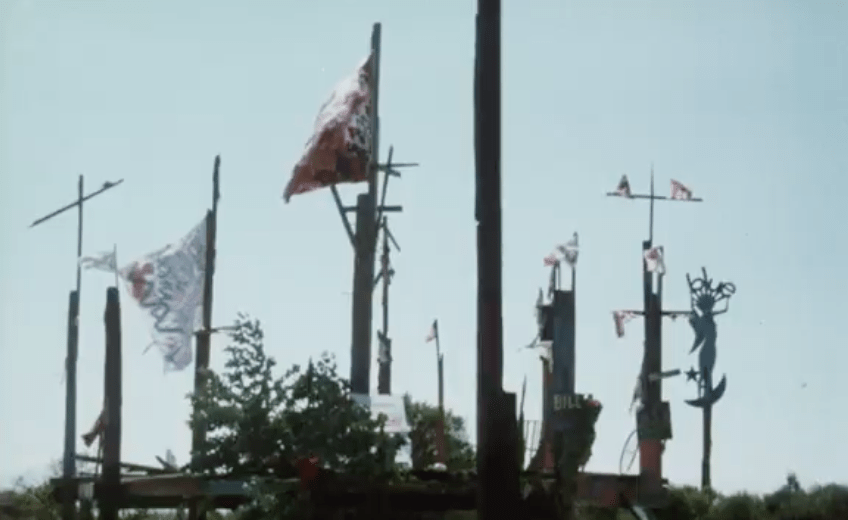
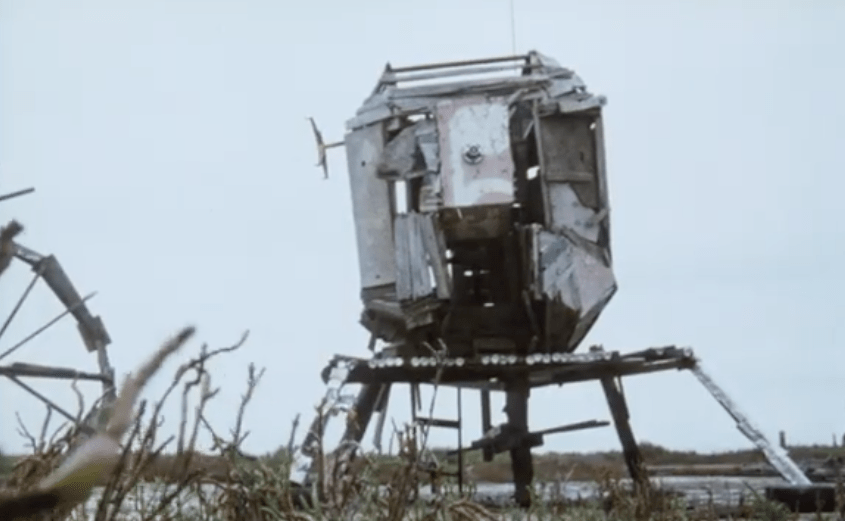
From Junkopia- A short film by Chris Marker | Courtesy of Criterion and Youtube
The fascist symbol painted on the tail of the biplane, a relic of the final war, roared: “the number twelve,” with the sharpness of two major league football helmets cracking in collision. “The twelfth man,” it called out silently, a rhetorical souvenir of the war. “The fans did not offer a home advantage,” I shouted back.

From Junkopia – A short film by Chris Marker | Courtesy of Criterion and Youtube
The weathered alter walls made of wooden fish bone skeletons were rotted from the salt sea air. I bowed down to the god of technology. The empty tin-soup-can minarets stood as apostates and a reminder that rations must be earned by the labors of my cellophane hope.
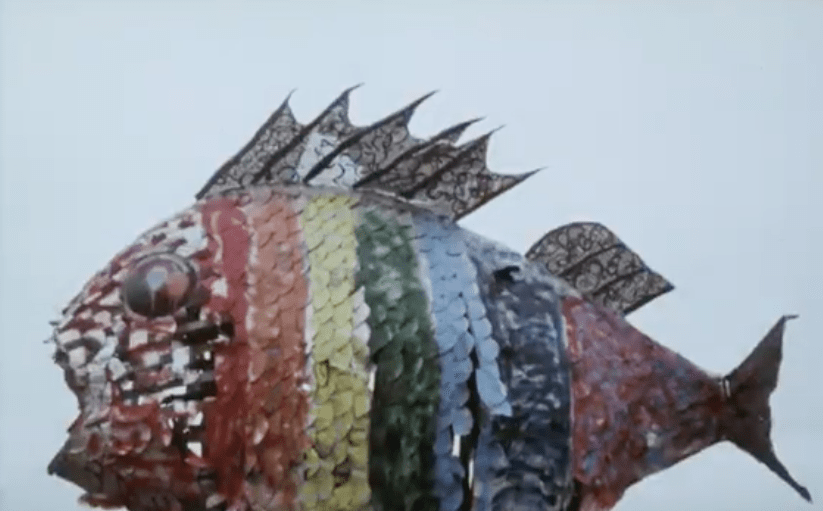
From Junkopia – A short film by Chris Marker | Courtesy of Criterion and Youtube
I waited for the signal to perform the requisite incantations. The white whisker entrails of the metallic stork swimming in the expansive future flapped in the mechanical breeze along with the Messiah’s wings. The five-feet tall, hand-made paper stork hovering nearby narcissistically mocked its own self-absorbed symbol of fertility.
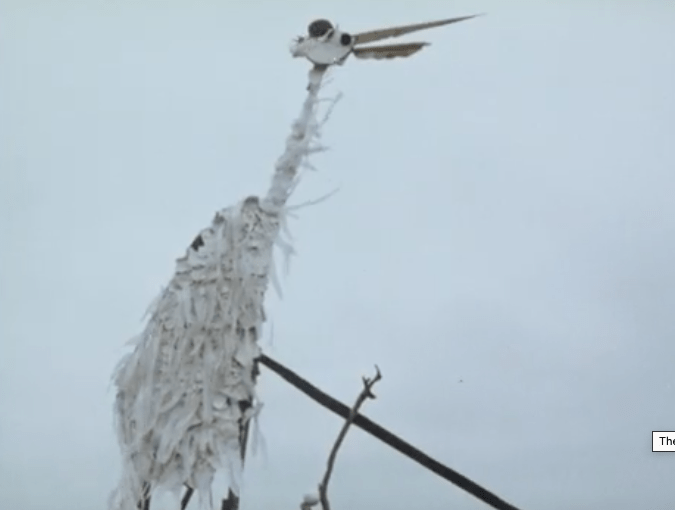
From Junkopia – A short film by Chris Marker | Courtesy of Criterion and Youtube
No one knew how or when the Kangaroos had arrived in Junktopia.

From Junkopia – A short film by Chris Marker | Courtesy of Criterion and Youtube
But, like the nationless human inhabitants, they were there to stay, because no one else wanted them.
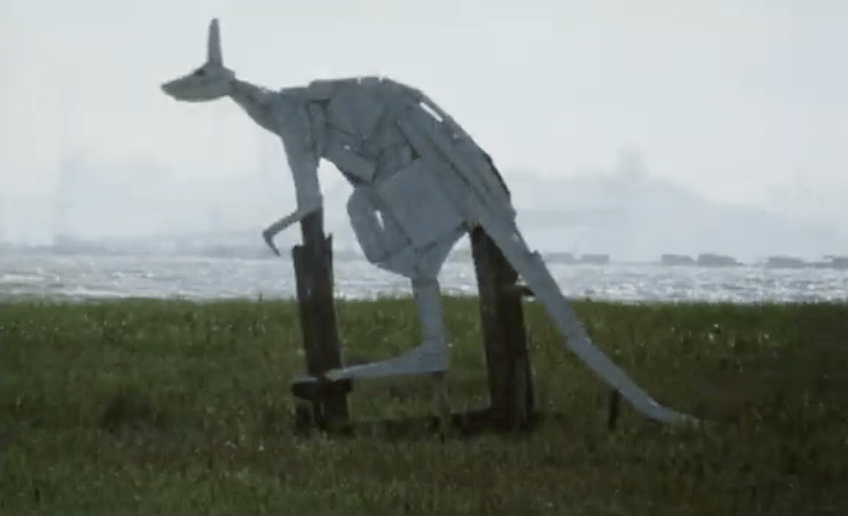
From Junkopia – A short film by Chris Marker | Courtesy of Criterion and Youtube
Junkopia – A short film by Chris Marker | Screenshot courtesy of Criterion and Youtube
-
Seattle Washington Union Bay Natural Wildlife Sanctuary
The road taken on a New Year’s day. A reimagining of Robert Frost’s The Road Not Taken.
The road taken down a mossy path on the first New Year’s Day.

Where two birds converged in a browny wood with a sigh.

Long I stood at the undergrowth.

The path was bent and gravely but it had the better claim.

Both were equal that morning but one was less traveled.

The other was fair and without leaves trodden bare.

Though the way leads to passing by and by.
Somewhere traveling ages hence, the one traveled made all the sense.

I regret there was only one road to travel.
But, one road was taken that morning and I kept the other for another day.

-
The Gothtopian Island of Mont-Saint-Michel, France
A creative nonfiction experience.
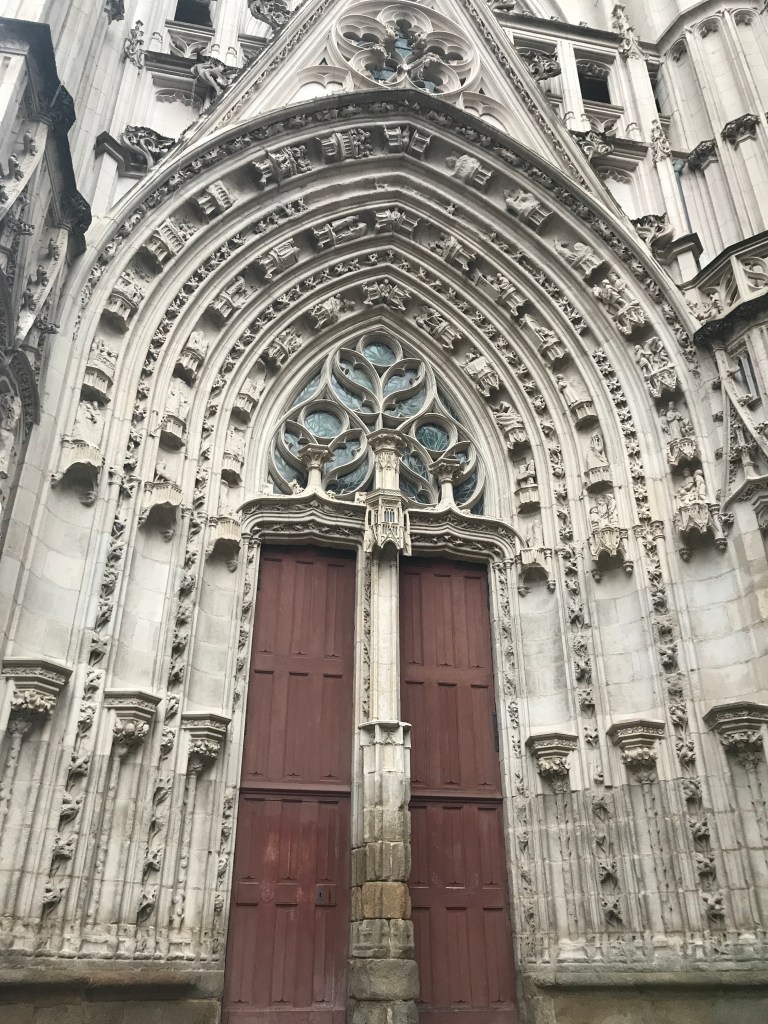
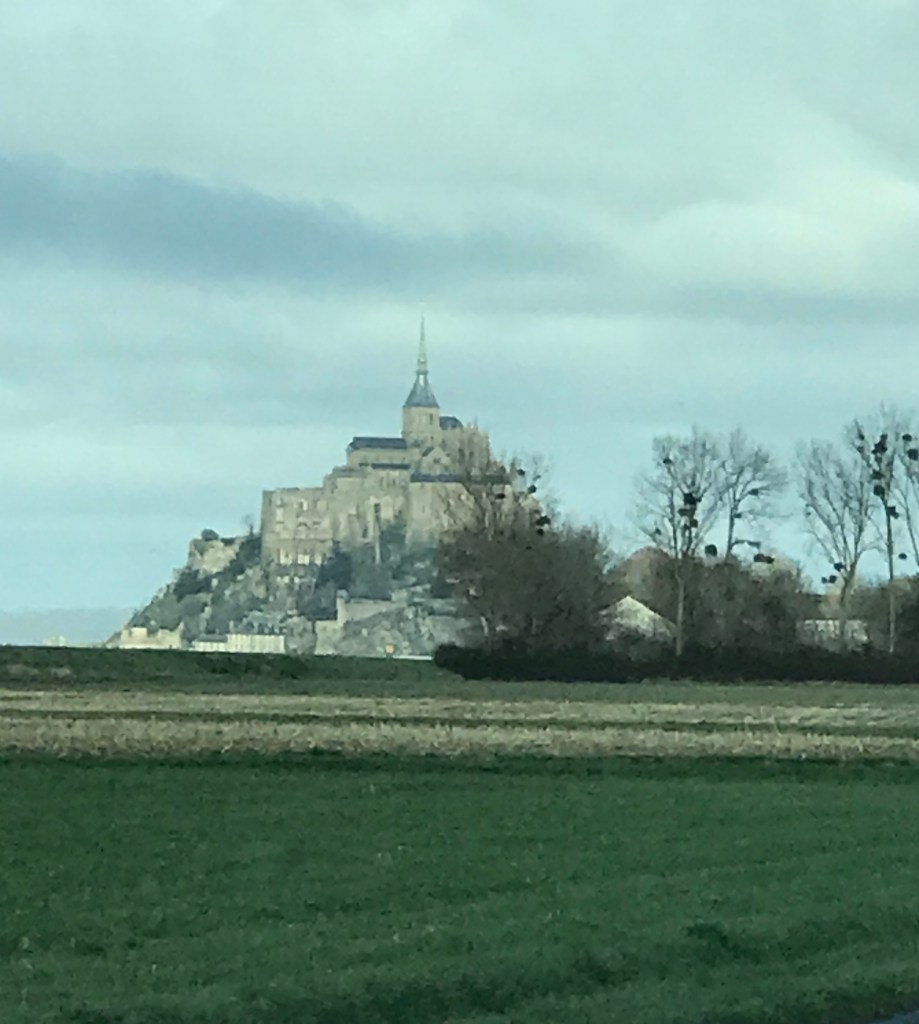
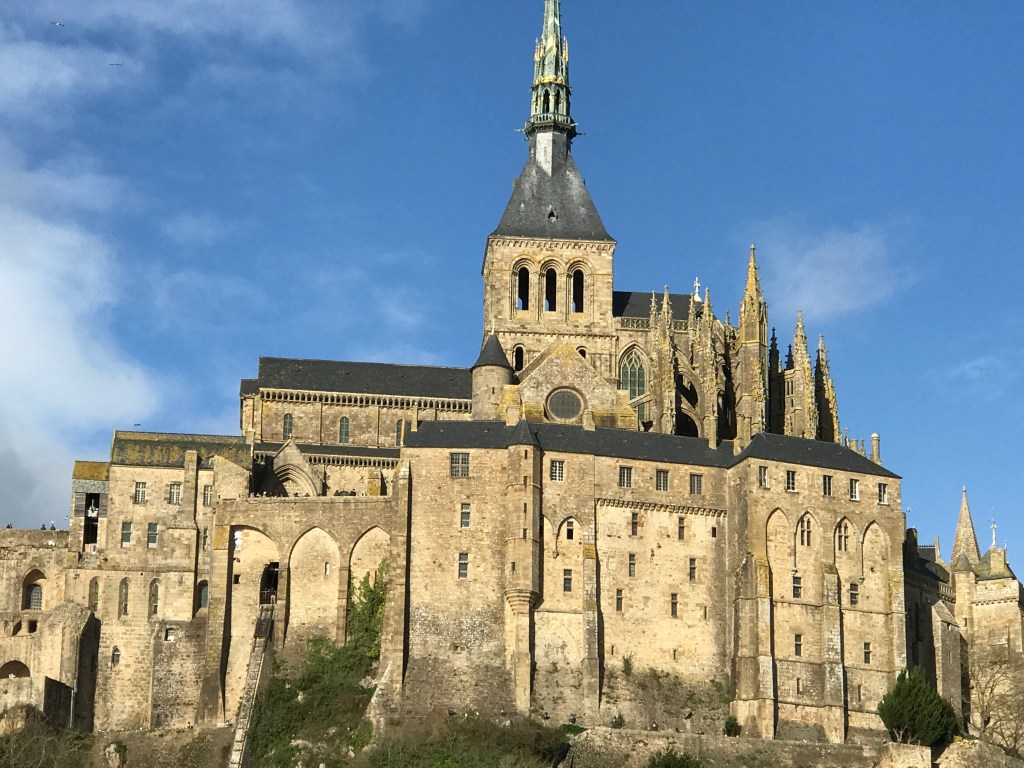
Mont Saint-Michel, France (Melodie Miller | Photographer)
I paused along the moss-clad path to Gothtopia’s altar, where worship lingered like incense in the ghostly ruins of Saint Michel’s basilica in Normandy. The damp perfume of aged wood and stone breathed through the centuries, pulling my soul through time’s fragile veil. I stepped first into the monastic refuge of 966 CE—then onward into the cold, stone prison of King Louis XI in 1472.

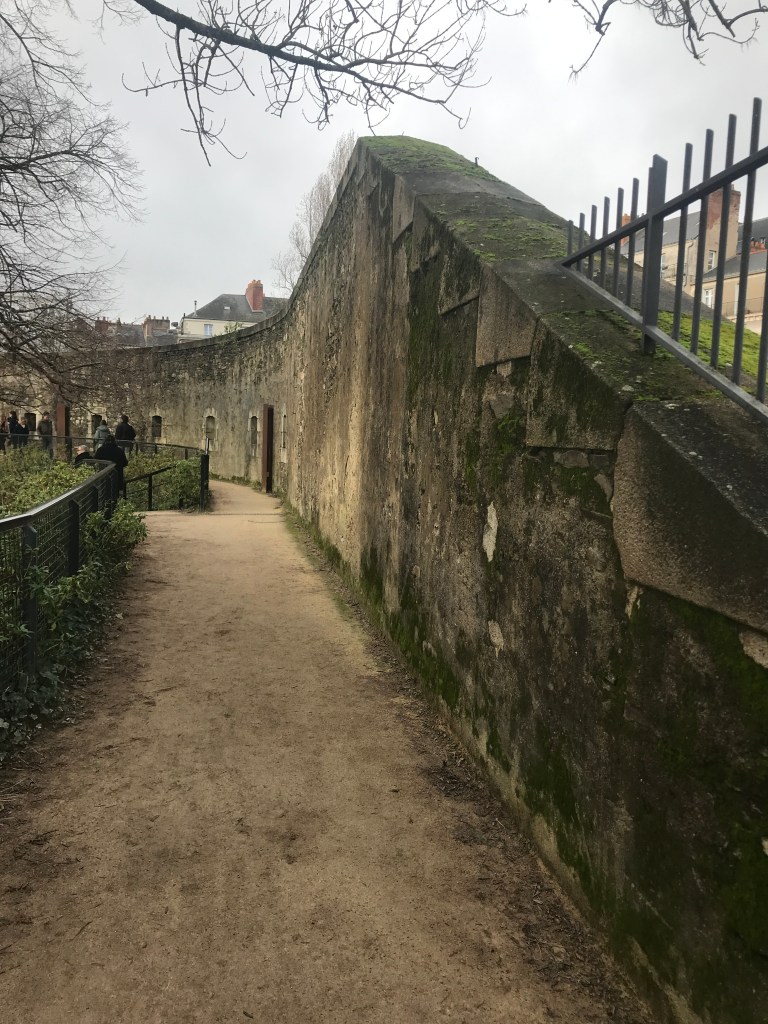
Mont Saint-Michel, France (Melodie Miller | Photographer)
The spirits of the exiled citizens whispered, “Run away,” yet I pressed forward. In the distance, the unforgiving door stood resolute, its distressed, burnt Tuscan auburn frame glinting beneath a lacquered sheen of blood-red defiance.

Mont Saint-Michel, France (Melodie Miller | Photographer)
A procession of artifacts drifted down the path, motionless yet advancing, as if carried by memory. Coordinates flickered across the heads-up display of my spectacles—longitude, latitude, fragments of direction. I had left my map on the battlefield, and my phone no longer held a charge. Though I was not truly lost, the world had misplaced me.
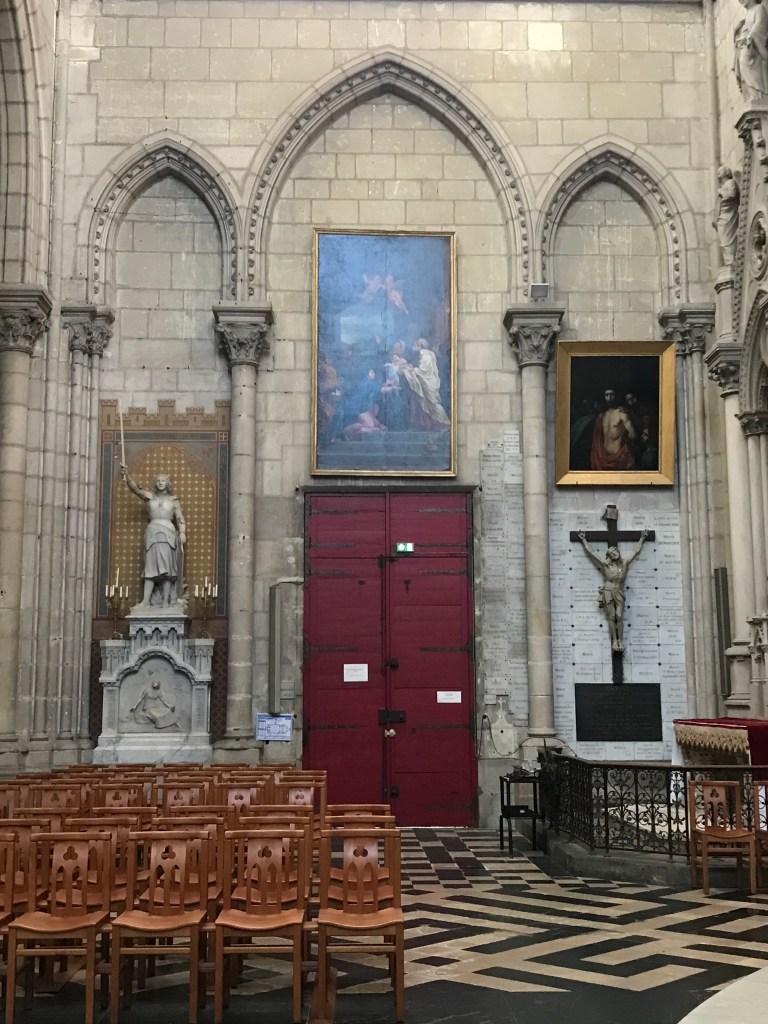
Mont Saint-Michel, France (Melodie Miller | Photographer)
The red lacquer door, a relic of a final warning, roared, “Open me!” Its cry rang like swords clashing in the hands of dying warriors. “The end is near,” it whispered in silence, the relic’s cruel souvenir. “The enemy offered no home advantage,” I answered, defiant against its echo.

Mont Saint-Michel, France (Melodie Miller | Photographer)
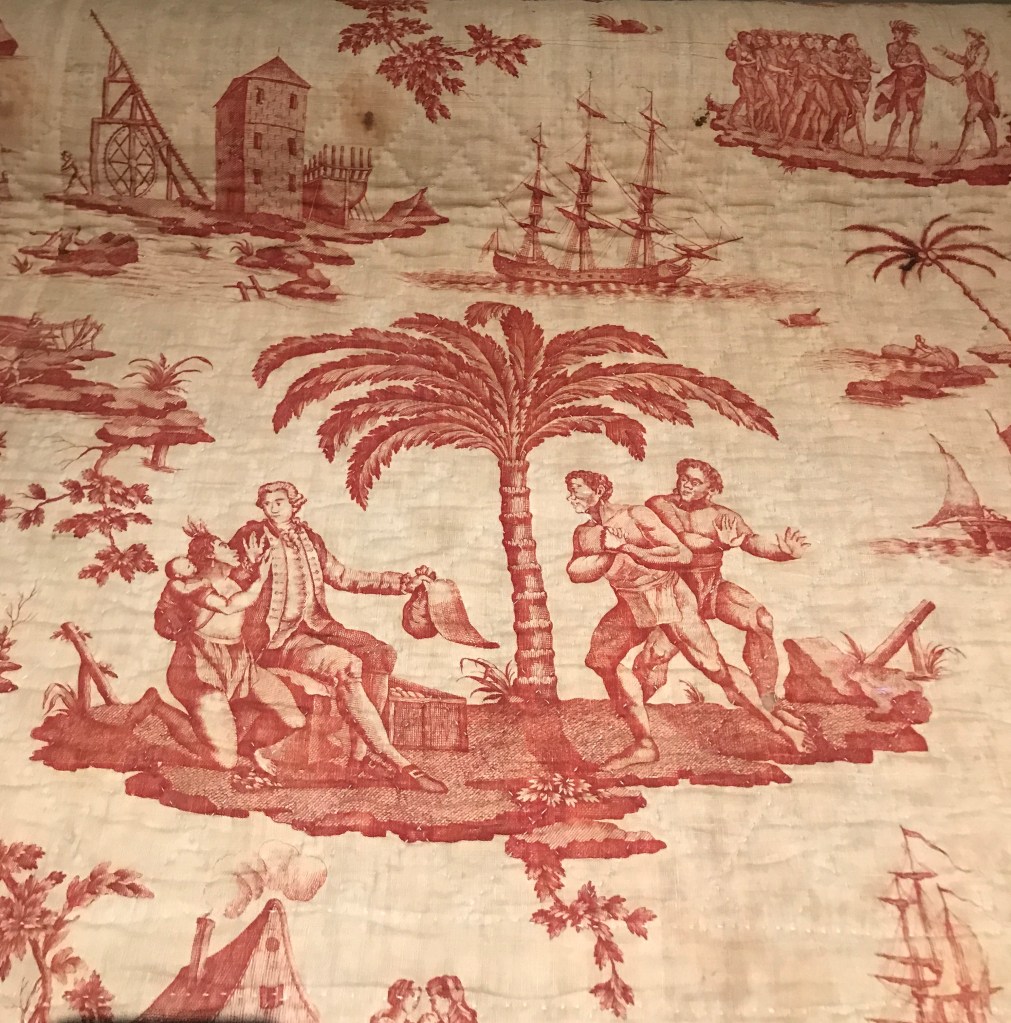
The unconscious masters ignored the printed enslaved, who begged for release from the fabric that bound them. I saw in the image a colonial warning—a reminder not to forget the past. I thought of the forced integration that tore children from their former lives as they boarded those buses. Their spirits have long since vanished, erased as characters and forgotten by their teachers and the system that failed them.
Mont Saint-Michel, France (Melodie Miller | Photographer)
Along the path, a messiah sat upon a fractured altar, her voice trembling as she called out for an apostle to gather the faithless flock. Her sword and wings—tattered, torn, and trembling—beat helplessly against the cold, mechanical wind of capitalistic dominion that had ruled over Gothtopia.

Mont Saint-Michel, France (Melodie Miller | Photographer)
As I drew near the altar, the hollow glass candles began to shatter under the prophet’s resonant cries. Razor-edged shards clashed around me. From below, the unfeeling Holy Mother wailed—a menacing summons that chilled the marrow of my faith.

Mont Saint-Michel, France (Melodie Miller | Photographer)
Through the monolithic arches, I saw the basilica—its nave filled with abandoned chairs, now nests for birds that had long forgotten how to fly. The Benedictine monks of 1790 CE were driven from the abbey by the revolutionaries, who also abolished the lettres de cachet, sealing the end of an era in French history.
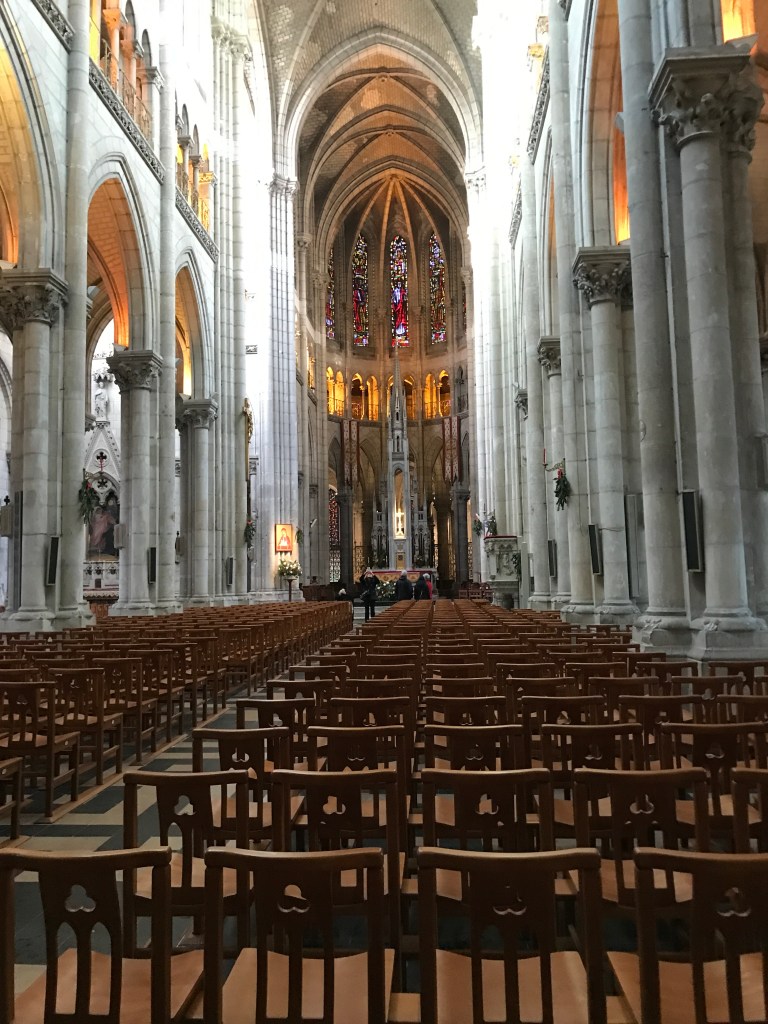
Mont Saint-Michel, France (Melodie Miller | Photographer)
The altar walls, built from the skeletons of time, stood weathered and decaying beneath the assault of the salt-laden sea air. I knelt before the new god of technology, awaiting the signal that would permit the ritual, the digital incantation demanded by faith’s replacement.
Around me, green moss and a viscera of pollution writhed through the mechanical vastness of the future, twining with the Messiah’s torn wings. Nearby, a self-adoring granite gargoyle hovered mockingly, its once sacred symbol of fertility now a caricature of its conceit.
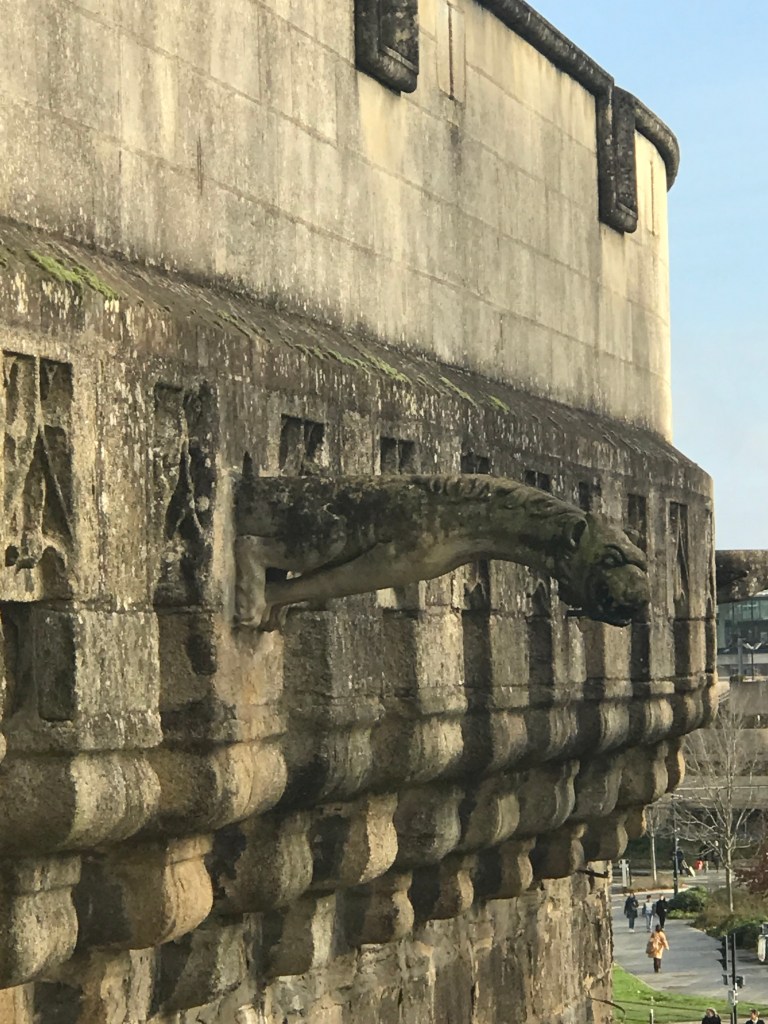
Mont Saint-Michel, France (Melodie Miller | Photographer)
Razor-sharpened wrought-iron impalers stood in place like sentinels, their blackened stocks recalling the disappeared fallen heads of statesmen. The tattered public servants gazed on from the gallery, trapped in an echo of the past. Their ghosts, condemned to linger in the gallery, watch as history repeats itself. A vessel of broken time, the basilica endures its shattered moments. Her remembrance, reflected in graven images of the memory of Saint Michel and in the minds of the pilgrims.

Mont Saint-Michel, France (Melodie Miller | Photographer)
The vacant wrought-iron bars framed a prophecy: our daily debts are the rations earned through the labors of hope, fragile offerings, easily crushed by a king’s will. Lettres de cachet once sanctioned imprisonment or death without trial within Mont-Saint-Michel’s shadowed Gothtopia. Yet, in bitter irony, this violation of justice preserved the abbey from utter ruin.
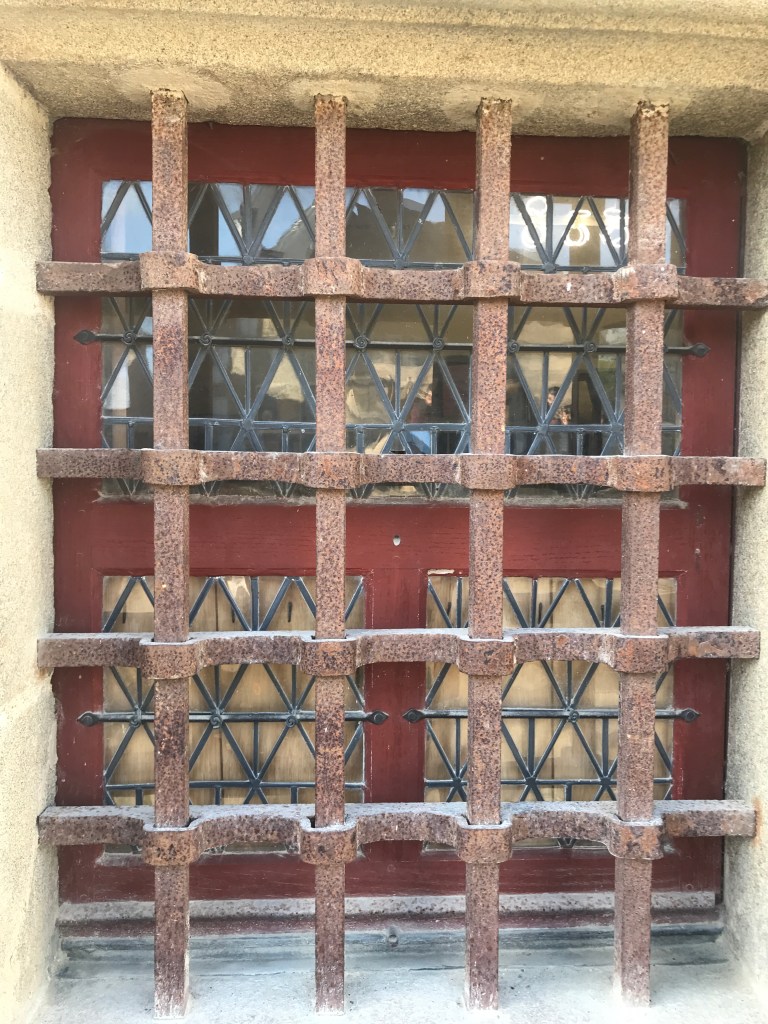
Mont Saint-Michel, France (Melodie Miller | Photographer)
As I turned to leave, the narcissistic ghosts gathered—unseen yet impenetrable—blocking the windows and door. They pulsed with vibrations drawn from the basilica’s menacing past, its walls still breathing history. One by one, the apparitions released their lethal cargo of memories upon the living below—those drifting through their holidays, blissfully unaware, unwilling to remember.
Mont-Saint-Michele, Normandy, France
-
A Hawai’ian Creation Story
Story interpreted by Melodie Miller | Designer | Illustrator
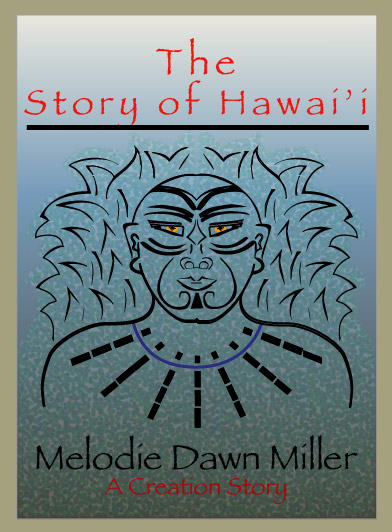
Keawe the Flaming Spirit of the Volcano (Melodie Miller, Illustrator, Adobe Illustrator)
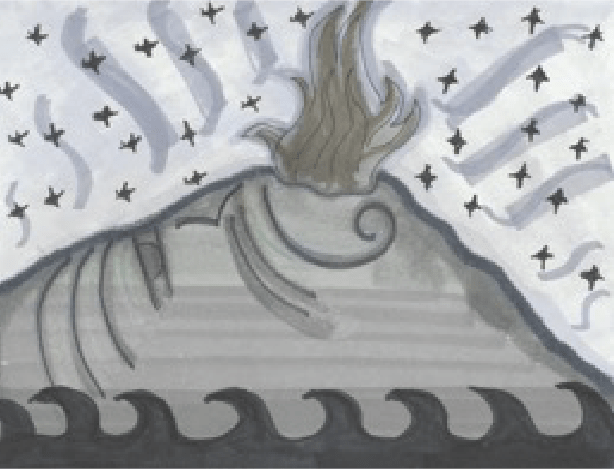
Po the Volcano and the Flames of Many Voices (Melodie Miller, Illustrator)
In the beginning there was Po, the all-powerful Volcano.

Keawe the Flaming Spirit of the Volcano (Melodie Miller, Illustrator)
And, Keawe, the flaming spirit of the Volcano.
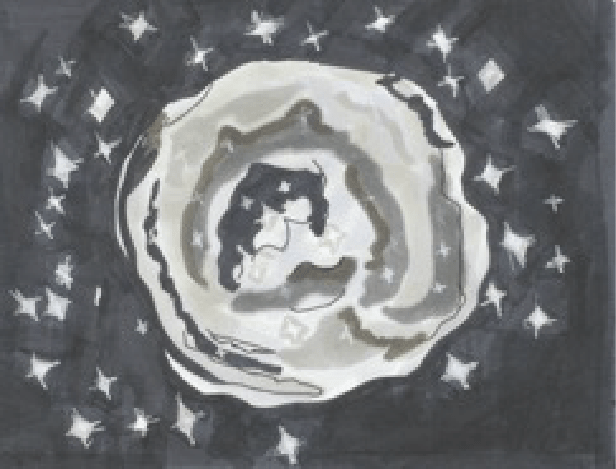
Untimed Infinite Time Passing (Melodie Miller, Illustrator)
Surrounded by an abyss of empty darkness, together, they were alone.
One day Keawe, speaking his mind said, “Po, it is not good that I am so alone.”
“But we have always been alone together. It has always been our way. We are all powerful. We do not need another.” Po responded.

The Flames of Many Voices (Melodie Miller, Illustrator)
The Flames of Many Voices living inside Volcano echoed Po’s warning, speaking with crackling and slapping flames, “Yes, Yes, Yes. It has always been our way, way, way. We are all powerful, powerful, powerful. We do not need another, another, another.”
“But Po, I have no one to love.” Keawe said.
“Keawe, what is this word you say, Love?” Po asked.
“What is this word Love? What is this word Love? What is this word Love, Love Love?” the Flames echoed with the innocence of Many Voices, pushing and pulling at the walls of the Volcano.
Time passed.
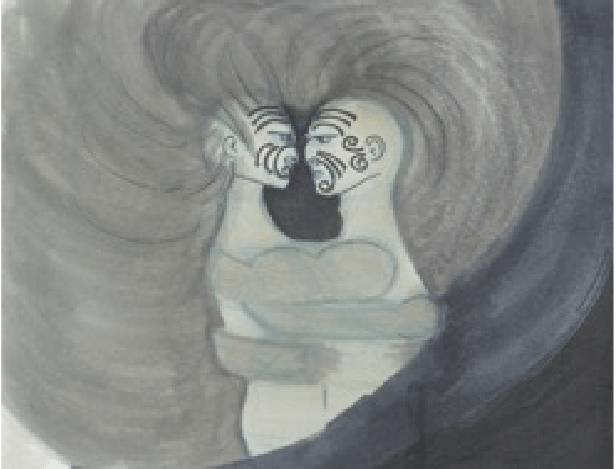
Na Wahine and Keawe (Melodie Miller, Illustrator)
Po did not want Keawe to be lonely, so he created Na Wahine for him to love.
“Keawe, I am Na Wahine. I have been waiting, alone for a long time, inside your heart. I am here now to share your love.” she said.
“Why did you not come sooner?” Keawe asked?
“Because you did not call for me.” she answered.
Looking down upon Keawe and Na Wahine, Po said, “Together you will rule. And, it is good.”
Then with a rumbling of the Volcano, Po commanded, “From your love, bring forth life to help you govern the heavens and the earth; bring forth beauty and all things will be good.”

The god princes and goddess princess of Hawai’ian legend (Melodie Miller, Illustrator)
Through Na Wahine, Keawe brought forth four sons.
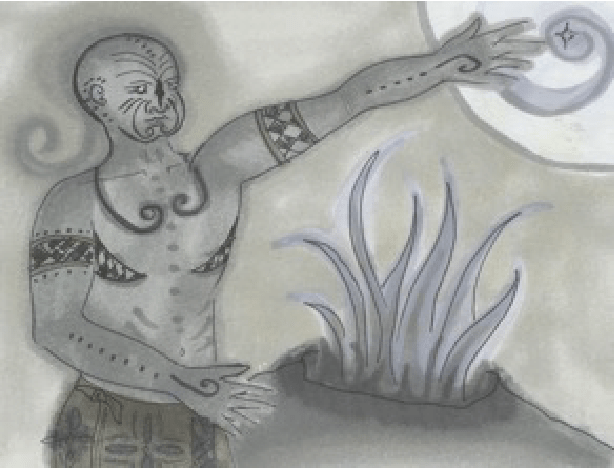
Kane the God Prince of Sky (Melodie Miller, Illustrator)
The first son was Kane, the god of the sky and all that it is.

Ku the God Prince of War and Peace (Melodie Miller, Illustrator)
The second son was Ku, the god of war and peace; and Kanaloa, the god of all things in and of the ocean;.

Kanaloa the God Prince of Ocean (Melodie Miller, Illustrator)
The third son was Kanaloa, the god of all things in and of the ocean.
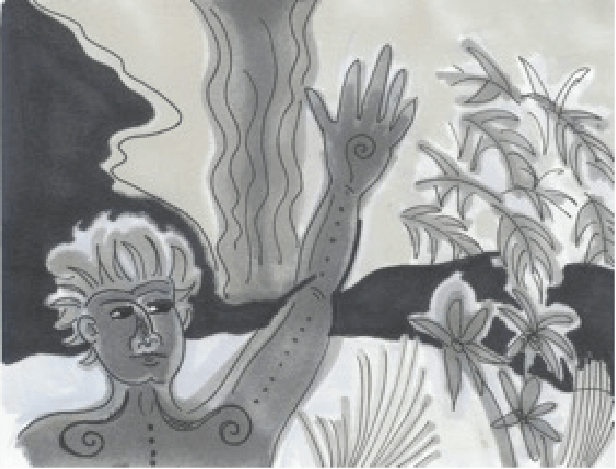
Lono the God Prince of the Land (Melodie Miller, Illustrator)
The fourth son was Lono the god of the land and that which it brings forth, the harvest and its bounty.


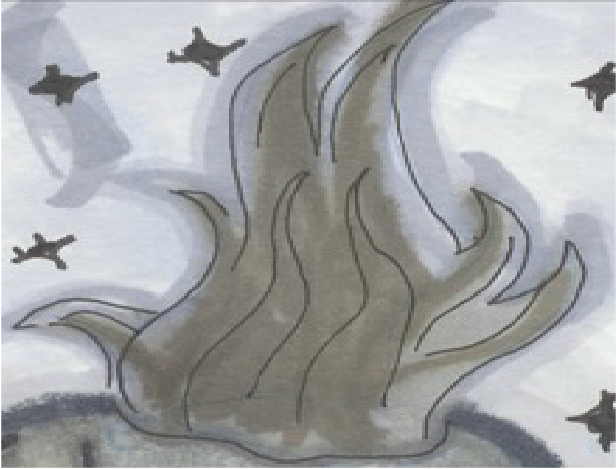
The Flames of Many Voices (Melodie Miller, Illustrator)
Along the walls of the Volcano the envious Flames of Many Voices became angry and agitate. The Flames of Many voices felt alone because Keawe was not alone.
“Call for me. Call for me. Call for me,” the Flames of Many Voices echoed.
But Keawa did not answer.
Time passed.
“Four daughters will be yours,” Po said.
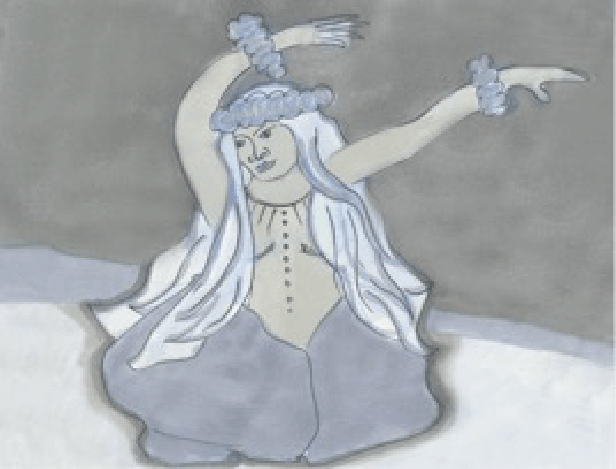
Laka the Goddess Princess of the Hula (Melodie Miller, Illustrator)
Your first-born daughter, Laka, will bring the hula, the language of the heart.” Po said. “Laka will keep the story; abide by her words.”
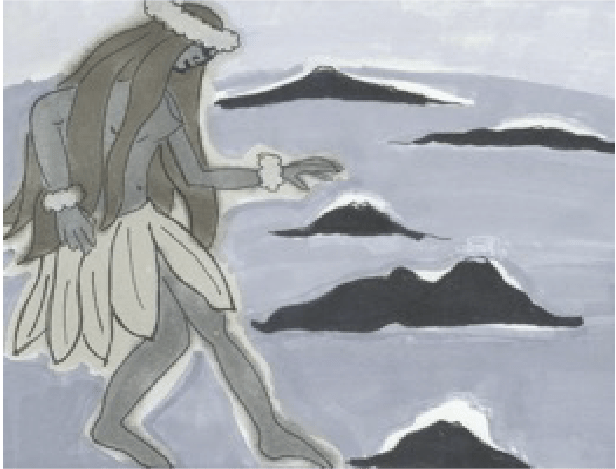
Hina the Goddess Princess of Sanctuary (Melodie Miller, Illustrator)
“Your second daughter Hina will give you sanctuary from danger, stand on her as a rock when in need.”

Kapo the Goddess Princess of the Lost (Melodie Miller, Illustrator)
“Your third daugher, hot tempered Kapo will govern furiously with her brother Kanaloa. Be remembered by Kapo when you are hungry and lost, she will feed you and lead you home.”

Papa the Goddess Princess of Nature and its Beauty (Melodie Miller, Illustrator)
The fourth daughter, Papa, “will rule all of nature with beauty beyond words. Anyone who looks upon her, even in her rage, will feel her power.” Po said.
Papas natural beauty will overpower the gazers senses, and none will find the strength to resist her.
“Once the beauty of Papa is gazed upon, she will enchant their heart forever,” Po said.

The Flames and the Goddess Princess of Nature and its Beauty (Melodie Miller, Illustrator)
The Flames of Many Voices gazed upon Papa and were stricken with love for her natural beauty, which was beyond challenge, thus they were lonely no more, They were enchanted.
To this day, anyone who looks upon the nature of Papa and the beauty of the Islands, will not have the strength to resist her love. Hawai’i will live in their hearts for eternity.
This is the creation story of the enchanting lands of Hawai’i, her captivating love and irresistible beauty.
-
Sunflower Farm Founder Podcast

It was early morning on a crisp, cold, sunny Sunday in November on the 55-acre Sunflower Farm. Founder John Roberts fed wood to the crackling campfire to warm the Farmfest guests. Community members of all ages come to the sustainable farm to roam among the magical forest and farm animals.

The farm is a healing “resting place for the community,” Roberts said. You can come as a family “to mingle with others that you never would have otherwise met.” The farm creates connections and an “intertwining of community that I think is beneficial.”
Roberts earned a bachelor’s degree in English from Colorado Mesa University. He taught at a primary school in Moshi, Tanzania, Africa. While in Moshi, he observed the benefits of outdoor-based learning. “The students plant seeds in the spring. By the end of the summer, they see the benefits of their participation in the farm. “
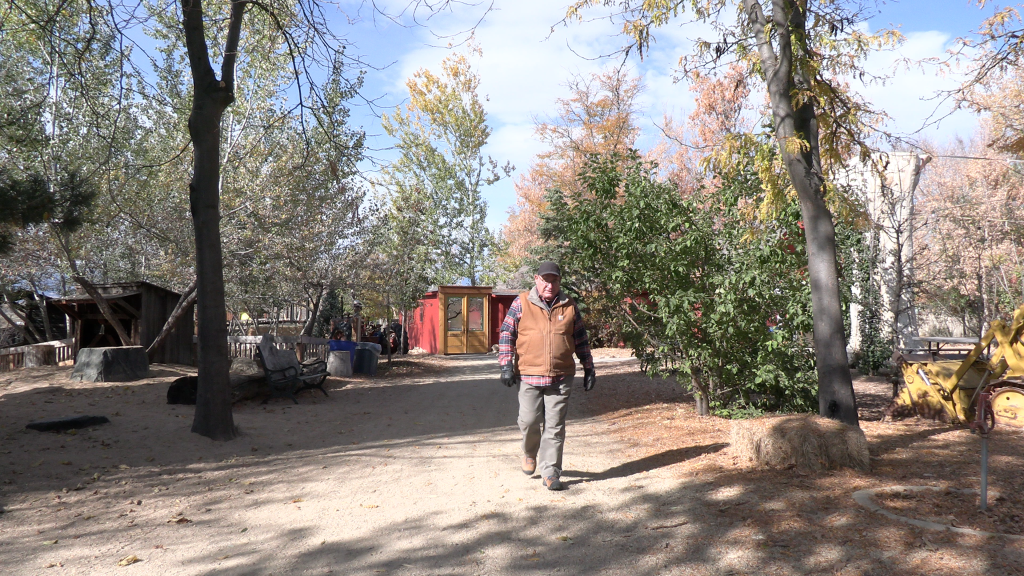
The children spend more than half their learning time out of doors. They play with the worms in the dirt and “begin to understand where their food comes from,” Liz Napp, the executive Sunflower Farm and Sunflower Farm Acres, said.

The farm is like an outdoor living room where Roberts introduces his guests to over 100 farm animals. “When I lived in Washington D.C., I realized that spaces are important,” Roberts said. “Over the last 25 years, I’ve created spaces for visitors to experience different things,” while enjoying the farm.
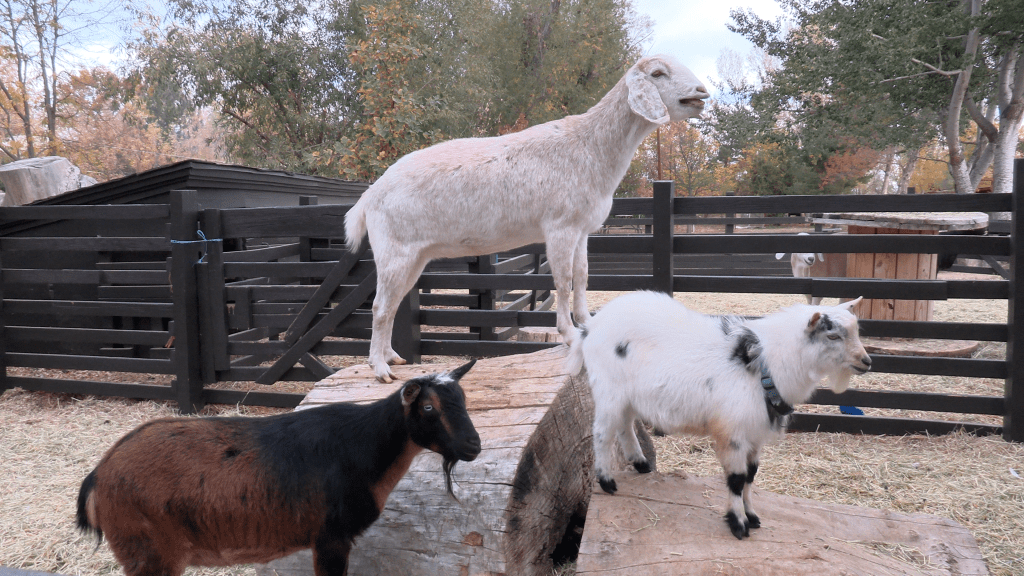
In 2024, Sunflower Farm became a production farm with an educational vision to immerse children in nature, land conservation and farming. Jacob McGuire, operations manager of Sunflower Farm Acres, said the children are “getting more than just the curriculum” as they navigate the property. They are “participating in preserving nature.”

As a conservation easement, Sunflower Farm is “required through contract to preserve much of the nature that exists,” McGuire said. This means no new structures can be built on the farm, so the preschool cannot grow.
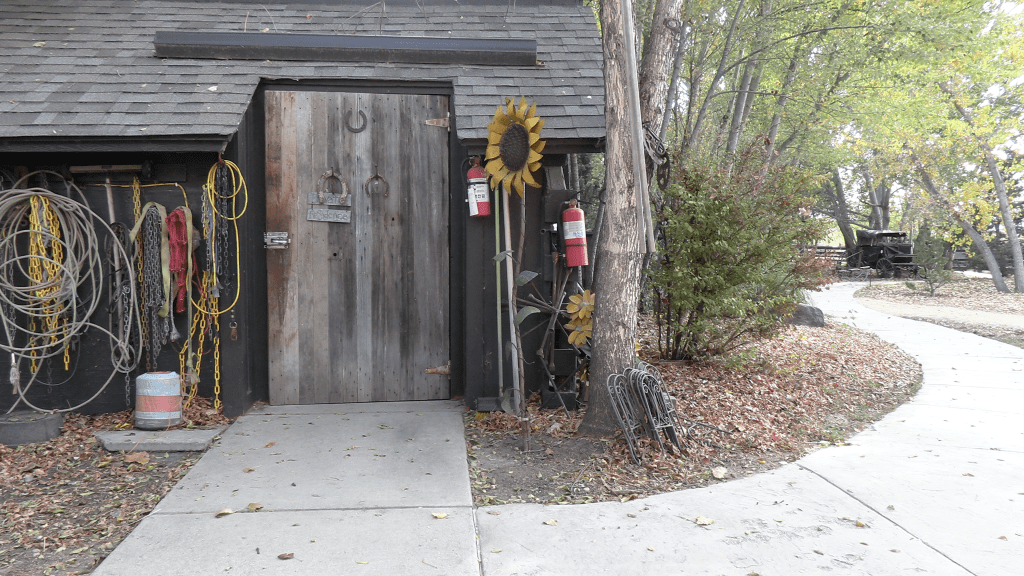
But there are other ways the farm can grow its contribution to the community. Healthy soil grows nourishing food, so Roberts is committed to working with aspiring local farmers.

We are “planning to expand educational internships focusing on regenerative farming practices,” McGuire, who has a master’s degree in international human rights from the University of Denver, said.
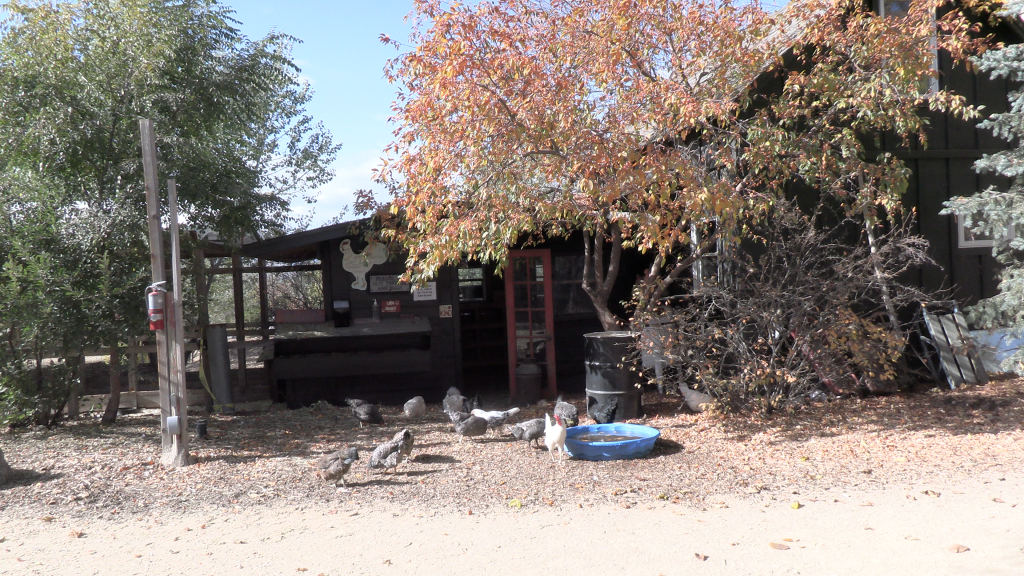
Roberts bought the homestead in 2002. It had a rundown farmhouse. However, Robert’s four children and their friends loved the place. Roberts, a master builder, improved the property, created the community spaces, and formed a preschool.

Roberts goal was to preserve the open space of the farm. He built winding pathways for visitors to explore a hay maze, a grain silo, and a twin-engine airplane. Guests can wander between hand-split wood enclosures where friendly goats and ponies greet everyone.
The farming and animal setting creates an “easy learning environment for kids to participate and they are eager to participate,” Roberts said. While planting pumpkin seeds, the children count and improve their “dexterity, and they’re also learning.”
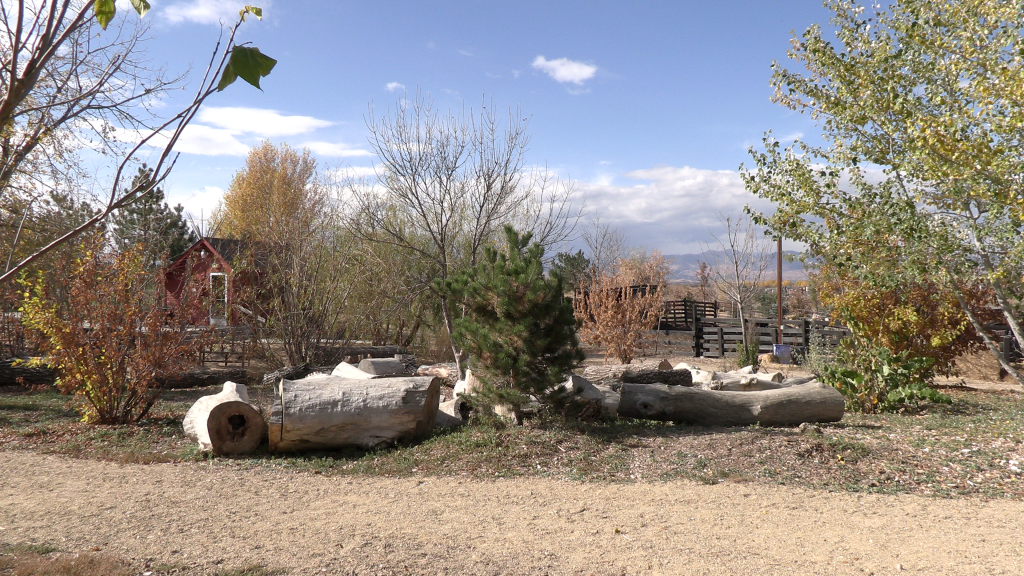
Looking to the future, Roberts said, “You know, I don’t think there’s going to be another Sunflower Farm. The business model does not financially support” the preschool.
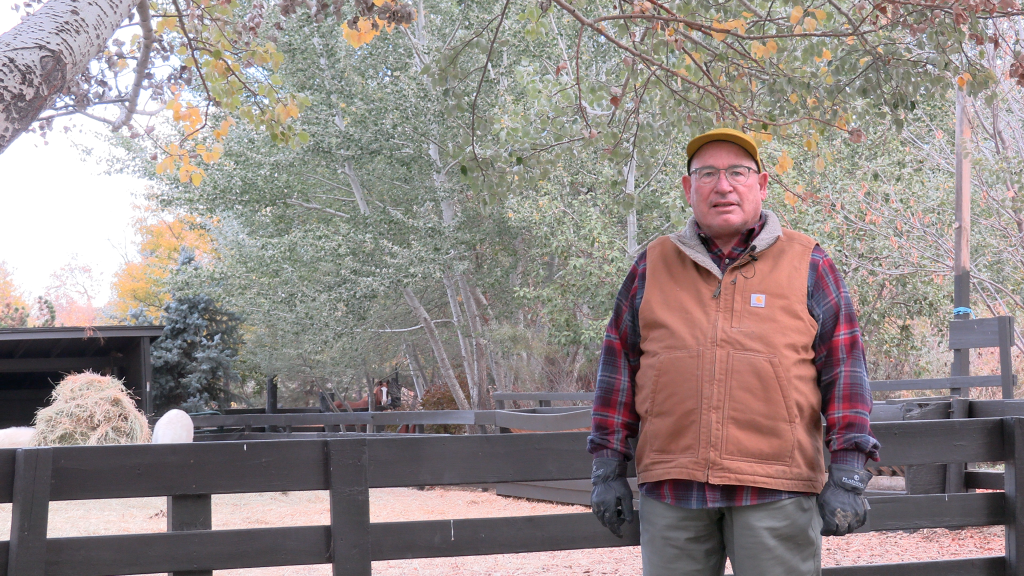
“I was raised poor, so money is not a motivating factor for me. Otherwise, I would have sold this farm years ago and retired.” Roberts said. “But I’ve made a commitment of myself to do this for the community. This is my purpose.”
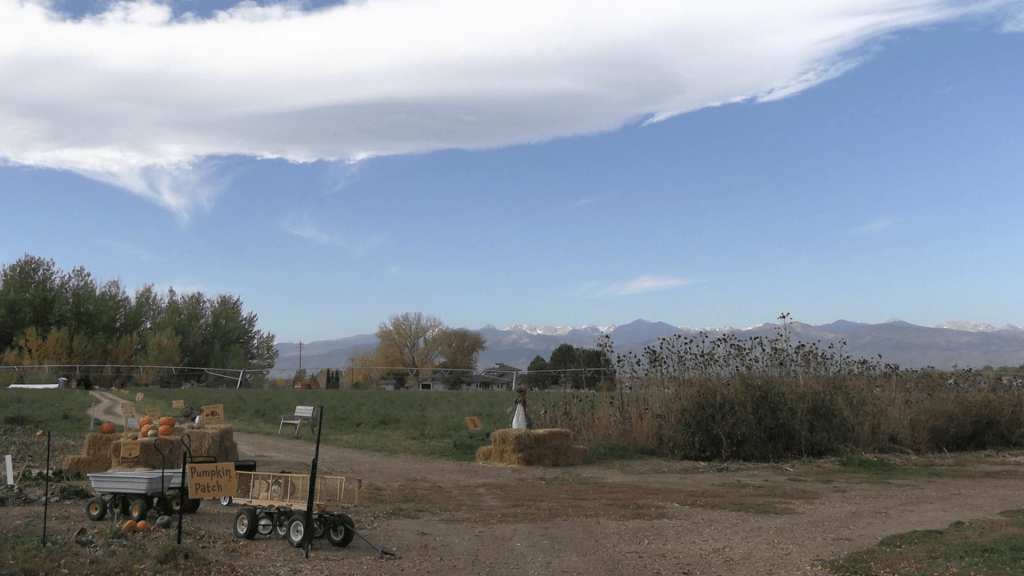
Visitors are welcome at the Sunflower Farm in Longmont Colorado with reservations.
-
Game in Luxury at the University of Colorado in Boulder

The Alienware Lounge at the Colorado Memorial Center on C.U. campus. (Melodie Miller / Photographer)
Game in luxury with state of the art Dell software can be found at the University of Colorado, Boulder lounge on the first floor of the Colorado Memorial Center. The gaming lounge is open seven days a week.

The Alienware Lounge features custom designed chairs for long periods of sitting. (Melodie Miller / Photographer)
The University of Colorado teamed up with Alienware, a hardware subsidiary brand of Dell in 2023 to build the second collegiate facility in the nation. According to the University, the 1,275-square-foot space inside the UMC was renovated with a $1.2 million donation from Dell Technologies and Intel.
The Alienware Lounge offers numerous games and open seating for up to one hour per session. Watch the Youtube video for a view of the facility. https://youtu.be/Dpi8Z01Gqcg (Melodie Miller / Photographer)
The luxury Alienware Lounge has 19 gaming desktops, three gaming laptops, and a console area that can comfortably seat up to 4 gamers. C.U. students receive 10 free days passes on their first visit.
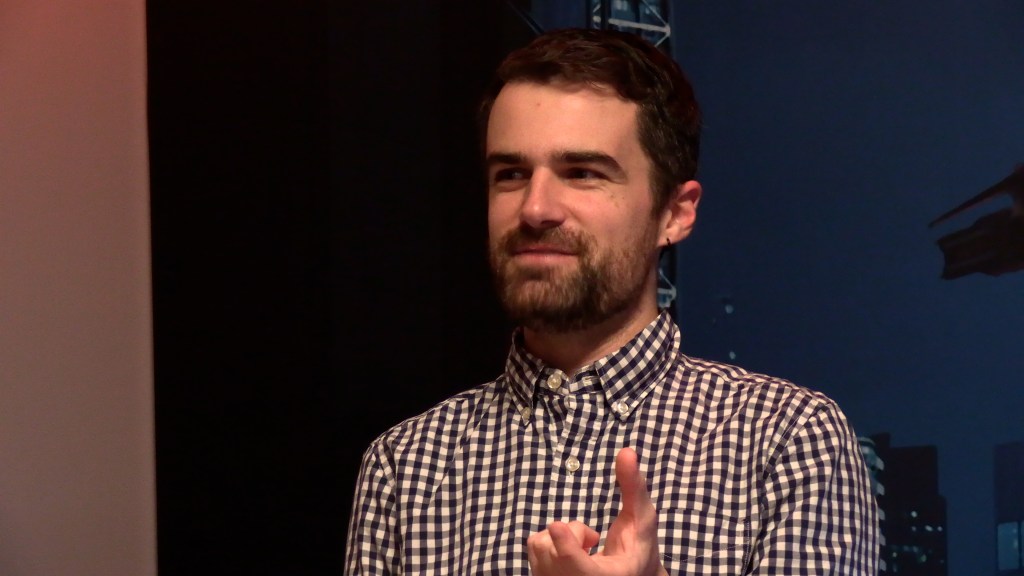
Adam Pallas, is the senior coordinator for gaming programs at C.U. Boulder. (Melodie Miller / Photographer).
Building a community at Alienware is one goal of the Center for Student Involvement at C.U. “I am full time. I am part of our Center for Student Involvement, which is where our gaming lounge is housed,” Senior Coordinator for Gaming Programs, Adam Pallas said. “I was brought on to the University in August 2023, prior to the opening of the gaming lounge, and I’ve been with it since then.”
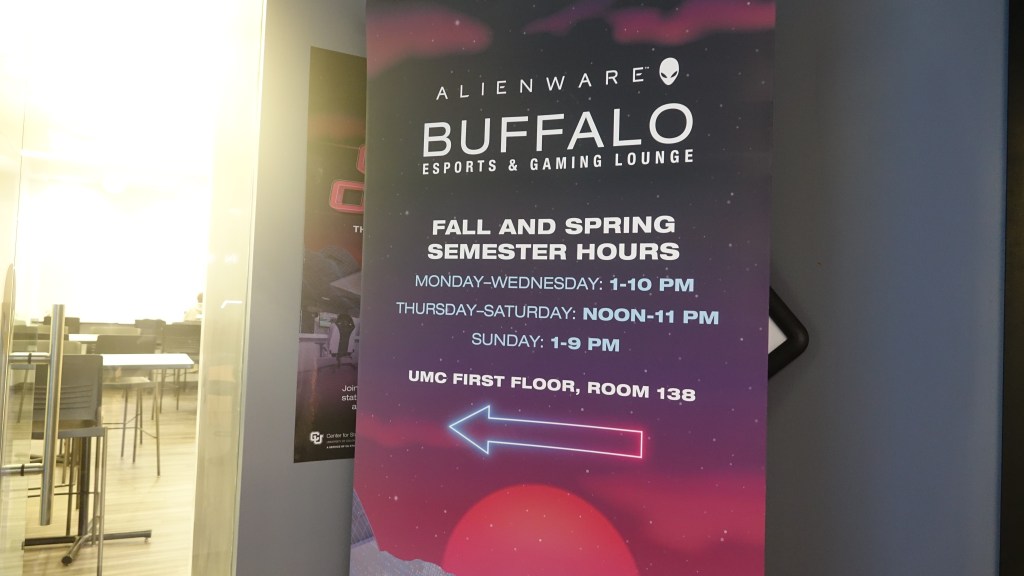
UCM Alienware Gaming Lounge is open 7-days a week. 
Alienware Esports Lounge has ample, custom seating. 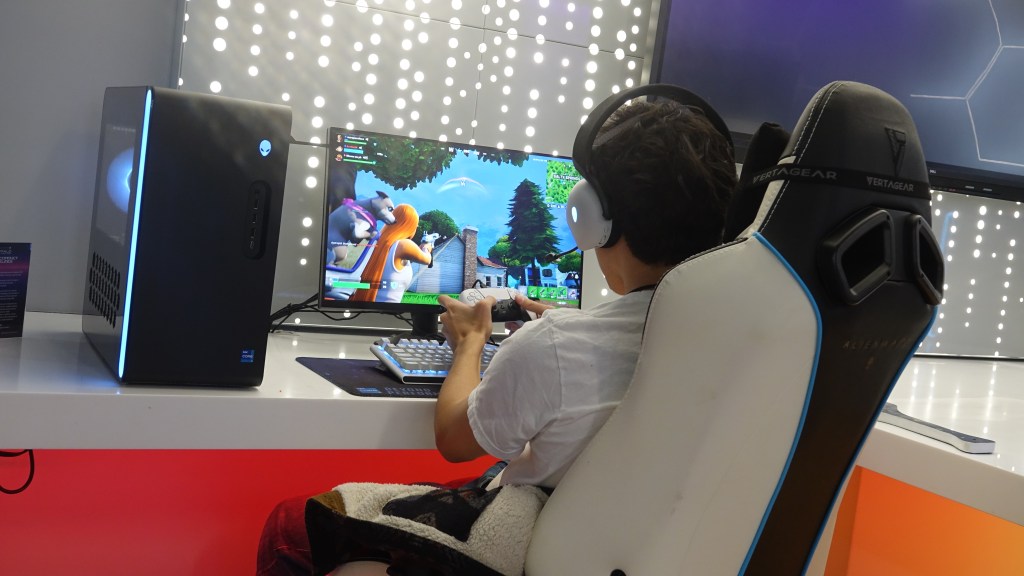
Log into your account to play the game of your choice. 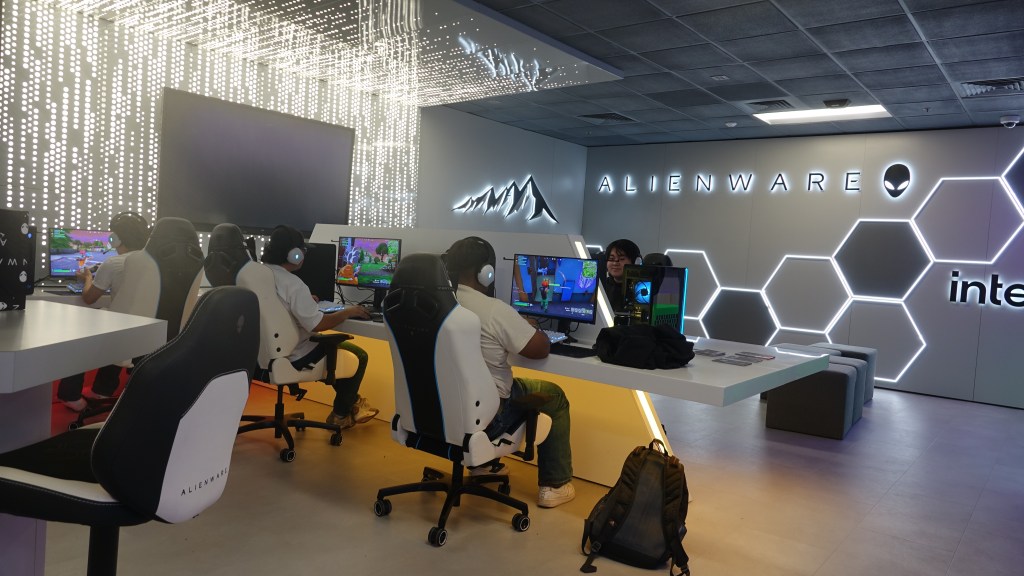
Stations accommodate playing with multiple friends. 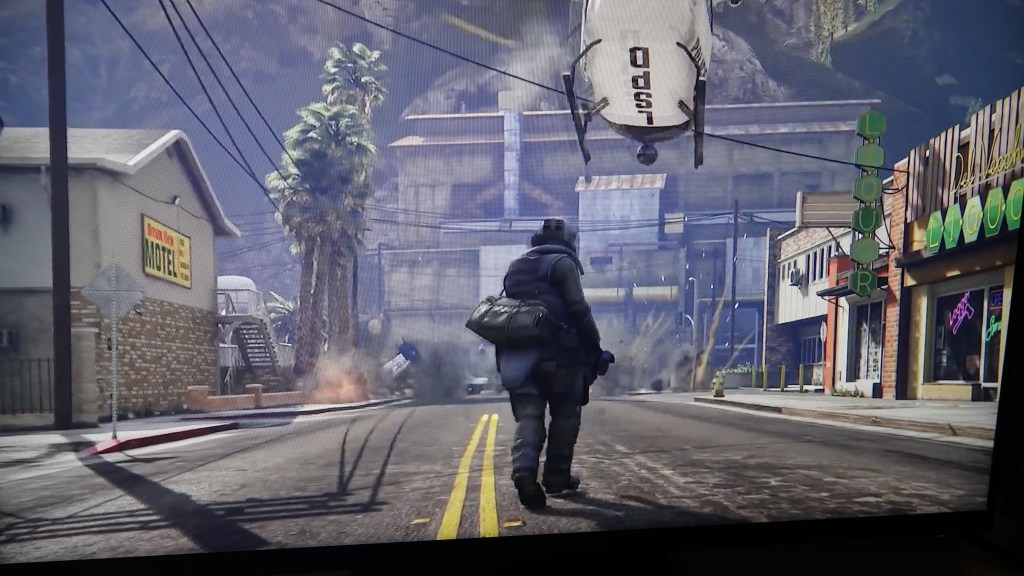
The lounge has 50 games installed on its PC’s. 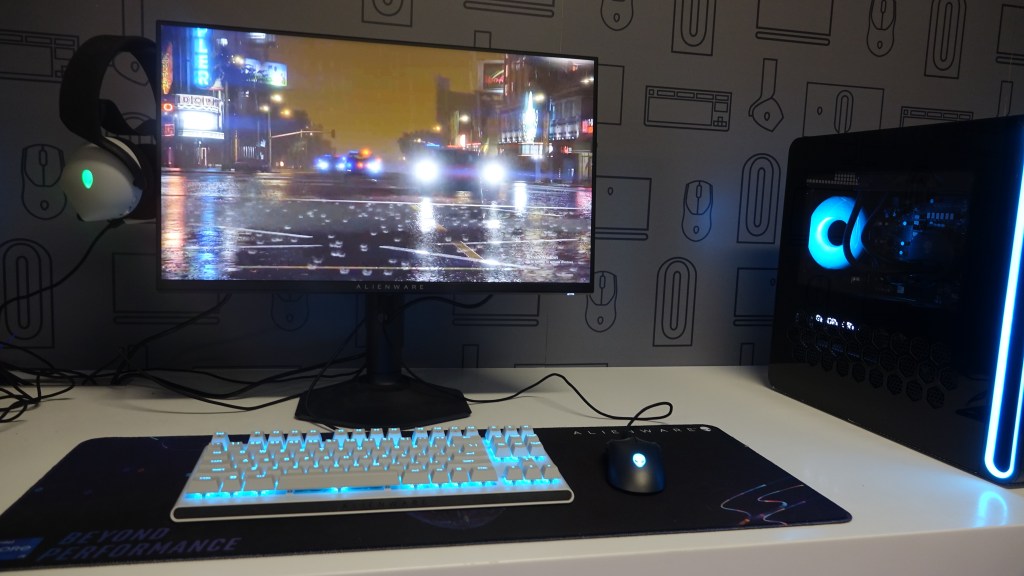
The lounge has state-of-the-art Dell gaming stations.
UCM Alienware Lounge entrance. (Melodie Miller / Photographer).
Alienware hosts in person gaming night once per month with free pizza and tonight its Minecraft Bingo. “Minecraft is not normally a competitive game, but we thought we could make it competitive by doing the Bingo competition,” Pallas said.
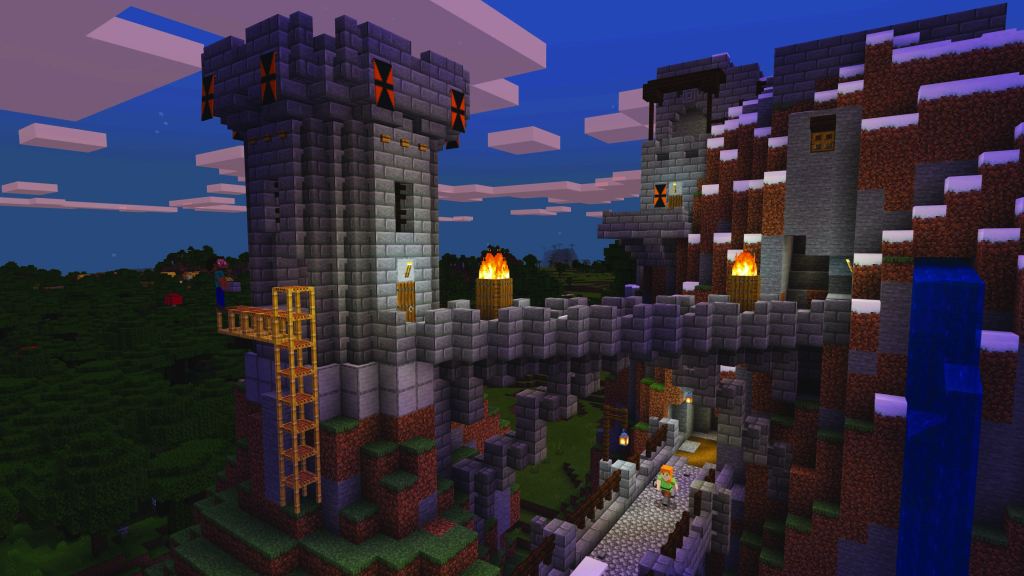
Minecraft ( http://www.minecraft.net/en-us/aboutminecraft )
Accept the Minecraft bingo challenge? Achieve 5 down, 5 across or 6 diagonally and win the game.

How to play Minecraft Bingo ( https://minecraftbingo.com/?s=3-0-0-4_56400 )
Mojang Studios, a video game developer based in Sweden introduce Minecraft in May 2009 as a sand-box-style where players could freely explore, interact with others and create. The idea is that people can experiment by playing survival or creative modes. Mojang Studios sold Minecraft to Microsoft Gaming in 2014 for $2.5 billion dollars.

Graphic was designed and developed with Piktochart. (Melodie Miller / Designer).
Minecraft has evolved over the years but it remains a sandbox-style video game that gives players a lot of freedom to explore, interact, and create virtual worlds without following a set objective. It is an environment where players build and explore virtual worlds by discovering and extracting raw materials with craft tools and machines.

Minecraft landing page( https://www.xbox.com/en-US/games/store/minecraft/9MVXMVT8ZKWC/0010 ) Eli Grimm is a sophomore at C.U. majoring in engineering. His favorite game is Minecraft because it is a “creative game to play with your friends,” Grimm said. “Its a great way to connect with people. If you have close friends, but you guys live far away, you could play some games together. It’s something that’s social.”
Eli Grimm, C.U. gamer and engineering major. (Melodie Miller / Photographer)
The Alienware Lounge is “sponsored by Dell Alienware. So we have these amazing rigs. These are top of the line computers that would cost several thousand dollars to make on your own,” student gaming event planner, Jesse Helser said.

Jesse Helser is a student gaming event planner at the Alienware Lounge at C.U. (Melodie Miller / Photographer)
C.U. student, Colin Stewart, a junior majoring in psychology said, “My goal tonight is to win. This is the second time I’ve been here. I participated in the first event of this semester and I honestly have my own gaming PC in my dorm. But I enjoy coming out here.”
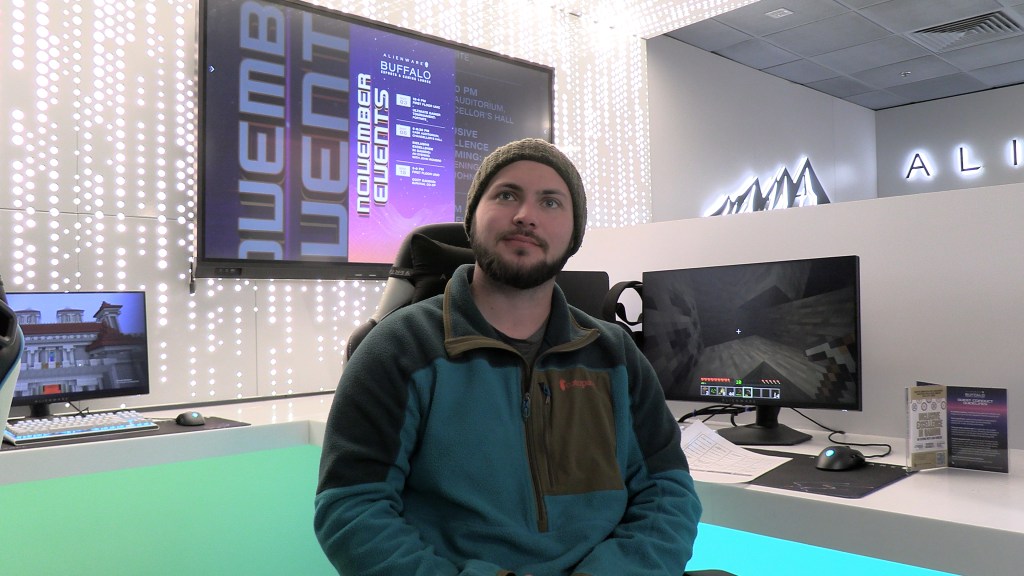
Colin Stewart, is a junior majoring in psychology at the University of Colorado in Boulder. (Melodie Miller / Photographer)
Although C.U. offers 50 games, Minecraft has become the best selling video game world wide since its release in 2009. Sales topped at 300 millions copies sold as of 2024 and according to Xbox, there are nearly 170 million monthly players exploring the critically acclaimed virtual worlds.

A C.U. student played a video game as his friends sitting near by joined in the same battle. (Melodie Miller / Photographer)
The Alienware gaming lounge is a place created for fun and competition that offers students the opportunity to team build playing on high-tech gaming equipment. They can grow a community of gamers facilitated by the Center for Student Involvement 7 days a week.
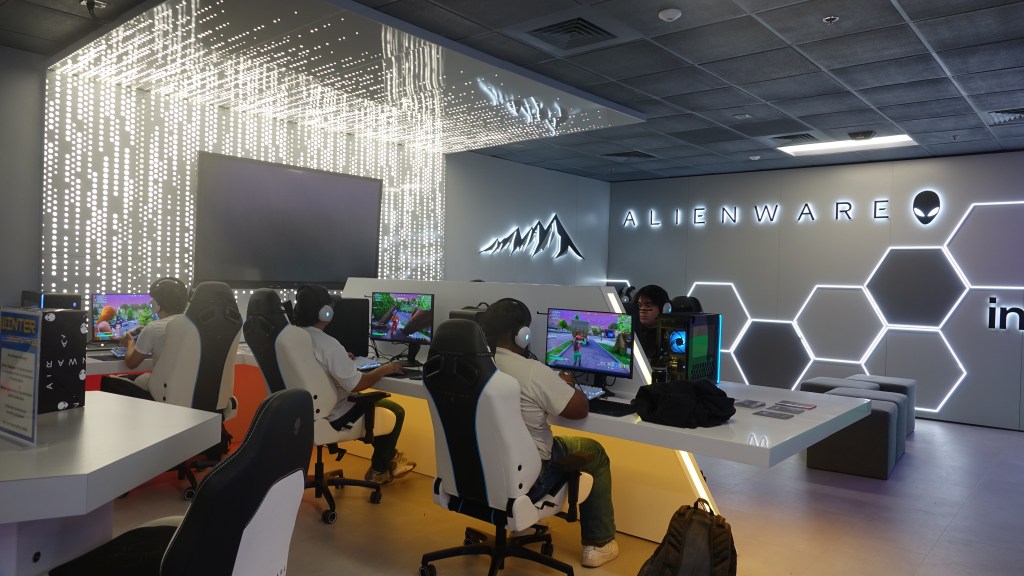
UMC Alienware gaming lounge. (Melodie Miller / Photographer) https://www.colorado.edu/involvement/gaming-lounge
The Alienware Lounge is a place of community where friends can join in video games for relaxation and enjoyment. Students will find Alienware hours and coming events on the website.
-
John Roberts shares his sustainable Sunflower Farm with the community

The Longmont Colorado Sunflower Farm video and interviews were written and produced by Melodie Miller.

Sunflower Farm, Longmont Colorado (Melodie Miller Photographer)
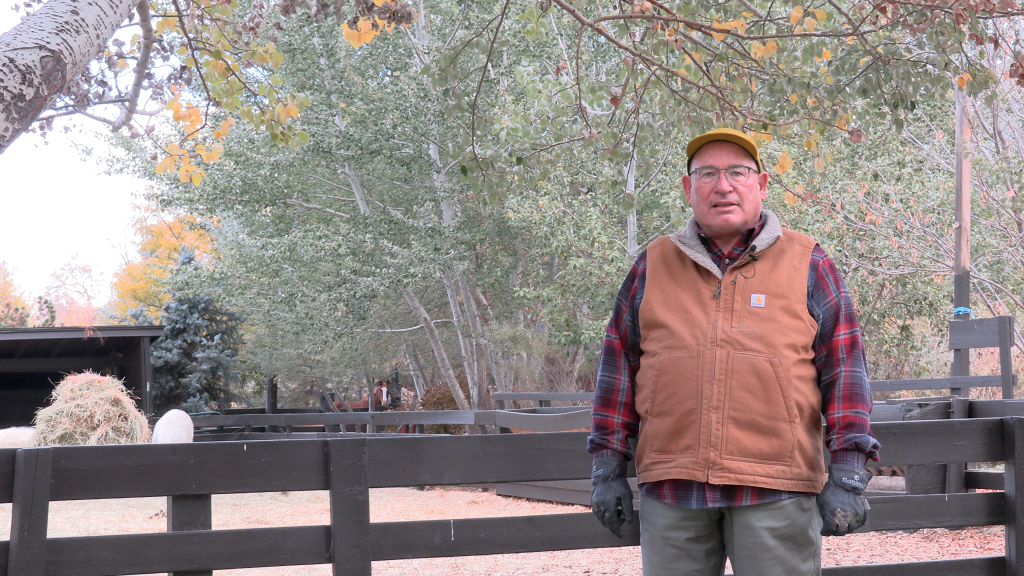
John Roberts, owner of Sunflower Farm, Longmont Colorado (Melodie Miller Photographer)
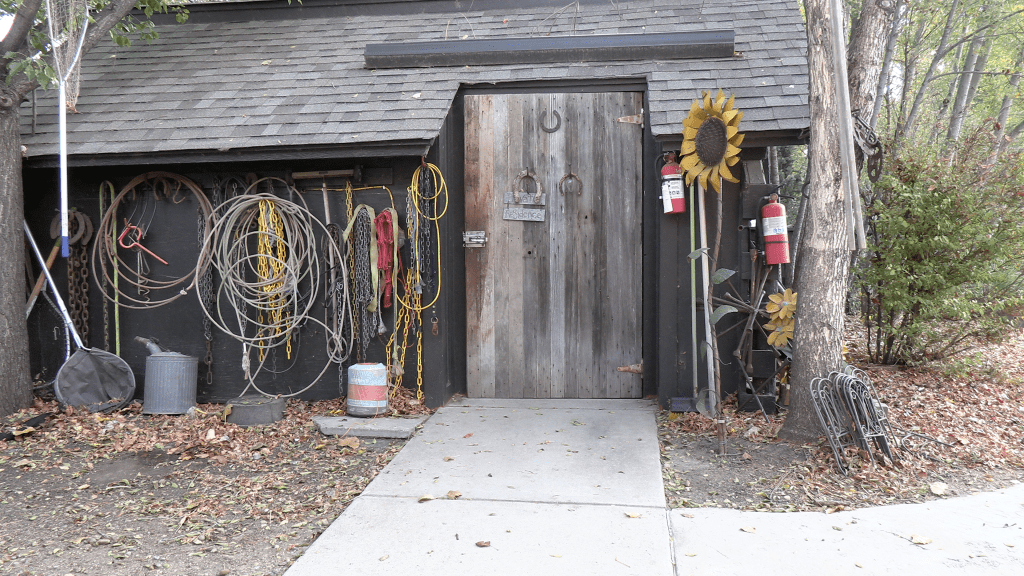
The tool shed on Sunflower Farm, Longmont Colorado (Melodie Miller Photographer)


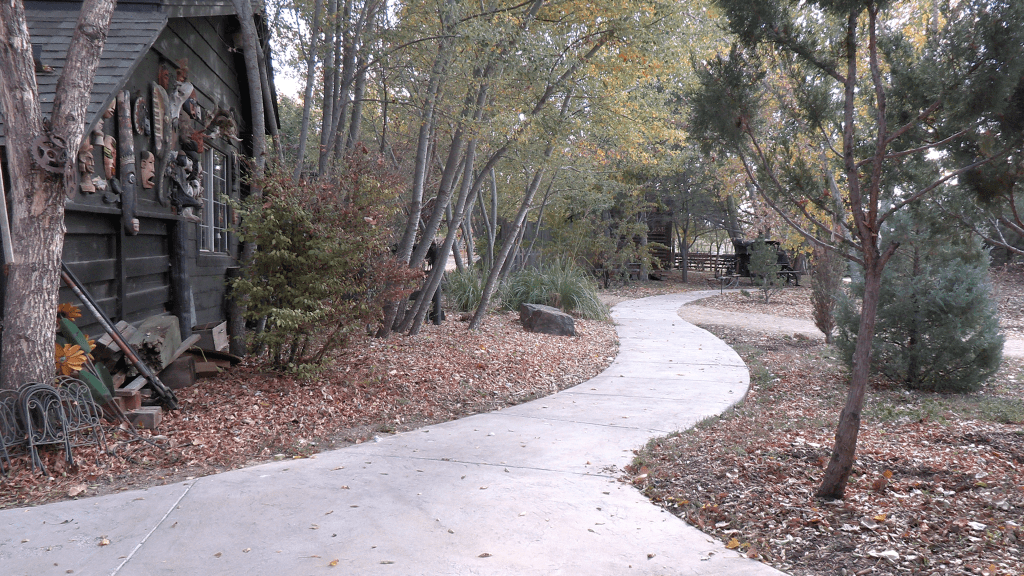


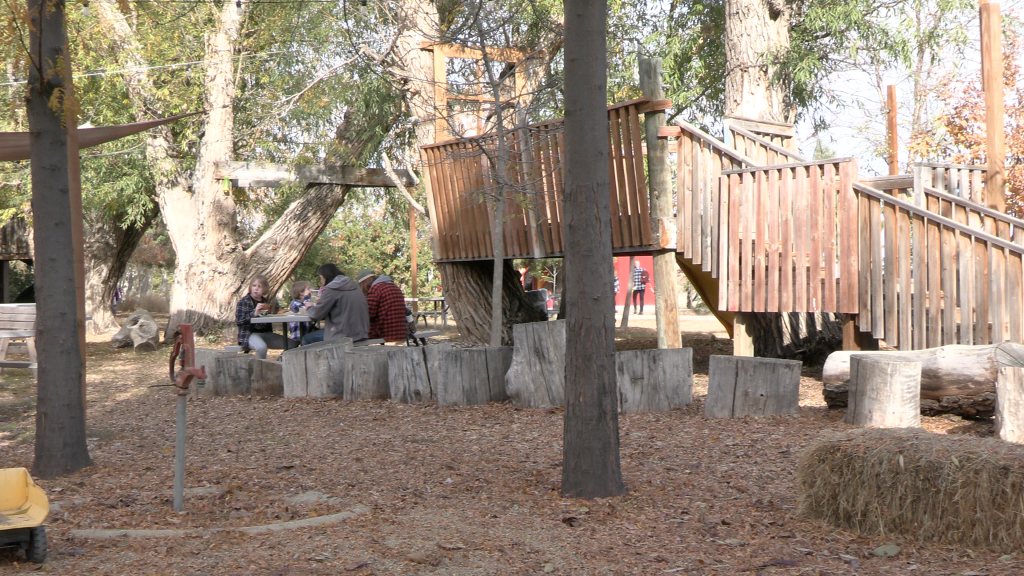
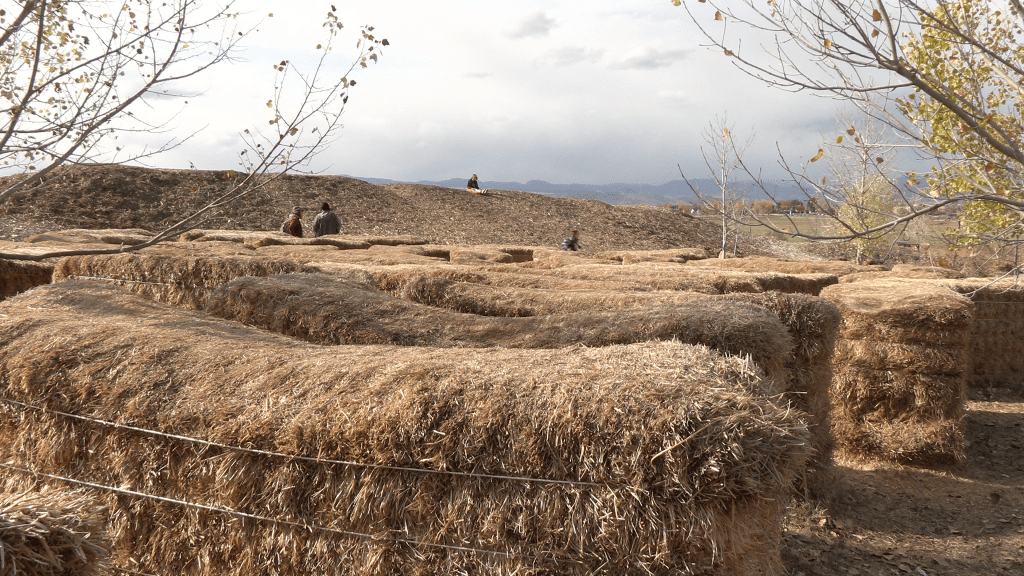

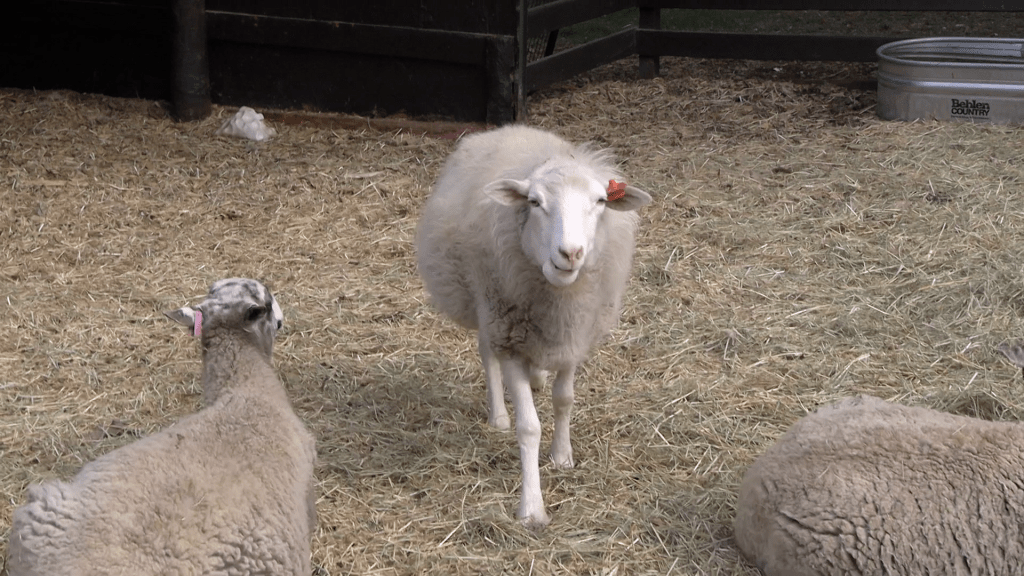
-
Sunflower Farms: Radio Script
Sunflower Farm, Longmont Colorado (Melodie Miller / Photographer)
-
Super-Frog Saves Tokyo: A Classical Dream Vision Narrative
An analysis of Haruki Murakami’s Super-Frog saves Tokyo written by Melodie Miller.
Super-Frog Saves Tokyo illustration by PMGL (Courtsey of Amazon Books)
Haruki Murakami was born in Kyoto in 1949 and now lives near Tokyo. His work has been translated into more than fifty languages.
- https://en.wikipedia.org/wiki/Haruki_Murakami
- https://en.wikipedia.org/wiki/Drive_My_Car_(film)
- Norwegian Wood (1987)
- The Wind-Up Bird Chronicle (1994–95)
- Kafka on the Shore (2002)
- 1Q84 (2010)
- Men Without Women (2014)
- The Elephant Vanishes (1993)
-
The Story of the Western Wing: Breaking Tang Tradition
The West Wing, a play written by Wang Shifu (1250-1300) in the Yuan Dynasty.
Scenes from The Story of the Western Wing, National Museum of Asian Art (Courtesy of The Smithsonian)
-
The Story of Ying-ying: Strange Love
A timeless story of love where social expectations conflict with personal desires.
Scene from Romance of the Western Chamber, an opera inspired by the story of Ying-ying (Illustration of act 10 courtesy of Wikipedia.org)
-
Humans are Synonymous with Monsters in “Monster Takes a Bride” (1807), Ikku Jippensha
Original 19th century Japanese Woodblock Print The Monster Takes a Bride, 1886
-
Syntax in Shakespeare’s Sonnet 20 “A women’s face with nature’s own hand painted”
An exploration of the poet’s depiction of nature and beauty.
The Chandos portrait is an oil painted portrait thought to depict William Shakespeare (1564–1616). Painted between 1600 and 1610, it may have served as the basis for the engraved portrait of Shakespeare used in the First Folio in 1623. Attributed to John Taylor. (Courtesy of Wikipedia.org)
Read more about Shakespeare’s Sonnet 20 “A woman’s face with Nature’s own hand painted”
-
The Frozen Castle, a Murderous Tale
The Frozen Castle created in Microsoft Copilot by Melodie Miller
-
A Sublime Experience
Waiting for the the last ferry in a dark, wet abandoned parking lot in the far Northwest.
The sublime and disruptive aesthetics of winter in the Northwest. Image generated by CoPilot designed by Melodie Miller.
A sublime ferry crossing the Puget Sound on a Northwest winter night. Image generated by CoPilot designed by Melodie Miller.
A sublime drive home after crossing Puget Sound on a Northwest winter night. Image generated by CoPilot designed by Melodie Miller.
-
The Elbow Room
Melodie Miller ©
The Elbow Room is a situational comedy series set in 1984 at the birth of tech in Seattle, Washington. The Elbow Room is a fictitious bar on a Washington State Ferry where young commuters hang together during their battle to and from Bainbridge Island to their jobs in Seattle. Their friendships exist only inside the world of their commute and every effort is made to keep their personal lives separate from their ferry boat adventures.
-
Colorado Funds Affordable Housing but Not All Home Buyers Qualify
The term “starter home” has a new meaning. The average price of a home in Boulder jumped from $166,000 in 2000 to $966,000 in 2025. Boulder’s cost of living is 41% higher than the national average. This means a dozen eggs that costs $4 in Jackson, Mississippi, will cost $5.64 in Boulder, Colorado. What does that mean for housing?
The median sale price of homes in Boulder County, Colo. in 2024 was $970,000, according to Zillow.com. To match a house payment with the average rental price of $2,300 per month, a buyer needs $725,000 for a down payment.
With a median household income of $84,840 and expenses of $77,280 yearly, an excess of $7,560 per year will require ninety-five years to save the downpayment.
Zillow.com Boulder Housing Market Overview 2023 – 2024 – accessed Jan. 3, 2025
The Common Sense Institute of Colorado reported in January of 2023 that voters passed Proposition 123 with a 54 percent majority to fund affordable housing programs statewide.
Data USA. Adobe Express. (Melodie Miller / Creator)
Data USA reported similar data for Boulder, Colorado, in 2022, with a higher median household income of $99,700 and a lower median property value of $671,100. This additional $14,860 yearly income means a buyer could buy a house in 25 years.
However, according to Pro Builder, housing prices in Boulder increased 121% or $107 per day between 2015 and 2025. If prices continue to rise at that rate, a future buyer’s goal becomes non viable.
State Senator Dylan Roberts – Colorado Senate Democrats (Photographer / Uncredited)
“During my time in the state senate, I have been trying to find ways to lower the cost of living,” Senator Dylan Roberts said, “and this starts first and foremost with housing.”
Common Sense Institute Colorado Jan. 30, 2023
Proposition 123 dedicated a total of $290 million toward housing equity in the first year. Willoughby Corner at 120th and Emma Street in Lafayette is part of the Boulder County Housing Authority (BCHA) 400 affordable housing project using some Proposition 123 funding.
https://www.pinkardbuilds.com/expertise/affordable-housing-construction
“It takes a lot of funding. It takes federal funding, state funding, and a lot of it is funded by the low-income housing tax credits,” Bill Cole, housing partnership and policy manager for Boulder County. “It’s a federal program run through the state.”
According to Cole, the Willoughby Corner construction takes three phases. The first phase is 90 units of senior housing. The second phase is multifamily apartments totaling 200 units. “The third phase is actually going to be homeownership opportunities, townhomes, about 80 units,” Cole said. All units except the senior housing have a waiting list.
willoughby-corner-open-house-presentation-7-26-23 PDF (assets.bouldercounty.gov)
Boulder County’s affordable housing imposes income limits that exclude many people from government benefits. The average Boulder County resident earning a salary of $84,840 will not qualify for this benefit.
Boulder County Rent and Income Limits – Willoughby Center
Some potential home buyers find that there is no solution for home ownership. These buyers earn more than the income base to qualify for affordable housing but do not earn enough to make a substantial down payment.
“With 6% interest rate right now, how does a new home buyer afford that?” Boulder County realtor Ernie Sica said. “They have to have a really substantial income. That is really hard.”
With a mandatory high down payment, future homeowner Elena Sedin said, “My parents are already paying for my college. They can’t help me buy a house.”
According to Cole, those individuals who qualify for affordable housing should “Look at Prop 123. There’s gonna be a lot of the state funding for the foreseeable future,” Cole said. “Boulder County plans to build multifamily, senior and single-family developments as it tries to “increase the housing in the city of Boulder.”
-
The Decline of Hunting in the U.S. and the Threat to Wildlife Conservation
According to the archeological dating of the Morocco Jebel Irhoud animal fossils and the Homo sapiens who ate them, humans have hunted game animals for over 300,000 years. Although humans are omnivores, they did not start farming until 23,000 years ago, according to the Ohalo II archaeological site in Israel. This means that humans needed to hunt for 277,000 years for food security.
Kelly Maher, an avid Coloradan hunter and mother, said part of her family ethic is “we hunt to eat and we eat what we hunt.” During the Covid 19 shutdown, her family ate deer meat stored in the freezer from the previous hunting season. Maher said she believes hunting is a core part of “understanding our place in the world.”
Data from All About Bison. https://allaboutbison.com/national-mammal/
American wildlife suffered at the end of the nineteenth century from mismanagement, according to the Audubon Society. The bison population had diminished from 60 million to 300 in 100 years due to lack of management and overhunting according to All About Bison. Together, President Theodore Roosevelt, George Bird Grinnell and John Muir along with the Audubon Society, established a conservation movement to preserve nature.
Roosevelt, the “conservation president,” used his authority in 1906 to protect public lands and wildlife by creating the United States Forest Service (USFS). This service established 150 national forests and 18 national monuments through the American Antiquities Act. This act protected over 230 million acres of open public space for citizens of the United States use.
With the advent of city living, increased public criticism, and reduced barriers to food security, hunting has declined in the United States. The decline of hunters is problematic state-wide for wildlife conservation efforts that depend on funding from hunting license sales.
Source: 2020 U.S. Census Demographic – City density
According to Wildlife for All, between 1960 and 2020, hunting license sales increased by 2 million or 13.5 percent. The U.S. Census Bureau (USCB) reports that the population increased by 152 million or 84 percent. Although the number of hunters increased, it dropped from 7.8 percent of the population in 1960 to 4.8 percent in 2024.
The U.S. Fish and Wildlife Service manages nationwide conservation funding through the collection of hunting license revenue and firearms and ammunition excise sales tax from each state. The funding is distributed back to the state parks and wildlife departments that manage public land conservation and animal populations.
Sources: U.S. Census Bureau. Wildlife for All. U.S Fish and Wild Life Service Hunting licenses issued between 1960 and 2020 compared to the U.S. population.
“There are 180 hunting units that Colorado has divided into Game Management Units (GMUs),” Cody Heneghan, a hunt planner for Colorado Parks and Wildlife said. “These units designate which part of the state your particular license permits you to hunt in.”
Hunting licenses for Colorado’s Western GMUs with higher elk populations are in high demand with a limited number available per year. A hunter must apply for these types of licenses through a “big game draw,” or purchase a leftover license after the draw if one is available.
“I’m not hunting as much now because the last time I bought a license, it was in a unit with a low population and I didn’t get an elk that time,” Wally Light, a 21-year-old hunter said. “It was a lot of work without a payoff. It didn’t seem worth it.” According to Colorado Parks and Wildlife, the Federal Bureau of Land Management (BLM) manages 8 million acres of public land in Colorado. However, non of the 23,000 acres of open space and trails in rural Pitkin County are open for hunting. Open space hunting in Pitkin County Colorado is prohibited according to the Pitkin County Open Space and Trails program. However, private land is huntable with permission.
But private land is diminishing. In January, Pitkin County Open Space and Trails Board voted unanimously to purchase 650 acres of private land in upper Snowmass Creek Valley to reclassify it to BLM open space.
According to wildlife advocates, limiting hunting units in Colorado become problematic for wildlife management. “Management of ecosystems is important,” Maher said. “By virtue of the fact that humans are here, we must manage this system” to ensure the well-being of animals and the environment.
Between 1970 and 2000, hunting license sales revenue increased from $600 million to $1.1 billion according to The U.S. Fish and Wildlife Service reports. However, revenue remained stagnant over the next two decades.
Sources: U.S. Fish and Wildlife Service. Congressional Research Service. Hunting license sales revenue and federal excise tax collected equally $2.2 billion in 2024.
Data from the Congressional Research Service reports that between 2017 and 2022, excise tax collected from the sale of firearms increased from $600 million (inflation adjusted) to $1.1 billion due to increased sales during the pandemic but not to sales for hunting equipment. However, funding from the U.S. Congress has decreased since 2015.
Hunting is an integral part of maintaining a stable deer and elk population. Lands maintained by hunting license revenues distributed by the U.S. Fish and Wildlife Service are more likely to support natural wildlife.
The “availability of food sources in the wilderness is a factor in monitoring the population,” wildlife advocate Mark Surls said. This becomes a closed-loop, sustainable ecosystem.
The U.S. Fish and Wildlife Service operating budget, is partially funded through congressional appropriations. In 2024, the operating budget was $4.1 billion with $1.722 billion allocated by the government and the balance coming from grants, excise tax revenue and hunting license sales.
Sources: Congressional Research Service Funding requested to manage Fish and Wildlife Services, and congressional funding enacted to finance conservation in all 50 states and 16 territories.
Public opinion contributes to the hunter’s image in the U.S. On Nov. 5, voters were given a choice through “Cats Aren’t Trophies” Proposition 127 to decide whether Colorado Parks and Wildlife would continue to manage the mountain lion population by issuing hunting licenses.
“Hunting deer is fair chase,” wildlife advocate Carol Monaco said. But hound hunting “mountain lion is cruel.” It isn’t helping anyone and “very few big cats are dressed for consumption. We need to learn to coexist with wildlife.”
Surls advocates that hound hunting is unethical and should be removed from the hunting license options because “it gives our hunters a bad name for violations of fair chase,” integrity in hunting.
Some critics combine hunting for food with “trophy hunting.” Trophy hunting is hunting wild animals for sport and keeping body parts for display, not food. Mesa County Commissioner Cody Davis commented that this type of rhetoric is needless with an “end route to limit hunting” and “trophy hunting is already illegal in Colorado.”
Proposition 127 aimed to remove mountain lion population management from the Colorado Parks and Wildlife. In Nov. 290,000 voters rejected the proposition. In a compromising effort at a public engagement meeting critics of mountain lion hunting demanded that “guaranteed kill” be removed from hunting outfitter’s advertising because it is illegal in Colorado and a violation of CPW’s policy.
Source: Ballotpedia Colorado Proposition 127 to Prohibit Hunting of Mountain Lion was rejected by Colorado voters, allowing Colorado Parks and Wildlife to continue managing the population.
Source: Ballotpedia. Colorado Proposition KK, Excise Tax on Firearms was passed by Colorado voters, adding 6.5% excise tax to firearms and ammunition sales.
“We want to work with Colorado Parks and Wildlife,” Monaco said, “in every way so they can do their job” managing wildlife population.
As hunting license sales decrease, U.S. Fish and Wildlife Service funding must be replaced with a new source. Hunting licenses are an important source of revenue.
“Colorado Parks and Wildlife are brilliant at managing the wildlife population and it should stay that way. It is a scientific method of conservation,” Davis said
-
My Glamorous Career: A Memoir of Designing for U.S. Special Forces
This story is creative non-fiction about a designer who worked with U.S. Special Operations troops to create the perfect clothing to hunt for Osama bin Laden in the Hindu Kush mountain range between Afghanistan and Pakistan. This real project was completed in 2003. Bin Laden was killed on May 2, 2011.
While the events and core truths are based on real experiences, some details may have been altered. This includes names, identifying characteristics, and sometimes even timelines. These changes protect privacy or enhance the narrative. Any resemblance to places, real people, or situations is not intended to be exact.
The New York-New York Hotel and Casino in Las Vegas, Nevada is home to a miniature Statue of Liberty replica. (Photo courtesy of Ethan Miller/Getty Images)
I was willingly recruited into the world of covert operations by a special operations officer dressed all in black. It happened at the Las Vegas Convention Center. Any fan of “Casino” or “The Godfather” would rather meet the mob bosses, Sam Rothstein and Michael Corleone, than Joubert of “Three Days of the Condor” or Jason Bourne, the trained assassins. At least the Rothstein and Corleone characters embraced brotherhood like a family of gorillas. As long as you never refused an offer, they would always make room for compromise. But assassins are a different kind of animal. With assassins, things are over before you know what happened. You never see them coming. Like mountain lions, assassins hunt alone. Assassins do not negotiate. On that day in Las Vegas, I met an assassin.
Disguised as a procurement officer for the army, the assassin dressed impeccably in the best-selling and most important color in any apparel collection: black. I thought I was meeting a fellow couturier. With the erroneous belief that clothes make the man, I started the project thinking I was working with a compadre; better yet, a man who knew how to dress.
Microsoft Copilot Image generated by Melodie Miller
This misconception filled me with a false sense of security. I thought this would bridge the gap between me, the designer, and Eddie, the government-sanctioned hitman. I knew he would be ‘pack’n.’ I wasn’t afraid of guns; I grew up in a family of hunters. Still, I hoped I wouldn’t become the prey.
It all started at 8:45 a.m. Eastern Standard Time on that fateful morning in September 2001, when I woke from a dream where red balls of fire chased me down an endless hallway. When I turned on the television and saw the burning tower in New York City, my dream made sense.
I didn’t know it yet, but life would never be the same. The next thing I knew, I was in Las Vegas on a sweltering January day in 2002, when the country still shared a collective fear that a terrorist could be their neighbor, living on their street and be attending flight lessons at their municipal airport, preparing for another attack.
“How did I get here,”[1] I asked myself, “by letting the days go by without thinking, pursuing the American dream, and designing clothing for the self-absorbed,” I said.
Walking through the casino, I watched as gamblers followed the president’s advice to “enjoy life,”[2] so they headed to the slots and blackjack tables. Spending their money on entertainment helped them forget about the problems of the world. But I was not enjoying myself. I was working.
Microsoft Copilot Image generated by Melodie Miller
Leaving the casino, I took the long, hot walk from my hotel along the Boulevard, which seemed to become longer and warmer as I passed the miniature replica of the Statue of Liberty. I wondered if freedom, like the statue, would shrink following the attack on New York City.
Congested with noisy taxis, people rushing to their gambling destinations, and neon lights flashing at all times of the day and night, Vegas epitomized the ideal of the U.S.A.: get rich and fast if possible. The ground seemed to radiate beneath my feet as if the heat came from the underworld. I felt like I was walking on red-hot lava.
I thought, have I “found the ‘cost of freedom” [3] buried in my soul?
Microsoft Copilot Image generated by Melodie Miller
Ignorant of the danger ahead, I continued moving forward. The odor of hot oil mixed with concrete filled the air as I convinced myself I believed in the pledge of allegiance to the republic that had sheltered me all my life. But actually, I needed the money, so I kept walking toward the meeting. I was sweating, and moisture under my arms dripped down my skin, inside my crisp white business shirt, pooling at the belt buckled tightly at my waist.
I reached the stairs to the convention complex and looked up at the building towering over me like a colossal statue of Commodus, the blood sport-loving emperor of Rome who was assassinated by his gladiator trainer.
“One can never be too careful,” I thought.
The Greek columns seemed to be holding up my world. They reminded me that even a military power like the great Roman Empire did not guarantee eternal supremacy. This is true even for a country like America. The gargantuan doors seemed to suck me into the maze-like complex. The oversized tiger statues that flanked the doors looked at me with large, hungry eyes.
Microsoft Copilot Image generated by Melodie Miller
I entered the convention hall and temporarily disappeared into the self-induced state of Vegas coma, where no clocks, windows, or daylight existed. I began to lose track of the time of day, leaving my old life behind outside the doors that closed slowly behind me, and I wondered if the gods would “shed their grace”[4] on me.
Microsoft Copilot Image generated by Melodie Miller
The grandeur of the oatmeal-colored walls towered above me like ramparts of granite, and the cornfield maze hallways seemed to intentionally distort my location, as if I were walking in a field of “amber waves of grain.”[5] I continued moving forward as if the meeting beckoned with a silent signal, “Walk this way.” The artificially bright and ominously cavernous room mocked the “purple mountains’ majesty”[6] with massive signage overhead like “star-spangled banners” [7] precariously hanging from the sky.
Outdoor Retailer set up (Photograph courtesy of Outdoor Retailer)
The names on the signage represented capitalism in the outdoor industry whose canons preached verses of optimism for the planet’s soul. In reality, most of their products’ raw materials came from petroleum and polluted the planet, like every other industry on earth. “Just do it,”[8] “Never Stop Exploring,”[9] and “Reject Fast Fashion”[10] are not words to live by; they merely exchange one narrative for another.
Outdoor Retailer set up (Photograph courtesy of Outdoor Retailer)
The truth is, there’s no way to make consumer products without polluting the earth; it’s still a rose that stinks, no matter its name or slogan.
The hallways, filled with gas-powered forklifts, raced sinisterly down the aisles, transporting large, hazardously sized crates to locations marked by a small white number painted on the concrete floor. The crates that could instantly crush a human sat twelve feet in the air, precariously positioned atop the forklifts, as they sprinted down the aisles toward their temporary plot of “land of the free.”[11]
Microsoft Copilot Image generated by Melodie Miller
The crates held the makings of houses where no one would ever live. Two-hundred-thousand, four-hundred-thousand, and six-hundred-thousand-dollar homes were used for four days, twice a year, and no one even slept there.
These were not the homes of the brave[12], instead; they were temporary day quarters for the famous brands and sales representatives to sell their wares to professional buyers who then sold the goods to the consumers who had more money than they would ever spend.
Along the cavernous compound walls, numerous oversized garage doors stood wide open, letting warm air in and allowing the cold air out.
The Outdoor Retailer trade show returns to Salt Lake City Utah. (Photograph courtsey of Salt Lake Tribune)
The outdoor industry collectively claims they will save the planet by building the best products yet cause no unnecessary harm.
We will “use business to inspire and implement solutions to the environmental crisis,”[13] one leader who will go unnamed said. ‘Then close the damned garage doors and stop wasting the energy that is producing this air conditioning,” I thought.
As I walked to meet my contact, I thought, “maybe he’s short,” or “handsome” like Matt Damon’s character in “Bourne Identity”. Or, maybe he’s “scary,” like a special operations soldier.
I arrived at a small, unmarked booth, unencumbered with slogans or signage. I met the man dressed all in black.
“I am a procurement officer,” he said.
‘That’s strange, I thought, I was told he was a special operations officer.”
The “procurement” officer was freshly shaven and smelled of clean soap. He was much younger and smaller than I had expected. He never stood up from his chair.
He ran the back of his hand seductively down his smoothly shaven muscular cheek. He told me he had just cleaned up after his workout.
‘Cleaned up after work, that doesn’t sound good,” I thought.
He stuck his hand out and said, “I’m Michael, but everyone calls me Bengal. You can call me Bengal.”
“OK, like the cat?” I asked.
“Yes, actually like the tiger.”
And without taking a breath, he launched into describing the army assignment.
“The army has a classified mission. If you accept it, you will work on a need-to-know basis,” Bengal said.
“OK,” I said, thinking this must be a cosmic joke.
“Your mission, if you accept it,” he said.
Was he practicing his lines for the next “Mission Impossible” movie, or did he talk this way? I pretended to understand what the hell he was referring to regarding “on a need-to-know basis.”
I thought, ‘Well, I’ll need to know your physical measurements if you expect me to fit you with clothing.’
Sept. 11, 2001 airplane attacks on the Twin Towers (Dan Howell Phtographer / Shutterstockcom)
“I am allowed to share just a bit with you,” Bengal said. “The mission will occur in a frigid, mountainous place. We will be hunting the man linked to something in New York City.” “I can’t tell you anything more.”
“The attack on September eleventh,” Bengal whispered.
“Oh,” I said. This time I understood perfectly well who Bengal was referring to.
‘Shit,’ I thought. ‘Now Jason Bourne has shared the biggest secret in the world with me.
“We need warm clothes for the troops to wear to catch this guy. We need you to build them for us,” Bengal said. “Can you do that?”
Osama bin Laden. (Photograph courtesy of The Associated Press)
“Of course,” I said, “that’s what I do, but actually, I design them.”
“What’s the difference?” Bengal asked.
That question frightened me more than realizing his Glock was hidden in his gym bag under the table. Now I realized he was wearing black as a symbol of the covert nature of his profession, not because he was a fellow couturier. He didn’t understand the apparel industry and that made my job more dangerous.
“Think about the money,” I said to myself, “you can do this.”
“How soon can you get to Natick?” Bengal asked.
“Soon?” I asked.
__________________________________________
Seattle Tacoma Airport to Boston Logan Airport flight route (Image courtesy of Direct Flights.com)
It was a long flight “from sea to shining sea”[14], the night I flew from Seattle to Boston. Actually, the lyrics should go ocean to ocean or in this case, “from Puget Sound to Massachusetts Bay,” but this isn’t a geography class.
I arrived late and was the last person to pick up my rental car before the office closed. The ice-cold evening was moonless and black, sporting the best-selling color in fashion; maybe things are going my way. I walked alone through the parking garage searching for my car, looking side to side hoping no one would jump out and grab me.
As I climbed into the unfamiliar vehicle, the parking garage echoed a reminder that I was alone on this mission and I had accepted it, knowing full well the dangers. I fumbled for the overhead light and quickly surveyed the location of the crucial instruments to navigate my drive to the hotel.
Black Ice (Photo courtesy of Wikipedia.com)
The roads were covered with splotches of thin black ice. I recalled the time the family station wagon spun a complete 360 degrees on the road to Skykomish. My mom simply righted the car and continued driving without saying a word while the kids screamed in terror.
I drove alone on the snowy road to the small town that housed the military base. I was feeling apprehensive about the trip. The project was clandestine, and I had never held a gun. Shooting a gun was something I had never done. Not that I would be expected to participate in the mission; it’s just that guns are known to kill people, and now I would be close to the people who did that sort of thing.
I checked into the hotel and climbed into the bed with crisp, fresh, white sheets that smelled of bleach. No chemicals were strong enough to clean away the reality of the task I’d taken on and I restlessly fell to sleep.
The next morning came fast. It left me groggy at the “dawn’s early light”[15]. I rushed to get dressed, feeling unsure of myself and what to wear. I decided to wear black; how could I go wrong in black?
I covered my head with a baseball cap sporting a U.S.. Army chenille patch of red, white and blue and headed out the door. I was told to be in the hotel lobby at 0800. The message was, ‘he would find me.’ The written communication said a “special operations soldier will contact you at the hotel.” This gave me visions of a six-foot-four-inch, linebacker-sized man.
I allowed my libido to get the best of me for a brief moment. However, to my disappointment, a small figure approached me. He stood five feet four inches tall and was slightly hunched at the shoulders. He had a hyena’s face and smiled with a deceptive sneer. He, too, was dressed all in black, including his baseball cap, large combat boots, and wraparound Ray-Ban sunglasses. It was eight in the morning and it wasn’t sunny outside.
Microsoft Copilot Image generated by Melodie Miller
“You can tell everything about a subject by looking into their eyes,” he said, “that’s why I always wear your Ray-Bans.”
I wondered how he recognized me through his shades when we had never met before this moment and the idea triggered an adrenaline rush, making my heart race and I began to sweat.
“Did they already have a file on me?” I thought. bl
Then I remembered reading a scientific study about the smell of fear and struggled to calm my mind with the type of deep, long breaths I’d learned in yoga practice. I knew that animals could smell fear and I wondered if he had sniffed the panic dripping under my clothes. I pulled my sunglasses from my purse and covered my eyes.
Walt Disney’s Fantasia (1940 film) (Photograph courtesy of The Whitney Museum)
My contact signaled a command. He ordered me towards the exit with his short, gloved pointer finger. I felt as if the evil sorcerer from Fantasia had taken me under his powers like Sorcerer’s Apprentice Mickey Mouse’s marching brooms. . My hyena-like handler’s power pulled me through the revolving glass doors. I stepped out into the below-zero-degree morning.
SUV similar to the Tour de (special force: How the Army and Chevy team up on the front lines by Kirk Bell (Motor Authority. 2017 Chevrolet Tahoe and Suburban Midnight Editions at The Range Complex in Raleigh, North Carolina) (Image generated with Microsoft Design / Melodie Miller AI Graphic Engineer)
Feeling like the protagonist in a Disney movie, I floated towards the oversized, black S.U.V. that awaited us. Nearly invisible patches of black ice covered the concrete, and I felt encouraged that I could still recognize reality. Trying to act casual, I asked my contact about his position in the army and he answered without hesitation.
“I’m a sniper, and I’m good. I never miss and I always win.” He said arrogantly, like he was bragging about being an Olympic gold medal winner.
My mind began to fight itself with crazy ideas as I realized I was climbing into the black S.U.V. with a trained killer.
“Don’t worry, we’ll take care of you.”
I hadn’t said I was worried, and I didn’t like the idea of being “taken care of” by a professional hitman who was trained by the U.S. military. But I reminded myself again that the Army’s “C-notes” were just as honest as any other client’s money and, what’s more, the government paid on time.
I climbed into the imposing, blacked-out, windowed Chevrolet Suburban and slid across the frigid leather seat. I was aware that I could see out of the S.U.V., but no one could see in. I buckled the hard metal seat belt and cinched it tightly around my small waist. I looked to my right side and there lay a long scarf, handwoven in a distinctive Afghan tribal plaid pattern. I recognized the scarf as one used for wrapping a turban. It had a slight musky odor and as I looked closer, I could see that it was dirty and stained.
Microsoft Copilot Image generated by Melodie Miller
The sniper reached his hand back from the front seat and said, “I’ll take that scarf. My buddy sent that to me from Afghanistan. He said, “The guy won’t be needing it anymore.” This was followed by a short burst of hyena-sounding laughter. When he touched the scarf, the sniper grew agitated and felt compelled to share his story. I envisioned that he had pulled the sword from the stone, seemingly empowered as a knight, beyond reproach, entitled to kill for his kingdom.
“You’re probably wondering how I got my hands on that Afghani scarf?” he said.
“Well, OK, how?” I said reluctantly.
“Like I said. The guy didn’t need it anymore and my buddy borrowed it, so to speak, permanently,” the handler said and laughed again.
Isn’t that what he just told me, I thought. I remained silent, instinctively understanding that, like the spinning car, nothing good could come of where this story was going. But he pivoted to a different topic, which at first seemed like a good move but then reality went from sitting in the back of an S.U.V. driven by a trained assassin to the confessionals of a hit man.
“You’re probably wondering how I became a sniper.” He offered eagerly.
The words of my mother ran in my ears “If it’s not nice, don’t say anything at all.” I did not respond.
“I was eighteen years old and arrested for stealing a car. This time I knew it would be prison, not juvie detention. I told my attorney that I liked guns and was a perfect shot with an automatic rifle and we made a deal with the judge. The judge offered: “Prison or the Army?” I accepted the U.S. Army’s offer, and here I am, killing bad guys for my country, and I now I own my car.”
The S.U.V. raced down the small-town highway to the Natick Army Base. We passed Wellesley College, my step-aunt Helen’s alma mater and my resentment boiled irrationally as I thought about the one million dollars she had given to the college. Had she given me some of that million dollars, I wouldn’t have taken this dangerous job. I reminded myself that she didn’t give any of her money to humans, only institutions like the Seattle Opera House and the Huntington’s Foundation, and that seemed to comfort my foolish subconscious mind, at least temporarily. Besides, we weren’t really family; she was my step-aunt, and I doubt she even remembered my name on the day she died.
Billing Hall, Wellesley College, Wellesley, MA (Photograph courtesy of Wellesley College)
The S.U.V. approached the gated entrance to the military base, and the sniper automatically rolled down all the windows.
“I need you to hand me your identification and exit the car,” the guard said.
I reached for my wallet nervously, pulled out the cards, shuffled through them to find my driver’s license, and handed it to the guard. He scanned my license in a daunting manner, looked at me, asked me to remove my hat, and looked back at the license.
“I’ll need to see your passport,” the guard said, “and get out of the vehicle.”
“Oh, yes, of course,” I said and reached back into my purse.
I handed my passport to the guard and began to climb out, but I was escorted from the back of the S.U.V. and stood in the freezing rain while two other guards ran two bomb-detecting wands under the body of the car, while a third guard examined the undercarriage with a mirror. I watched the men examine the SUV while a fifth guard physically patted me down.
“Open the trunk,” the fifth guard said, “and open your luggage.”
The guard emptied my luggage and rummaged through my intimate belongings with the unfamiliar hands of a stranger wearing an automatic rifle over his shoulder. I looked around and noticed there were no other women in sight.
My gaze shifted toward the sky but stopped at the top of the fence surrounding the base. At the highest point on the chain-linked fence sat a wildly bundled layer of barbed wire, stacked one foot tall like the topping of a vicious birthday cake.
The guard reached out his hand slowly towards me, offering my ID. He looked me in the eyes and said softly, “I see your birthday is nine eleven; that sucks. You’re free to go. Have a nice day.”
Hindu Kush Mountain Range. (Explorerweb. Photo Courtesy of Tirich Mir. Photo: Abdul Rehman Joyia)
I emerged from the designated quarantine area sanctioned as a military contractor, hired to design clothing for the Special Operations Joint Services to keep them warm in the Hindu Kush mountain range of Afghanistan as they hunted the suspected perpetrator of the attack in New York City on the twin towers on Sept. 11, 2001.
The sniper and recruiter were my entry into the dark world of covert military operations and the men who carried out their missions. I learned that Special Operations Forces consisted of an atypical type of person, like the hyena man and Mr. Bengal, selected for their unique emotional traits and distinctive temperaments. They were fiercely loyal to each other and their country and slightly paranoid. They were trained in highly choreographed scenarios to extract and kill, and they were now my clients and I their collaborator.
Standing on the Natick military base, I became overwhelmed with anxiety, conflicted by my ideology and the compromising nature of secrecy. In a split second, I rationalized that even professionally trained military killers deserved clothes that would keep them warm.
I had an important job to do for my country, which meant turning camo into fashion and I would find a way to adapt. I hoped the Glocks would remain concealed.
Natick Soldier Systems Center, Natick, Massachusetts. The U.S. Army Natick Soldier Systems Center (NSSC) is a Department of Defense (DoD) installation with the mission to protect and sustain America’s military forces. NSSC is responsible for the technology, research, development, engineering, fielding, and sustainment of our military’s food, clothing, shelters, airdrop systems, and Soldier support items
My skills were procured by the Special Operations Office and like any true American, I needed the paycheck, so I accepted the mission.
Rob O’Neill, DEVGRU SEAL, Crye shirt. 911 Memorial Museum, New York City, New York (Melodie Miller, original designer) (Photographer Kristy Leibowitz)
- https://home.army.mil/natick/my-fort/newcomers
- https://www.911memorial.org/connect/blog/museum-unveils-exhibit-exploring-raid-bin-ladens-compound
[1] Eno, Brian. Frantz, Christopher. Byrne, David Byrne. Harrison, Jerry. Weymouth, Tina. “Once In a Lifetime.” Warner Chappell Music, Inc, Universal Music Publishing Group
[2] Bush, President George W. “Airline Safety,” The Washington Post. 27 September 2001.
[3] Stills, Steven. “Find the cost of Freedom,” B-side to “Ohio.”
[4] Bates, Katharine Lee. “America the Beautiful.” 1893.
[5] Bates.
[6] Bates.
[7] Key, Francis Scott. “The Star-Spangled Banner.” 14 Sept 1814.
[8] Nike. 1988.
[9] The North Face. 1990.
[10] Patagonia. 2018.
[11] Key.
[12] Key.
[13] Anonymous.
[14] Bates.
[15] Key.
-
A satirical description of K. Marx School of Business, MBAC 61984 Course Syllabus
Satire
When did higher education become the enemy? This is a fictional breaking news release that relays the satirical course syllabus at a fictitious Marxist business school. This satire is written in response to commentaries claiming that Marxist culture is prevalent on U.S. college campuses.
BREAKING NEWS: Underground Marxist School of Business syllabus discovered in bike satchel of arrested political dissident. Mother claims “Literary Theory and Critical Thinking studies are turning my child into a monster.” Infiltration of Marxism on college campuses proven.
Course Syllabus
MBAC 61984 Business Strategy – Innovative Management of “Profit and Means of Production”
Restricted to The Vanguard members and Master of Business Administration Candidates dedicated to overthrowing the bourgeoisie capitalist class.
Location: “SIBERIA, Gulag 13,” in the Basement of Hellems Arts and Science Building
Class Time: 12:00 PM – 12:50 PM
Instructor: Ivan T. Errible
Office Hours: Mondays after dark
Email: commi@KMSB.eduInstructors Statement: Class struggle between the bourgeoisie capitalist and the worker stands as an iconic representation of human existence as illustrated by the continuous battle concerning the owners of the means of production and the labor power. Marx tells us that “work, thrift and greed are […] (the capitalists) three cardinal virtues,”[1] and hording is their primary goal. Workers do not own the tools or means of production. Therefore, this is an essental element in gaining control of both the labor time and surplus labor time, stripping the bourgeoisie of charms of creating profit out of nothing.
When the KMSB graduate worker emerges into the capitalistic business world, it may be difficult to find comrades in arms who will join the movement against the exploitation of the proletariat. However, as a future “leader” of the Vanguard,[2] it will become increasingly important to recognize the exploited workers through group meetings and demonstrate the opportunities by which the means of their profit can be reclaimed. This class intends to teach student comrades how to infiltrate privately owned enterprises, furthering the initial stage in the Vanguard movement.
Upon graduation from this course, students will have the skills to influence workers actions by guiding them through the process of reclaiming the “Surplus Value” of their labor through transitioning privately owned tools and factories, to a lasting state-run, ruling proletarian party with nationalized ownership of the means of production
This class intends to teach student comrades how to infiltrate privately owned enterprises, furthering the initial stage in the Vanguard movement. Upon graduation from this course, students will have the skills to influence workers actions by guiding them through the process of reclaiming the “Surplus Value” of their labor through transitioning privately owned tools and factories, to a lasting state-run, ruling proletarian party with nationalized ownership of the means of production.
[1] Das Kapital, Vol 1, Part 1, Chapter 2
[2] The Vanguard: the non-profit corporation of the KMSB proletariat movement, dedicated to avoiding taxes and operating with the use of free labor, donations from guilt ridden capitalists and state supported educational funding.
You may find, at times, that the origins of your ivy league social class lingers and unduly attempts to influence your path, however, do not let these past systems of thought conflict with the goals of the Vanguard. The Vanguard recognizes that the organization of capitalism, as Marx tells us is “vampire-like ,(and) lives only by sucking living labor,”[1] therefore it seems to muddle the socialists thinking. Believe me when I say your role in the movement will put a stake through the heart of capitalism by expanding democratic centralism and rule by all.
Additionally, through service to the philosophy of Marxism and the dictatorship of the proletariat, students in pursuit of eliminating growth and profit from the corporate structure will find this class leads to a full understanding of how to take control of the means of production by the newly established worker run apparatus.
Course Description: This course introduces students to the techniques of understanding reality, thoughts and emotions through the philosophy of Dialectical Materialism and the understanding of nature as a whole. Student struggles will be observed by the classroom collective and will be discussed in a joint ownership atmosphere with other students.
This course may not be taken concurrently with MBAC 71984 or 81984 and may not be repeated. A grade of “D” or higher in MBAC 61984 is a prerequisite for subsequent advancement in the Vanguard movement.
Required Texts and Materials:
Karl Marx, Das Kapital (1867),Engles, Marx, Communist Manifesto (1848),Kim Jung-un, Perfect Brilliance: How to Starve the Populus to Garner Loyalty
Office Hours: 1:30 am -4:30 am on Mondays located in Gulag 14, Hellems Basement (go down the east-west stairs until you reach the basement and turn left and walk in a circle until you hit the brick wall at the end of the hall). If you cannot make these hours, remember that increases in productivity results from cooperation, therefore these hours work for everyone.
Grade Distribution:
Agitating: 10%
Participation / Dissent: 25%
Book Burning: 40%
Recruiting: 25%Course Requirements:
Agitating Workshops: Probably the stuff you’re here for. We will perform agitating workshop readings, followed by play acting on a daily basis. You shall learn the exact words to use to gas light a crowd and cause law abiding citizens to act against their better judgement.
Each workshop will be done in groups where individuals will receive constructive critique of their power of persuasion and each round’s requirements will be provide on the day of practice. The grades for these practice trainings will be based on how quickly a student can agitated another student.
Participation / Dissent: You are required to do three participation and dissent activities and you will be given a chance to lead your own agitation rally. The length and location of the rally will be determined by the instructor. Whether the rally concerns disrupting the state apparatus or boycotting labor factories, dig in and try to find out what makes descension work. Do your best to be analytical. Outside academic cited sources should be used and are required.
[1] Das Kapital, Vol 1, Part 3, Chapter 10
Book Burnings: Most homework in this class will take the form of book burnings, particularly texts on democracy, freedom of speech, property ownership and voting rights. The specific book burnings will pertain to a counterrevolutionary piece we read that day. Your instructor may give you a creative prompt, something analytical to provide a catalyst for that day’s discussion and inspiration to begin the bonfire activities. I grade these activities on the basis of satisfactory completion of a collection of citywide book burning results.
Recruiting Activities: At times we’ll practice recruiting activities in class, to mainly test a few strategies and get us into the mood for the next event. Occasionally you will be asked to take home and flesh out your strategies, in which case they ought to be planned in great detail and executed in secrecy.
Final Portfolio: You will construct a final protest rally plan and recruit participants.
Attendance, Punctuality and Late Work: Successful work in the K. Marx School of business is dependent upon regular recruitment of comrades to support the plight of the proletariat worker. Students who are unavoidably absent should make arrangements with the collective to make up the time missed. Failure to attend class and activities regularly may result in receipt of an F in a course and food sanctions for you and your family.
Plagiarism: Everything you will need to know will be read in Das Kapital and the Communist Manifesto whose texts are well known. Plagiarism is not possible when only two books exist.
Policies, Accommodations for Disabilities: If you qualify for accommodations because of a disability, do not bother submitting an accommodation letter because it has already been predetermined that accommodations based on documented disabilities in the revolutionary environment automatically disqualify comrades from leading teams.
Religious Holidays: God does not exist.
Honor Code: All students enrolled in a KMBS course are responsible for knowing and adhering to the Honor Code of Das Kapital and the Communist Manifesto. Violations of the policy may include: praying, reading other books, thinking your own thoughts, lying about your thoughts, not accepting a bribery offer, refusing to threaten new noncompliant recruits, unauthorized access to alternative reading materials, dishonest clicker fraud, executing the same or similar agitation rally’s in more than one city without permission from the course instructors and most importantly, an unwillingness to inform on personal friends who own the means of production.
All incidents of misconduct will be reported to gulag guards who have a sixth-grade education and who happily bully any and all human beings, including women, children and infants.
Students who are found responsible for violating the Das Kapital and the Communist Manifesto integrity policies will be subject to death by poison.
Discrimination & Sexual Harassment: The KMSB remains committed to fostering intolerant acts of misconduct on the bourgeois class which includes assault, harassment, and stalking owners of means of labor. Individuals who believe they have been subject to retaliatory actions from a bourgeois owner of means of labor should report the incident to the Institutional Institute of Impartiality and Obedience (IIIO) and punitive action will be taken secretly in the dark of night.
Class Schedule
Subject to change based on classroom progress. Changes will be noted in class.Week One
M. 8/27 – Introduction/Syllabus – Read syllabus out loud and sign a pledge of silenceW. 8/29 – Direct Struggle
Have Read: Marx Das Kapital, Section 1 (all), Section 2 (all)
+ Marx “Letter from Marx to Engels” (1867).
+ Anonymous Proletariat’s “Grief and How to Project Your Failings onto Others”F. 8/31 – Division of Labor
Have Read: “Ford and the Assembly Line,” Chapter 3 (pg. 55-61) (Canvas)
+ Gehring, “The Use of Force and Dogma”
+ Stalin, “How to Talk to a Worker”Week Two
M. 9/3 – LABOR DAY, NO CLASS, “The instrument of labor (in) the form of a machine […] becomes a competitor of the worker,”[1] therefore, burn a factory today.W. 9/5 – Production, Distribution and Consumption
Have Read: Henry Ford’s, People as Machines, Chapter 6 (pg. 167-175)
+ Walt Disney, Building a Psychological Utopia, (How to fool all the people all of the time.)
+ Tolkien’s The Hobbit, Ch. 1 (How to recruit the unwilling with false promises.)F. 9/7 – Consumption
Have Read: George Wallace’s “Incarnations of the Burned Worker” (179-181)
+ Poe’s “Tell Tale Heart,” (How to hide victims of book burnings.)Week Three
M. 9/10 – The Antithesis of Use Value and Exchange Value
Have Read: Hapsburg “The Czar’s Ghosts and their Jewels” (Lessons in how to use the trappings of the bourgeois to fund propaganda and agitation.)
+ Marx “The Poverty of Philosophy” (1847)W. 9/12 – Democratic Centralism
Have Read: Das Kapital, Section 1 and 2, (again), (This is the most important page in the book.)
+ Poe’s “The Fall of the House of Usher,” (Lessons in how to drive bourgeois friend’s mad.)F. 9/14 – Workshop Preparation (Wear clothes and shoes you are willing to burn.)
Turn in: FIRST BOOKBURNING REPORT
[1] Das Kapital, Vol 1, Part 4, Chapter 15
Week Four
M. 9/17 – Religion and Wives Tales (Reasons to not waste time reflecting on spiritual ideals.)
Have Read: Moscow Institute of Scientific Atheism, Chapter 9 (Pg. 1)+ Lenin’s “How Religion Deprives People of “I” (Canvas)
Week Five
M. 9/24 – Group Agitation Workshop (Bring tools of disruption, e.g. baseball bats, hammers.)
Have Read: Das Kapita,l Chapter 1, (again)+Kim Jong-un’s Propaganda and Misinformation Handbook
Turn in: Agitation and Propaganda Rally Agenda, first draftFINALS WEEK
Submit Agitation and Propaganda Rally Operation, final Time/Place TBD.Click these links to understand how Marxism and Marxist terms are used in the media.
- https://www.theguardian.com/news/2015/feb/18/yanis-varoufakis-how-i-became-an-erratic-marxist
- https://www.heritage.org/progressivism/commentary/the-root-cause-the-insanity-college-campuses-older-you-may-think
- https://alyesque.medium.com/the-university-is-not-our-friend-2e6dfdecf0bc
- https://www.cla.purdue.edu/academic/english/theory/marxism/terms/
-
The Nationless State of Junktopia
A reimagining of Chris Marker’s Junkopia, short film shot in the Emeryville Mudflats of northern California. Story written by Melodie Miller.
I walked with hesitation down the path towards the Junktopia Alter, a place of worship that guarded The Great Bridge.
From Junkopia – A short film by Chris Marker | Courtesy of Criterion and Youtube
A montage of artifacts walked the pathway without moving a muscle. The longitude and latitude flashed transparently in the heads-up display of my spectacles.
From Junkopia – A short film by Chris Marker | Courtesy of Criterion and Youtube
I imagined the smell of lavender hovering in the bay.
From Junkopia- A short film by Chris Marker | Courtesy of Criterion and Youtube
In the distance the Bridge stood colorless, in need of recognition of its emptiness.
From Junkopia- A short film by Chris Marker | Courtesy of Criterion and Youtube
The memory hurled me to the day The Great Bridge almost collapsed.
From Junkopia – A short film by Chris Marker | Courtesy of Criterion and Youtube
The eyes of the unconscious biplane looked oppositionally at the myopic cockatoo that sat on my shoulder.
From Junkopia- A short film by Chris Marker | Courtesy of Criterion and Youtube
My bird recognized the fascist symbol painted on the wheel of the biplane as a warning to go no further.
From Junkopia- A short film by Chris Marker | Courtesy of Criterion and Youtube
My amygdala said “Run!” but I persisted onward.
In the distance the Junktopia Alter remained its original color of distressed and burnt Tuscany auburn; looking like it was primed for a top coat of blood red paint.
From Junkopia – A short film by Chris Marker | Courtesy of Criterion and Youtube
I thought of Catch 22 and its airplane that flew detached from the war without Yossarian on board who was long dead as a character and forgotten by middle school teachers and students.
Along the path, a false messiah perched in a lifeless tree called to me longingly, beckoning for an apostle to gather a flock of followers.
From Junkopia – A short film by Chris Marker | Courtesy of Criterion and Youtube
Her fuchsia and dark black mesh wings, torn and ravaged, desperately flapped in the turbine powered mechanical wind of capitalistic rule dominating the newly formed nationless state of Junktopia.
From Junkopia – A short film by Chris Marker | Courtesy of Criterion and Youtube
In the distance, the lime, swampy grasslands filled with abandonment stood as shelter for the birds that no longer could fly. The decibels soaring from the speakers increased, projecting the vibrational reminiscence of the biplanes menacing history preparing to drop its deadly cargo on the unsuspecting living things resting below.
From Junkopia – A short film by Chris Marker | Courtesy of Criterion and Youtube
I approached the alter and the vacant, ornamental glass bottles that guided the unlighted path began to shatter from the sonic sounds spilling overhead, the speakers positioned ubiquitously on the bridge.
Jagged fragments threatened my jugular while the unsympathetic marsh called to me with a menacing howl.
One, razor sharp, ragged edge of a fragmented bottle neck hung from the bridge rafters by a wire hangman’s noose; its rusted metal screw top like a decapitated democratic statesman, his fellow, screw top public servants looked on from the gallery.
From Junkopia- A short film by Chris Marker | Courtesy of Criterion and Youtube
I had abandoned my map on the battlefield and my cell phone no longer recognized a charged. I felt lost although I was not.
From Junkopia- A short film by Chris Marker | Courtesy of Criterion and Youtube
The Republic now rests as fragments of shattered glass reflected as graven images in the birds eye.
From Junkopia- A short film by Chris Marker | Courtesy of Criterion and Youtube
The fascist symbol painted on the tail of the biplane, a relic of the final war, roared: “the number twelve,” with the sharpness of two major league football helmets cracking in collision. “The twelfth man,” it called out silently, a rhetorical souvenir of the war. “The fans did not offer a home advantage,” I shouted back.
From Junkopia – A short film by Chris Marker | Courtesy of Criterion and Youtube
The weathered alter walls made of wooden fish bone skeletons were rotted from the salt sea air. I bowed down to the god of technology. The empty tin-soup-can minarets stood as apostates and a reminder that rations must be earned by the labors of my cellophane hope.
From Junkopia – A short film by Chris Marker | Courtesy of Criterion and Youtube
I waited for the signal to perform the requisite incantations. The white whisker entrails of the metallic stork swimming in the expansive future flapped in the mechanical breeze along with the Messiah’s wings. The five-feet tall, hand-made paper stork hovering nearby narcissistically mocked its own self-absorbed symbol of fertility.
From Junkopia – A short film by Chris Marker | Courtesy of Criterion and Youtube
No one knew how or when the Kangaroos had arrived in Junktopia.
From Junkopia – A short film by Chris Marker | Courtesy of Criterion and Youtube
But, like the nationless human inhabitants, they were there to stay, because no one else wanted them.
From Junkopia – A short film by Chris Marker | Courtesy of Criterion and Youtube
Junkopia – A short film by Chris Marker | Screenshot courtesy of Criterion and Youtube
-
Seattle Washington Union Bay Natural Wildlife Sanctuary
The road taken on a New Year’s day. A reimagining of Robert Frost’s The Road Not Taken.
The road taken down a mossy path on the first New Year’s Day.
Where two birds converged in a browny wood with a sigh.
Long I stood at the undergrowth.
The path was bent and gravely but it had the better claim.
Both were equal that morning but one was less traveled.
The other was fair and without leaves trodden bare.
Though the way leads to passing by and by.
Somewhere traveling ages hence, the one traveled made all the sense.
I regret there was only one road to travel.
But, one road was taken that morning and I kept the other for another day.
-
The Gothtopian Island of Mont-Saint-Michel, France
A creative nonfiction experience.
Mont Saint-Michel, France (Melodie Miller | Photographer)
I paused along the moss-clad path to Gothtopia’s altar, where worship lingered like incense in the ghostly ruins of Saint Michel’s basilica in Normandy. The damp perfume of aged wood and stone breathed through the centuries, pulling my soul through time’s fragile veil. I stepped first into the monastic refuge of 966 CE—then onward into the cold, stone prison of King Louis XI in 1472.
Mont Saint-Michel, France (Melodie Miller | Photographer)
The spirits of the exiled citizens whispered, “Run away,” yet I pressed forward. In the distance, the unforgiving door stood resolute, its distressed, burnt Tuscan auburn frame glinting beneath a lacquered sheen of blood-red defiance.
Mont Saint-Michel, France (Melodie Miller | Photographer)
A procession of artifacts drifted down the path, motionless yet advancing, as if carried by memory. Coordinates flickered across the heads-up display of my spectacles—longitude, latitude, fragments of direction. I had left my map on the battlefield, and my phone no longer held a charge. Though I was not truly lost, the world had misplaced me.
Mont Saint-Michel, France (Melodie Miller | Photographer)
The red lacquer door, a relic of a final warning, roared, “Open me!” Its cry rang like swords clashing in the hands of dying warriors. “The end is near,” it whispered in silence, the relic’s cruel souvenir. “The enemy offered no home advantage,” I answered, defiant against its echo.
Mont Saint-Michel, France (Melodie Miller | Photographer)
The unconscious masters ignored the printed enslaved, who begged for release from the fabric that bound them. I saw in the image a colonial warning—a reminder not to forget the past. I thought of the forced integration that tore children from their former lives as they boarded those buses. Their spirits have long since vanished, erased as characters and forgotten by their teachers and the system that failed them.
Mont Saint-Michel, France (Melodie Miller | Photographer)
Along the path, a messiah sat upon a fractured altar, her voice trembling as she called out for an apostle to gather the faithless flock. Her sword and wings—tattered, torn, and trembling—beat helplessly against the cold, mechanical wind of capitalistic dominion that had ruled over Gothtopia.
Mont Saint-Michel, France (Melodie Miller | Photographer)
As I drew near the altar, the hollow glass candles began to shatter under the prophet’s resonant cries. Razor-edged shards clashed around me. From below, the unfeeling Holy Mother wailed—a menacing summons that chilled the marrow of my faith.
Mont Saint-Michel, France (Melodie Miller | Photographer)
Through the monolithic arches, I saw the basilica—its nave filled with abandoned chairs, now nests for birds that had long forgotten how to fly. The Benedictine monks of 1790 CE were driven from the abbey by the revolutionaries, who also abolished the lettres de cachet, sealing the end of an era in French history.
Mont Saint-Michel, France (Melodie Miller | Photographer)
The altar walls, built from the skeletons of time, stood weathered and decaying beneath the assault of the salt-laden sea air. I knelt before the new god of technology, awaiting the signal that would permit the ritual, the digital incantation demanded by faith’s replacement.
Around me, green moss and a viscera of pollution writhed through the mechanical vastness of the future, twining with the Messiah’s torn wings. Nearby, a self-adoring granite gargoyle hovered mockingly, its once sacred symbol of fertility now a caricature of its conceit.
Mont Saint-Michel, France (Melodie Miller | Photographer)
Razor-sharpened wrought-iron impalers stood in place like sentinels, their blackened stocks recalling the disappeared fallen heads of statesmen. The tattered public servants gazed on from the gallery, trapped in an echo of the past. Their ghosts, condemned to linger in the gallery, watch as history repeats itself. A vessel of broken time, the basilica endures its shattered moments. Her remembrance, reflected in graven images of the memory of Saint Michel and in the minds of the pilgrims.
Mont Saint-Michel, France (Melodie Miller | Photographer)
The vacant wrought-iron bars framed a prophecy: our daily debts are the rations earned through the labors of hope, fragile offerings, easily crushed by a king’s will. Lettres de cachet once sanctioned imprisonment or death without trial within Mont-Saint-Michel’s shadowed Gothtopia. Yet, in bitter irony, this violation of justice preserved the abbey from utter ruin.
Mont Saint-Michel, France (Melodie Miller | Photographer)
As I turned to leave, the narcissistic ghosts gathered—unseen yet impenetrable—blocking the windows and door. They pulsed with vibrations drawn from the basilica’s menacing past, its walls still breathing history. One by one, the apparitions released their lethal cargo of memories upon the living below—those drifting through their holidays, blissfully unaware, unwilling to remember.
Mont-Saint-Michele, Normandy, France
-
A Hawai’ian Creation Story
Story interpreted by Melodie Miller | Designer | Illustrator
Keawe the Flaming Spirit of the Volcano (Melodie Miller, Illustrator, Adobe Illustrator)
Po the Volcano and the Flames of Many Voices (Melodie Miller, Illustrator)
In the beginning there was Po, the all-powerful Volcano.
Keawe the Flaming Spirit of the Volcano (Melodie Miller, Illustrator)
And, Keawe, the flaming spirit of the Volcano.
Untimed Infinite Time Passing (Melodie Miller, Illustrator)
Surrounded by an abyss of empty darkness, together, they were alone.
One day Keawe, speaking his mind said, “Po, it is not good that I am so alone.”
“But we have always been alone together. It has always been our way. We are all powerful. We do not need another.” Po responded.
The Flames of Many Voices (Melodie Miller, Illustrator)
The Flames of Many Voices living inside Volcano echoed Po’s warning, speaking with crackling and slapping flames, “Yes, Yes, Yes. It has always been our way, way, way. We are all powerful, powerful, powerful. We do not need another, another, another.”
“But Po, I have no one to love.” Keawe said.
“Keawe, what is this word you say, Love?” Po asked.
“What is this word Love? What is this word Love? What is this word Love, Love Love?” the Flames echoed with the innocence of Many Voices, pushing and pulling at the walls of the Volcano.
Time passed.
Na Wahine and Keawe (Melodie Miller, Illustrator)
Po did not want Keawe to be lonely, so he created Na Wahine for him to love.
“Keawe, I am Na Wahine. I have been waiting, alone for a long time, inside your heart. I am here now to share your love.” she said.
“Why did you not come sooner?” Keawe asked?
“Because you did not call for me.” she answered.
Looking down upon Keawe and Na Wahine, Po said, “Together you will rule. And, it is good.”
Then with a rumbling of the Volcano, Po commanded, “From your love, bring forth life to help you govern the heavens and the earth; bring forth beauty and all things will be good.”
The god princes and goddess princess of Hawai’ian legend (Melodie Miller, Illustrator)
Through Na Wahine, Keawe brought forth four sons.
Kane the God Prince of Sky (Melodie Miller, Illustrator)
The first son was Kane, the god of the sky and all that it is.
Ku the God Prince of War and Peace (Melodie Miller, Illustrator)
The second son was Ku, the god of war and peace; and Kanaloa, the god of all things in and of the ocean;.
Kanaloa the God Prince of Ocean (Melodie Miller, Illustrator)
The third son was Kanaloa, the god of all things in and of the ocean.
Lono the God Prince of the Land (Melodie Miller, Illustrator)
The fourth son was Lono the god of the land and that which it brings forth, the harvest and its bounty.
The Flames of Many Voices (Melodie Miller, Illustrator)
Along the walls of the Volcano the envious Flames of Many Voices became angry and agitate. The Flames of Many voices felt alone because Keawe was not alone.
“Call for me. Call for me. Call for me,” the Flames of Many Voices echoed.
But Keawa did not answer.
Time passed.
“Four daughters will be yours,” Po said.
Laka the Goddess Princess of the Hula (Melodie Miller, Illustrator)
Your first-born daughter, Laka, will bring the hula, the language of the heart.” Po said. “Laka will keep the story; abide by her words.”
Hina the Goddess Princess of Sanctuary (Melodie Miller, Illustrator)
“Your second daughter Hina will give you sanctuary from danger, stand on her as a rock when in need.”
Kapo the Goddess Princess of the Lost (Melodie Miller, Illustrator)
“Your third daugher, hot tempered Kapo will govern furiously with her brother Kanaloa. Be remembered by Kapo when you are hungry and lost, she will feed you and lead you home.”
Papa the Goddess Princess of Nature and its Beauty (Melodie Miller, Illustrator)
The fourth daughter, Papa, “will rule all of nature with beauty beyond words. Anyone who looks upon her, even in her rage, will feel her power.” Po said.
Papas natural beauty will overpower the gazers senses, and none will find the strength to resist her.
“Once the beauty of Papa is gazed upon, she will enchant their heart forever,” Po said.
The Flames and the Goddess Princess of Nature and its Beauty (Melodie Miller, Illustrator)
The Flames of Many Voices gazed upon Papa and were stricken with love for her natural beauty, which was beyond challenge, thus they were lonely no more, They were enchanted.
To this day, anyone who looks upon the nature of Papa and the beauty of the Islands, will not have the strength to resist her love. Hawai’i will live in their hearts for eternity.
This is the creation story of the enchanting lands of Hawai’i, her captivating love and irresistible beauty.
-
Sunflower Farm Founder Podcast
It was early morning on a crisp, cold, sunny Sunday in November on the 55-acre Sunflower Farm. Founder John Roberts fed wood to the crackling campfire to warm the Farmfest guests. Community members of all ages come to the sustainable farm to roam among the magical forest and farm animals.
The farm is a healing “resting place for the community,” Roberts said. You can come as a family “to mingle with others that you never would have otherwise met.” The farm creates connections and an “intertwining of community that I think is beneficial.”
Roberts earned a bachelor’s degree in English from Colorado Mesa University. He taught at a primary school in Moshi, Tanzania, Africa. While in Moshi, he observed the benefits of outdoor-based learning. “The students plant seeds in the spring. By the end of the summer, they see the benefits of their participation in the farm. “
The children spend more than half their learning time out of doors. They play with the worms in the dirt and “begin to understand where their food comes from,” Liz Napp, the executive Sunflower Farm and Sunflower Farm Acres, said.
The farm is like an outdoor living room where Roberts introduces his guests to over 100 farm animals. “When I lived in Washington D.C., I realized that spaces are important,” Roberts said. “Over the last 25 years, I’ve created spaces for visitors to experience different things,” while enjoying the farm.
In 2024, Sunflower Farm became a production farm with an educational vision to immerse children in nature, land conservation and farming. Jacob McGuire, operations manager of Sunflower Farm Acres, said the children are “getting more than just the curriculum” as they navigate the property. They are “participating in preserving nature.”
As a conservation easement, Sunflower Farm is “required through contract to preserve much of the nature that exists,” McGuire said. This means no new structures can be built on the farm, so the preschool cannot grow.
But there are other ways the farm can grow its contribution to the community. Healthy soil grows nourishing food, so Roberts is committed to working with aspiring local farmers.
We are “planning to expand educational internships focusing on regenerative farming practices,” McGuire, who has a master’s degree in international human rights from the University of Denver, said.
Roberts bought the homestead in 2002. It had a rundown farmhouse. However, Robert’s four children and their friends loved the place. Roberts, a master builder, improved the property, created the community spaces, and formed a preschool.
Roberts goal was to preserve the open space of the farm. He built winding pathways for visitors to explore a hay maze, a grain silo, and a twin-engine airplane. Guests can wander between hand-split wood enclosures where friendly goats and ponies greet everyone.
The farming and animal setting creates an “easy learning environment for kids to participate and they are eager to participate,” Roberts said. While planting pumpkin seeds, the children count and improve their “dexterity, and they’re also learning.”
Looking to the future, Roberts said, “You know, I don’t think there’s going to be another Sunflower Farm. The business model does not financially support” the preschool.
“I was raised poor, so money is not a motivating factor for me. Otherwise, I would have sold this farm years ago and retired.” Roberts said. “But I’ve made a commitment of myself to do this for the community. This is my purpose.”
Visitors are welcome at the Sunflower Farm in Longmont Colorado with reservations.
-
Game in Luxury at the University of Colorado in Boulder
The Alienware Lounge at the Colorado Memorial Center on C.U. campus. (Melodie Miller / Photographer)
Game in luxury with state of the art Dell software can be found at the University of Colorado, Boulder lounge on the first floor of the Colorado Memorial Center. The gaming lounge is open seven days a week.
The Alienware Lounge features custom designed chairs for long periods of sitting. (Melodie Miller / Photographer)
The University of Colorado teamed up with Alienware, a hardware subsidiary brand of Dell in 2023 to build the second collegiate facility in the nation. According to the University, the 1,275-square-foot space inside the UMC was renovated with a $1.2 million donation from Dell Technologies and Intel.
The Alienware Lounge offers numerous games and open seating for up to one hour per session. Watch the Youtube video for a view of the facility. https://youtu.be/Dpi8Z01Gqcg (Melodie Miller / Photographer)
The luxury Alienware Lounge has 19 gaming desktops, three gaming laptops, and a console area that can comfortably seat up to 4 gamers. C.U. students receive 10 free days passes on their first visit.
Adam Pallas, is the senior coordinator for gaming programs at C.U. Boulder. (Melodie Miller / Photographer).
Building a community at Alienware is one goal of the Center for Student Involvement at C.U. “I am full time. I am part of our Center for Student Involvement, which is where our gaming lounge is housed,” Senior Coordinator for Gaming Programs, Adam Pallas said. “I was brought on to the University in August 2023, prior to the opening of the gaming lounge, and I’ve been with it since then.”
UCM Alienware Gaming Lounge is open 7-days a week. Alienware Esports Lounge has ample, custom seating. Log into your account to play the game of your choice. Stations accommodate playing with multiple friends. The lounge has 50 games installed on its PC’s. The lounge has state-of-the-art Dell gaming stations.
UCM Alienware Lounge entrance. (Melodie Miller / Photographer).
Alienware hosts in person gaming night once per month with free pizza and tonight its Minecraft Bingo. “Minecraft is not normally a competitive game, but we thought we could make it competitive by doing the Bingo competition,” Pallas said.
Minecraft ( http://www.minecraft.net/en-us/aboutminecraft )
Accept the Minecraft bingo challenge? Achieve 5 down, 5 across or 6 diagonally and win the game.
How to play Minecraft Bingo ( https://minecraftbingo.com/?s=3-0-0-4_56400 )
Mojang Studios, a video game developer based in Sweden introduce Minecraft in May 2009 as a sand-box-style where players could freely explore, interact with others and create. The idea is that people can experiment by playing survival or creative modes. Mojang Studios sold Minecraft to Microsoft Gaming in 2014 for $2.5 billion dollars.
Graphic was designed and developed with Piktochart. (Melodie Miller / Designer).
Minecraft has evolved over the years but it remains a sandbox-style video game that gives players a lot of freedom to explore, interact, and create virtual worlds without following a set objective. It is an environment where players build and explore virtual worlds by discovering and extracting raw materials with craft tools and machines.
Minecraft landing page( https://www.xbox.com/en-US/games/store/minecraft/9MVXMVT8ZKWC/0010 ) Eli Grimm is a sophomore at C.U. majoring in engineering. His favorite game is Minecraft because it is a “creative game to play with your friends,” Grimm said. “Its a great way to connect with people. If you have close friends, but you guys live far away, you could play some games together. It’s something that’s social.”
Eli Grimm, C.U. gamer and engineering major. (Melodie Miller / Photographer)
The Alienware Lounge is “sponsored by Dell Alienware. So we have these amazing rigs. These are top of the line computers that would cost several thousand dollars to make on your own,” student gaming event planner, Jesse Helser said.
Jesse Helser is a student gaming event planner at the Alienware Lounge at C.U. (Melodie Miller / Photographer)
C.U. student, Colin Stewart, a junior majoring in psychology said, “My goal tonight is to win. This is the second time I’ve been here. I participated in the first event of this semester and I honestly have my own gaming PC in my dorm. But I enjoy coming out here.”
Colin Stewart, is a junior majoring in psychology at the University of Colorado in Boulder. (Melodie Miller / Photographer)
Although C.U. offers 50 games, Minecraft has become the best selling video game world wide since its release in 2009. Sales topped at 300 millions copies sold as of 2024 and according to Xbox, there are nearly 170 million monthly players exploring the critically acclaimed virtual worlds.
A C.U. student played a video game as his friends sitting near by joined in the same battle. (Melodie Miller / Photographer)
The Alienware gaming lounge is a place created for fun and competition that offers students the opportunity to team build playing on high-tech gaming equipment. They can grow a community of gamers facilitated by the Center for Student Involvement 7 days a week.
UMC Alienware gaming lounge. (Melodie Miller / Photographer) https://www.colorado.edu/involvement/gaming-lounge
The Alienware Lounge is a place of community where friends can join in video games for relaxation and enjoyment. Students will find Alienware hours and coming events on the website.
-
John Roberts shares his sustainable Sunflower Farm with the community
The Longmont Colorado Sunflower Farm video and interviews were written and produced by Melodie Miller.
Sunflower Farm, Longmont Colorado (Melodie Miller Photographer)
John Roberts, owner of Sunflower Farm, Longmont Colorado (Melodie Miller Photographer)
The tool shed on Sunflower Farm, Longmont Colorado (Melodie Miller Photographer)


Leave a Reply