The Many Lives of Mesa Verde
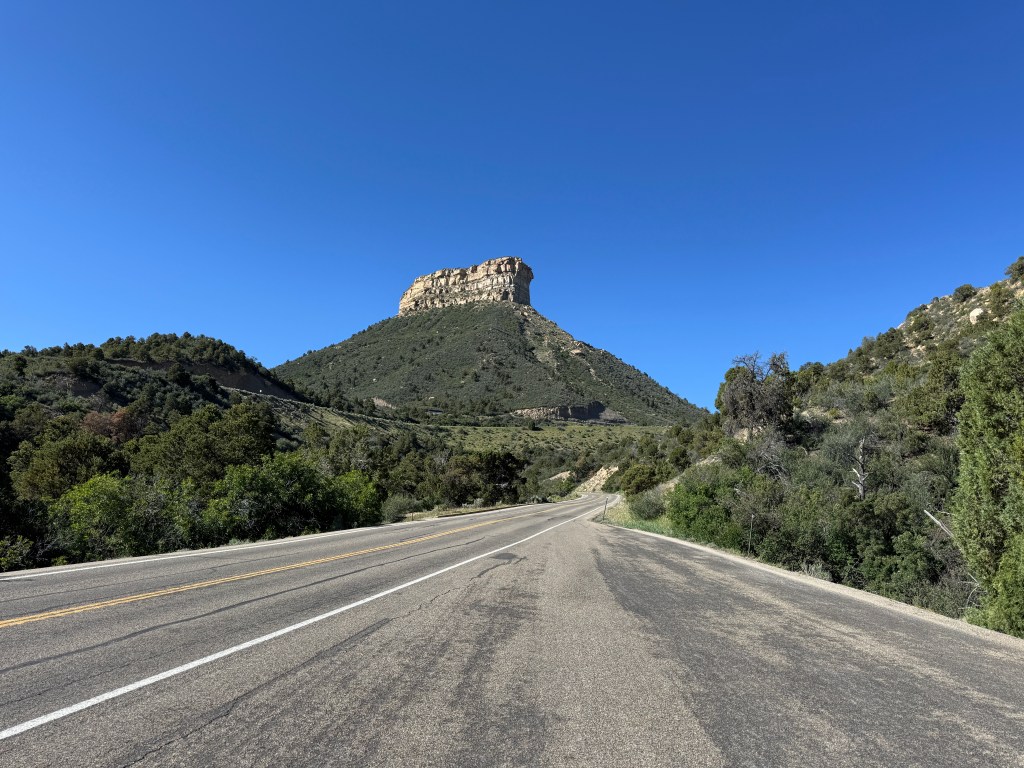
The Mesa at Mesa Verde National Park appears to be a green table, but it is a cuesta, a cliff with a flat ridge and a slope. (Melodie Miller | Photographer)
Reporting from Mesa Verde, Colorado
June 11, 2026 2:48 p.m. MDT, Updated June 23, 2926 4:24 p.m.
____________________________________________
Did you know…
The Mesa Verde in the national park, just 38 miles west of Durango, is not actually a mesa.
And, although the home of the Cliff Palace dwellings bears a Spanish name, they were built by the Ancestral Puebloan peoples.
“Many of the Pueblos were named by the Spanish,” Dr. Scott Ortman, of the University of Colorado Boulder, said. “It tends not to be very common for archaeological sites to be renamed to the indigenous language names.”
Attribution of Mesa Verde started with early speculation about the Aztecs and Aztlan. However, cultural consistency emerged between Cliff Palace and the modern Pueblos of the Four Corners, connecting the two places.
Dr. Steve Lekson, Professor of Anthropology at the University of Colorado, writes in A History of the Ancient Southwest that “Cliff Palace might be empty and abandoned, but only a few days’ walk away were Pueblo peoples who built towns that looked like Cliff Palace.”
In 1776, according to Legends of America, two Mexican-Spanish missionaries, Francisco Atanasio Dominguez and Silvestre Vélez de Escalante, were leading explorers from Spain through the region. They camped at the base of the La Plata Mountains, near the flat forested area of Mesa Verde. 83 years later, in 1859, Mesa Verde is attributed to John S. Newberry, although the name had been in use prior to his writing.
“The earliest permanent settlements here at Mesa Verde date back to between 500 and 600 CE and are often characterized by pit houses which can be seen on the mesa tops of both Chapin and Wetherill Mesas. The alcove sites (cliff dwellings) were mostly constructed beginning in the late 1100s to early 1200s CE,” Dalton Dorrell, Mesa Verde National Park Service Supervisory Park Ranger of Education, Community Outreach, and Interpretation, said.
The Spanish word mesa translates to table, a flat surface. But Mesa Verde is a cuesta, a steep cliff with a flat ridge on top and a sloping plain on the other side.
“Cuesta has been used as a geological term only since the early 19th century. It is not unusual for the geological term and the place name given to a location to differ,” Dorrell said.
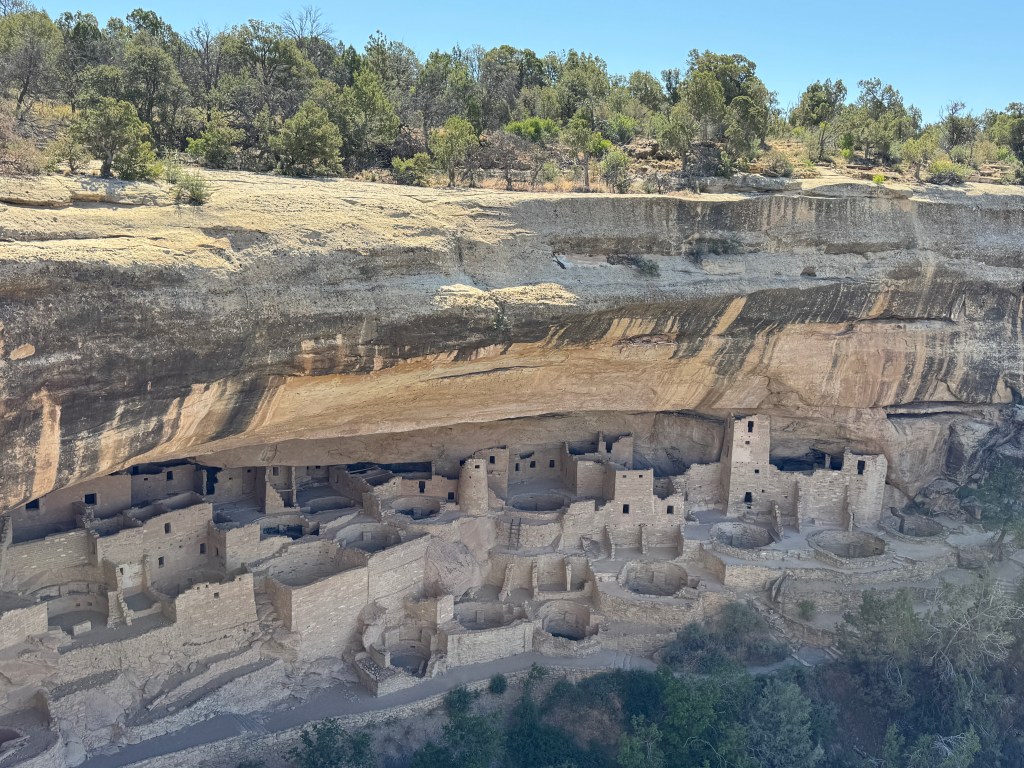
Cliff Palace, Mesa Verde National Park Ancestral Puebloan dwellings ( Melodie Miller | Photographer)
Then, in 1888, according to Lekson, Richard Wetherill and Charlie Mason came across the Cliff Palace.
“Cliff Palace is discovered by this cowboy who lived in Mancos named Richard Wetherill,” Lekson said.
On December 18, 1888, Wetherill, his brother-in-law Charles Mason, and their Ute guide Acowitz saw Cliff Palace and went on horseback to investigate.
Wetherill, Mason, and Acowitz, came across the cliff dwellings of the Ancestral Puebloans while “rounding up cattle in the snowstorm. And I guess there’s some questions to whose cattle was he rounding up,” Lekson said.
After the discovery, a significant movement emerged to preserve the 12th-century cliff dwellings and the artifacts found at Mesa Verde.
Wetherill “leaves the place seven ways to Sunday, and it’s just full of stuff. The Pueblos left pots and baskets and all kinds of stuff.” Lekson said. Wetherill “takes a bag full of this stuff up to and tries to sell it. I’ve seen the newspaper advertisements.”
According to the New Mexico Historical Review, Wetherill’s father, Benjamin Wetherill, “looked at the relics and realized the importance of the finds.”
Wetherill writes a letter to the Smithsonian requesting that it take over funding to protect the ruins and artifacts. Over time, interest in protecting the ruins grows.
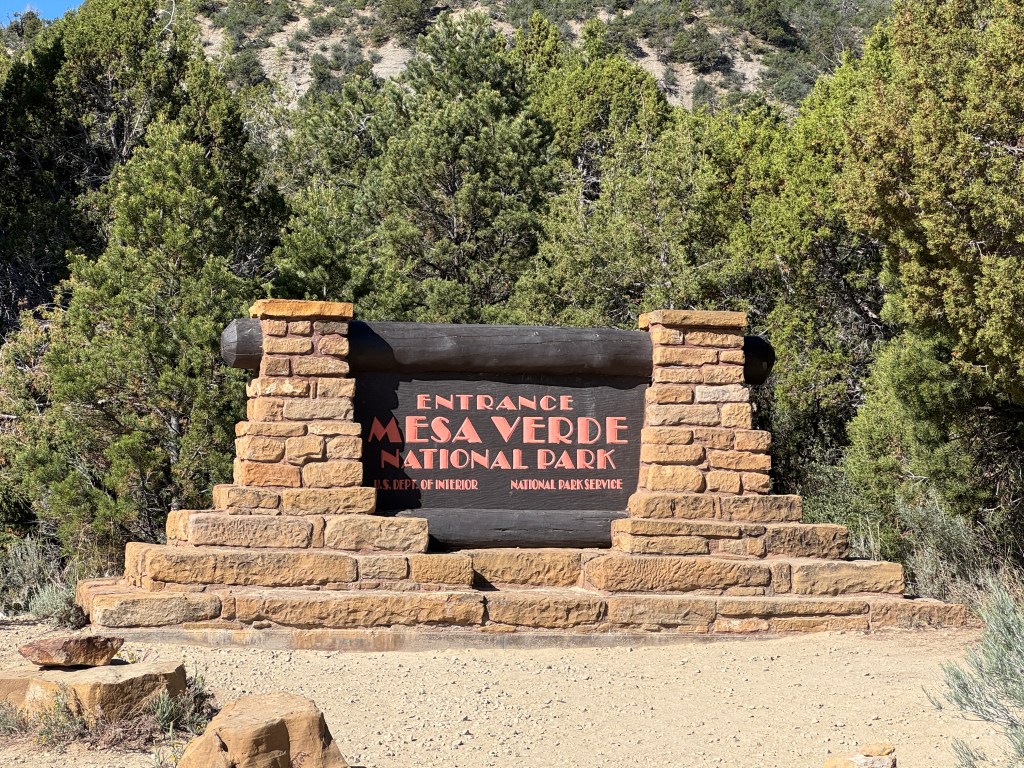
The Mesa Verde National Park sign is emblematic of the Art Deco style popular in 1906. ( Melodie Miller | Photographer)
In 1906, President Theodore Roosevelt signed the congressional bill to preserve the area’s ancient works, specifically 5,000 ancestral man-made sites and artifacts. Although Mesa Verde is a cuesta, the name remains, and the Ancestral Puebloans’ cliff dwellings are preserved.
Mesa Verde is located 35 miles west of Durango, at 35780 US-160, Mancos, CO 81328.
Melodie Dawn Miller
- melodie.miller@gmail.com
Melodie Dawn Miller is an apparel industry professional with expertise in design, development, and production. She holds bachelor’s degrees in English Literature and Classic Civilizations. She is currently studying French and Journalism at the University of Colorado.
 Melodie Dawn Miller