Luc Learns to Share

by Melodie Miller © 2024
Le titre de mon histoire est Luc Apprend à Partager. Cette histoire est une lecture pour débutante français. Je suis débutant dans l’apprentissage du français.
The title of my story is “Luc Learns to Share.” This story is beginning French reading. I am a beginner in learning French.
Luc est le personnage principal du histoire. Il a dix ans. Il est un souris grise et brun.
Luc is the main character of the story. He is 10 years old. He is a grey and brown mouse.

The image of Luc is generated by Microsoft Copilot (Melodie Miller / AI Prompt Engineer)
La région de mon histoire est la Suisse, dans la ville de Berne.
The region of my story is Switzerland, in the town of Berne.

The image of Luc’s village is generated by Microsoft Copilot (Melodie Miller / AI Prompt Engineer)
La famille de Luc est très grande.
The family of Luc is very big.

The image of Luc’s family is generated by Microsoft Copilot (Melodie Miller / AI Prompt Engineer)
Le père de Luc est professeur. Le père de Luc lui a appris à partager.
The father of Luc is a professor. The father of Luc taught him to share.

The image of Luc’s father is generated by Microsoft Copilot (Melodie Miller / AI Prompt Engineer)
La mère de Luc est professeur. La mère de Luc lui a appris à partager..
The mother of Luc is a professor. The mother of Luc taught him to share.

The image of Luc’s mother is generated by Microsoft Copilot (Melodie Miller / AI Prompt Engineer)
Et son village aime partager avec tout le monde.
And his village likes to share with everyone.
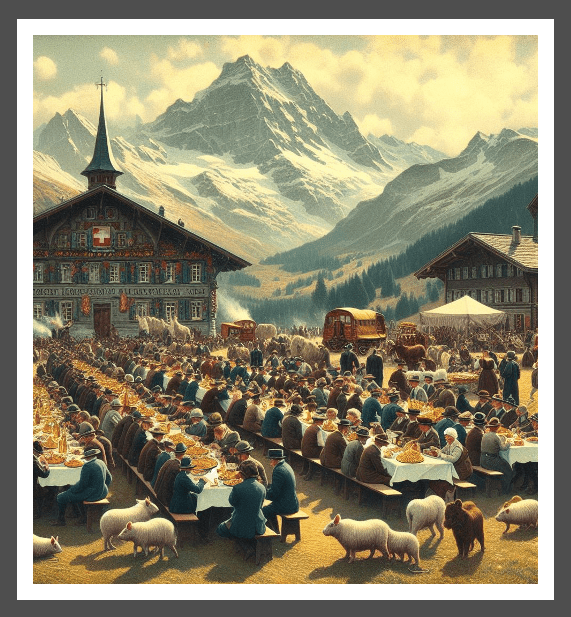
The image of Luc’s village is generated by Microsoft Copilot (Melodie Miller / AI Prompt Engineer)
Mais, Luc n’aimait pas partager. Alors, Luc est allé dans la grande ville.
But, Luc did not like to share. So, Luc went to the big city.

The image of Luc in the big city is generated by Microsoft Copilot (Melodie Miller / AI Prompt Engineer)
Sa famille était triste.
His family was sad.
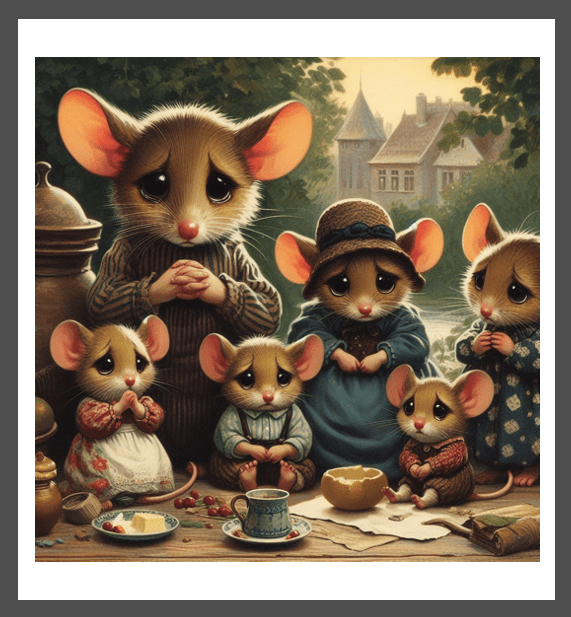
The image of Luc’s family is generated by Microsoft Copilot (Melodie Miller / AI Prompt Engineer)
Mais, Luc est heureux. Il rêve de ne pas partager sa nourriture.
But, Luc is happy. He dreams of not sharing his food.

The image of Luc is generated by Microsoft Copilot (Melodie Miller / AI Prompt Engineer)
Il rêve de manger tout le fromage seul.
He dreams of eating all the cheese alone.
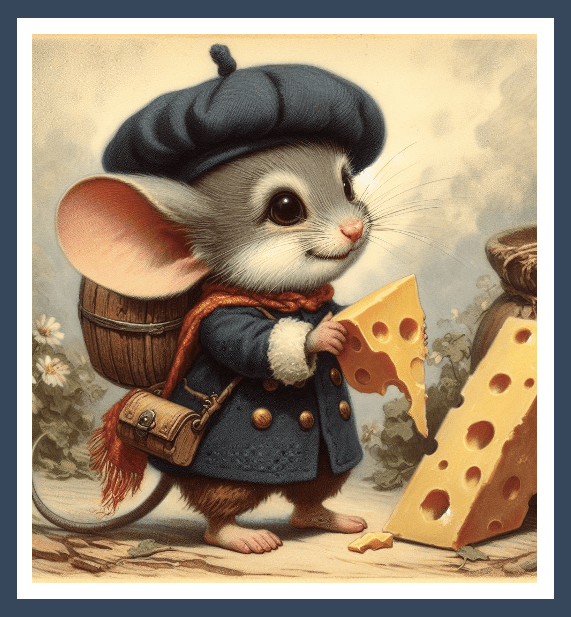
The image of Luc is generated by Microsoft Copilot (Melodie Miller / AI Prompt Engineer)
Il pense qu’il y a beaucoup de nourriture dans la grande ville.
He thinks that there is a lot of food in the big city.

The image of Luc’s imagination of food in the big city is generated by Microsoft Copilot (Melodie Miller / AI Prompt Engineer)
Mais, quand Luc est allé au magasin pour trouver de la nourriture, un homme l’a chassé. L’homme n’aimait pas avec Luc.
But, when Luc goes to the store to find food, the man chases him. The man did not like to share with Luc.
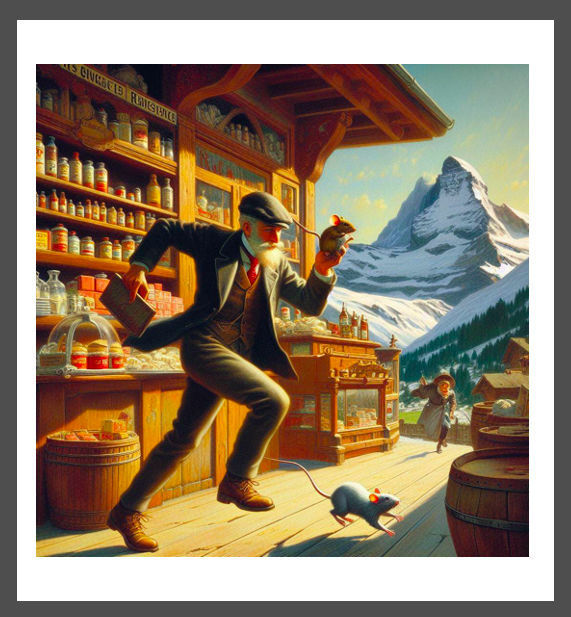
The image of Luc and the store keeper is generated by Microsoft Copilot (Melodie Miller / AI Prompt Engineer)
L’homme dit “Pas de souris autorisée.”
The man says “No mice allowed.”

The image of Luck and the “No Micse Alowed” is generated by Microsoft Copilot (Melodie Miller / AI Prompt Engineer)
Luc a appris qu’il doit partager pour avoir des amis.
Luc learns that he must share to have friends.

The image of a sad Luc is generated by Microsoft Copilot (Melodie Miller / AI Prompt Engineer)
Luc a appris à aimer partager parce que qu’il adore ses amis.
Luc learns that he likes to share because he loves his friends.

The image of Luc is generated by Microsoft Copilot (Melodie Miller / AI Prompt Engineer)
-
Annecy, France, the Venice of the Alps, has a rich and complex history
Annecy, pronounced ahn-SEE by the French, lies on the northern tip of Lake Annecy, 35 kilometers (22 mi) south of Geneva, Switzerland.
Once, under the House of Savoy, Annecy was in the County of Genevois and belonged to the Dukes of Savoy, a branch of the Genevois-Nemours family who ruled from 1514 to 1659.
For centuries, Annecy sat at the crossroads of competing powers, religions and borders, changing hands many times, settling only in 1860 as part of France.
Old Town Annecy, with canals, the Palais de l’Isle, and the Château d’Annecy, retains the House of Savoy’s ambiance.
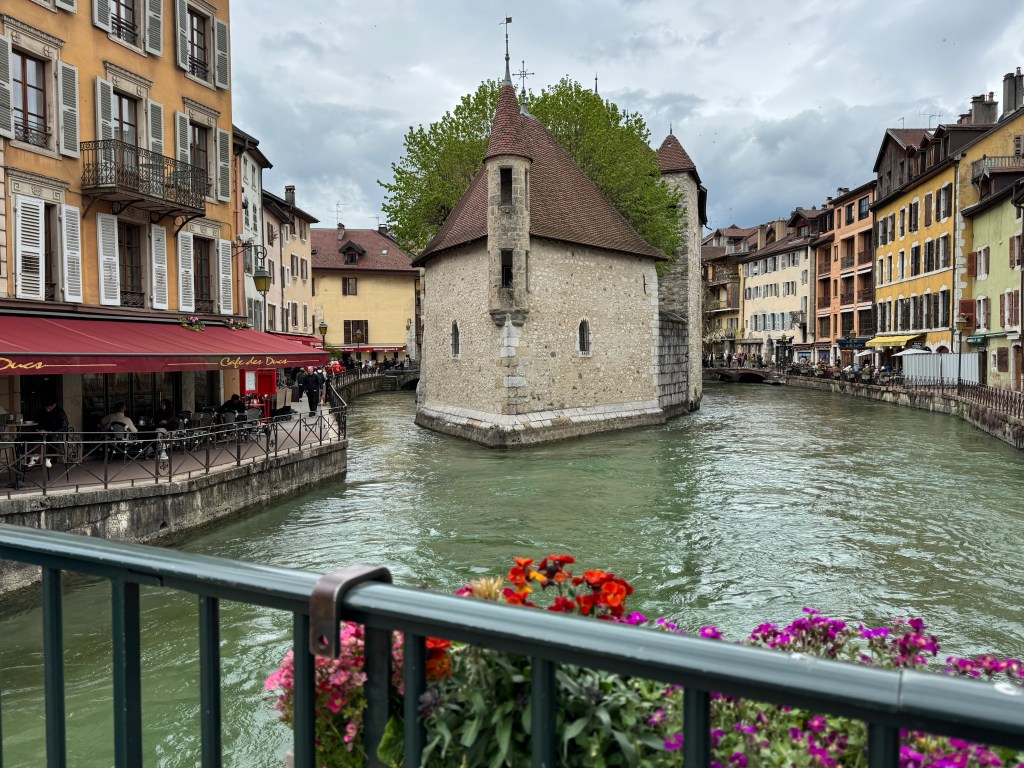
Palais de l’Isle in the Old Town of Annecy, France (Photograph by Melodie Miller)
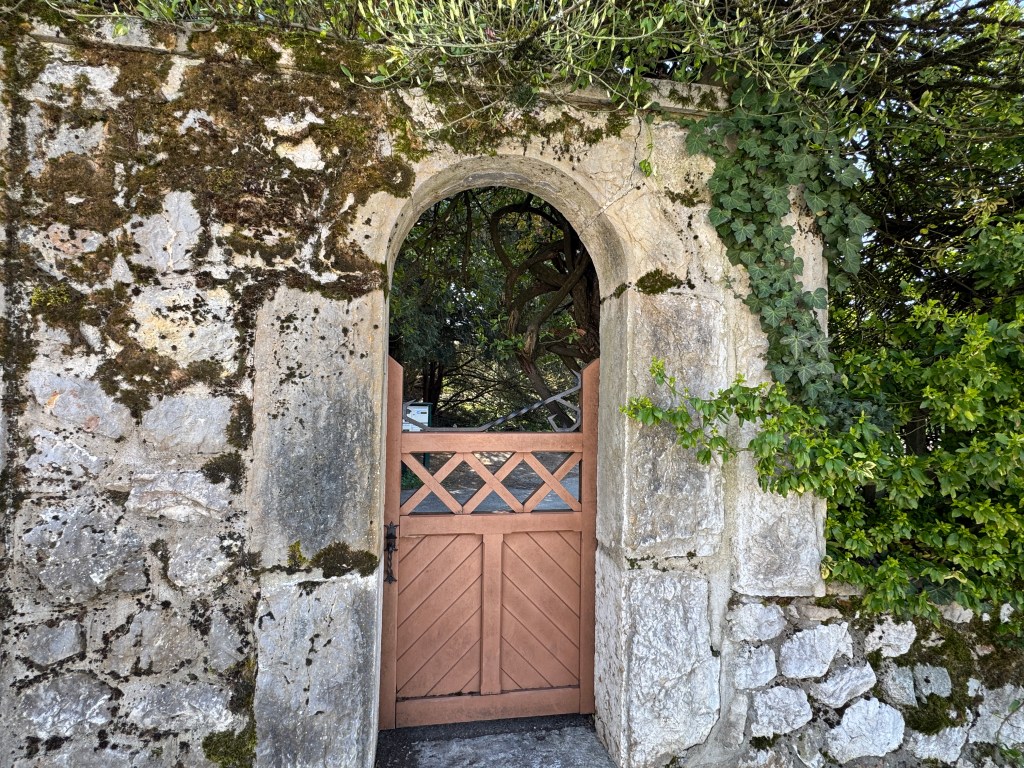
In Annecy, France, a charming small wooden gate with a classical Roman arch is the entrance to a hidden French garden. (Photograph by Melodie Miller)
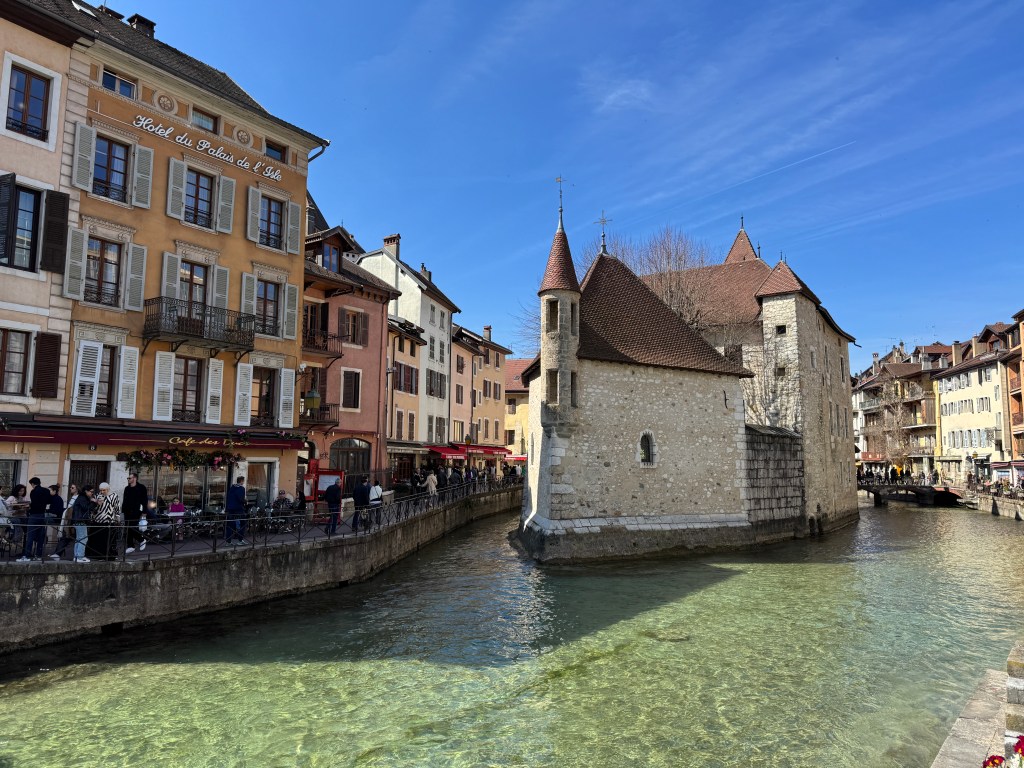
The Palais de l’Isle, a 12th-century, medieval fortified stronghold prison in 1325 and the mint of the Counts of Geneva, is now a museum in the Thiou River in Annecy, France. (Photograph by Melodie Miller)
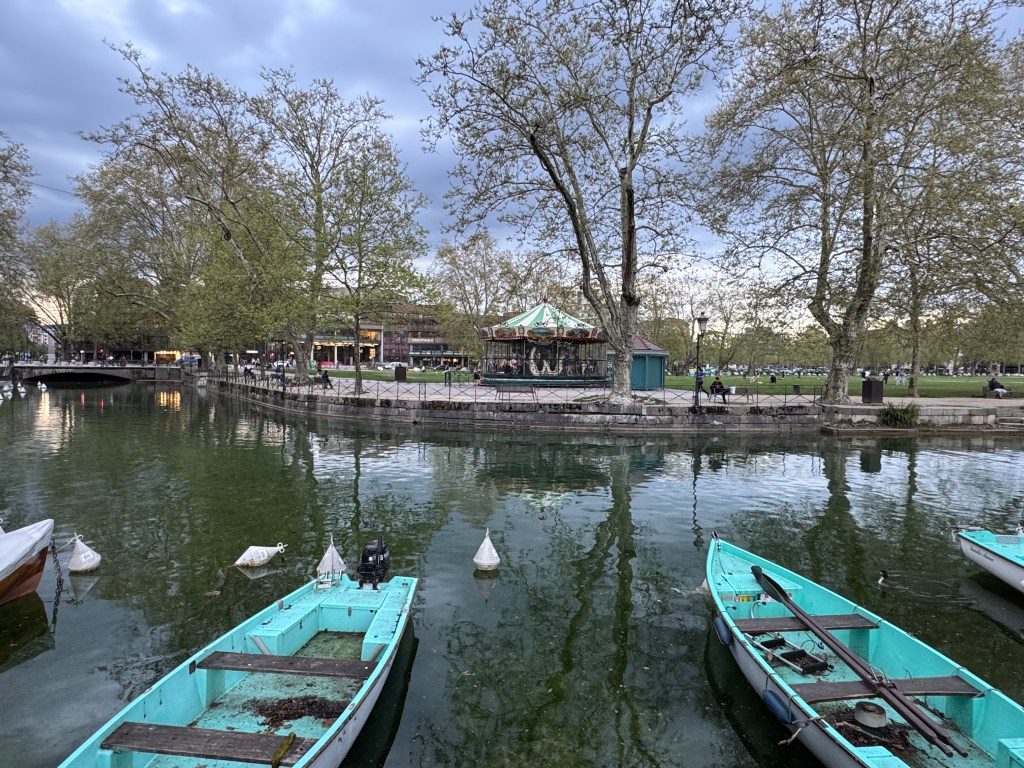
Canal du Vassé, a calm waterway that links to Lake Annecy. The Jardins de l’Europe and Ponts des Amours are visible in the background. (Photograph by Melodie Miller)
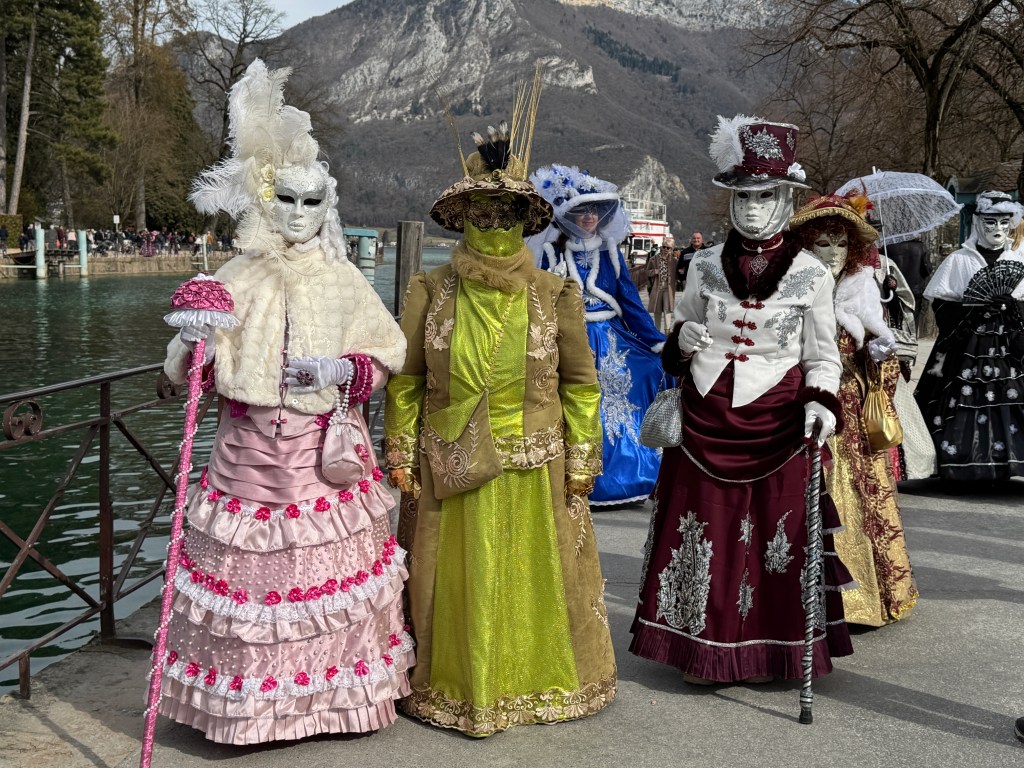
Actors at the Carnaval Vénitien d’Annecy wear ornate Venetian masks and costumes, standing in front of Lake Annecy. (Photograph by Melodie Miller)
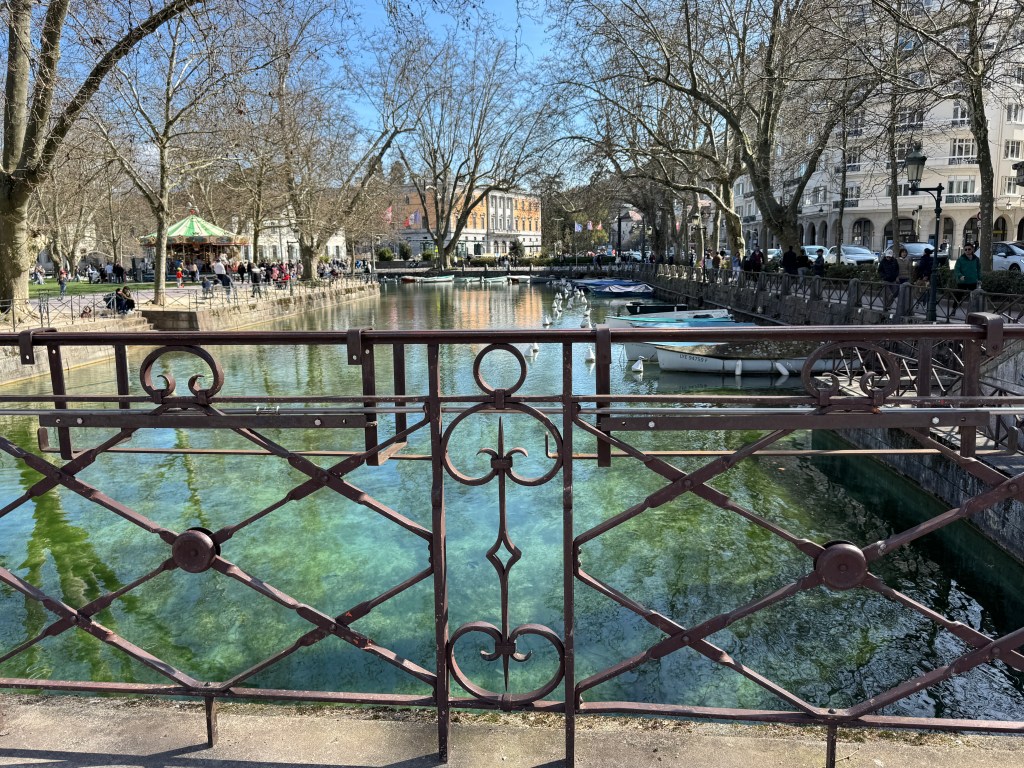
Pont Albert Lebrun, Annecy, France (Photograph by Melodie Miller)
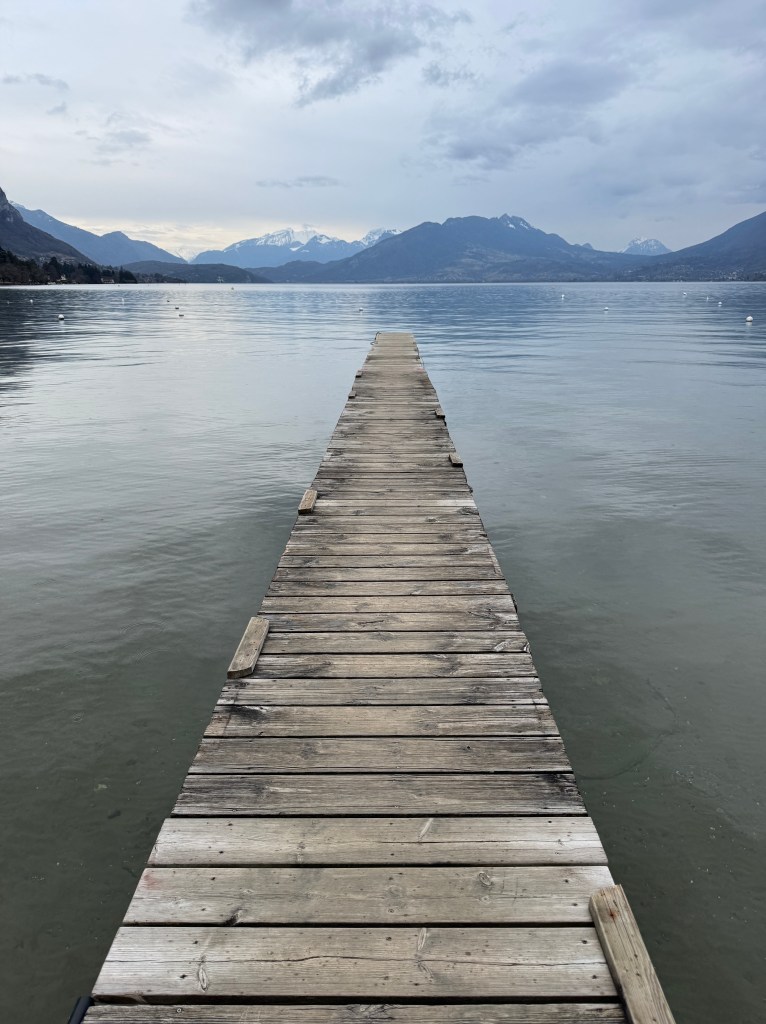
Lake Annecy in Haute-Savoie, France, looking south toward the peaks of the Bornes Massif. (Photograph by Melodie Miller)
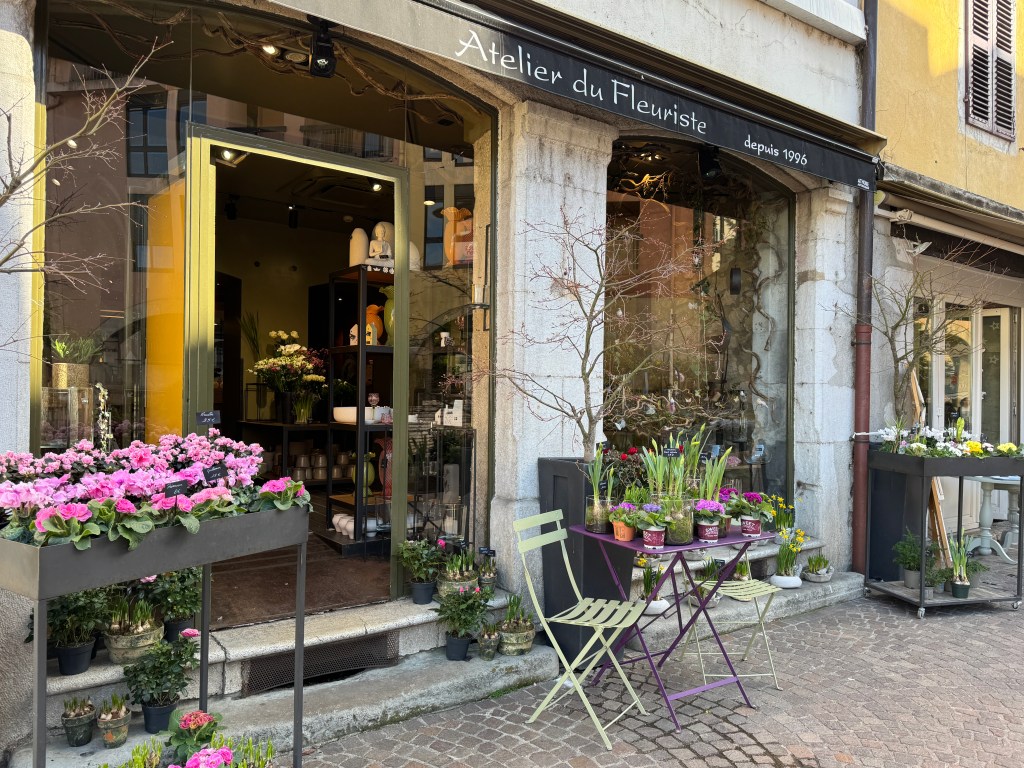
L’Atelier du Fleuriste, Annecy, France (Photograph by Melodie Miller)

Annecy, France, at the Sunday farmer’s market. (Photograph by Melodie Miller)
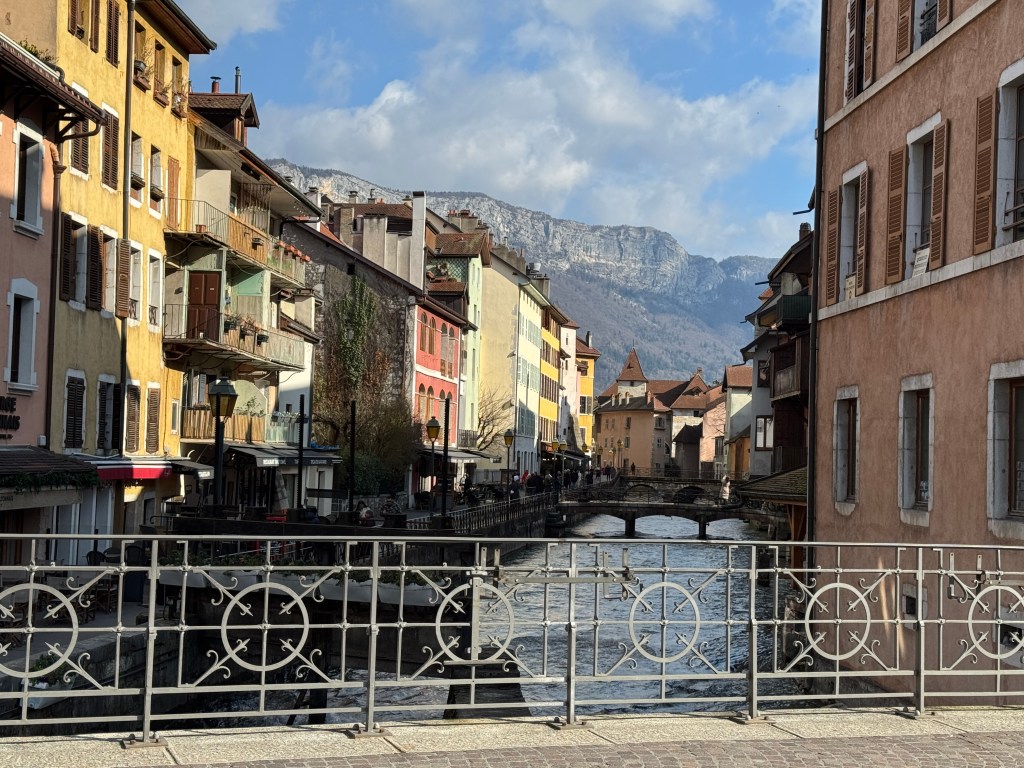
Historical Old Town of Annecy, France. (Photograph by Melodie Miller)

Orange Taxacco at the Annecy, France, farmer’s market.(Photograph by Melodie Miller)
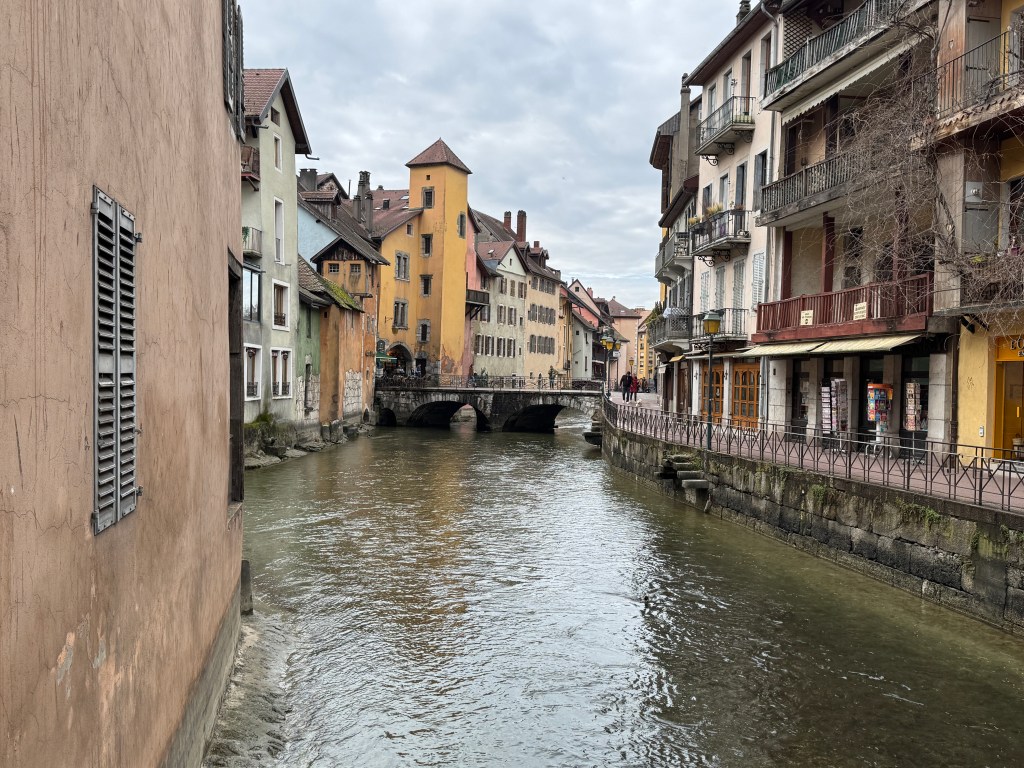
Thiou River and canal area in the historical Old Town of Annecy, France. (Melodie Miller)

In Annecy, France, the farmers’ market is full of delectable eats. (Photograph by Melodie Miller)
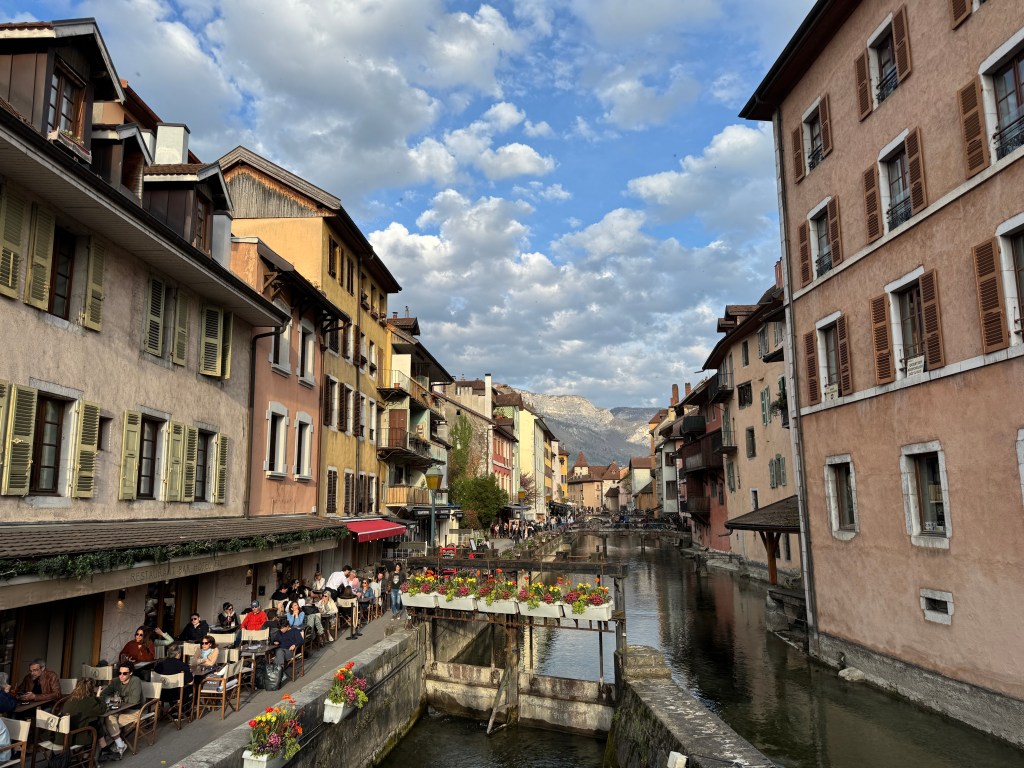
Annecy’s Old Town, France, is lined with gastronomic delights. (Photograph by Melodie Miller)
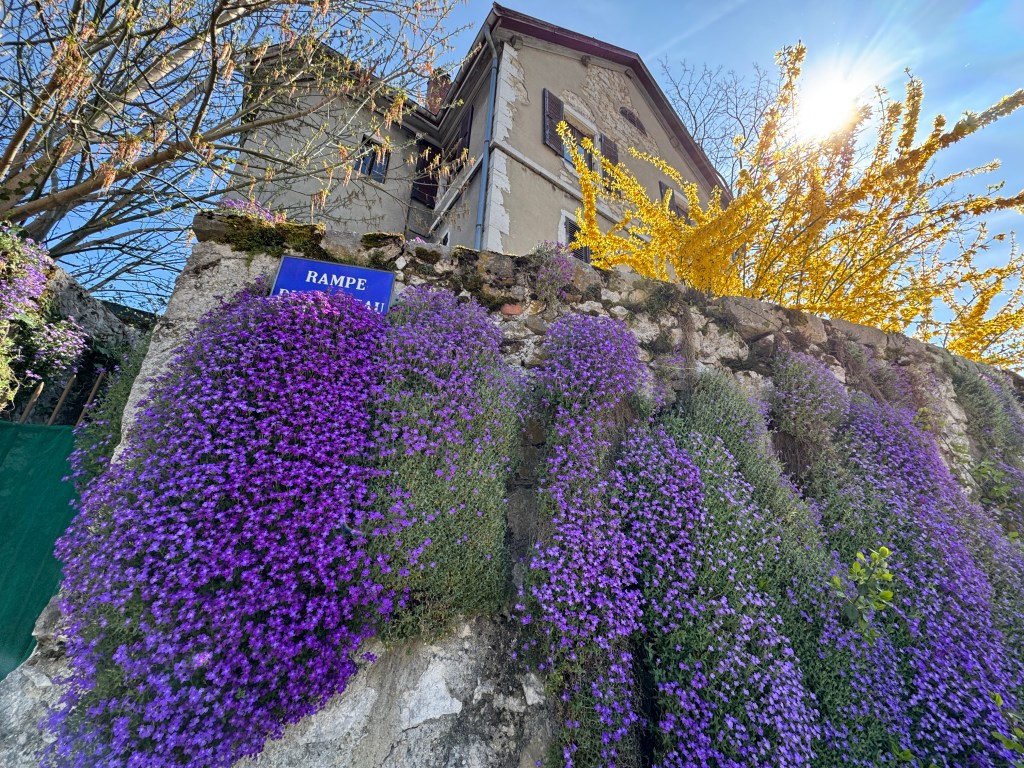
Purple rock cress cascades from the stone wall below the Château d’Annecy. (Photograph by Melodie Miller)
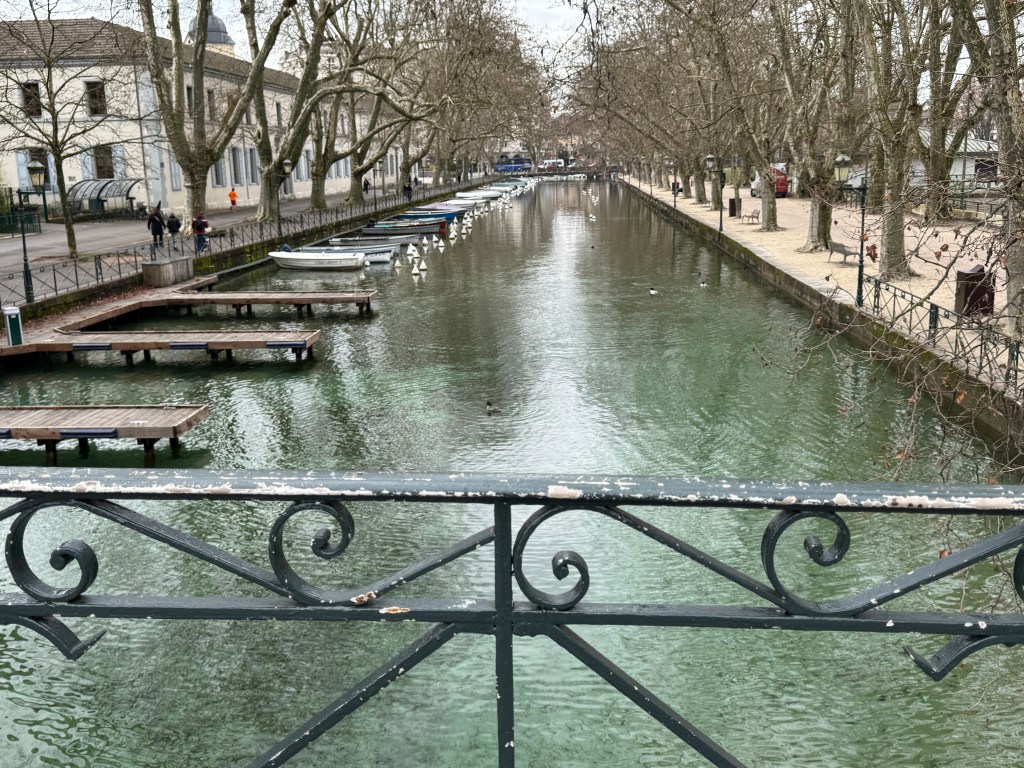
The tree-lined waterway of the Canal de Vasse looking down toward the Pont des Amours in Annecy, France. (Photograph by Melodie Miller)
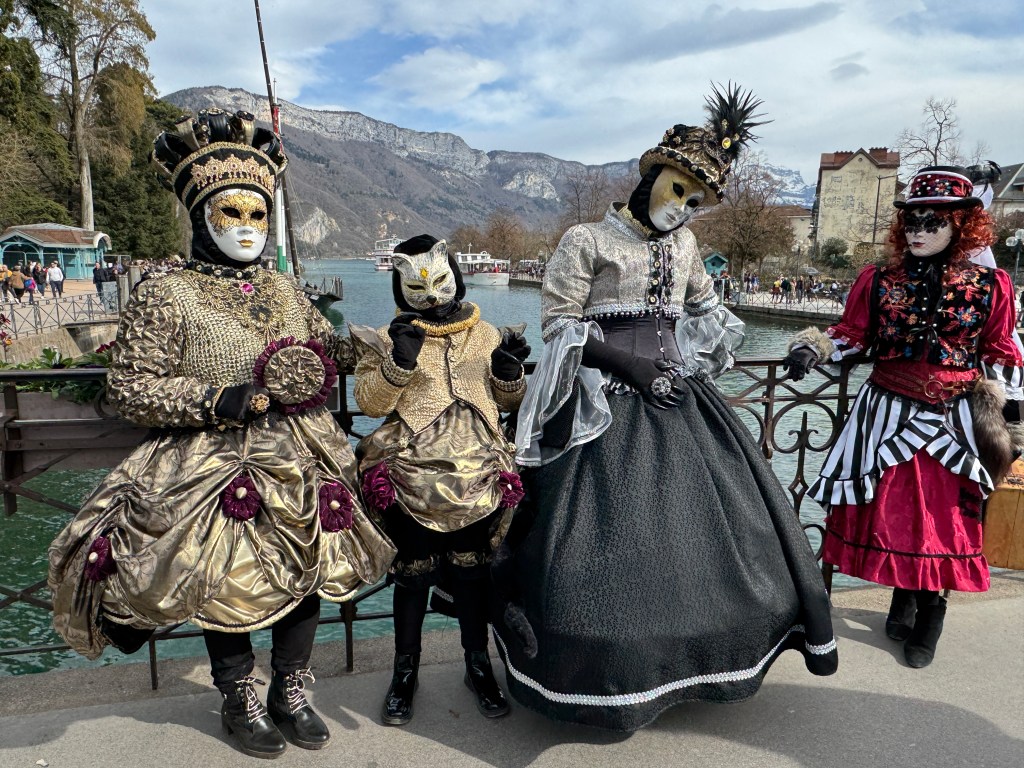
Actors at the Carnaval Vénitien d’Annecy wear ornate Venetian masks and costumes, standing in front of Lake Annecy. (Photograph by Melodie Miller)
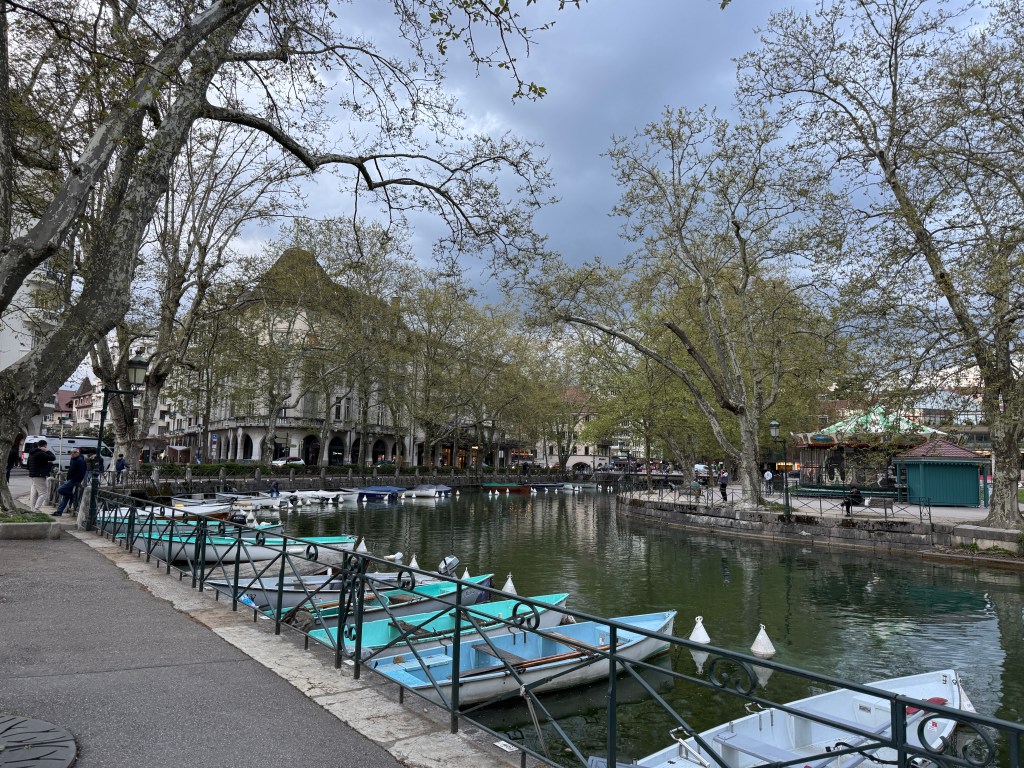
Canal du Vassé, a calm waterway that links to Lake Annecy. The Jardins de l’Europe and Ponts des Amours are visible in the background. (Photograph by Melodie Miller)
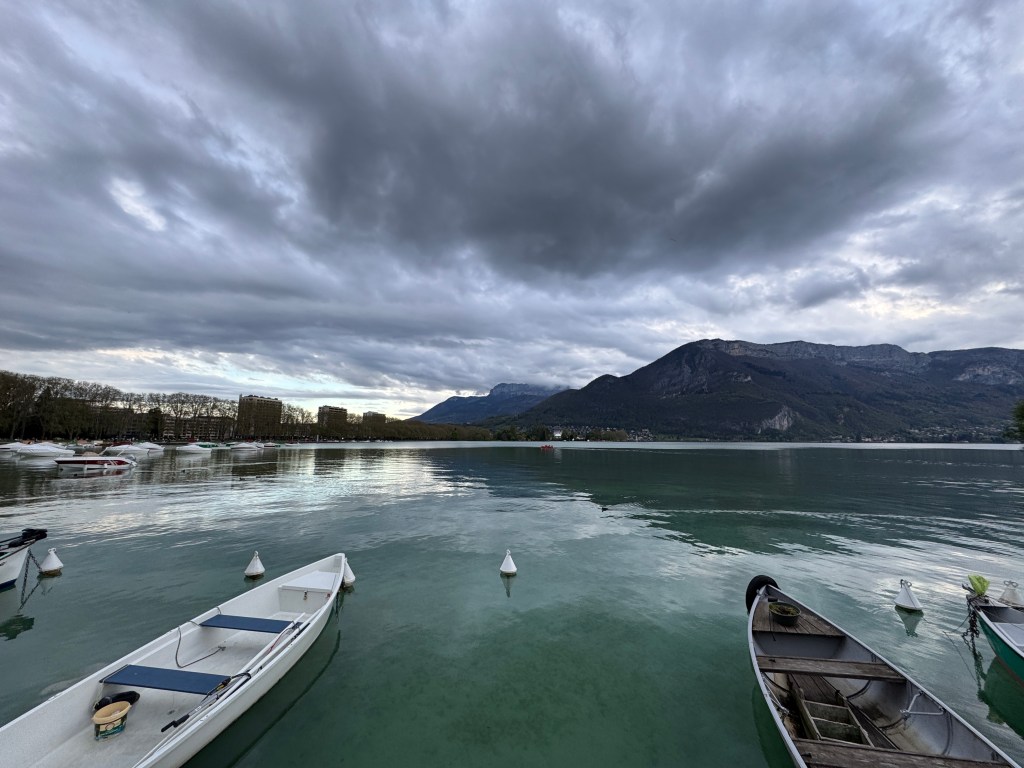
Lake Annecy looking to the south. (Photograph by Melodie Miller)
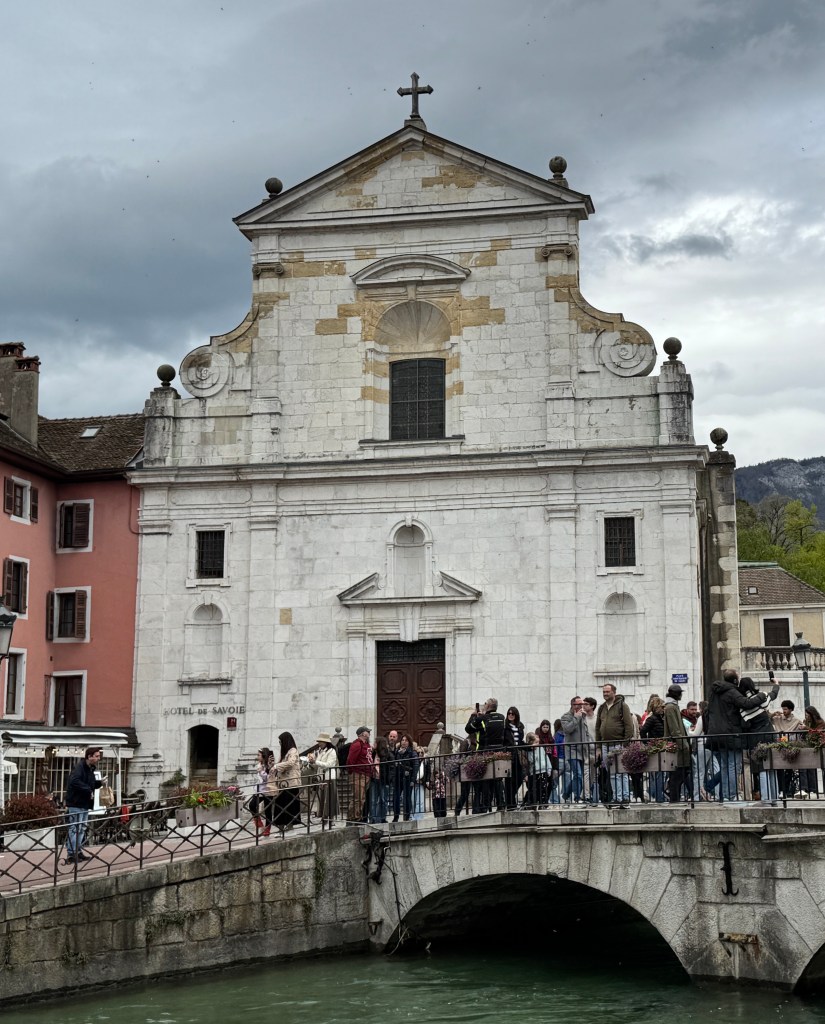
Just 43 km (25 miles) from Annecy, Geneva became a strong hold of the Protestant movement. Rejecting the movement’s austerity, Saint François de Sales, a Roman Baroque-inspired Catholic church on the Thiou canal in Old Town Annecy, France, was built in 1642.
Saint François de Sales exemplifies Counter-Reformation architecture that followed the Council of Trent (1545 to 1563), a response to the growth of Protestantism. Reformation called for more visible, emotionally engaging worship and sermons with a focus on clear sightlines to the altar. The hope was to bring people back to the Catholic church. (Photograph by Melodie Miller)

Annecy, France, farmers market on a Sunday morning. (Melodie Miller)
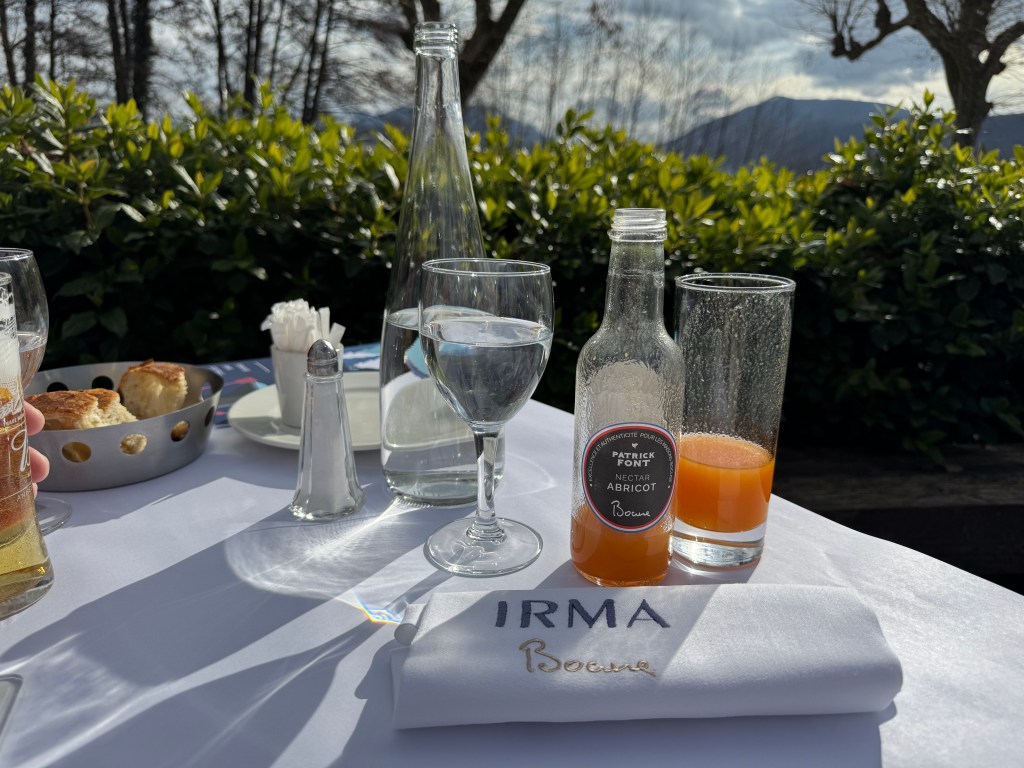
Enjoying a glass of Patrick Font Apricot Nectar at the L’Impérial Palace, on Lake Annecy, France. (Melodie Miller)
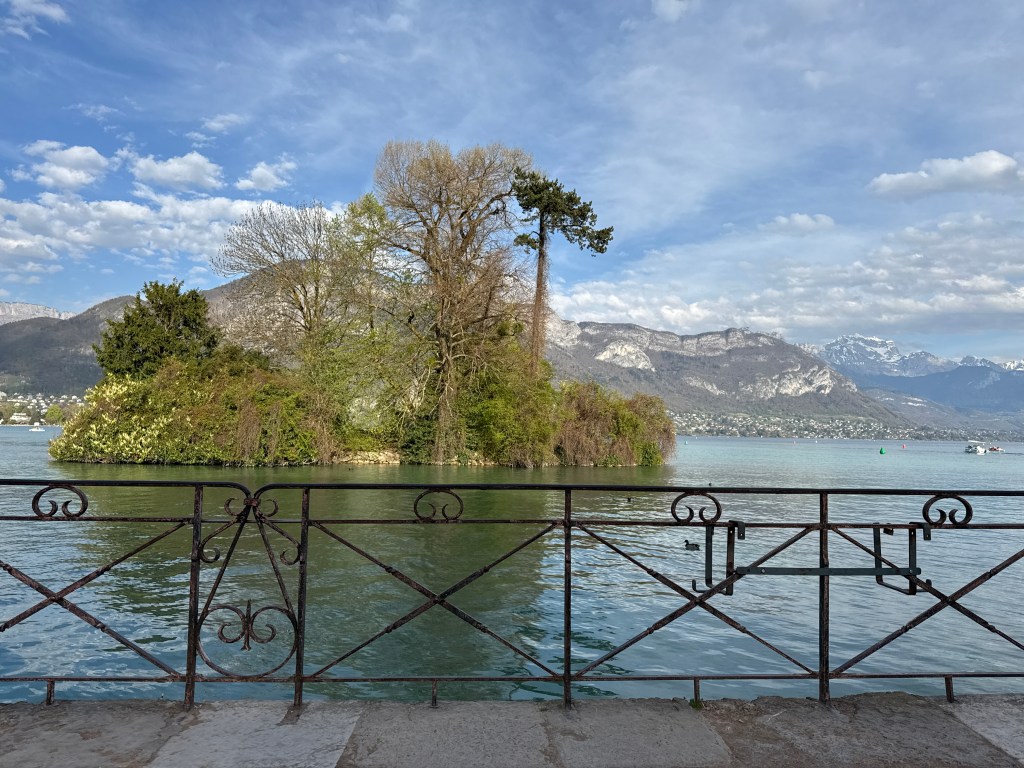
Île des Cygne (Swan Island), Annecy, France (Melodie Miller)
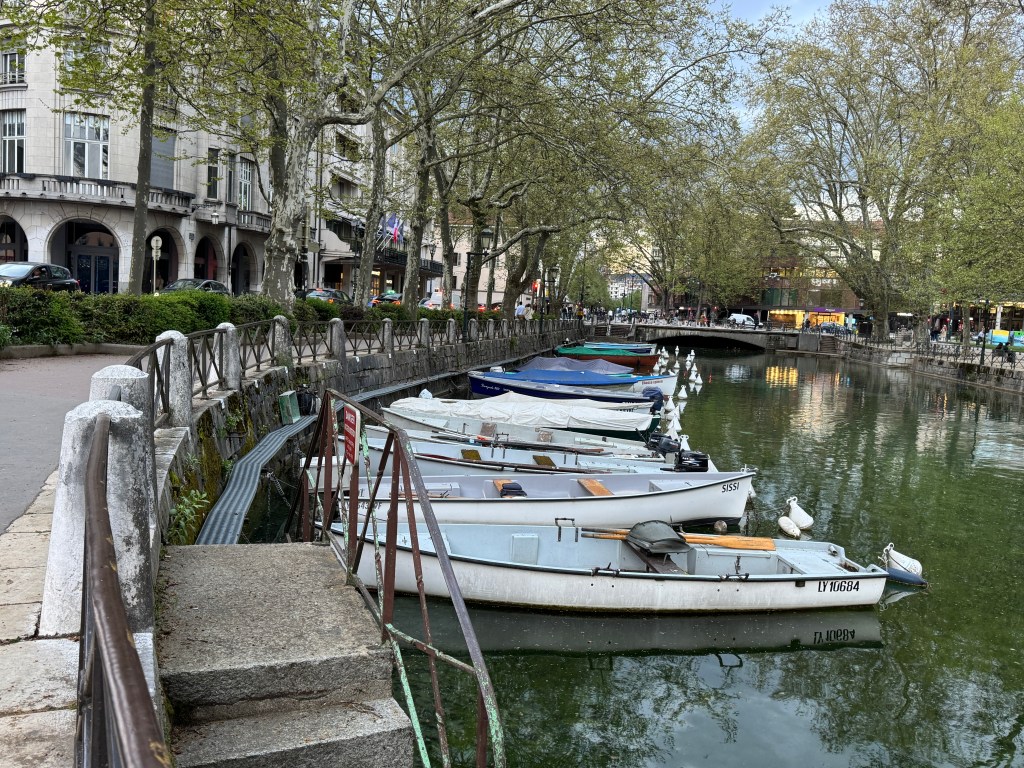
Lake Annecy boat canal, Annecy, France (Melodie Miller)
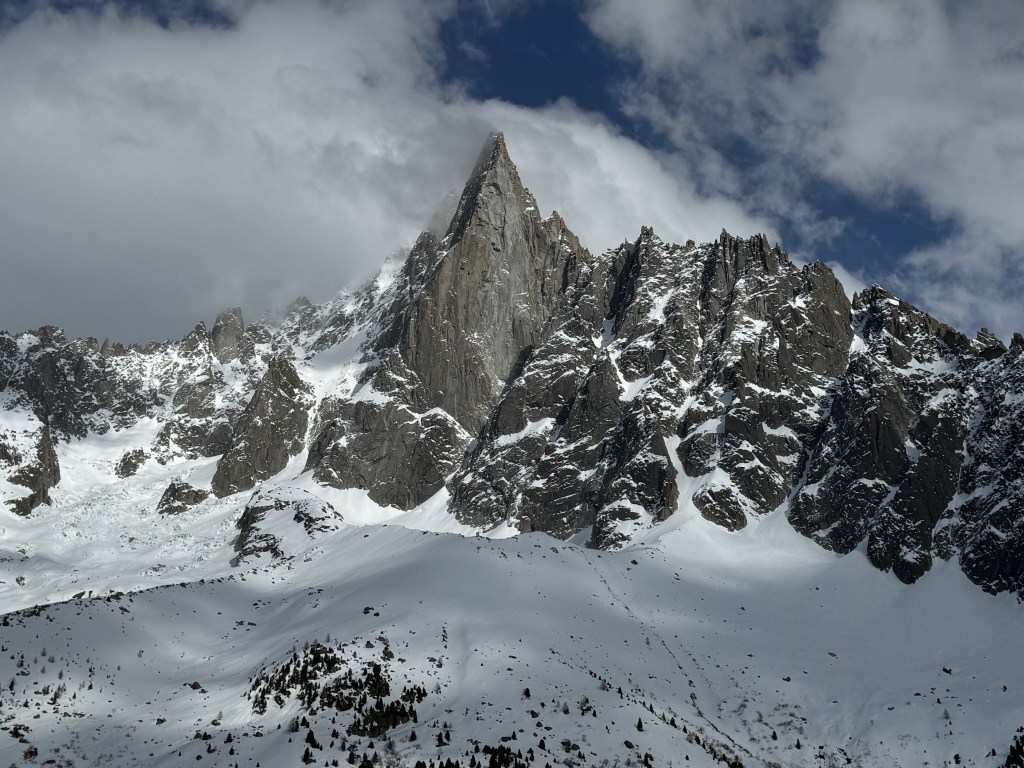
The mountain Aiguille du Dru in the Mont Blanc massif of the French Alps. (Melodie Miller)

Annecy, France, farmers’ market heirloom tomatoes. (Melodie Miller)

La Tavern de Pontverre, Lovagny, France (Melodie Miller)
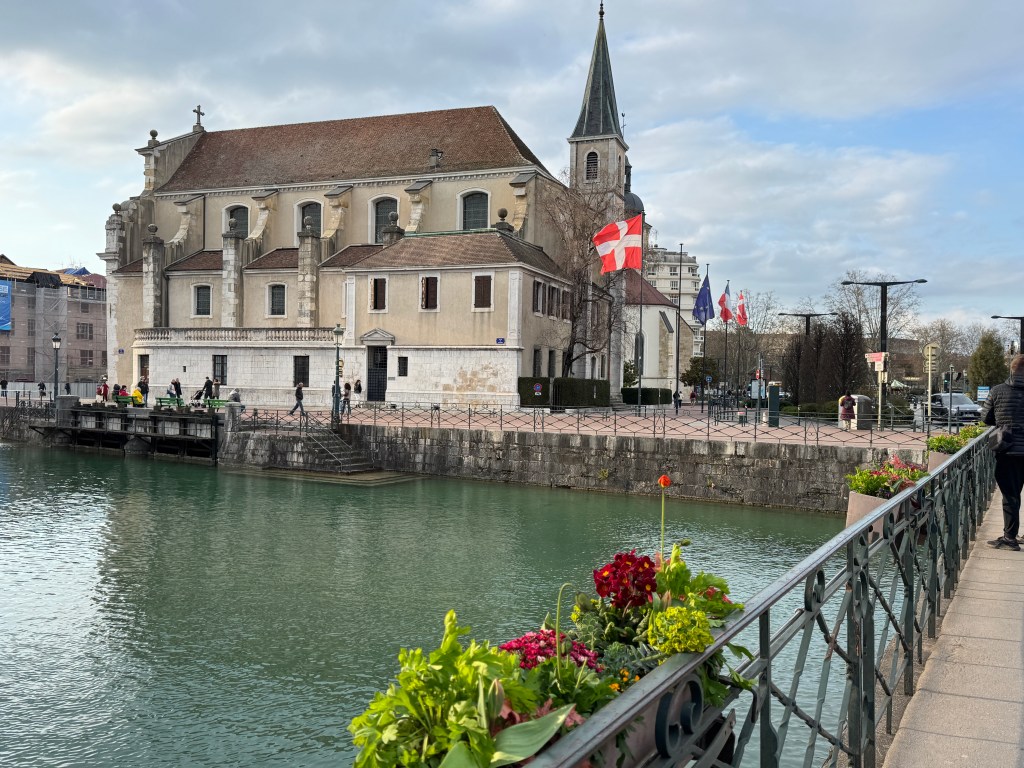
Église Saint-François de Sales, a Baroque-style Catholic church dating to 1642 in Annecy, France. (Melodie Miller)
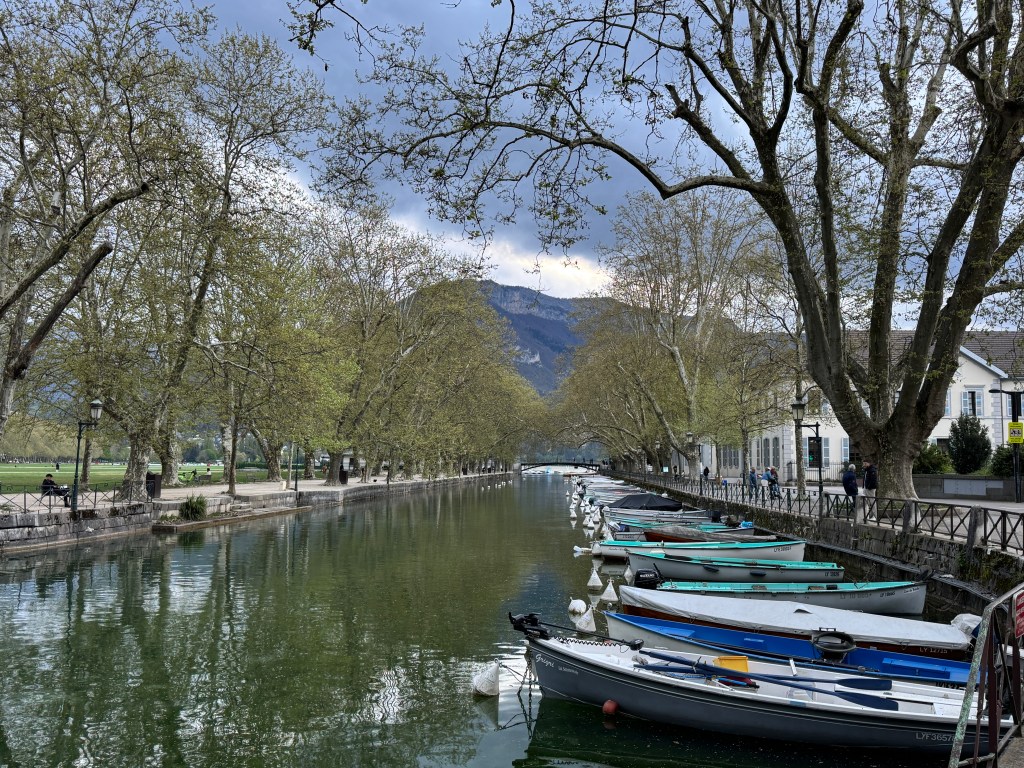
Lake Annecy boat canal, Annecy, France (Melodie Miller)
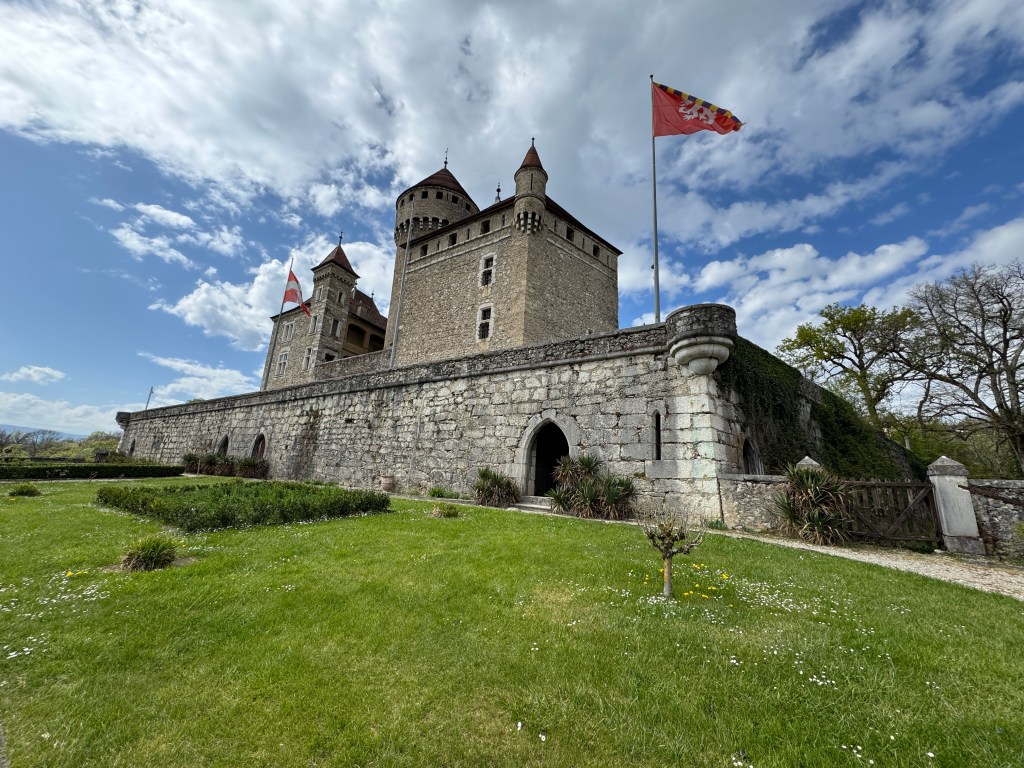
Château de Montrottier, Annecy France, (Melodie Miller)
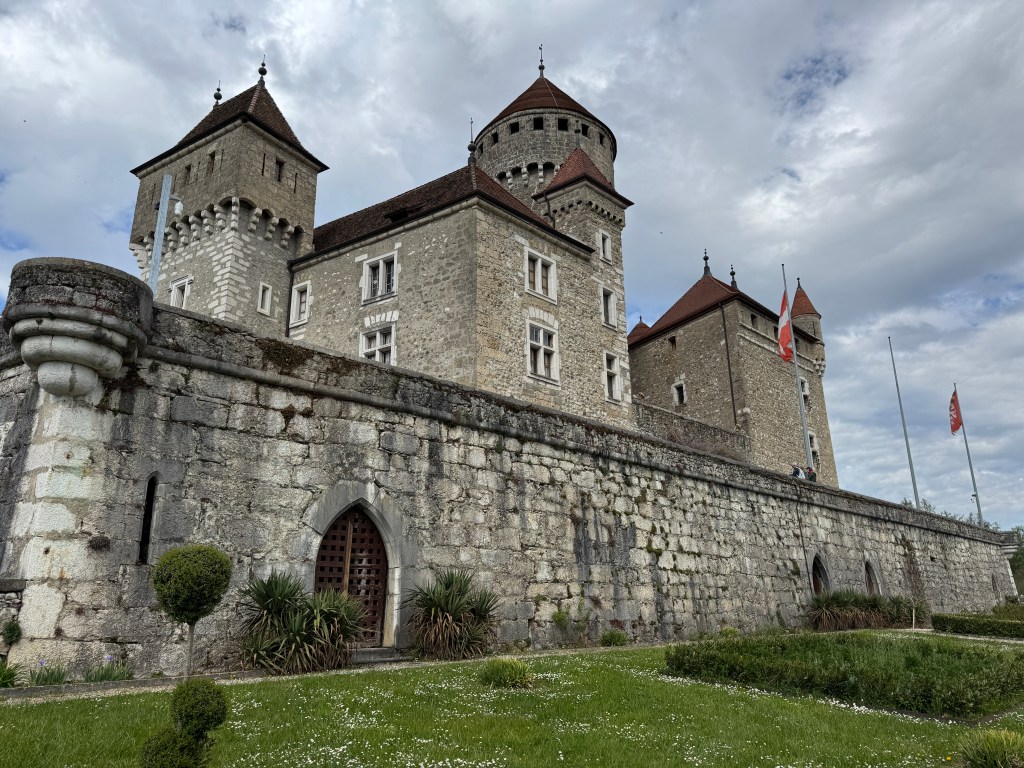
Château de Montrottier, Annecy, France (Melodie Miller)
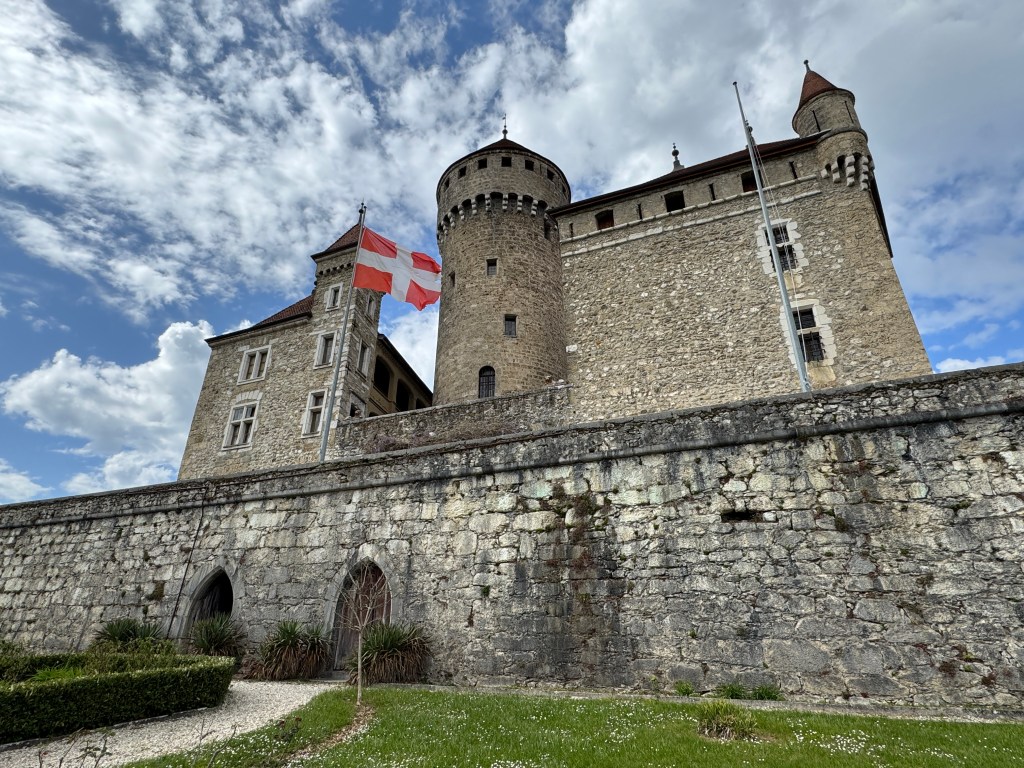
Château de Montrottier, Annecy, France (Melodie Miller)
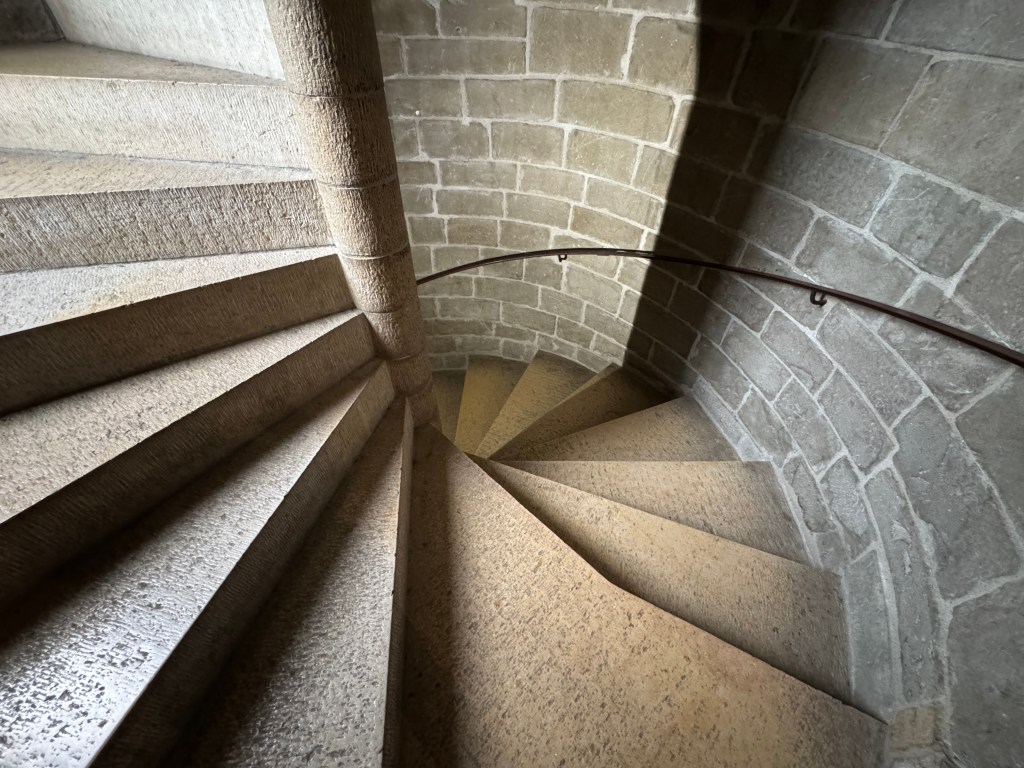
Château d’Annecy, Annecy, France (Melodie Miller)
-
“Let the Right One In”
C.U. Presents closed its modern vampire love story to a packed house at the University of Colorado Loft Theatre in Boulder.
Director Heather Kelley’s adaptation of Jack Thorne’s play “Let the Right One In” closed to a sold-out audience on Sunday, Oct. 20, at the University of Colorado Loft Theatre.
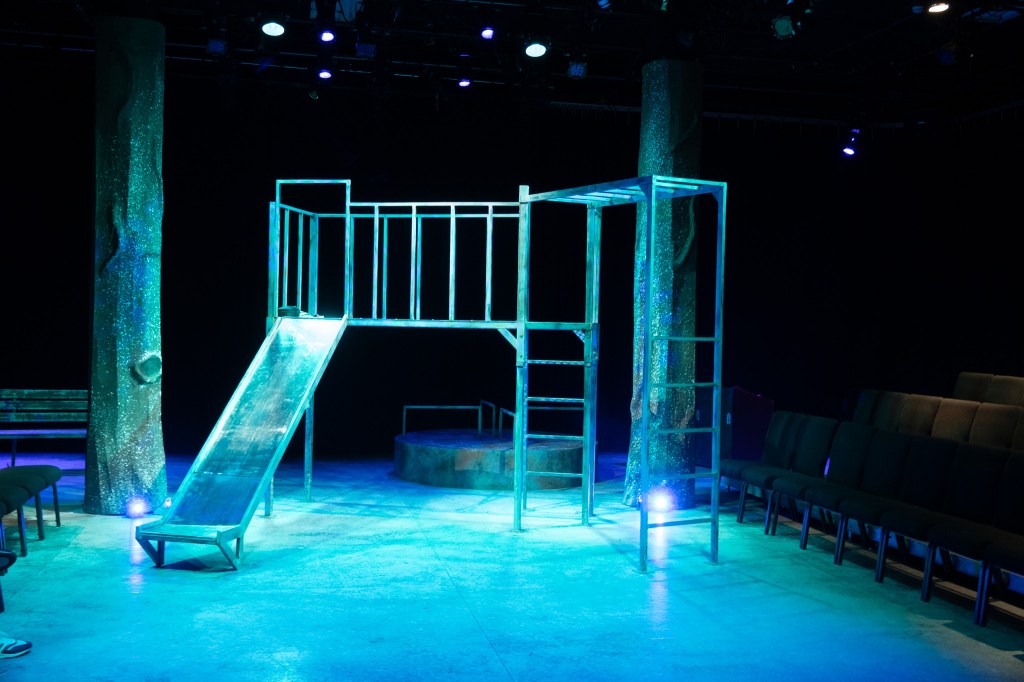
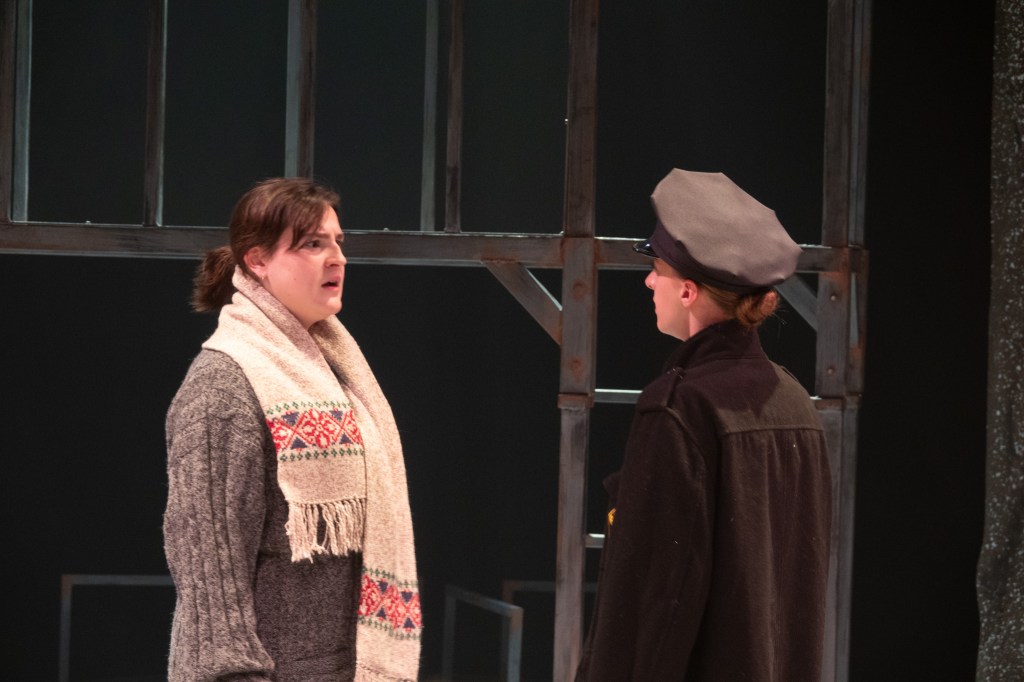
“Let the Right One In” playground scenic design by Hyley Delich, illuminated with blue light. (Melodie Miller | Photographer)
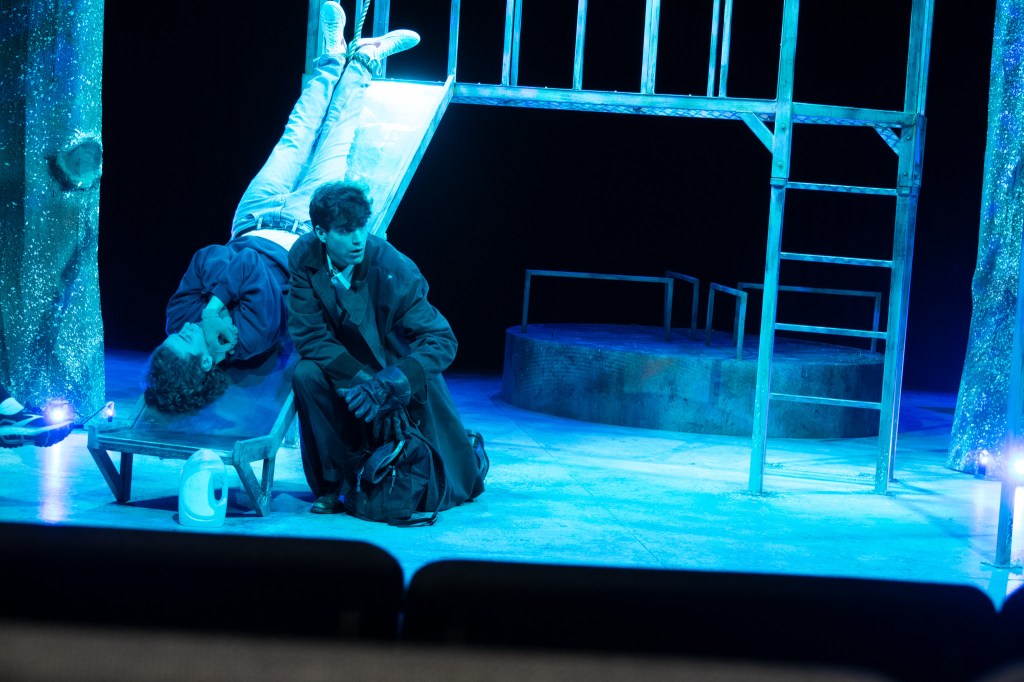
Roan Cochrane as Hakan (Right) drains the blood from his victim played by Ian McCance (Left). (Melodie Miller | Photographer)
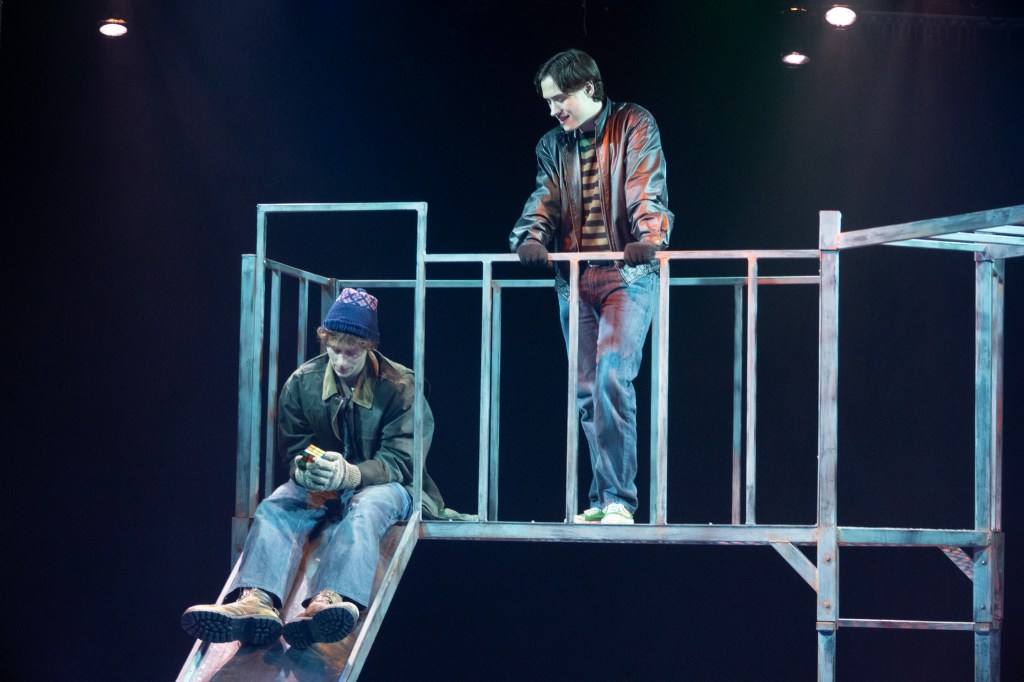
Bully Jonny, played by Ian Von Pechmann, talks with Oskar, played by Salem Channell. (Melodie Miller | Photographer)

“Let the Right One In” playground setting designed by Hayley Delich is illuminated with pink light. (Melodie Miller | Photographer)
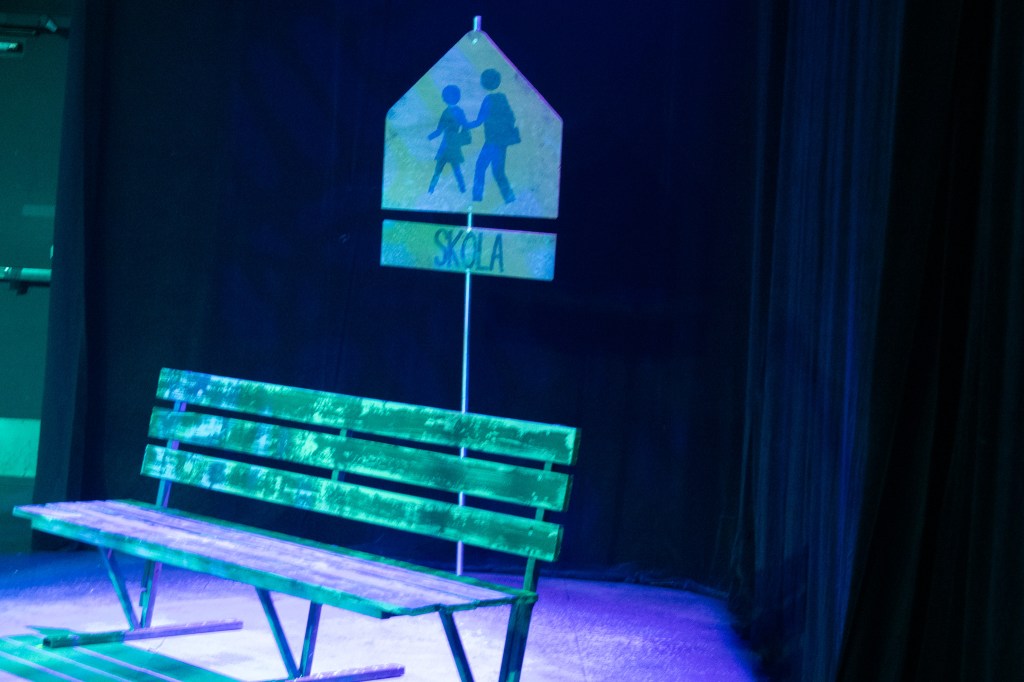
The menacing playground of “Let the Right One In” stands empty.(Melodie Miller | Photographer)
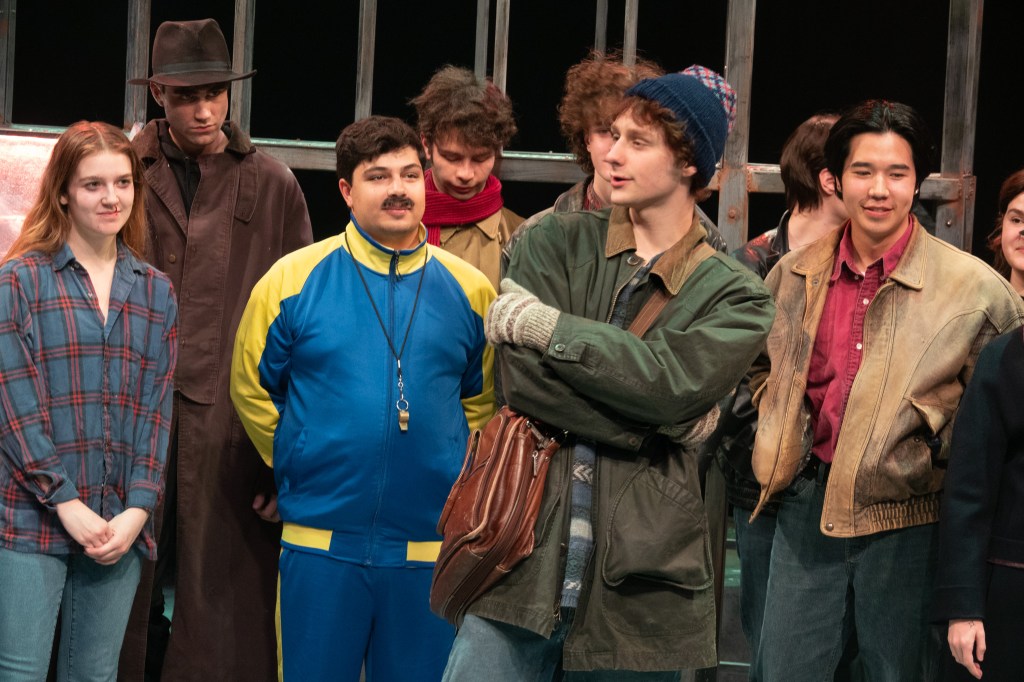
Salem Channell as Oscar (center front); Middle row: Wyleigh Watson as Eli, Charlie Hough as Mr. Avila, Sam Stitt as Jimmy, Pechmann as Jonny. Back row: Roan Cochrane as Hakan, Ian McCance as Dad, Cade Heaton as Micke, Savannah Gullett (far right, back) as Mum. (Melodie Miller | Photographer)
-
2026 Denver Film Festival honors John Leguizamo
John Leguizamo’s career reflects the independent spirit the award celebrates.
by Melodie Miller | November 11, 2026
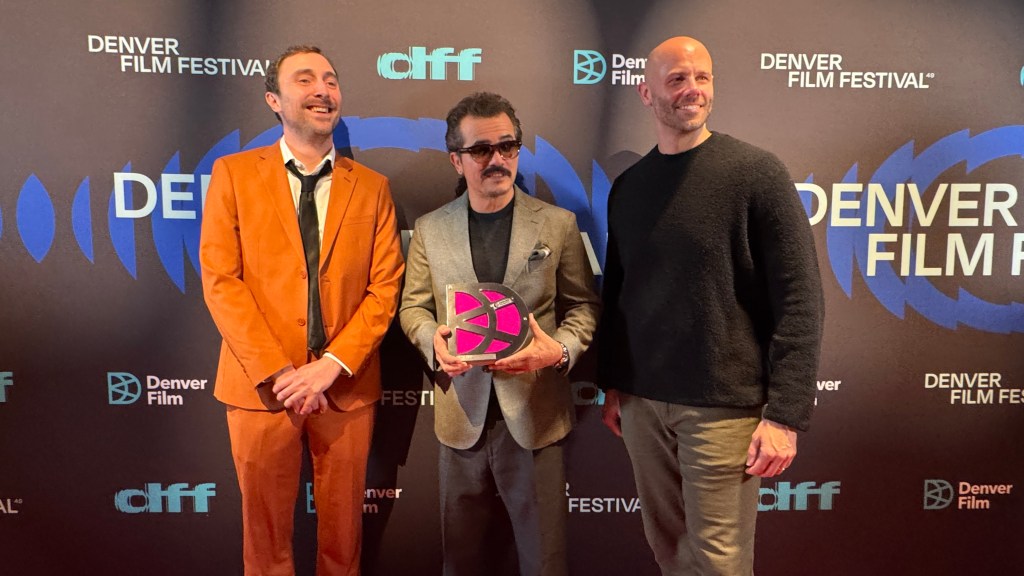
From left, Denver Film Artistic Director Matthew Campbell, John Leguizamo and Denver Film CEO Kevin Smith pose with the John Cassavetes Award at the Sturm Infinity Theater at the Denver Museum of Nature & Science. (Melodie Miller | CU Independent)
John Leguizamo attended the red carpet in Denver at the Sturm Infinity Theater at the Denver Museum of Nature & Science to accept the 49th Denver Film Festival’s highest honor, the John Cassavetes Award, before introducing Christopher Nolan’s “The Odyssey” to the audience.

John Leguizamo plays Eumaeus, an old and blind swineherd loyal to Odysseus in Christopher Nolan’s “The Odyssey.” (Courtesy of Universal Pictures)
In the film, Leguizamo plays Eumaeus, a serious, pragmatic figure in Western literature. However, on the red carpet, Leguizamo is delightful, sharing anecdotes about making “The Odyssey” with Christopher Nolan and Matt Damon.
Read the full story by Melodie Miller at the CU Independent and get the inside scoop.
-
2026 Denver Film Festival honors John Leguizamo
John Leguizamo’s career reflects the independent spirit the award celebrates.
by Melodie Miller
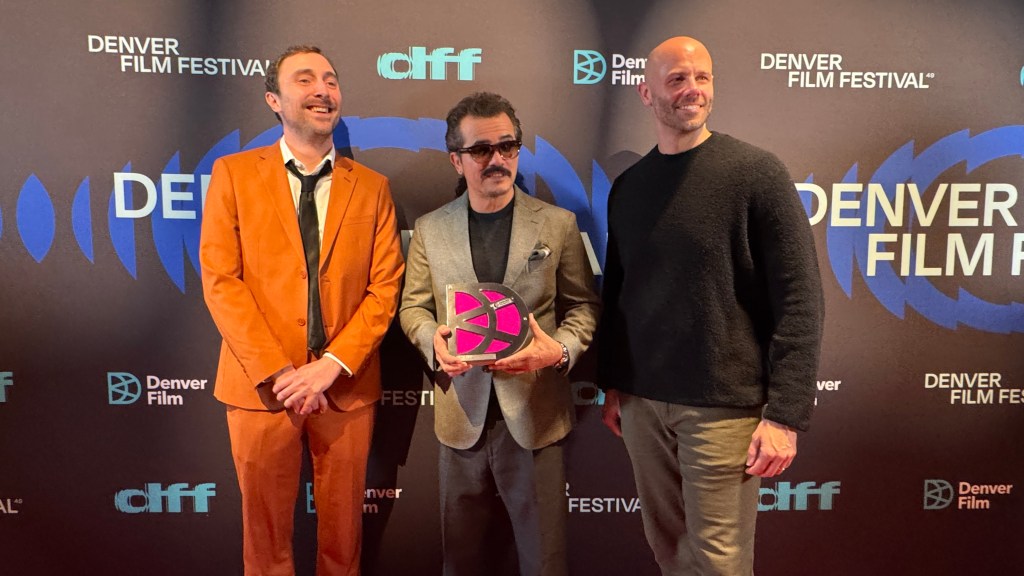
From left, Denver Film Artistic Director Matthew Campbell, John Leguizamo and Denver Film CEO Kevin Smith pose with the John Cassavetes Award at the Sturm Infinity Theater at the Denver Museum of Nature & Science. (Melodie Miller | CU Independent)
The 49th Denver Film Festival presented John Leguizamo with its highest honor, the John Cassavetes Award on Oct. 30. The award recognizes artists who show the independent spirit of the man often called the father of American independent film.
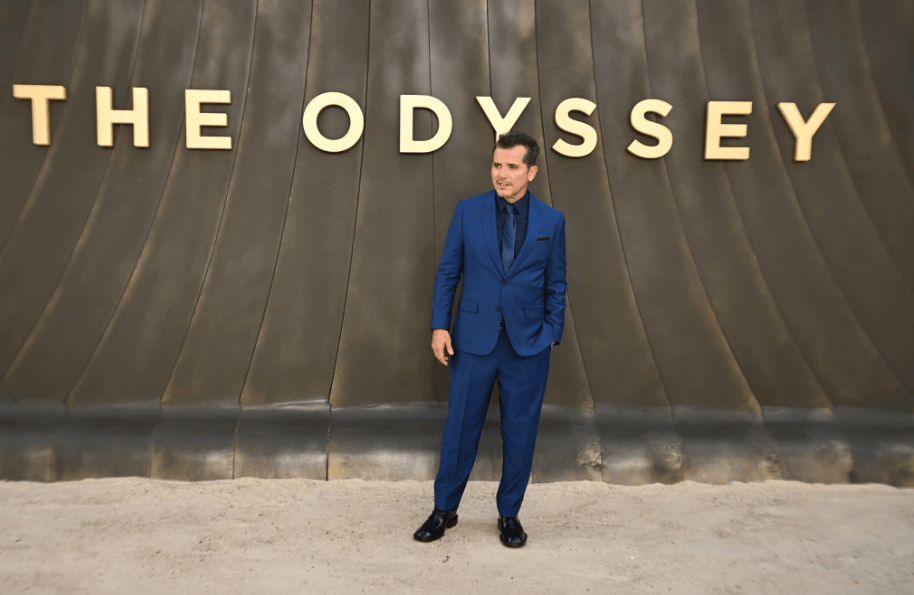
John Leguizamo, who plays Eumaeus in Christopher Nolan’s “The Odyssey,” poses at the world premiere on July 6 at the Odeon Lux Leicester Square in London, England. (Courtesy of Universal Pictures)
Before the ceremony’s screening of Christopher Nolan’s “The Odyssey,” John Leguizamo talked about playing Eumaeus, the old and blind swineherd he calls “the most loyal character in Western literature.”

John Leguizamo plays Eumaeus, an old and blind swineherd loyal to Odysseus in Christopher Nolan’s “The Odyssey.” (Courtesy of Universal Pictures)
Leguizamo accepted the 2026 Cassavetes Award, calling his role as Eumaeus in “The Odyssey” the most vulnerable role of his career.
Read the full story at the CUIndependent.
-
“Beetlejuice:” Never trust the living or the mischievous dead
Thirty-eight years later, “Beetlejuice” reminds audiences that not all ghosts are bad.
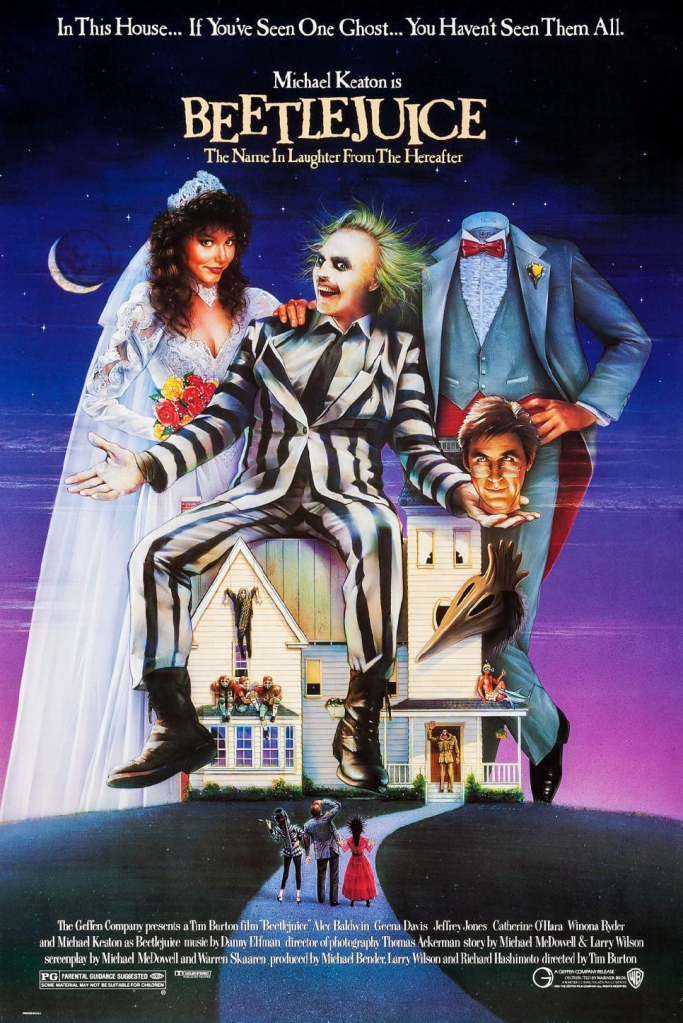
Geena Davis (left) as Barbara Maitland, Michael Keaton as Beetlejuice and Alec Baldwin as Adam Maitland are outside their quaint farmhouse in the fictitious town of Winter River, Connecticut. (Courtesy of Warner Bros.)
Then came the end of the harvest and the dark nights. Bonfires were lit, costumes donned and treats set out, a custom of offering hospitality to entities and ancestors who lived beyond the veil in the Netherworld. This was Samhain, a 2nd-century CE Gaelic ritual practiced in ancient northern Europe before winter’s threat began. It was a celebration that shaped Halloween and historical ghost stories.
This Halloween, as we remember Tim Burton’s “Beetlejuice” (1988), thirty-eight years after it first haunted theaters, the most trustworthy characters in Winter River, Connecticut, are still the dead.
The Melodious Report visits Burton’s classic, where the satire has grown sharper and the title character’s humor has not aged well.
Read the full review to find out why “Beetlejuice” earns a Melodious Thumbs Up, with a caveat.
-
Anthony Ippolito embodies Sylvester Stallone in “I Play Rocky”
Screenwriter Peter Gamble joins the 49th Denver Film Festival to present the dream that became history.
by Melodie Miller | November 2, 2026
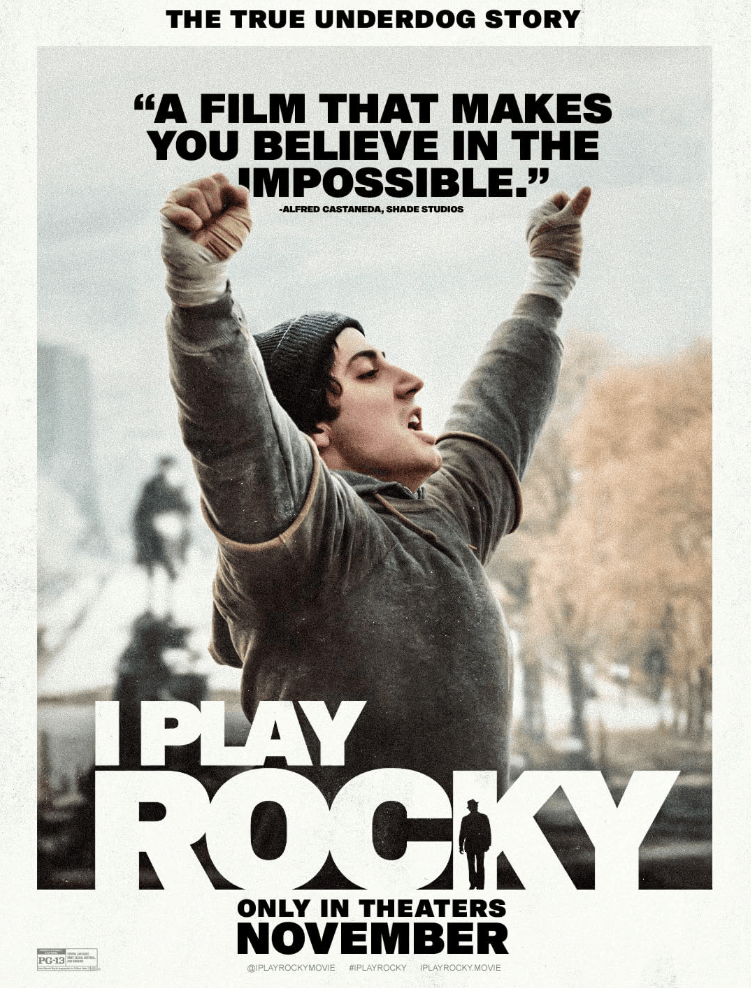
Anthony Ippolito, as Sylvester Stallone, celebrates during a training run through Philadelphia in a scene from “I Play Rocky.” (Courtesy of Amazon MGM Studios, Baha Productions and Fireside Films)
The studio executives wanted the “Rocky” script, but not the unknown actor who wrote it, Sylvester Stallone. They wanted a star. They didn’t realize they were looking at one.
“I Play Rocky,” directed by Peter Farrelly and written by Peter Gamble, stars Anthony Ippolito as Stallone, who gives an award-worthy performance as Gamble’s words jump off the page.
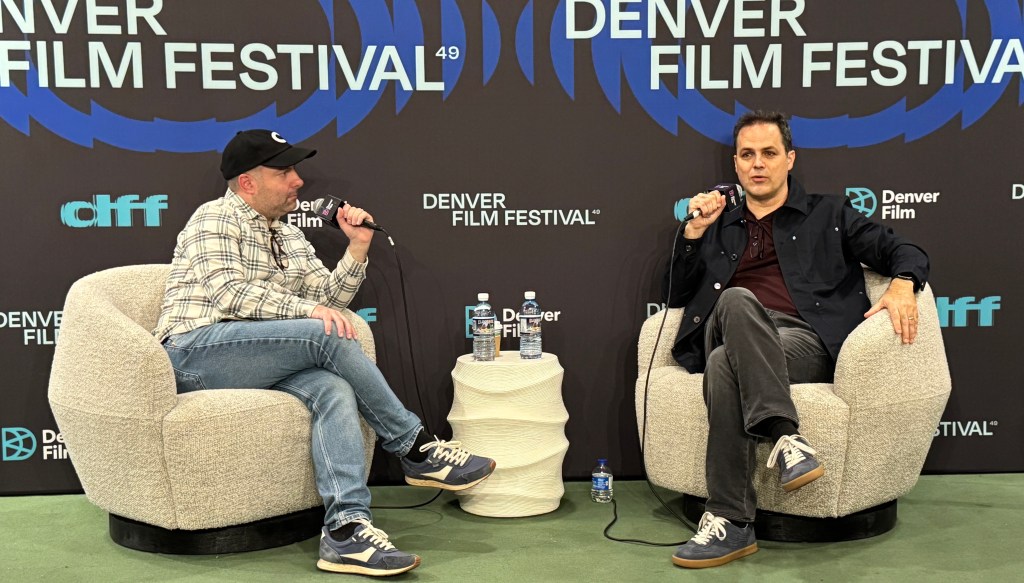
Chris Rosen of The Ankler interviews Peter Gamble at the Tattered Cover in Denver. (Melodie Miller / CU Independent)
Melodie Miller spoke with Gamble on the 49th Denver Film Festival red carpet and at the Tattered Cover in Denver about his journey of turning a dream into reality.
Read the full story by Melodie Miller in the CU Independent.
-
“Welcome to the Fishbowl” Unleashes Chaos in Colorado
An epic farce that invites a temporary suspension of disbelief — a fun place to be.
by Melodie Miller | October 28, 2026

Jeremy Swift, left, plays Storm Grandquist, a narcissistic writer escorted by Elizabeth Ford, played by Natalie Gold, to the Big Literary Award celebration in Telluride. (Courtesy of By And Large Medialabs)
Director Sheryl Glubok’s road trip comedy, “Welcome to the Fishbowl,” screened at the 49th Denver Film Festival on Oct. 23 at MCA Denver Holiday Theater as one of the festival’s Colorado Spotlight series.
Filmed and set in Colorado, the screwball comedy uses the landscape as a backdrop for a chaotic comedy of remarriage that includes stolen cars, a jailbreak, and second chances.
Melodie Miller sat down with director Glubok and cast members Jeremy Swift, known for “Ted Lasso,” Natalie Gold, known for “Succession,” and Marin Hinkle, known for “The Marvelous Mrs. Maisel,” to discuss the making of the film.
Read the full story by Melodie Miller in the CU Independent.
-
“Centered: Joe Lieberman” shows that the center is not an empty space
Joe Lieberman, a politician who built his career putting country before party
by Melodie Miller | October 20, 2026
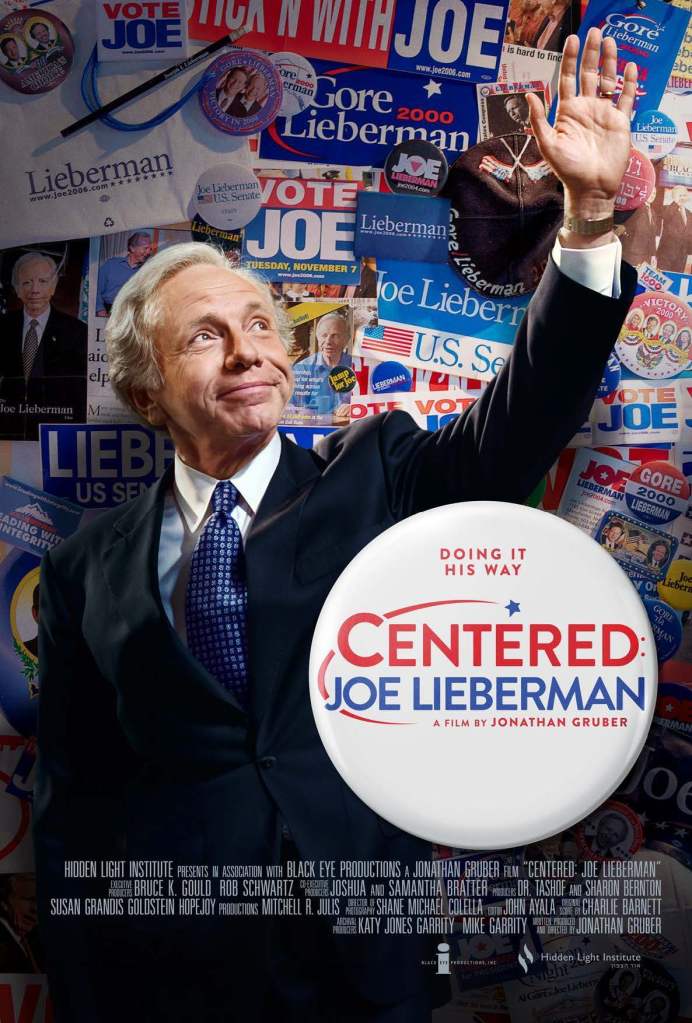
Senator Joe Lieberman, who represented Connecticut in the U.S. Senate for 24 years, waves to a crowd. (Courtesy of “Centered: Joe Lieberman”)
Screen Time with Melodie Miller is a review column that looks beyond the trailer and connects audiences to movie perspectives.
What does it look like when a politician puts country over party? Packed with vignettes of wins, losses, and reinvention, the 2024 film “Centered: Joe Lieberman” by award-winning writer and director Jonathan Gruber follows the Connecticut senator’s 24-year Senate career of wins, losses, and reinvention.
From the Yale students who helped elect him to the Connecticut state senate, including a young volunteer named Bill Clinton, to his run as an independent after his party abandoned him.
The film is a portrait of a man whose center was rooted in independence, integrity, and initiative.
“Don’t make a decision based on what you saw in TikTok,” Gruber said.
Read the full story by Melodie Miller in CU Independent Student News.
-
“Digger” feeds us realities we would rather not eat
A critique of power, its destructive excess, and those who cling to its bounty

Tom Cruise plays Curtis as Digger Rockwell in “Digger,” holding the ten-cent shovel his wildcatter grandfather used to build the family’s enormous wealth. (Courtesy of Warner Bros. Pictures)
Spoiler Alert: This review discusses the film’s ending.Screen Time with Melodie Miller, a review column that looks beyond the trailer and connects audiences to movie perspectives.
In Alejandro G. Iñárritu’s “Digger,” Tom Cruise trades stunts for self-reckoning. Cruise plays Curtis, a community theater actor who plays Digger, an oil baron who saves no one but himself. Iñárritu stages an apocalyptic play, “Fossil Fools,” within the surreal world of the film.
Screen Time gives the film a Melodious Thumbs Up. Cruise and Riz Ahmed earn praise for their performances as men opposed in their ideals but yoked and compromised by lies.
If you are looking for truths without chases, read the full story at the CU Independent. Decide whether the film earns the Melodious Thumbs Up.
-
Boulder takes its climate fight to the nation’s highest court
by Melodie Miller | October 13, 2026
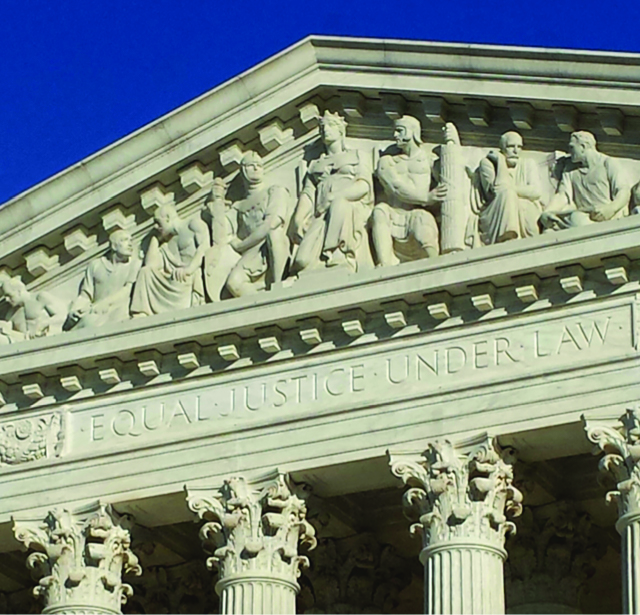
The Supreme Court Building’s west pediment tympanum is a triangular recessed section filled with allegorical marble sculptures by artist Robert I. Aitken. The figures represent Liberty Enthroned, flanked by Order and Authority, along with prominent historical and legal figures. The architrave, the horizontal lintel directly beneath the sculpture, is carved with the motto “Equal Justice Under Law.” (Image Courtesy of the Associated Press)
The U.S. Supreme Court opened its new term on October 5 with an oral argument in a closely watched climate case brought by the city and county of Boulder, Colorado, against Suncor Energy (U.S.A.) Inc. and ExxonMobil. Boulder seeks to recover a share of costs it has incurred and will incur in responding to damage it attributes to climate change. Boulder alleges the oil companies knew fossil fuels contributed to climate change and concealed their knowledge.
The oil companies’ attorneys, backed by the U.S. Department of Justice, argued that interstate and international emissions are a federal matter that state law cannot reach. Boulder’s attorney, Kevin Russell, argued that the case concerns deceptive marketing, not emissions and that states have long provided remedies for injuries within their borders.
Three justices’ questions signaled doubt about whether the court has jurisdiction. If the court rules it has jurisdiction, it will decide whether the Clean Air Act and the Constitution can block Boulder’s state-law claims. If not, the case will return to the Colorado courts and proceed toward trial.
Read the full story by Melodie Miller at the CU Independent.
-
Lights, cameras, Sundance Film Festival
CU students volunteer to lay out the red carpet in Boulder
by Melodie Miller | October 6, 2026

The Boulder Theater displays the launch of the Sundance Film Festival. (Melodie Miller)
Brian Marquez spends his days recruiting the volunteers who make the “shows must go on” at the Sundance Film Festival. As a senior manager of talent at the Sundance Institute, Marquez will place more than 2,000 volunteers in theaters, press offices and on production crews this January. For Marquez, volunteers are the festival’s heart and soul.
“Volunteers truly make the Sundance Film Festival happen,” Marquez said. “We couldn’t do it without them.”
This year, hundreds of volunteers will be CU Boulder students. When the festival premieres in Boulder, January 21 through 31, students can trade 18 hours of service for free screenings, industry connections, and firsthand experience working with an internationally attended film festival.
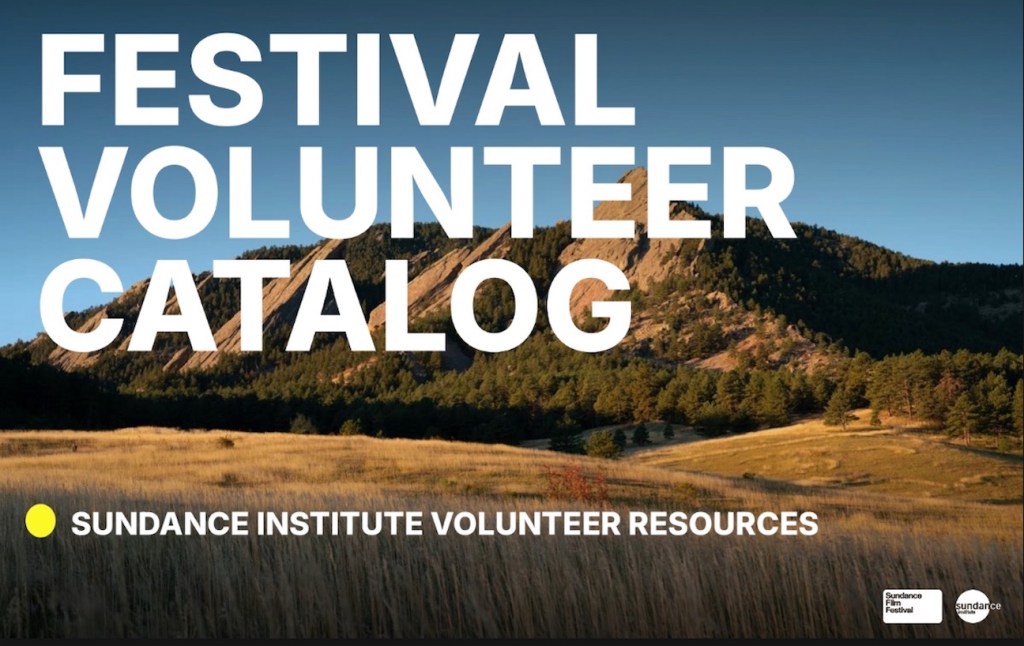
Screenshot Sundance Film Festival Volunteer Catalog 2027. (Photo courtesy of Sundance Film Festival)
The university worked closely with Sundance to make the volunteering schedule manageable for students. Megan Medina, who directs Service Learning and Impact in Community Engagement at CU Boulder, helped lower the volunteer minimum from 24 hours to 18 so the shifts could fit around classes.
Nathan Paul Jones of Career Services sees the festival as a networking gateway for students. Jones said that Sundance has already begun posting internships on Handshake. The real career benefit is in the time spent working with industry professionals.
Cinema Studies Senior Cadence Tucker recommends volunteering, especially for first- and second-year students.
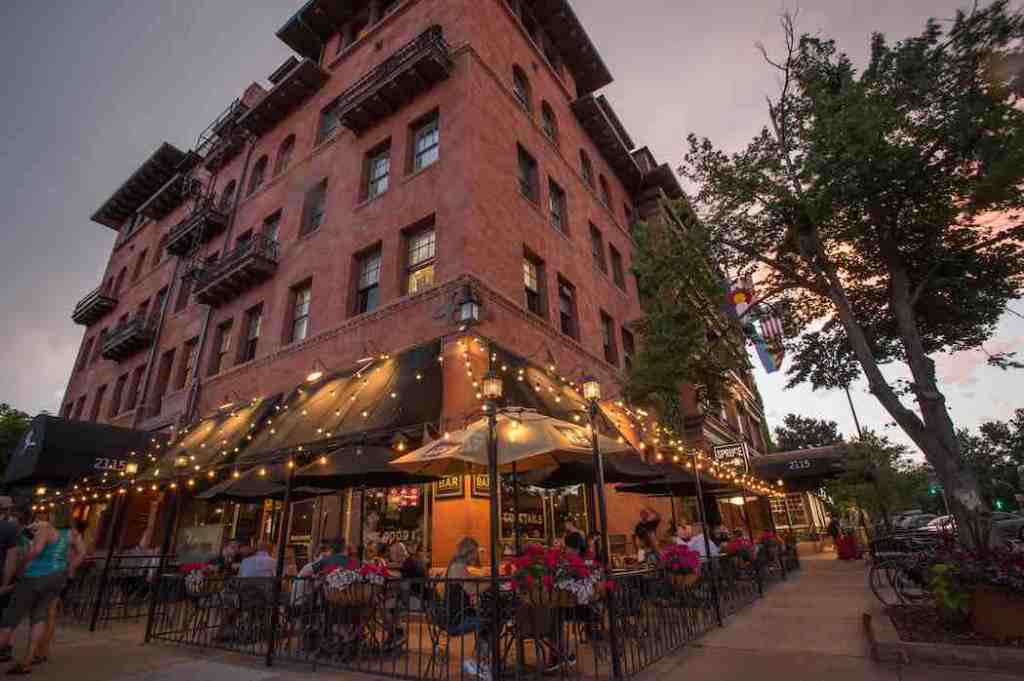
The Hotel Boulderado outdoor corner bar. (Photo courtesy of Tim Romano|The Boulderado)
The festival footprint is compact. About 150 films will be screened at the 2027 film festival in fifteen theaters in Boulder, all within a two-mile radius of the Sundance hub at the Hotel Boulderado. Governor Jared Polis’s office estimates the festival could bring up to $2 billion to Colorado over the next decade.
Read the full story by Melodie Miller at the CU Independent.
-
‘Campus Life’ exhibit highlights CU Boulder’s evolving nature
‘Campus Life: 150 Years of Human and More-Than-Human Relationships‘
by Melodie Miller | September 9, 2026
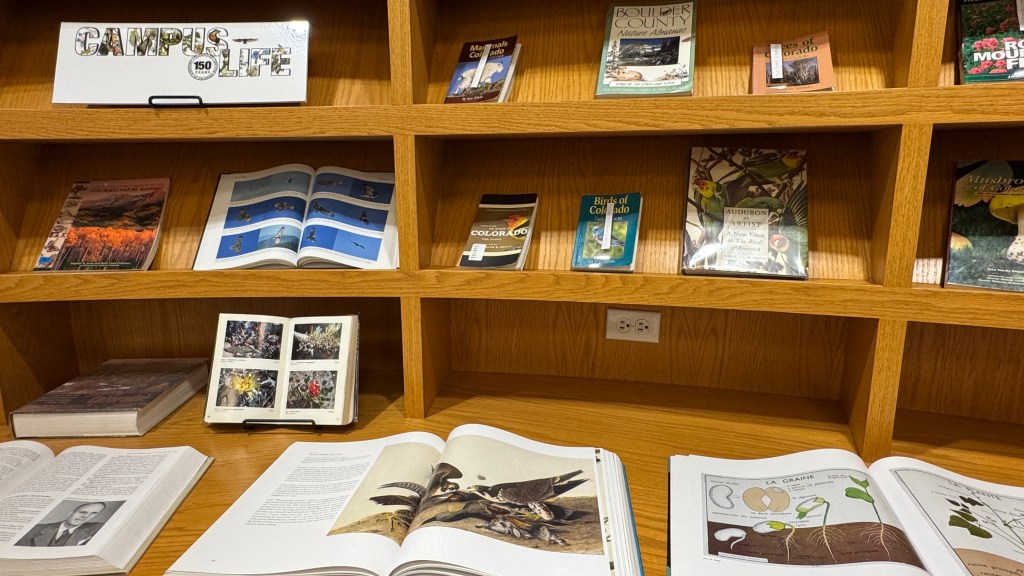
Historical landscape books, field guides, and illustrated volumes of CU Boulder flora and fauna line the shelves at the “Campus Life” exhibit inside the Jerry Crail Johnson Earth Sciences & Map Library. (CU Independent / Melodie Miller)
The University of Colorado was founded on a treeless plain 150 years ago, but today, more than 5,000 trees later, the campus is recognized as an Arbor Day Foundation Campus of Higher Education that effectively maintains urban forests.
This history is at the center of “Campus Life,” an exhibit in the Jerry Crail Johnson Earth Sciences & Map Library that traces 150 years of relationships between people, plants and animals on campus. The planning decisions made more than a century ago continue to shape how the campus community coexists with its biological neighbors.
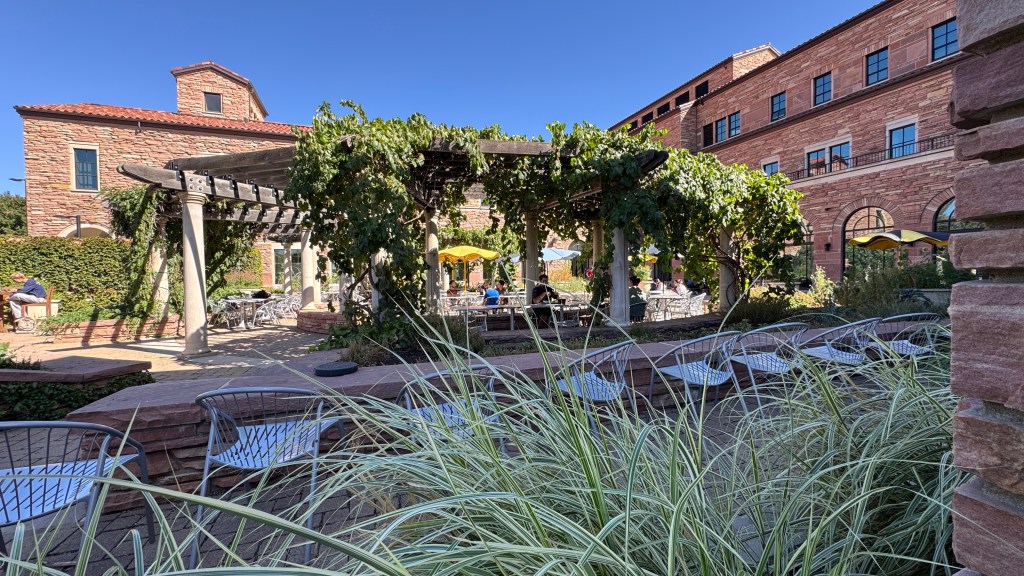
The Center for Community dining garden is surrounded and filled with drought-resistant plantings. (CU Independent / Melodie Miller)
Throughout the campus grounds, plantings enhance the beauty of the environment while maintaining a commitment to non-human habitats, minimal water use and other environmental considerations.
Read the full story at the CU Independent.
-
Sundance Film Festival Leaders Say Community Will Define Boulder Event
Sundance will maintain its mission while building a new festival rooted in Boulder culture
by Melodie Miller & Addisson Pribble | October 5, 2026

Boulder Theater marquee displays the Sundance Film Festival name (Photo courtesy of Miles Fujimoto)
Someone’s next big break in a film career might come while waiting in line for a screening or riding a bus across town in Boulder. This was the message Sundance Film Festival director Eugene Hernandez and Sundance Institute managing director Paula DuPré Pesmen shared with Colorado student reporters at a Sept. 30 press conference on the festival’s move from Park City, Utah, to Boulder.
When Sundance opens Jan. 21-31, 2027, its venues will sit within a 2.4-mile radius of the Hotel Boulderado, a more compact footprint than the Utah festival’s three locations.
Asked what will define the Sundance Film Festival’s new home, festival director Eugene Hernandez offered one word: community.
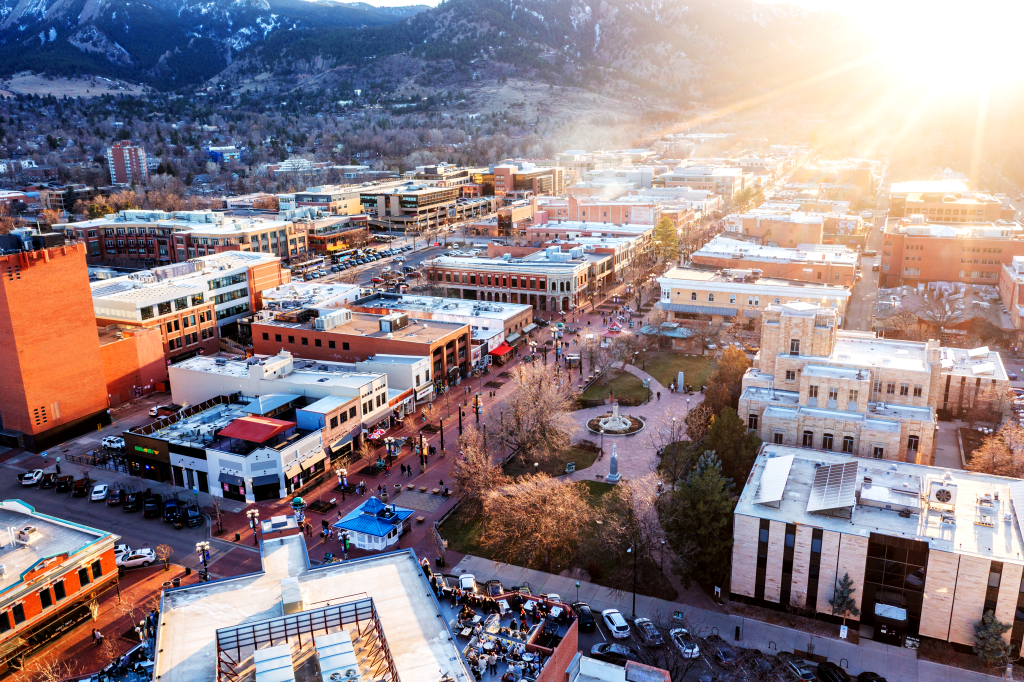
Part of the Sundance Film Festival footprint spans from the Boulder Theater, north, up Pearl Street toward Broadway, a direct route to the University of Colorado campus and more venues (Photo courtsey of Justin Bilancieri)
Melodie Miller attended the press conference by Zoom and co-wrote the story. Read the full story at the CU Independent.
-
‘The Wizard of the Kremlin’: a cautionary tale
The chilling ‘post-truth’ mechanics of Putin’s Russia and its coercive control
by Melodie Miller | October 5, 2026
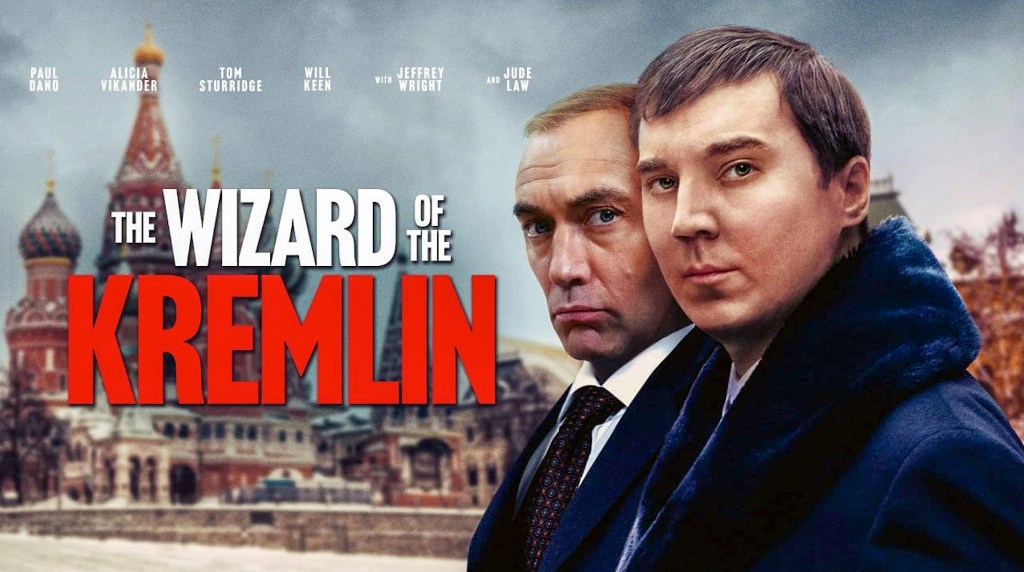
Jude Law as Vladimir Putin and Paul Dano as Vadim Baranov appear in “The Wizard of the Kremlin.” (Photo courtesy of Vertical Entertainment/Gaumont)
Screen Time with Melodie Miller, a review column that looks beyond the trailer and connects audiences to movie perspectives.
In a remote, frozen blue forest far from Moscow’s politics, Vladimir Putin’s former spin doctor walks his dog without once looking over his shoulder. Snow-encrusted trees twist behind him like prison barbed wire, a fence he helped build. The silence feels more like a warning than a peaceful retirement.
The Melodious Report breaks down Olivier Assayas’ “The Wizard of the Kremlin,” a film adapted from Giuliano da Empoli’s novel.
The film traces two paths that open after the fall of the Soviet Union, one toward wealth and one toward power; both lead to the Kremlin’s door. Jude Law plays Putin, icy cold in appearance and soul. Paul Dano plays Vadim Baranov, a reserved, steady strategist who rides alongside Putin as he rises to power.
Released on streaming platforms weeks before the 2026 midterm elections, it is a portrait of political power, psychological control and dark Russian humor that may serve as a cautionary tale.
See if “The Wizard of the Kremlin” earns a Melodious Thumbs Up.
Read the full story by Melodie Miller at the CU Independent.
-
‘The Dog Stars’: A mirror to a divided America
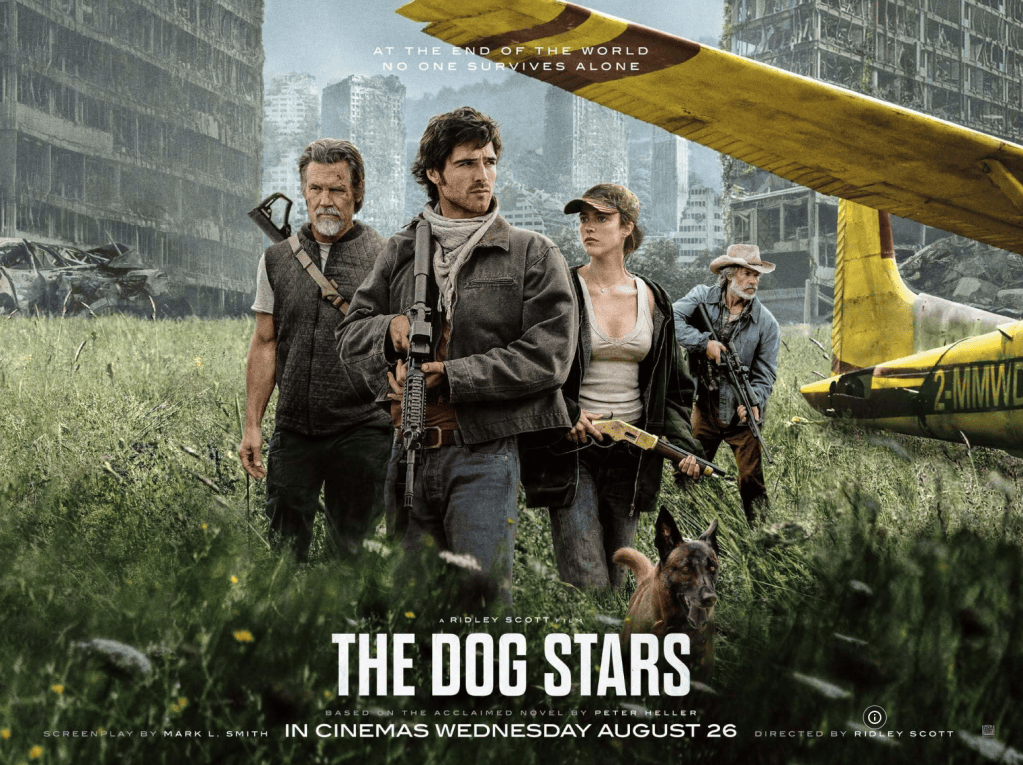
The poster released by 20th Century Studios shows, from left, Josh Brolin as Bangley, Jacob Elordi as Hig, Margaret Qualley as Cima, and Guy Pearce as Pops, with Jasper the dog, in “The Dog Stars.” (20th Century Studios via IMDb)
Screen Time with Melodie Miller, a review column that looks beyond the trailer and connects audiences to movie perspectives.
A 1956 Cessna, nicknamed “The Beast,” glides over the conifer-filled canyons, and for a moment, the end of the world looks peaceful. Then the violence begins.
The Melodious Report takes a closer look at Ridley Scott’s “The Dog Stars,” adapted from Peter Heller’s 2012 novel. Starring Jacob Elordi and Josh Brolin as two survivors guarding an abandoned airport in post-apocalyptic Erie, Colorado, the film weighs violence toward strangers against the risk of human connection. The review draws parallels between the film and today’s immigration debates, pandemic isolation and misinformation.
The film offers a portrait of a divided America.
Speaking at a live Colorado Public Radio event, Heller responded to the film’s mixed critical reception in a conversation with CPR’s Ryan Warner at the Denver Press Club. The Melodious Report attended and photographed the event.
Read the full story by Melodie Miller at the CU Independent.
-
Keeping the Wild West Alive at the Strater Hotel in Boomtown Durango, Colorado
A 19th-century gold-rush mining town is alive in Durango.
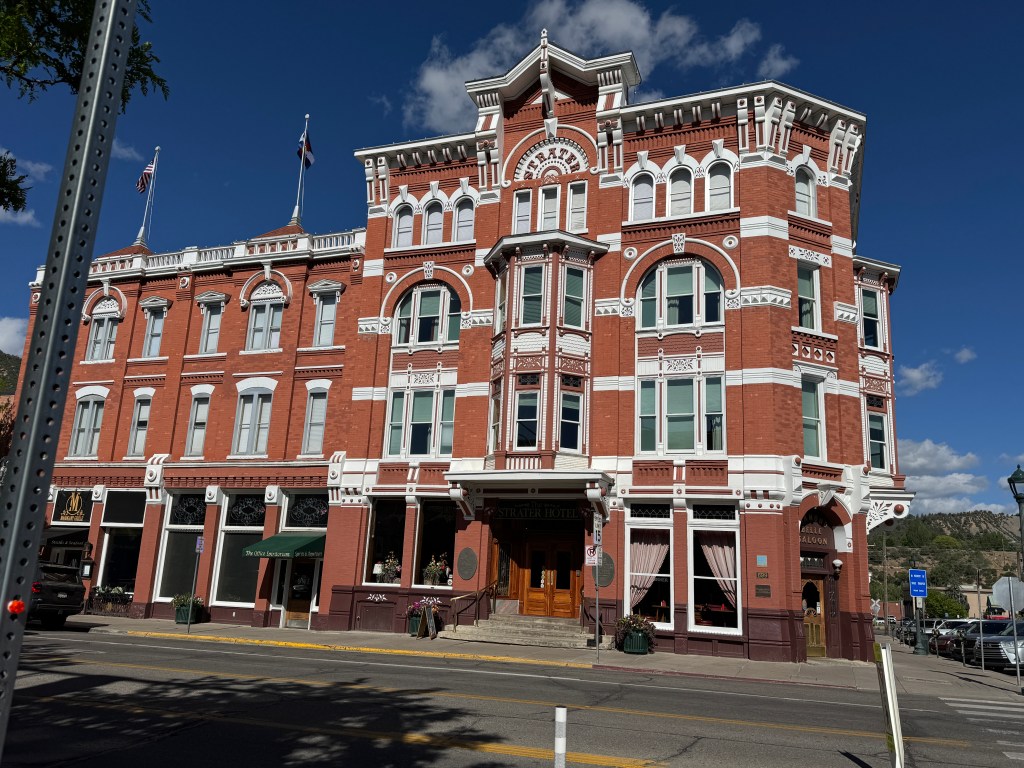
The historic Strater Hotel on Main Street, Durango (Photograph by Melodie Miller)
By Melodie Dawn Miller Reporting from Durango, Colorado June 16, 2026 2:00 p.m. MDT
The Strater Hotel is a distinctive red-brick building situated on Durango’s Main Street in the Historic District, where visitors can rest their heads in the Wild West without traveling back in time. Built in 1887 by Fred, Frank and Antone Strater, the Boomtown hotel is filled with historically accurate furnishings and decor that take visitors back to the 19th century without sacrificing modern conveniences or civil order.
“American mining towns were mostly civil,” Jennifer M. Larson writes in Why the West Became Wild. The American West “grew so rapidly during the nineteenth-century gold rush that they were dubbed boomtowns.”

Tiffany-inspired elevator awning emulates the 1880s Art Nouveau decorative period. (Photograph by Melodie Miller)
Designed and built during the region’s mining boom, the Strater Hotel management strives for authenticity with century-old oak furnishings, replicated 19th-century wallpaper, and Tiffany Art Nouveau-emulated lighting fixtures, giving guests a Wild West experience.
“The hotel is dedicated to providing factual information. The hotel is a living museum,” Tori Ossola, the General Manager of the Strater Hotel, said.
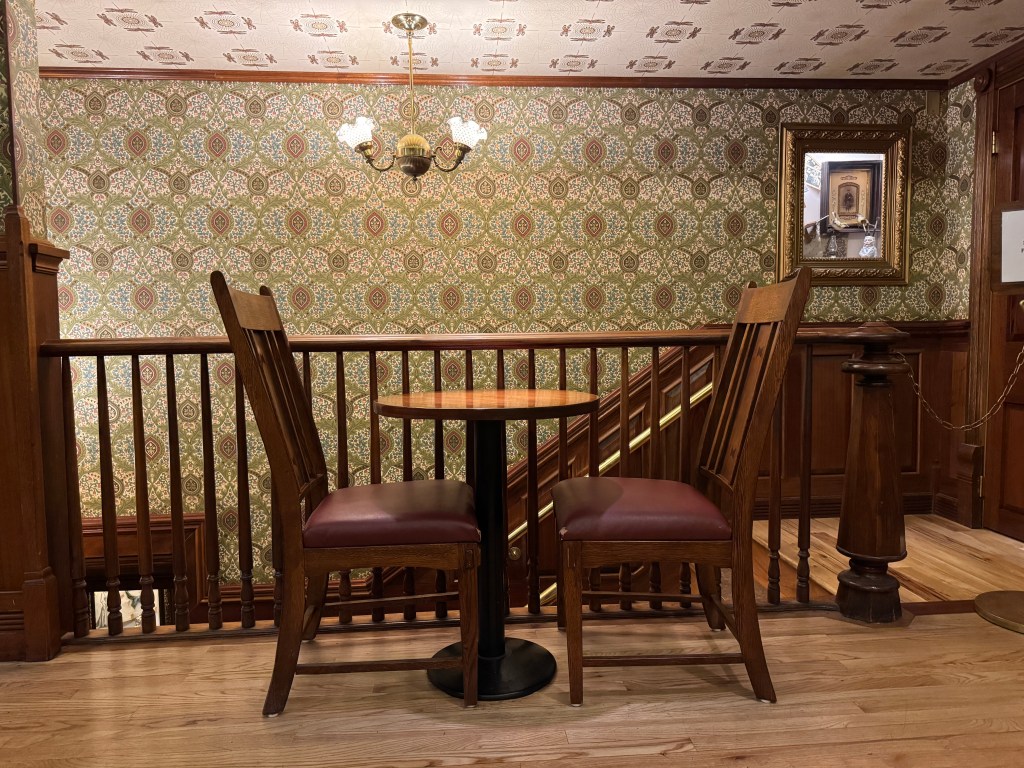
Historical maple furnishings and Bradbury & Bradbury wallpaper at the Strater Hotel (Photograph by Melodie Miller)
The ladder-back Mission chairs, hand-milled oak staircase railing, and heavy balusters showcase the early American Craftsman-style set against a backdrop of color that favors gently aged tones of the late Victorian era.
According to Historic Hotels of America, in 1926, owner Earl A. Barker, Sr. became dedicated to preserving the hotel’s prestigious status and he inspired the following generations to follow in his footsteps.
“The large collection of Victorian antique furniture we have throughout the property can be attributed to the second-generation Barker family,” Ossola said. Then, the third generation, Mr. Rod Barker and his wife Lori, “did the major heavy lifting on the renovation.”

Historically inspired Gilded Age Bradbury and Bradbury wallpaper covers the walls of the Strater Hotel (Photograph by Melodie Miller)
The Knightsbridge Damask wallpaper by Bradbury & Bradbury of San Francisco recreates the Anglo-Japanese Aesthetic Movement, using motifs from 1875 to 1890. Designed in 1986 by artistic director and co-owner Stephen Bauer, the motifs recreate patterns following the transition of the 19th-century designer William Morris.
The late-Victorian-inspired wallpaper is reminiscent of the Gilded Age, featuring teardrop-shaped ogee and gold-metallic floral medallions joined by a lattice of leaves.
“We strive to be a resource to historic properties for the preservation and restoration of their buildings,” a representative of Bradbury & Bradbury, Lisa Bauer, said.
The Strater Hotel wallpaper colors are unique because “the pattern has recently received a refresh,” Bauer said, but “it has never been retired, only revised.”
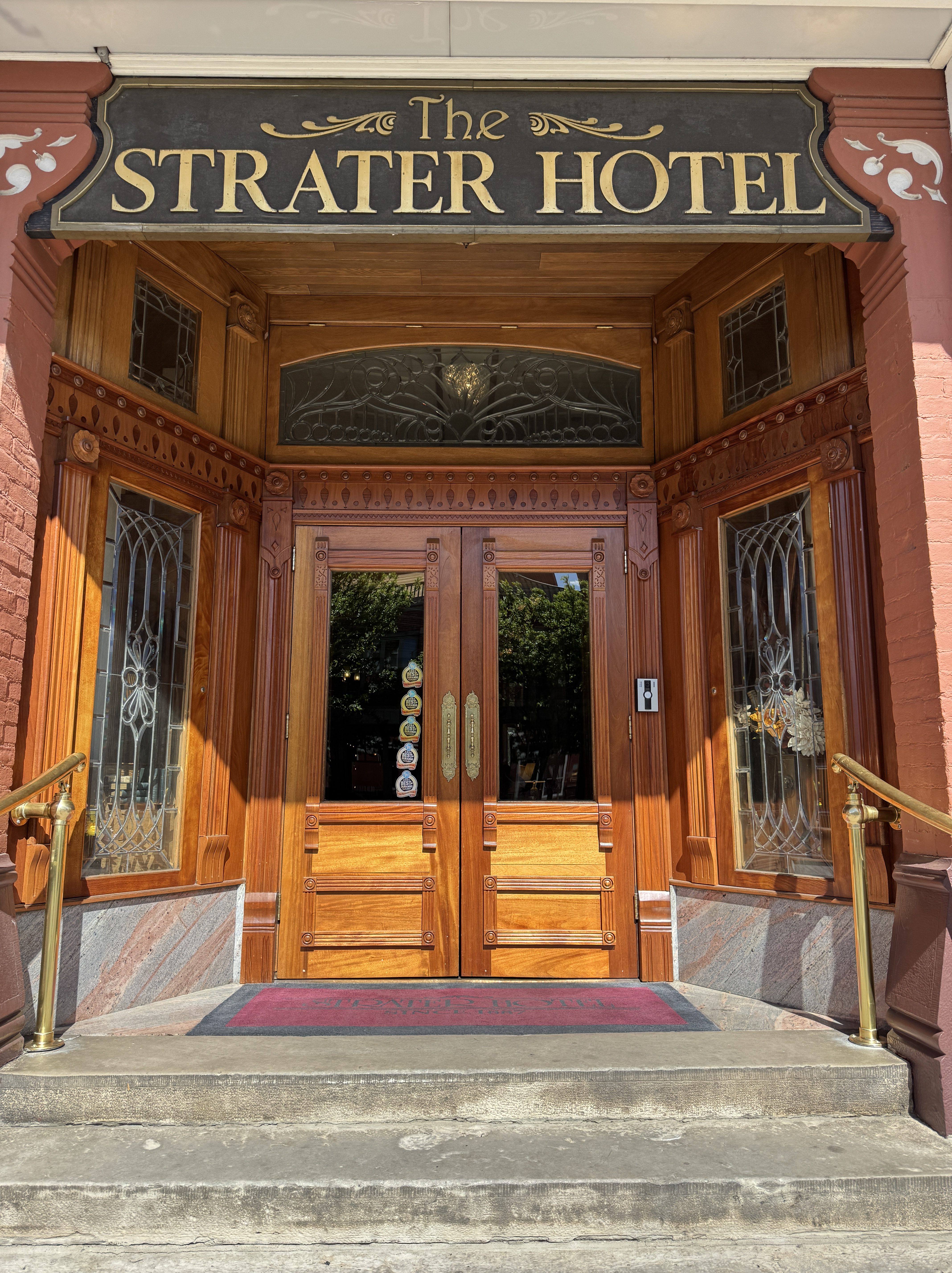
The historic Strater Hotel on Main Street, Durango (Photograph by Melodie Miller)
An original mining boomtown, Durango was founded in September 1880, according to the City of Durango History. Henry Strater built the hotel in 1887 “right after the Silver Panic,” Ossola said.
According to Historical Hotels.org, Strater believed a contemporary Durango offered a “great economic opportunity” worthy of a grand hotel.
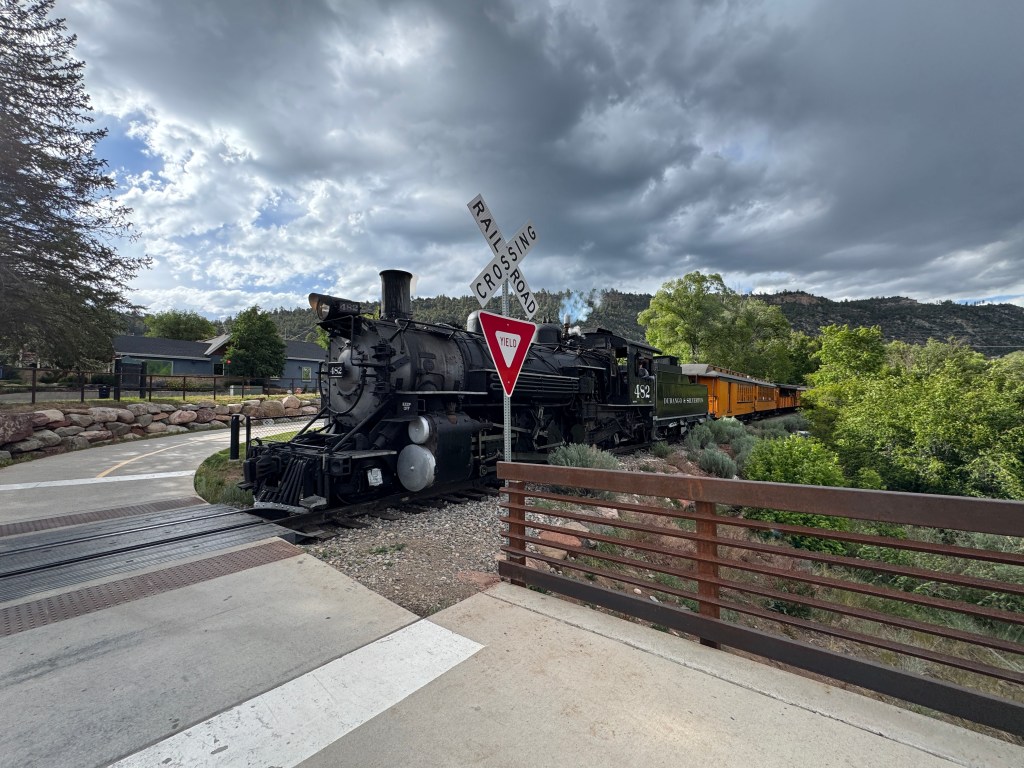
The Durango Silverton Gauge Railway steam engine and passenger car train (Photograph by Melodie Miller)
Along with the hotel, the economic boom brought the Durango to Silverton Gauge Railway steam engine that continues to carry passengers through the rugged San Juan Mountains of Southwestern Colorado. Built in 1882 to haul silver and gold ore, the historic steam-powered train transports passengers on a 45-mile round trip along the Animas River through canyons, forests, and landscapes largely unchanged since the 19th century. The train station is 0.2 miles, approximately a 3-minute walk, from the Strater Hotel.
In 2021, the Garrett family bought the hotel from the Barker family and “upgraded every single one of our hotel rooms to have its own heating and cooling system,” Ossola said.
“Not super sexy stuff, right? But still making sure that our guests having that historic experience are comfortable,” Ossola said.
____________________________________________
The Strater Hotel is listed on the National Register of Historic Places and the Historic Hotels of America.
699 Main Avenue, Durango, CO 81301 — www.strater.com — 800.247.4431
____________________________________________
Contact
Melodie Dawn Miller
- melodie.miller@colorado.edu
- www.melodiemiller.com
Melodie Dawn Miller is an apparel industry professional with expertise in design, development, and production.
She holds bachelor’s degrees in English Literature and Classic Civilizations.
She is currently studying History and Journalism at the University of Colorado.
-
The Puebloans built the Aztec Ruins in New Mexico
A Testament to Upper-Class Living in Ancient Times
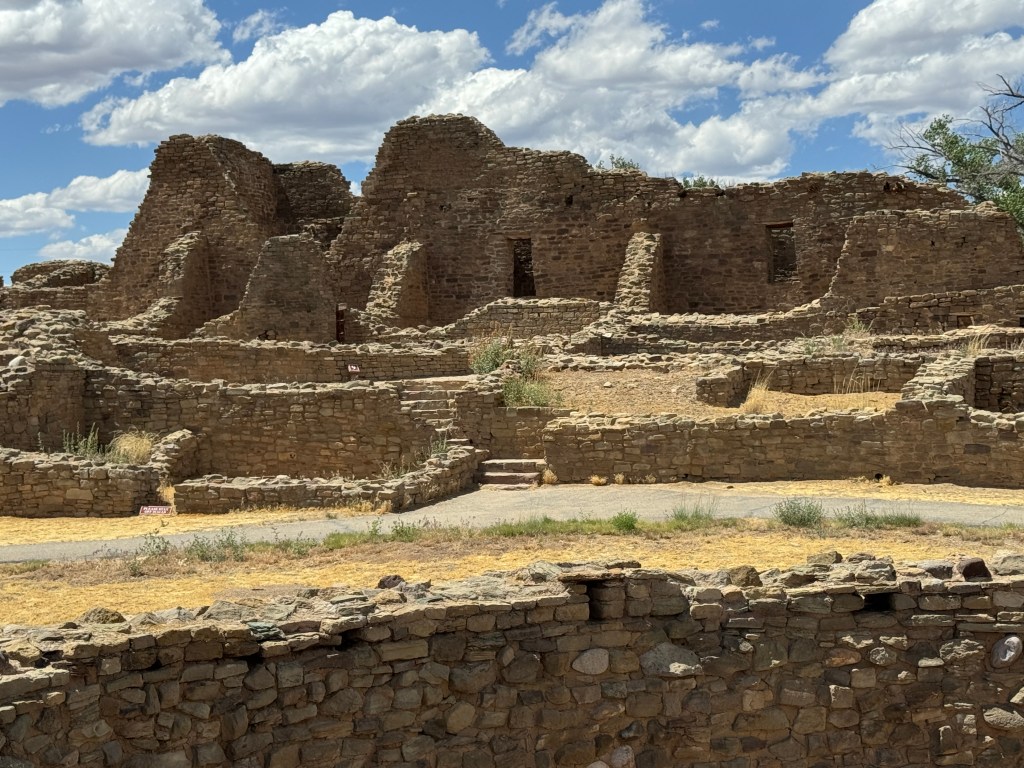
The Aztec Ruins, New Mexico (Photography | Melodie Miller)
Reporting from Aztec, New Mexico
June 1, 2026 Updated June 11, 2026, 3:14 MDT
Did you know that…
You can visit a 12th-century community of Puebloan structures at the Aztec Ruins National Monument in New Mexico, near Durango, Colorado. If the Pueblos built the community, why is it named the Aztec Ruins?
“The Spanish are calling the Aztec ruins Aztec before non-Spanish Europeans show up,” Dr. Steve Lekson, Professor of Anthropology at the University of Colorado, said.
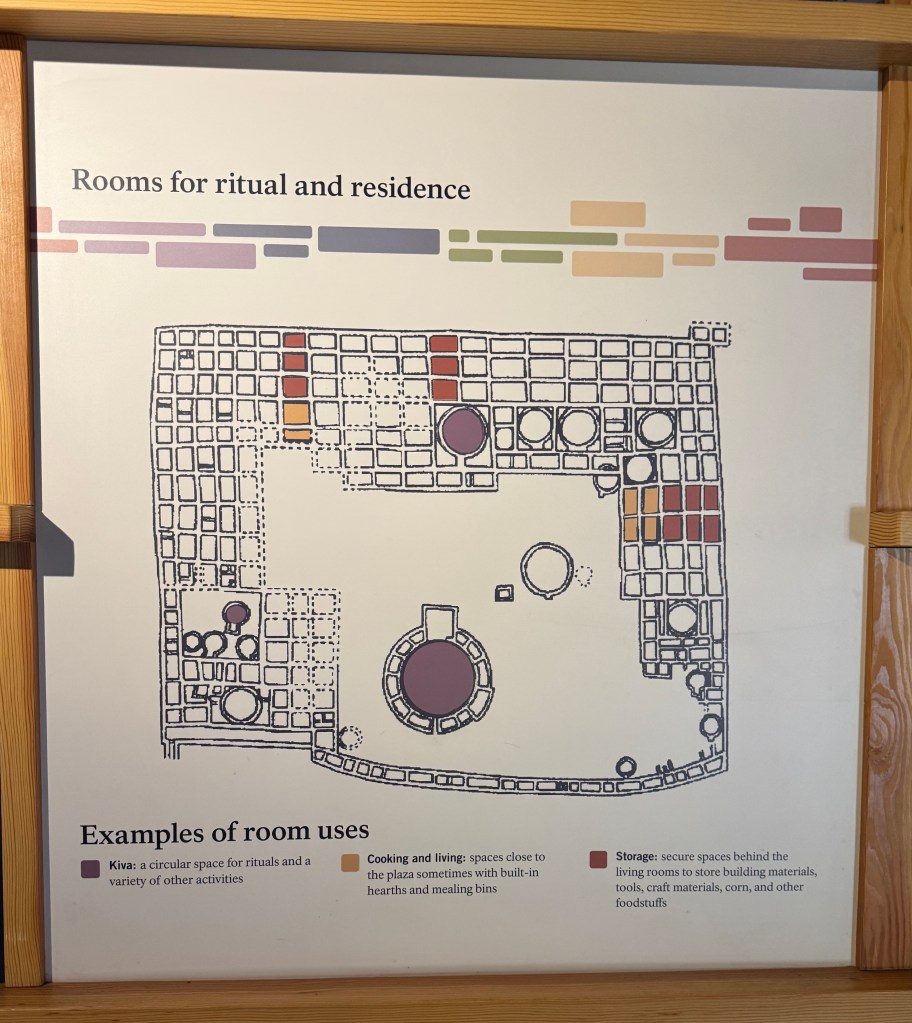
During the 19th century, scholars in Mexico City, Mexico, wrote that the Aztecs had built the 400-room community. However, most modern archaeologists accept that the ancestral Puebloans, a farming culture, built the dwellings, and the Aztecs, an elite class, lived there for a period of time.
“It’s a complicated story,” Dr. Scott Ortman, of the University of Colorado Boulder, said. One concern is “naming a site in one particular indigenous language” when many tribes view themselves as descendants of the area.
Thus, the 19th-century name took hold and remains.
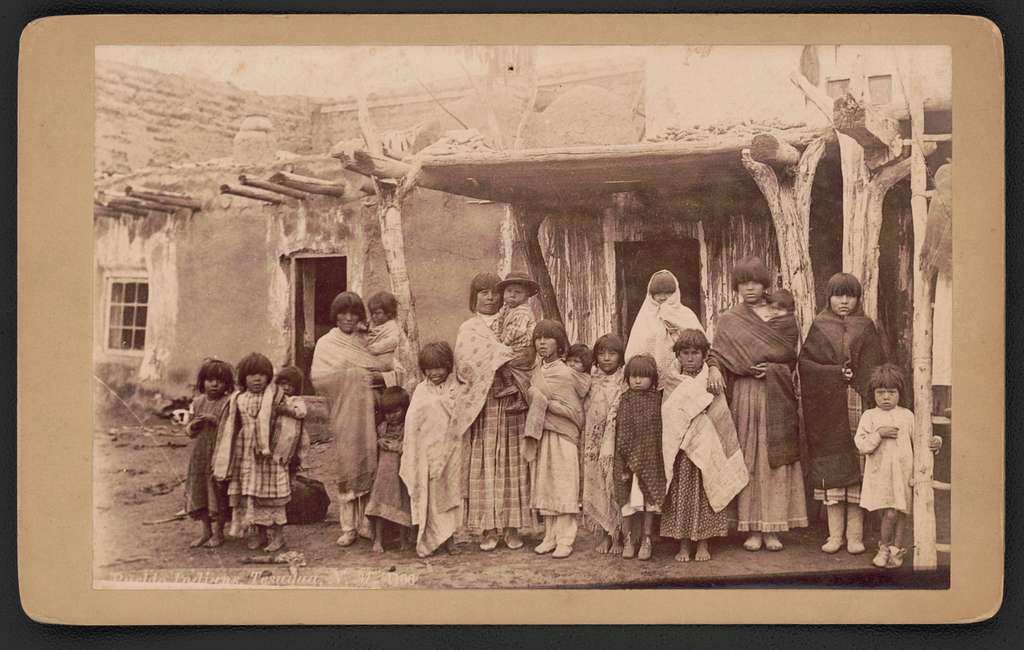
Pueblo Indians, Tesuque, N.M. (1893) (William Edward Hook | Courtesy of the Library of Congress)
Migration lies at the heart of the Aztec and Pueblo ancestral origin story. More than a record of movement, their ancestors’ journeys shape identity and belonging today.
According to Mexican scholars of the 1800s, the Aztec Ruins were the “first home of the Aztecs” before they migrated south to Mexico, Lekson, said.
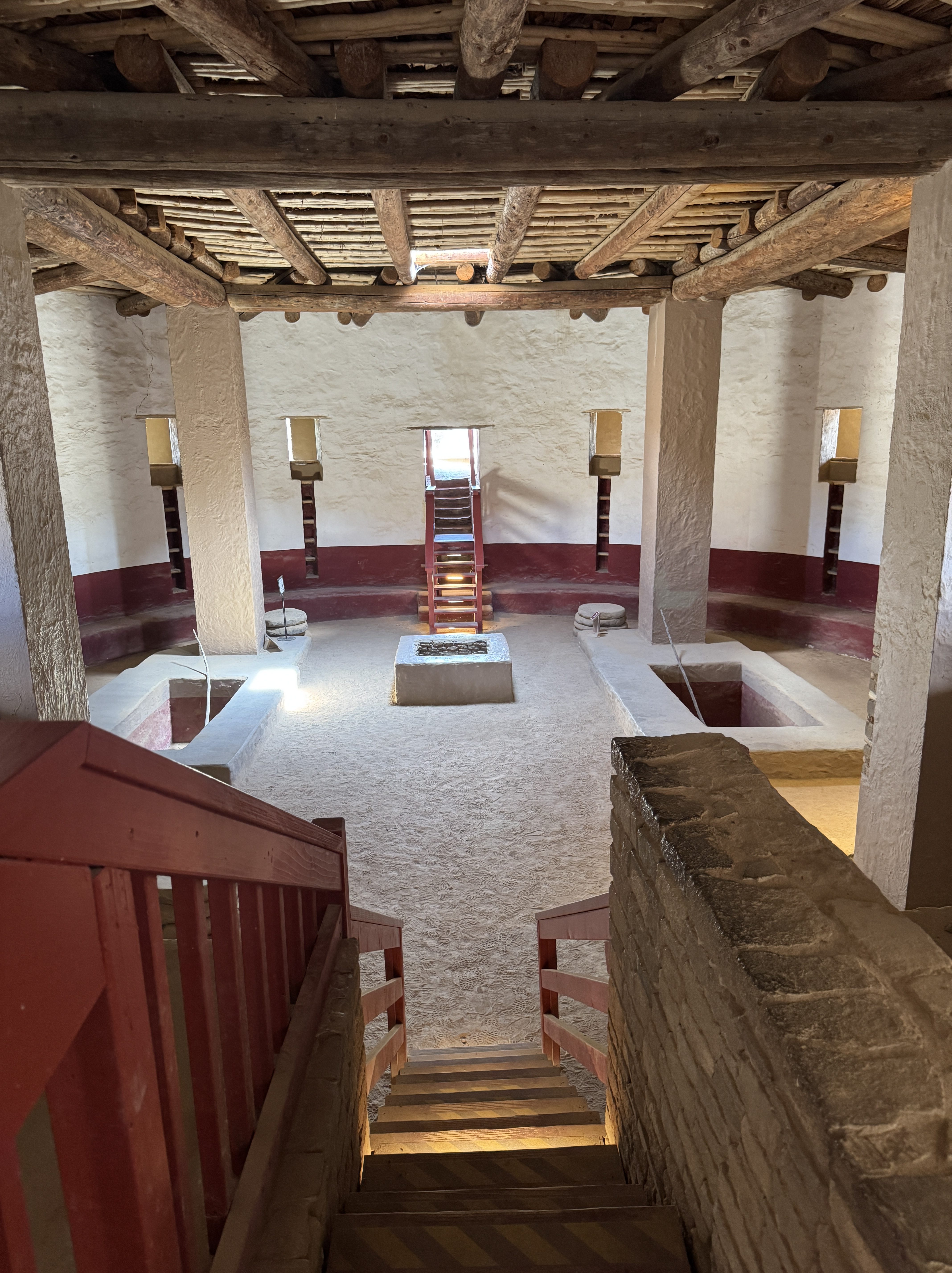
The Aztec Ruins kiva replica, Aztec, New Mexico (Photography | Melodie Miller)
The 381-acre National Park protects the Ancestral Pueblo great house community and the kiva ceremonial room replica. Kivas are built with ventilation, a fire pit, and a sipapu — a spiritual gateway to and from the underworld. An important part of modern Pueblo and Hopi communities is sacred dances and rituals held in community kivas.
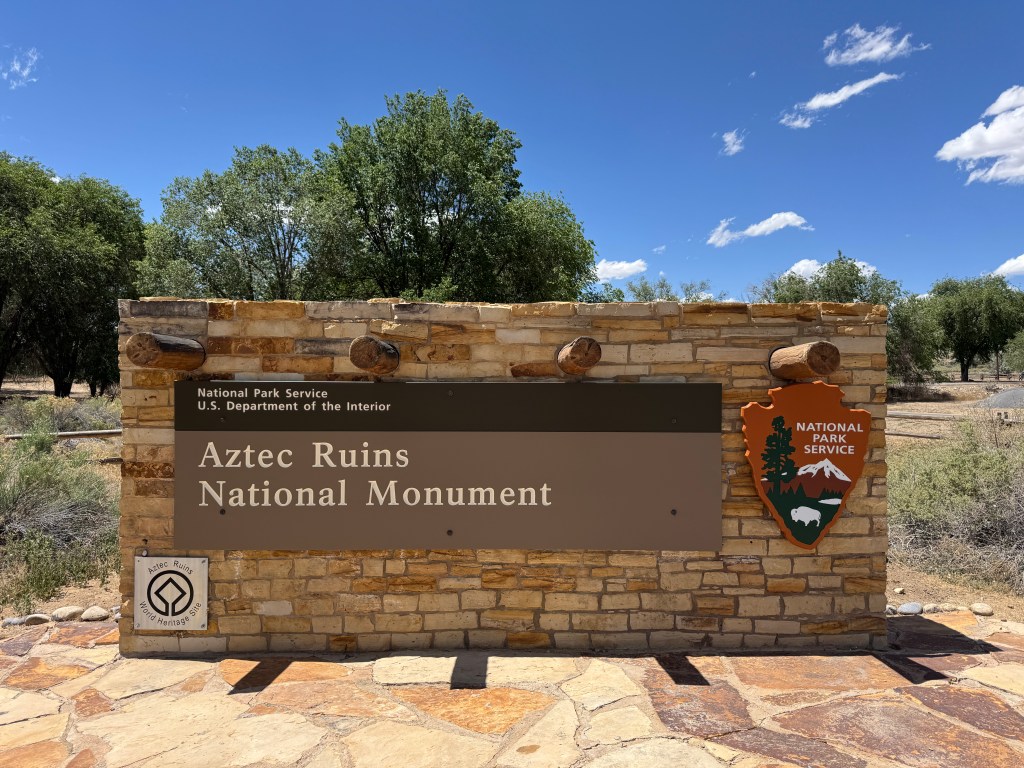
The Aztec Ruins National Monument, New Mexico (Photography | Melodie Miller)
President Warren G. Harding used the Antiquities Act of 1906 to designate the site as the Aztec Ruins National Monument on January 24, 1923.
Nathan Hatfield, Aztec National Park Ranger Supervisor of Interpretation, said, “I believe that by 1928 most southwestern scholars and archaeologists agreed that the Aztecs of Mexico were not responsible for building” the Aztec Ruins.
Consensus among archaeologists grew, accepting the continuity between the Ancestral Pueblo builders and the Aztec ruins.
Archaeologists have come to accept that “Aztec was built by ancestors of today’s Pueblo people,” Ortman said. “We didn’t need DNA. It was just recognizing the continuity and culture.”
Now the name is accepted as an artifact of history. A name change would require an act of Congress.
______________________________________________
The Aztec Ruins National Monument is located 40 miles (ca. 64 km) south of Durango, at 725 Ruins Rd, Aztec, New Mexico 87410.
Aztec Ruins National Monument Website
_______________________________________________________
Contact
Melodie Dawn Miller
- melodie.miller@colorado.edu
- http://www.melodiemiller.com
Melodie Dawn Miller is an apparel industry professional with expertise in design, development, and production.
She holds bachelor’s degrees in English Literature and Classic Civilizations.
She is currently studying History and Journalism at the University of Colorado.
-
A Table, A Palace, A Park
The Many Lives of Mesa Verde
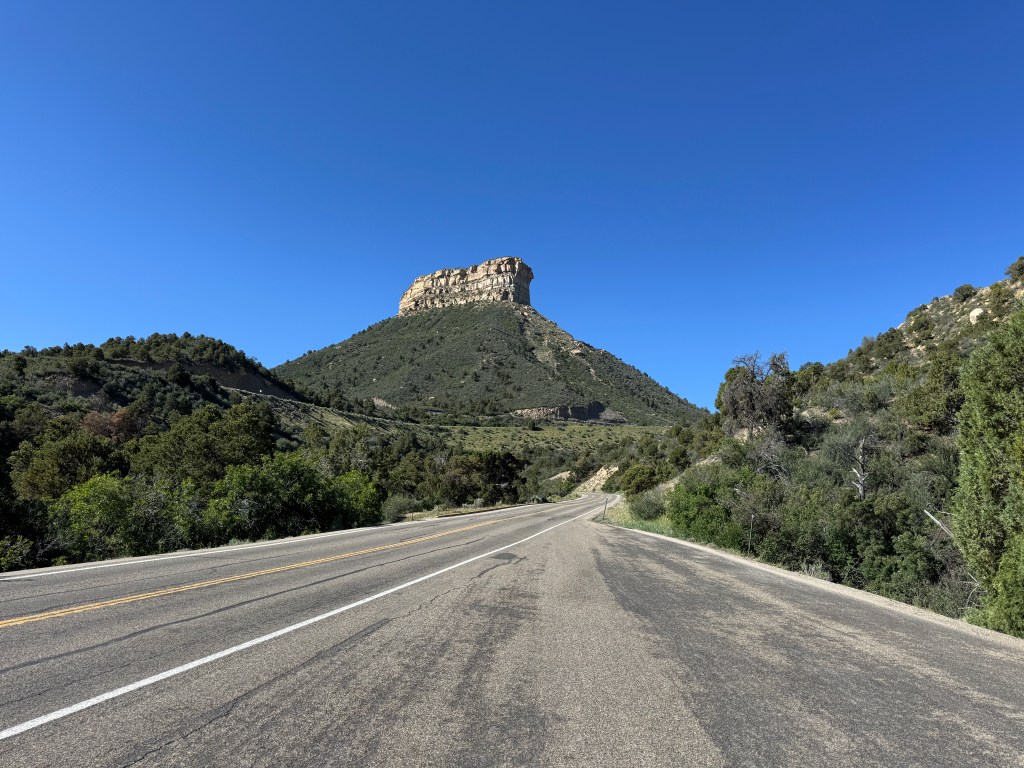
The Mesa at Mesa Verde National Park appears to be a green table, but it is a cuesta, a cliff with a flat ridge and a slope. (Melodie Miller | Photographer)
Reporting from Mesa Verde, Colorado
June 11, 2026 2:48 p.m. MDT, Updated June 23, 2926 4:24 p.m.
____________________________________________
Did you know…
The Mesa Verde in the national park, just 38 miles west of Durango, is not actually a mesa.
And, although the home of the Cliff Palace dwellings bears a Spanish name, they were built by the Ancestral Puebloan peoples.
“Many of the Pueblos were named by the Spanish,” Dr. Scott Ortman, of the University of Colorado Boulder, said. “It tends not to be very common for archaeological sites to be renamed to the indigenous language names.”
Attribution of Mesa Verde started with early speculation about the Aztecs and Aztlan. However, cultural consistency emerged between Cliff Palace and the modern Pueblos of the Four Corners, connecting the two places.
Dr. Steve Lekson, Professor of Anthropology at the University of Colorado, writes in A History of the Ancient Southwest that “Cliff Palace might be empty and abandoned, but only a few days’ walk away were Pueblo peoples who built towns that looked like Cliff Palace.”
In 1776, according to Legends of America, two Mexican-Spanish missionaries, Francisco Atanasio Dominguez and Silvestre Vélez de Escalante, were leading explorers from Spain through the region. They camped at the base of the La Plata Mountains, near the flat forested area of Mesa Verde. 83 years later, in 1859, Mesa Verde is attributed to John S. Newberry, although the name had been in use prior to his writing.
“The earliest permanent settlements here at Mesa Verde date back to between 500 and 600 CE and are often characterized by pit houses which can be seen on the mesa tops of both Chapin and Wetherill Mesas. The alcove sites (cliff dwellings) were mostly constructed beginning in the late 1100s to early 1200s CE,” Dalton Dorrell, Mesa Verde National Park Service Supervisory Park Ranger of Education, Community Outreach, and Interpretation, said.
The Spanish word mesa translates to table, a flat surface. But Mesa Verde is a cuesta, a steep cliff with a flat ridge on top and a sloping plain on the other side.
“Cuesta has been used as a geological term only since the early 19th century. It is not unusual for the geological term and the place name given to a location to differ,” Dorrell said.
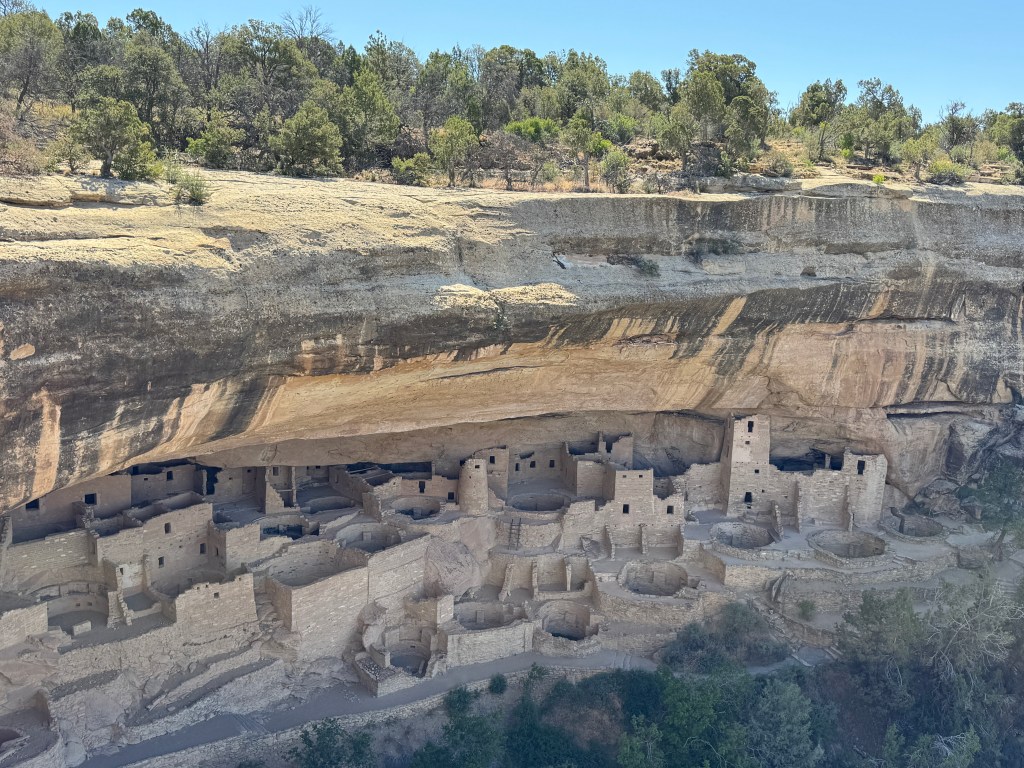
Cliff Palace, Mesa Verde National Park Ancestral Puebloan dwellings ( Melodie Miller | Photographer)
Then, in 1888, according to Lekson, Richard Wetherill and Charlie Mason came across the Cliff Palace.
“Cliff Palace is discovered by this cowboy who lived in Mancos named Richard Wetherill,” Lekson said.
On December 18, 1888, Wetherill, his brother-in-law Charles Mason, and their Ute guide Acowitz saw Cliff Palace and went on horseback to investigate.
Wetherill, Mason, and Acowitz, came across the cliff dwellings of the Ancestral Puebloans while “rounding up cattle in the snowstorm. And I guess there’s some questions to whose cattle was he rounding up,” Lekson said.
After the discovery, a significant movement emerged to preserve the 12th-century cliff dwellings and the artifacts found at Mesa Verde.
Wetherill “leaves the place seven ways to Sunday, and it’s just full of stuff. The Pueblos left pots and baskets and all kinds of stuff.” Lekson said. Wetherill “takes a bag full of this stuff up to and tries to sell it. I’ve seen the newspaper advertisements.”
According to the New Mexico Historical Review, Wetherill’s father, Benjamin Wetherill, “looked at the relics and realized the importance of the finds.”
Wetherill writes a letter to the Smithsonian requesting that it take over funding to protect the ruins and artifacts. Over time, interest in protecting the ruins grows.
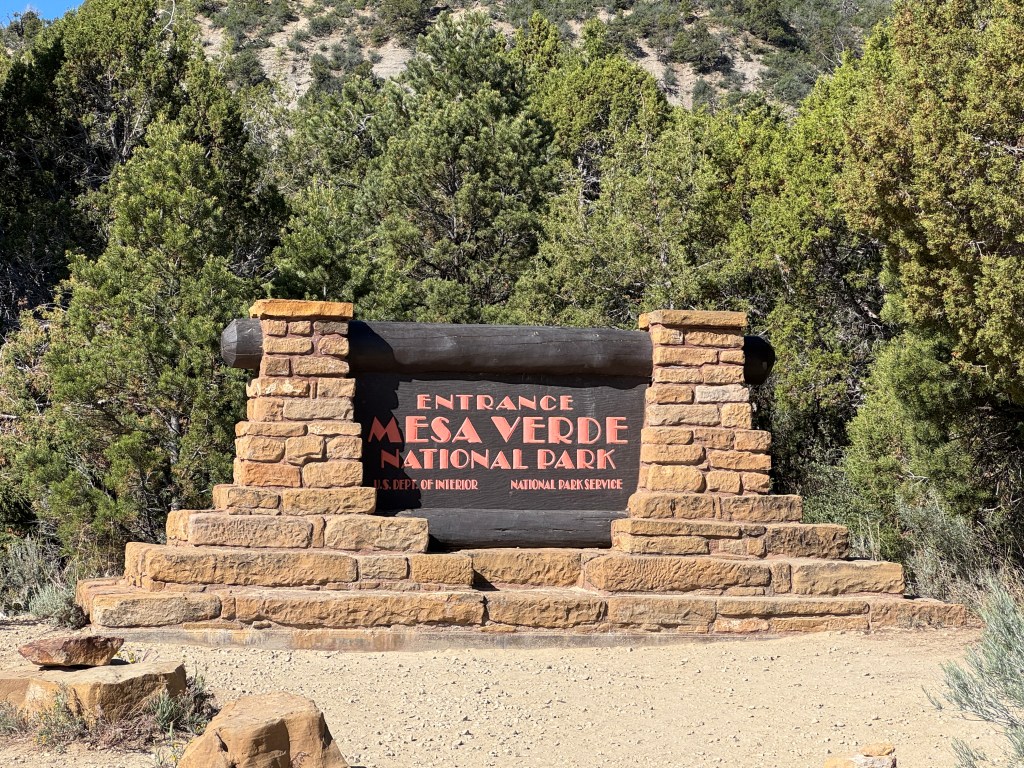
The Mesa Verde National Park sign is emblematic of the Art Deco style popular in 1906. ( Melodie Miller | Photographer)
In 1906, President Theodore Roosevelt signed the congressional bill to preserve the area’s ancient works, specifically 5,000 ancestral man-made sites and artifacts. Although Mesa Verde is a cuesta, the name remains, and the Ancestral Puebloans’ cliff dwellings are preserved.
Mesa Verde is located 35 miles west of Durango, at 35780 US-160, Mancos, CO 81328.
Melodie Dawn Miller
- melodie.miller@gmail.com
Melodie Dawn Miller is an apparel industry professional with expertise in design, development, and production. She holds bachelor’s degrees in English Literature and Classic Civilizations. She is currently studying French and Journalism at the University of Colorado.
-
Research and Technical Applications – Apparel Design by Melodie Miller

Photos courtesy of SKEA
SKEA Skiwear
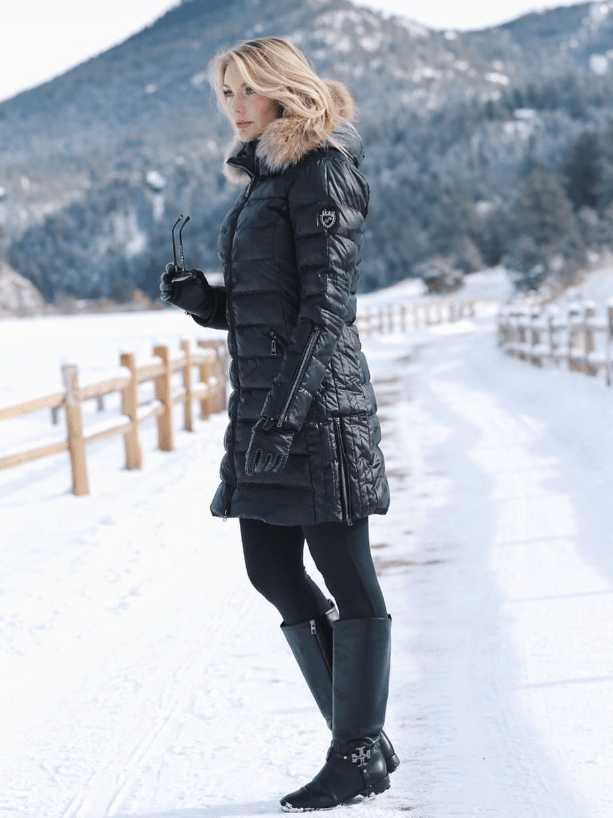
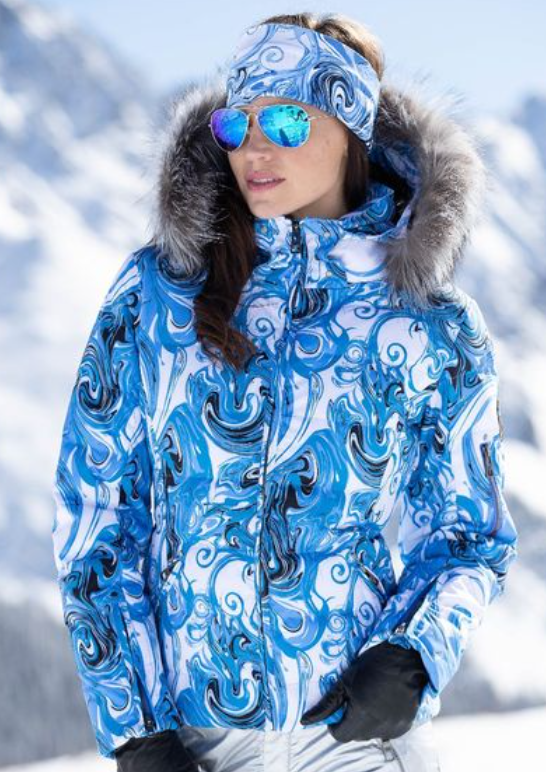
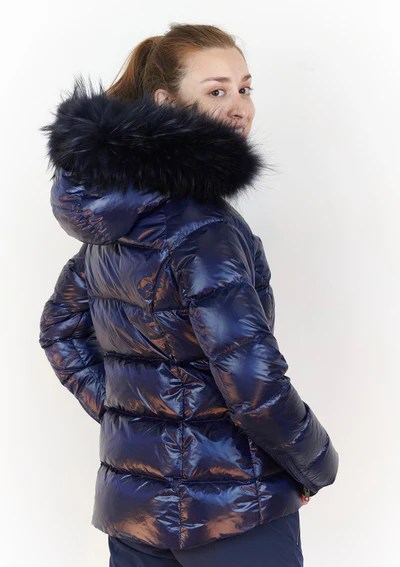
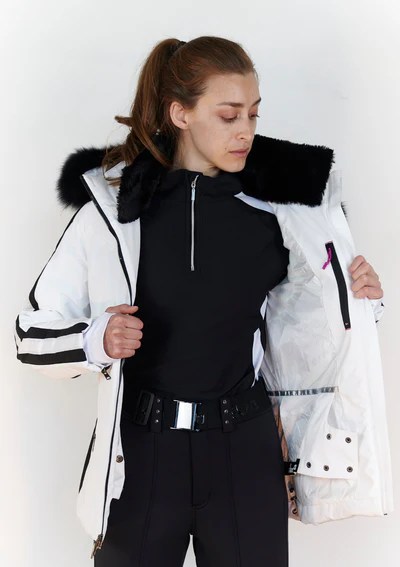
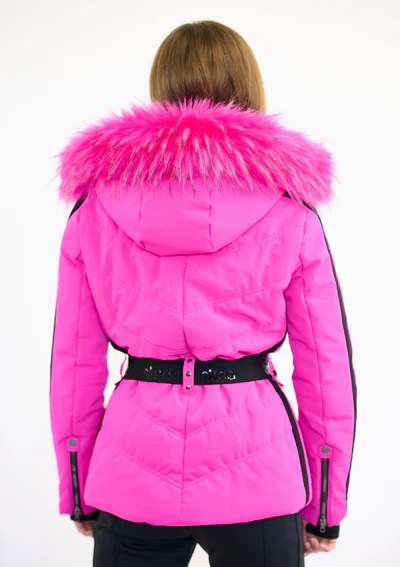
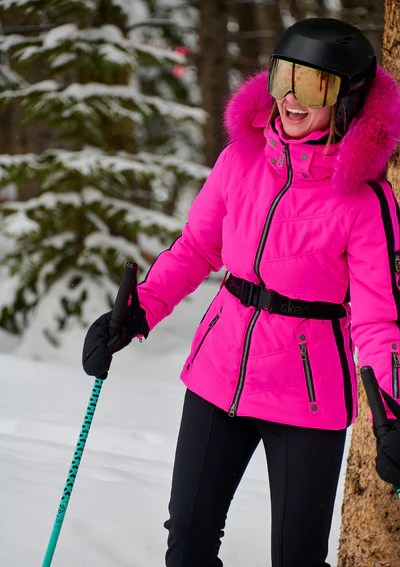
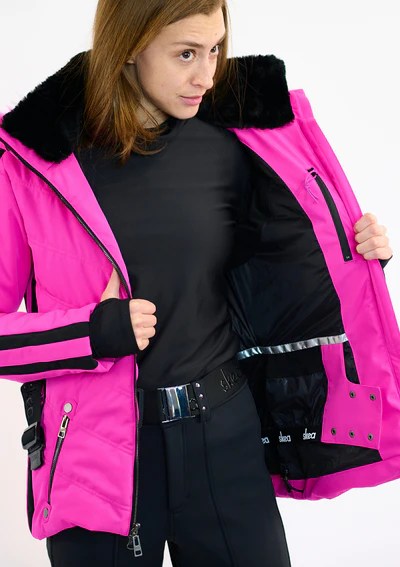
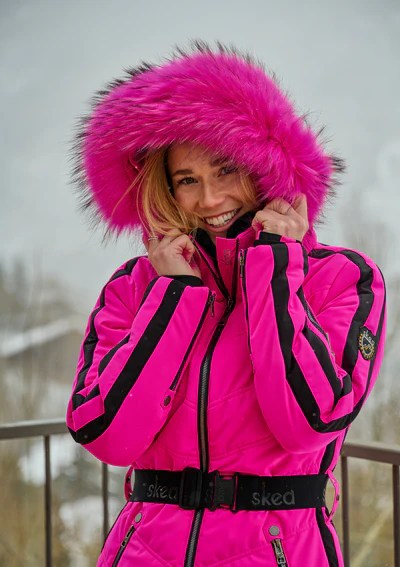
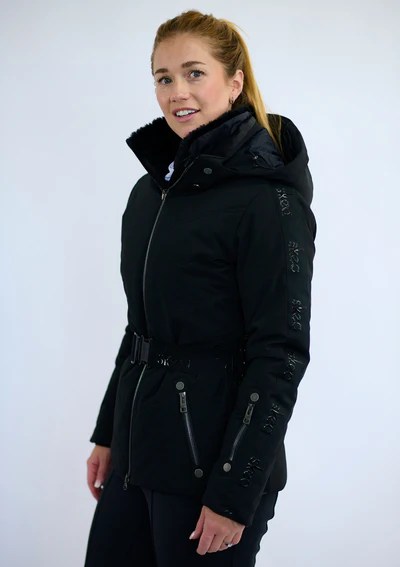
The SKEA Elsa down filled ski parka with matching fur ruff.
Photos courtesy of SKEA
- Nylon Ciré – Ciré is a highly glazed wax finish that creates a water resistant barrier.
- Down filled insulation throughout
- Underarm ventilation zips.
- Interior sleeve cuff with thumb holes.
- Interior snow-skirt
- 3 zipper pockets
- Fixed collar and hood
- Optional snap-on real/faux fur trim
- An athletic fit with room to move
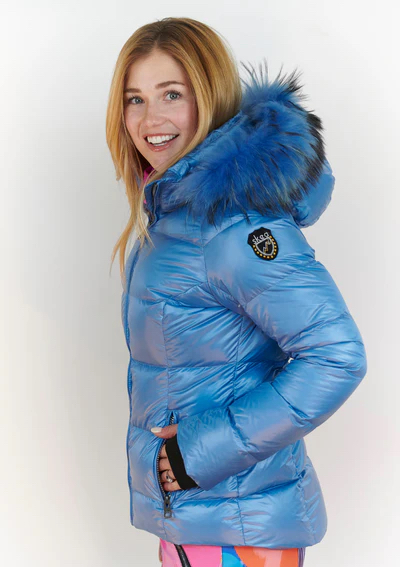
Unleash your skiing flair with the SKEA Elsa Jacket. This jacket is not just breathable and hydrophobic, but effortlessly shifts from the slopes to the streets. Filled with down, it offers unbeatable warmth and adaptability for your mountain adventures. The Elsa parka combines purpose and femininity, and comes in a range of colors to match your taste.
Photos courtesy of SKEA
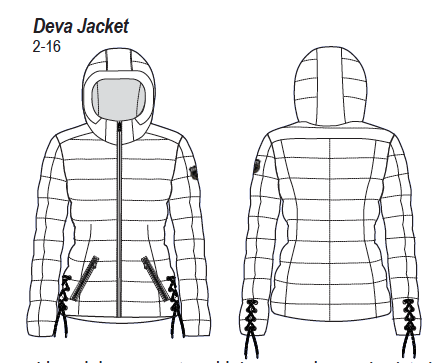
The SKEA Elsa down filled parka sketch and production instructions

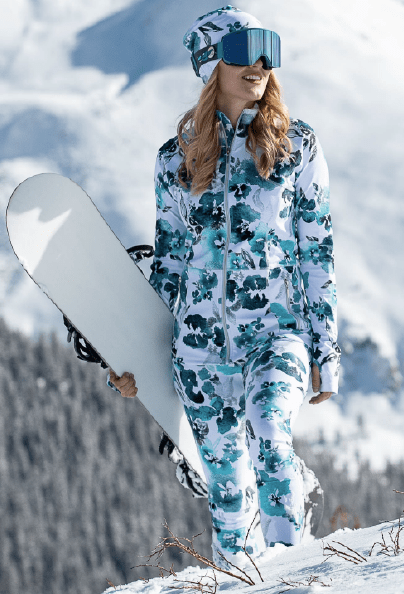
SKEA photo shoot at Loveland Pass, Colorado
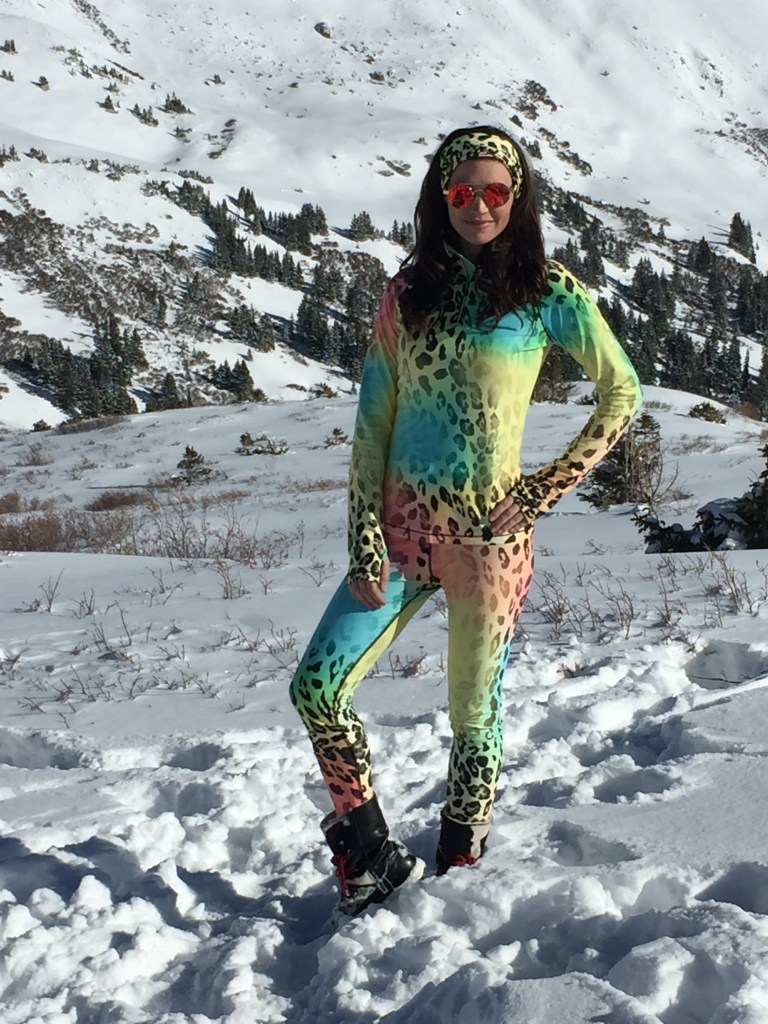


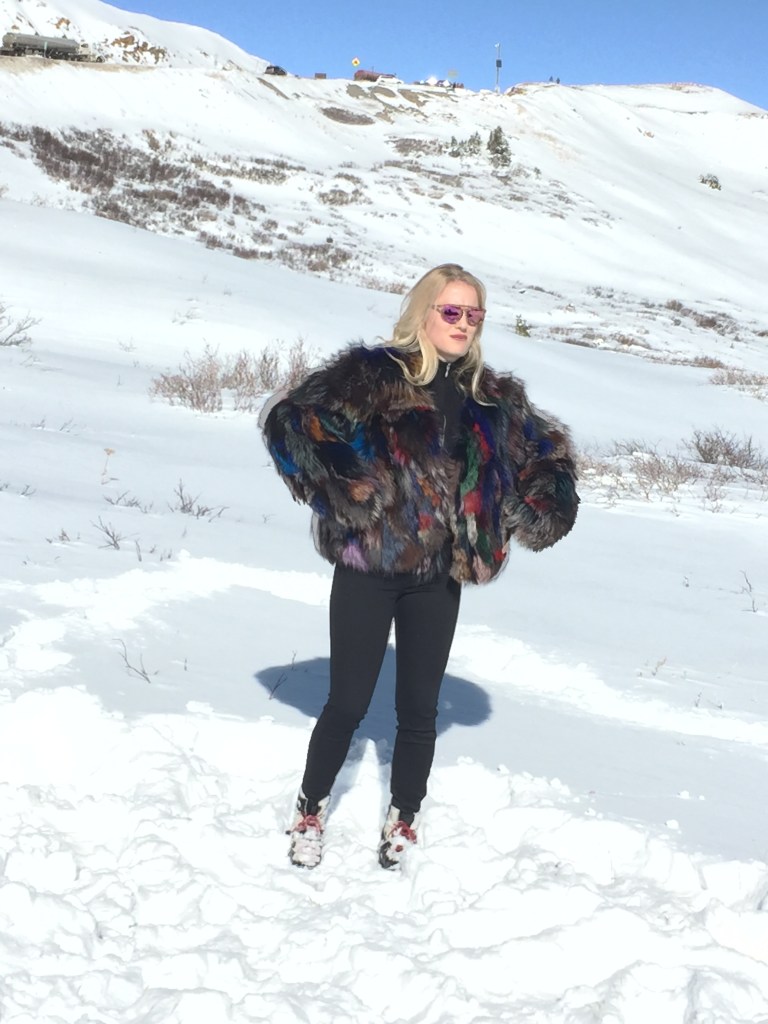







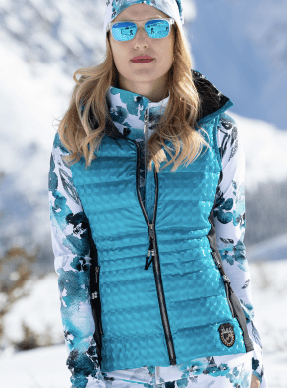
Photos courtesy of SKEA
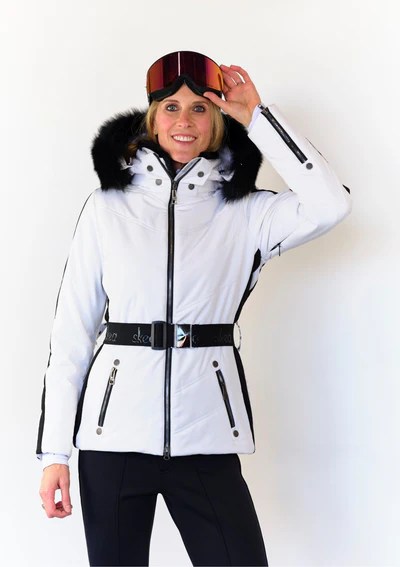
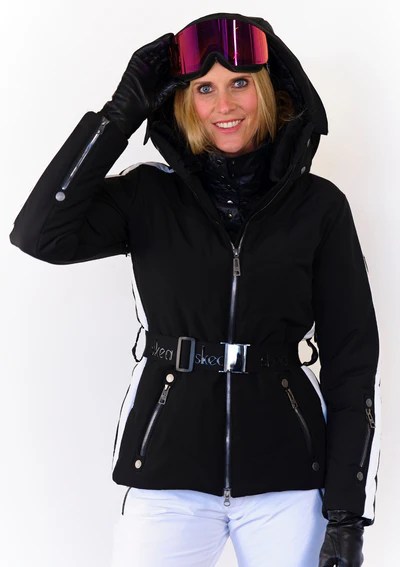
The SKEA vintage ski-wear inspired Thinsulate insulated Coco Parka
Photos courtesy of SKEA
- Polyester Stretch super water repellant 20K WP
- 200 grams Thinsulate Insulation
- 4 zip pockets
- Faux fur lined inner collar
- Helmet compatible hood with optional fur trim
- Removable belt to wear or not with snap down belt loops
- Snow skirt
- Cinch bottom
- Slim fit
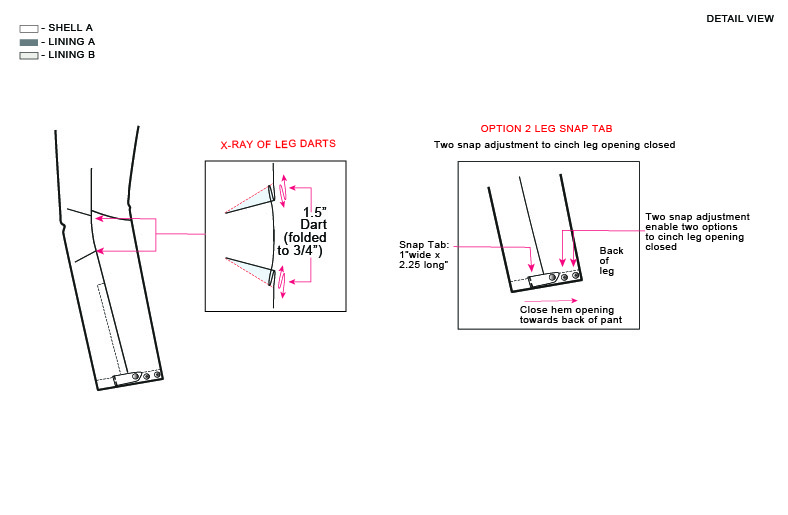
The Coco Thinsulate insulated parka sketch and production instructions


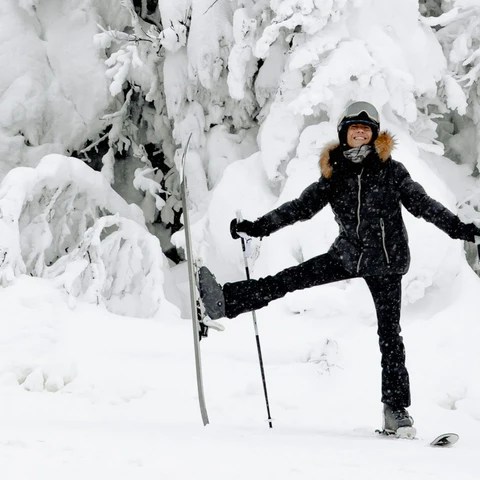

Photos courtesy of SKEA
Cosmic Vest is the perfect layering garment. Snuggle into the collar on icy days.
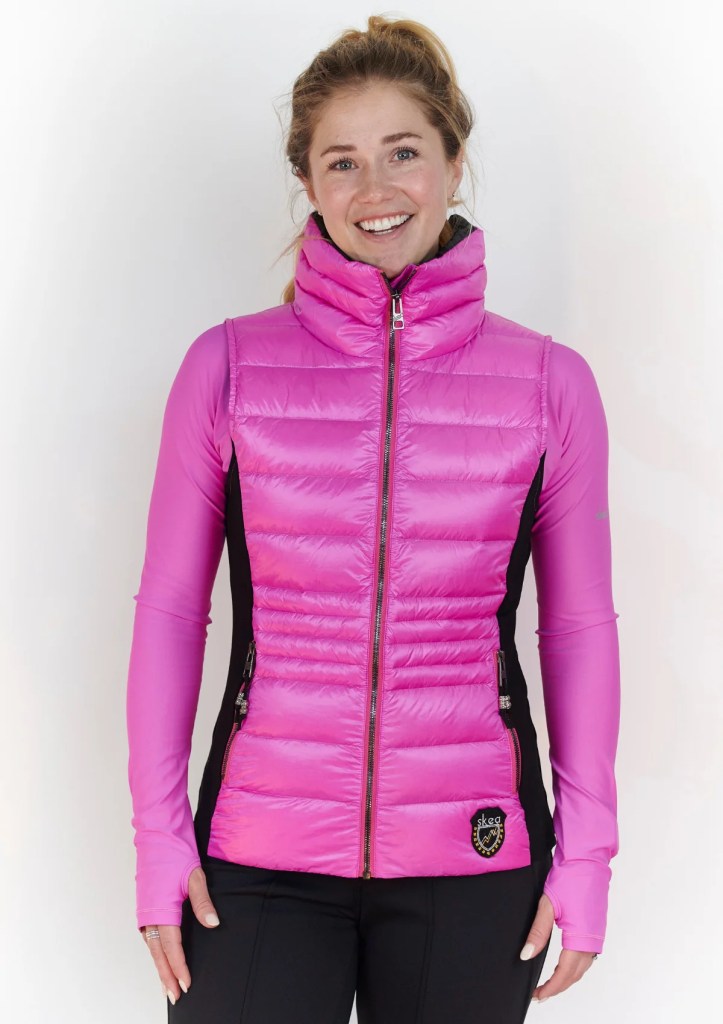
Photos courtesy of SKEA
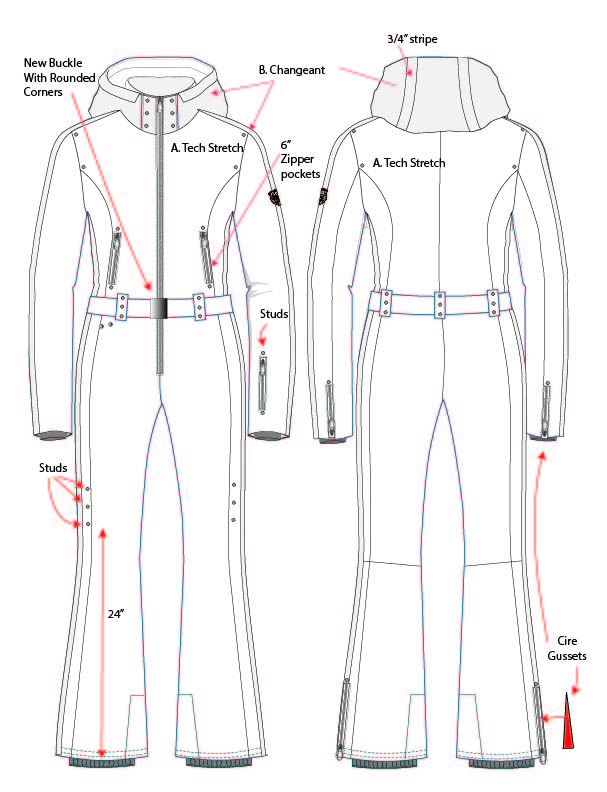
The SKEA Brit insulated ski suit

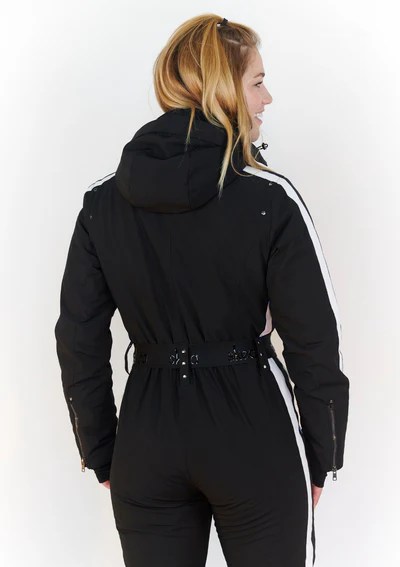
Photos courtesy of SKEA

Stay warm in Skea high quality, quick drying polyster knit baselayer’s designed by Melodie Miller

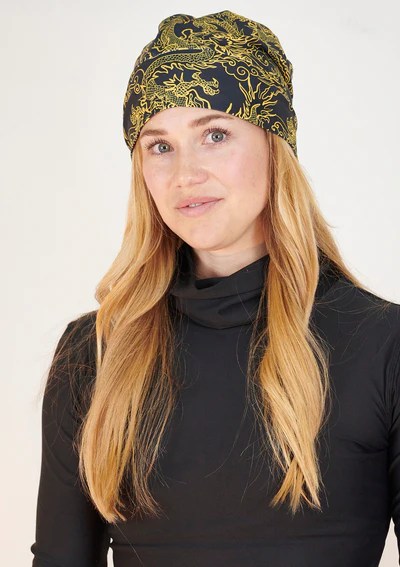

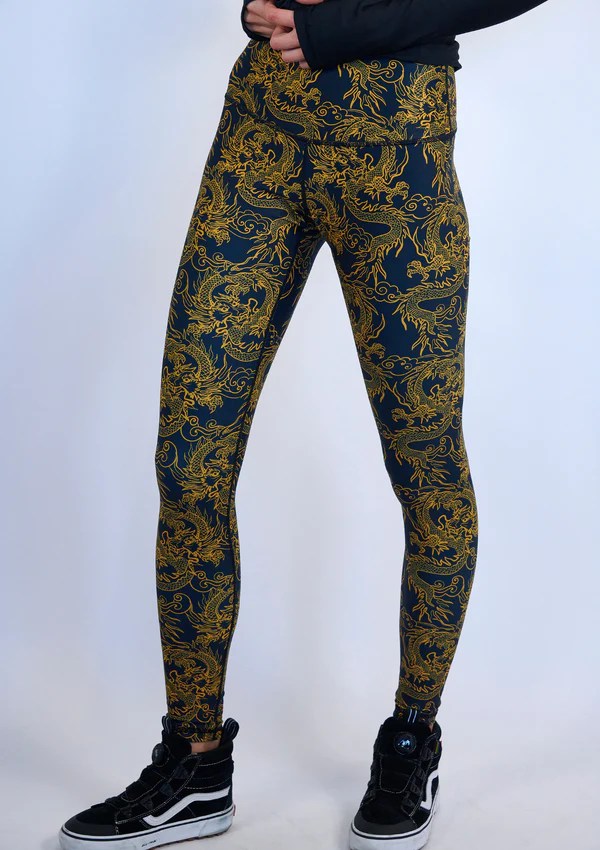


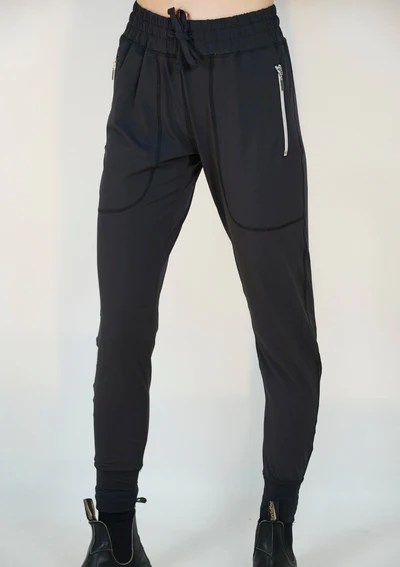
Tennis and Golf for Skea by Melodie Miller



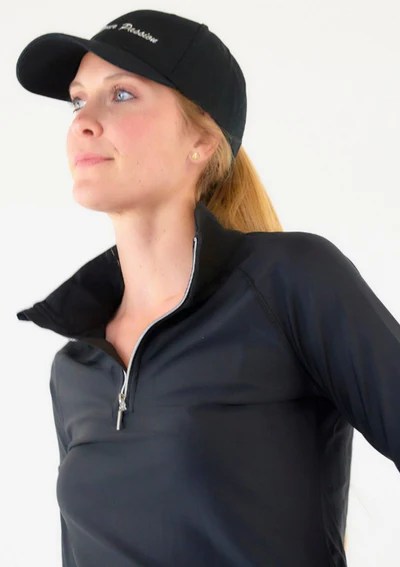


Sierra Design extreme elevation mountain apparel designed by Melodie Miller

Paul Nanawa wearing Sierra Designs designed by Melodie Miller | Mt. Rainier | Photo courtesy of Eric Larsen


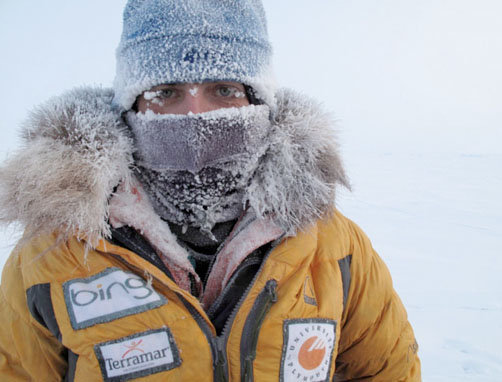
Paul Nanawa | Mt. Rainier | Eric Larsen | Both men wear Sierra Designs extreme weather gear designed by Melodie Miller | Photos courtesy of Eric Larsen
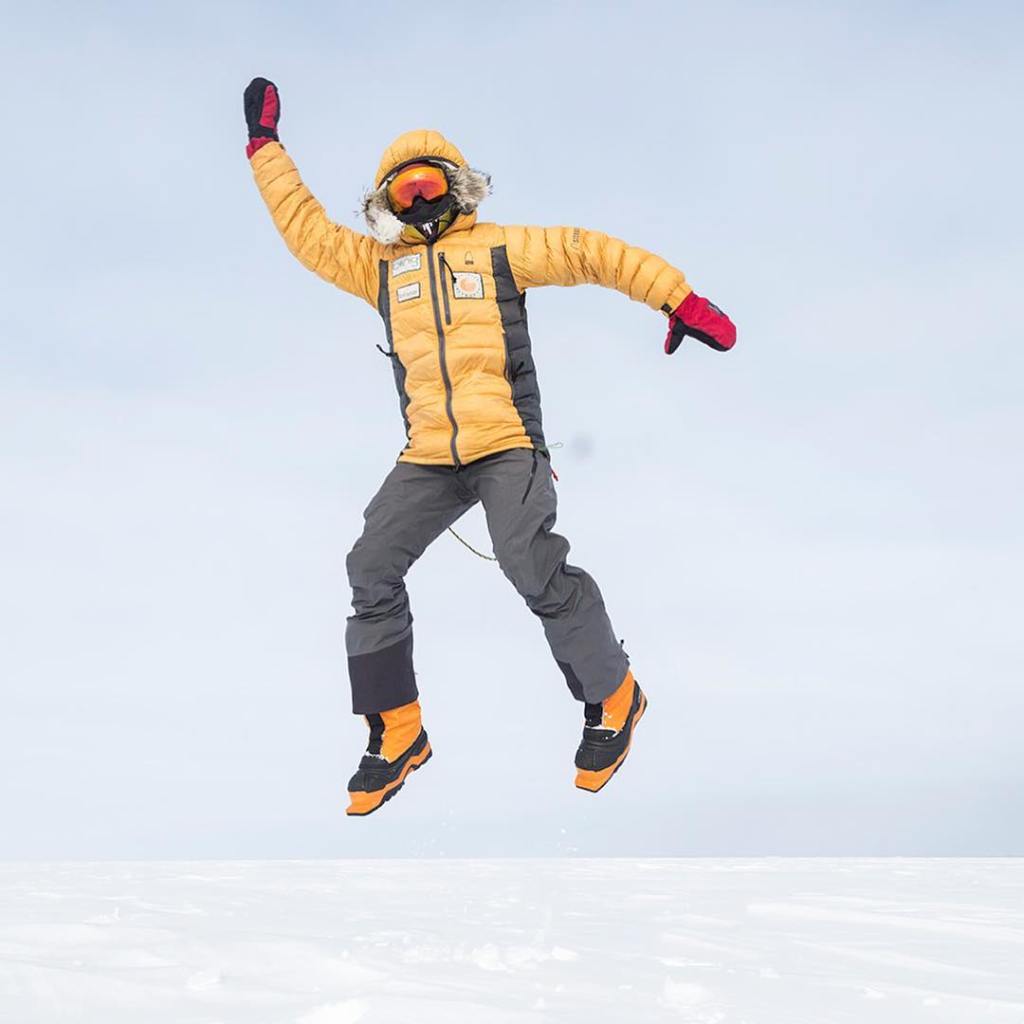
Eric Larsen and his team wear yellow and orange Sierra Designs cold weather gear designed by Melodie Miller | Photos courtesy of Eric Larsen

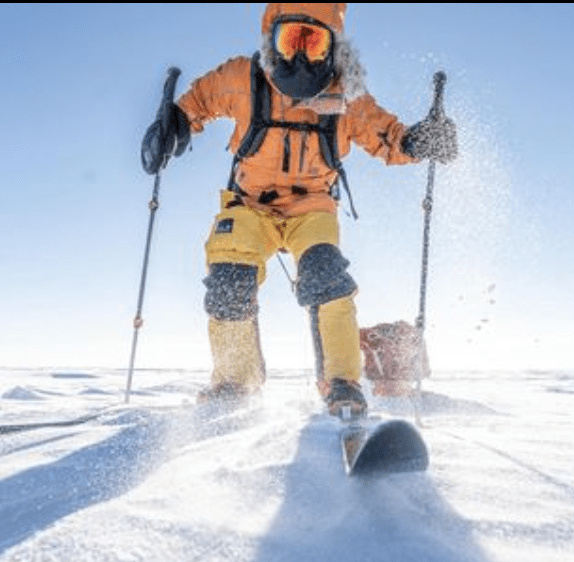

Eric Larsen and his team wear yellow and orange Sierra Designs cold weather gear designed by Melodie Miller | Photos courtesy of Eric Larsen
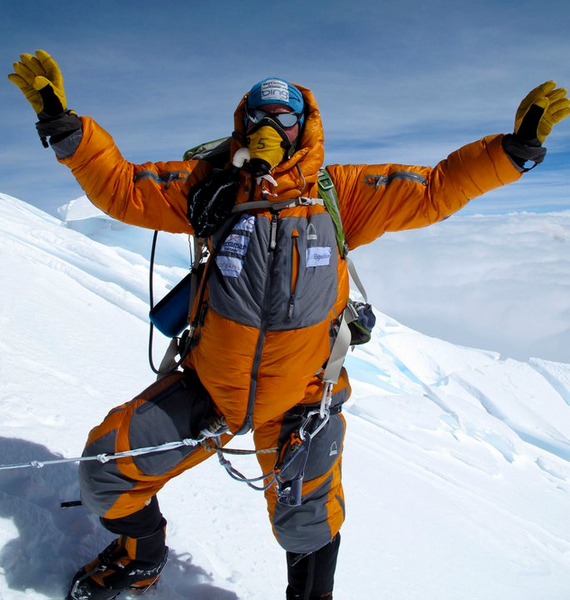

Eric Larsen attemps to summit Mt. Everest. (Right). Eric Larsens (Center right) expedition team wear orange Sierra Designs cold weather gear designed by Melodie Miller | Photos courtesy of Eric Larsen
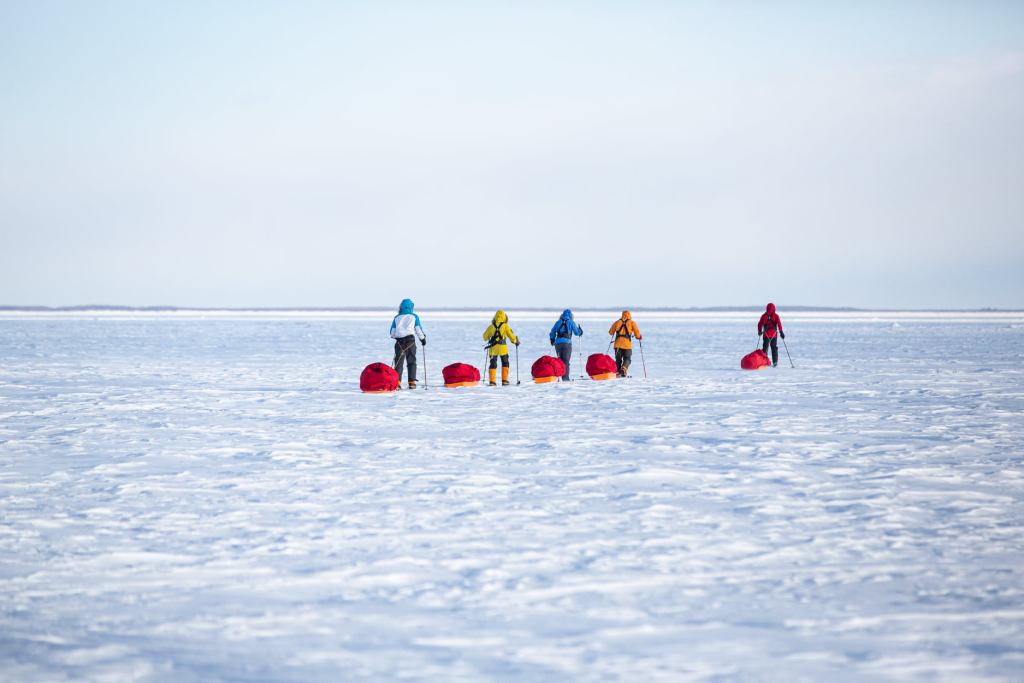
Eric Larsen and his team at the South Pole wear orange Sierra Designs extreme cold weather gear designed by Melodie Miller | Photos courtesy of Eric Larsen

Shaun Mauer at the summit of Mt. Rainier wearing Sierra Designs mountain gear designed by Melodie Miller.

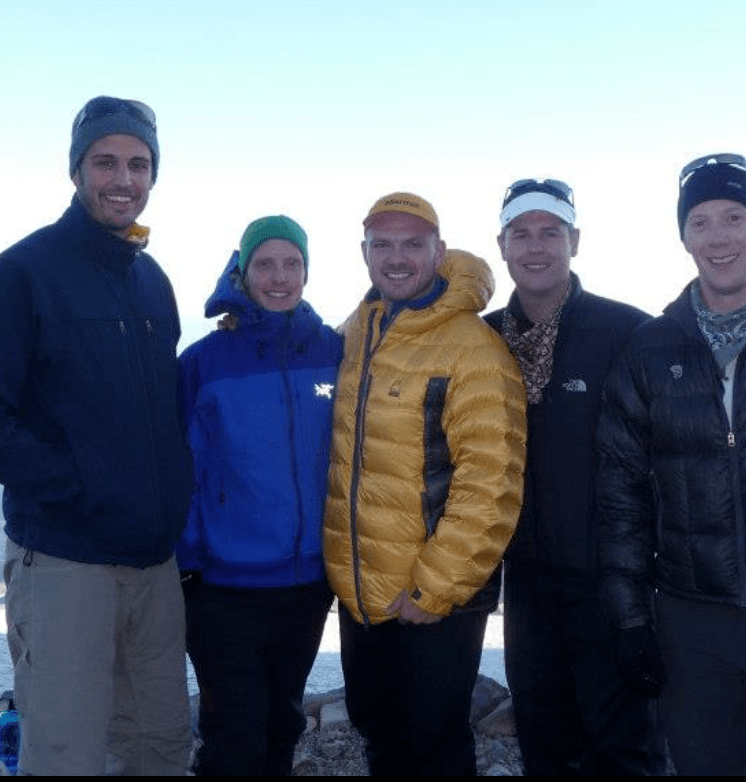
Brian Tschider and Shaun Mauer at John Muir as they prepare to ascend Mt. Rainier wearing Sierra Designs mountain gear designed by Melodie Miller. (Right) Shaun Mauer wearing Sierra Designs mountain gear designed by Melodie Miller. (Center Left)
HEXA Custom outdoor apparel designed and developed by Melodie Miller

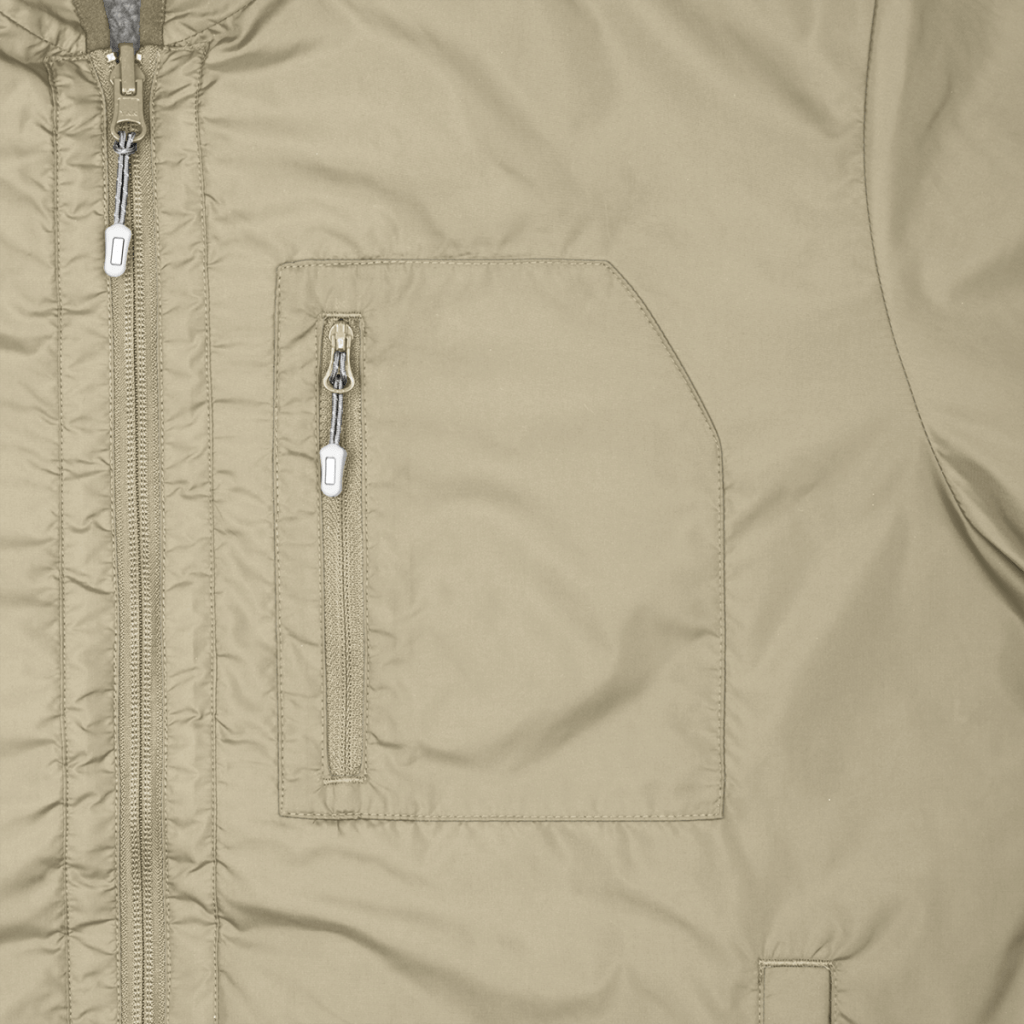


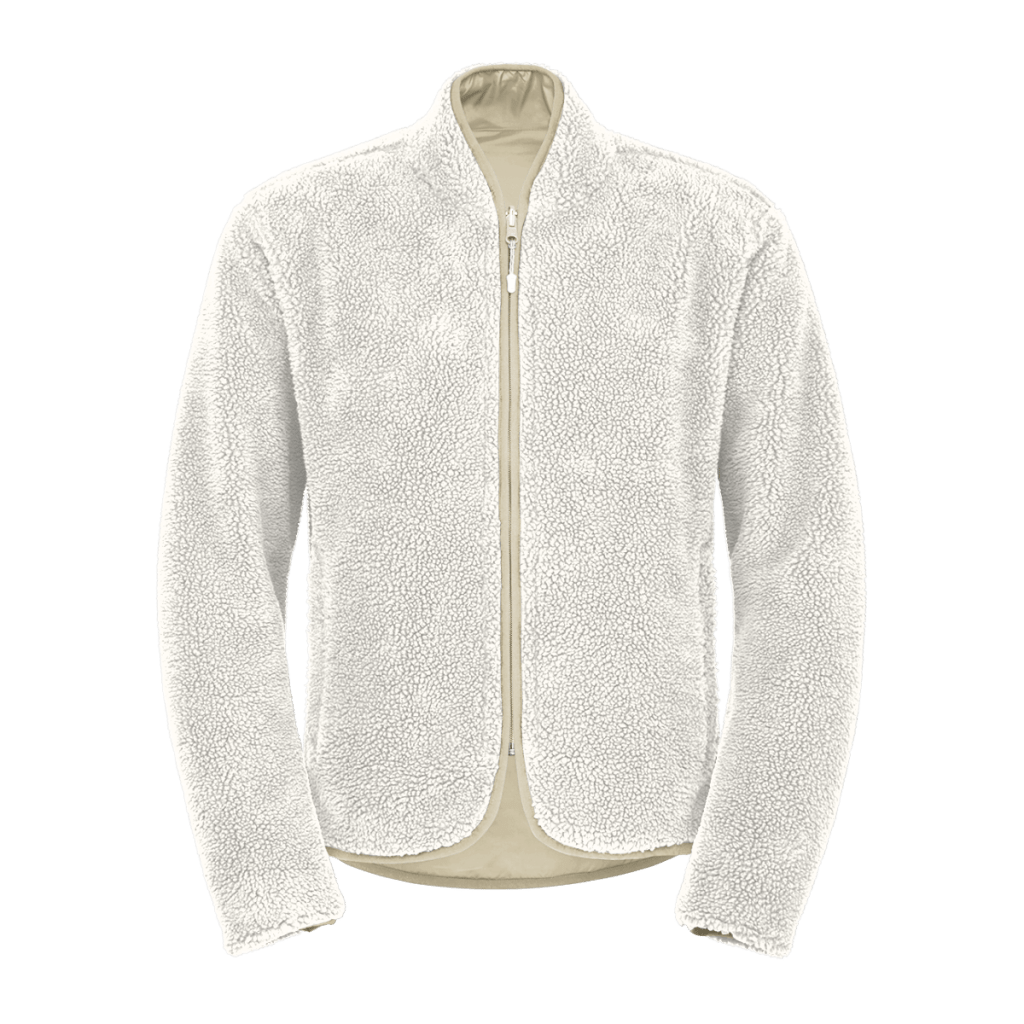
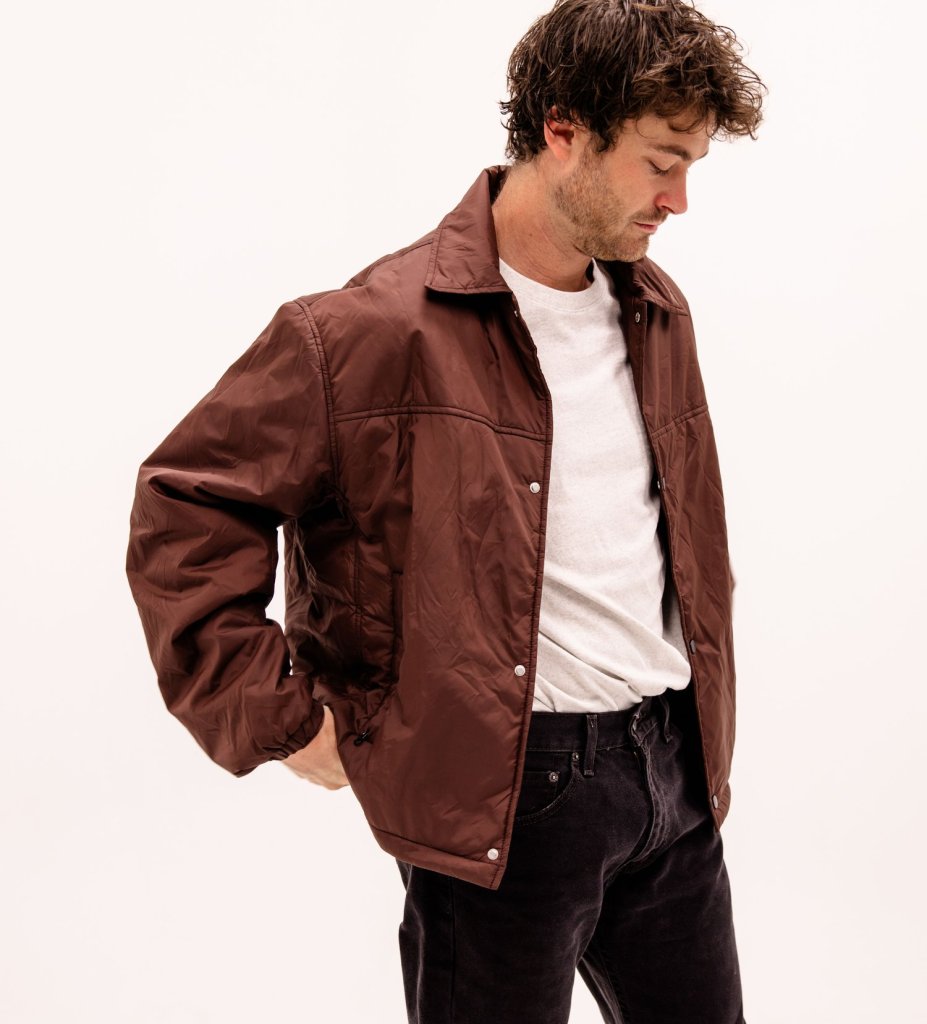


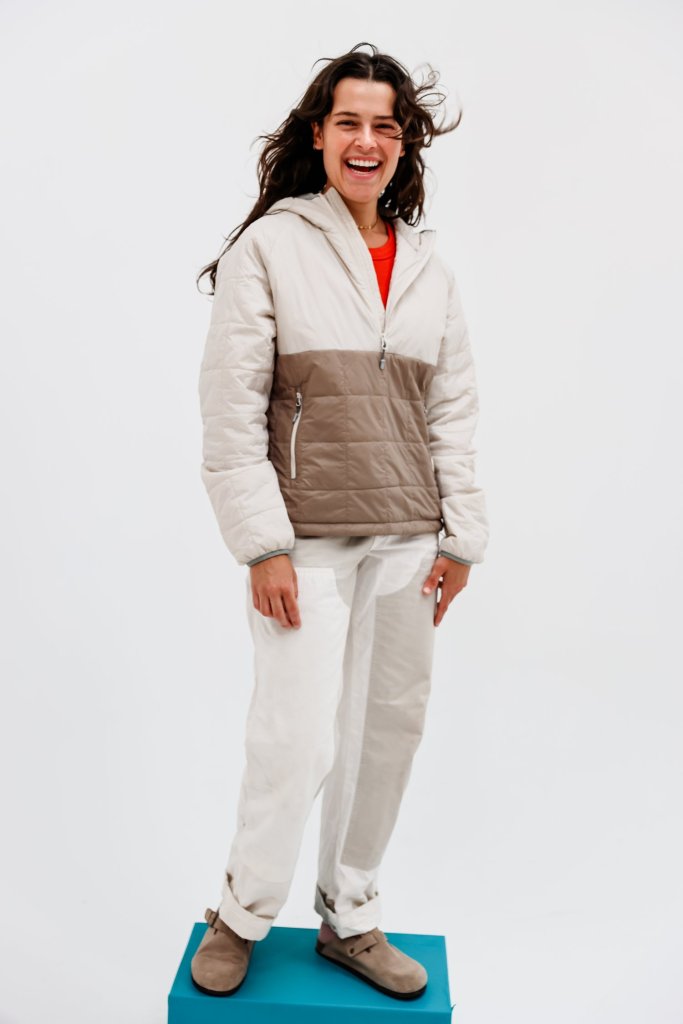
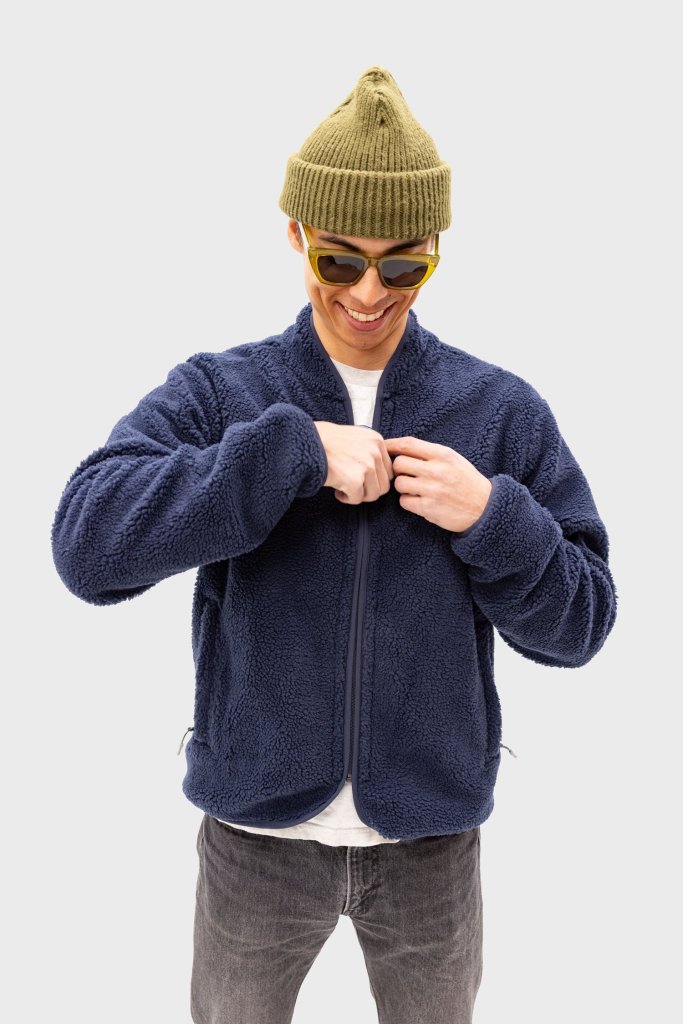
HEXA Reversible Sherpa Jacket (Photos courtesy of HEXA Custom)
Insulated Camping Blankets 57″ x 75″

HEXA Custom | Men’s Quilted Sherpa Vest | Sketch and Engineering
HEXA Custom | Women’s Standard Jacket | Sketch and Engineering
HEXA Custom | Men’s Standard Jacket | Sketch and Engineering
HEXA Custom | Men’s and Women’s Reversible Sherpa Vest | Sketch and Engineering

Academy Sports + Outdoors outdoor apparel designed by Melodie Miller


Academy Sports + Outdoors | Men’s Magellan Waterproof Jacket (Melodie Miller | Designer)
Academy Sports + Outdoors | Women’s Magellan Waterproof Pant (Melodie Miller | Designer)
Pearl Isumi Triathlon Suit

Dame Flora Duffy, DBE, is a Bermudian professional triathlete (Center) wearing Pearl Izumi developed exclusively for Duffy by Melodie Miller. Duffy won a gold medal at the 2020 Summer Olympics in Tokyo, Bermuda’s first gold medal. She also competed in the Beijing, London, and Rio de Janeiro Olympics. In 2018, she won gold in the women’s triathlon at the XXI Commonwealth Games in Australia.
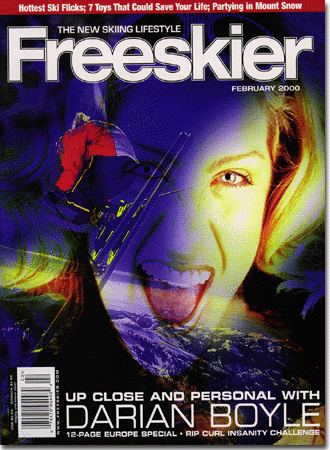
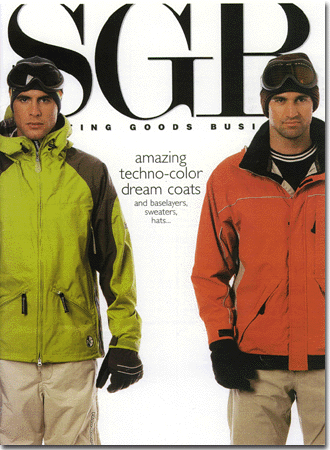
Magazine Covers of designs by Melodie Miller







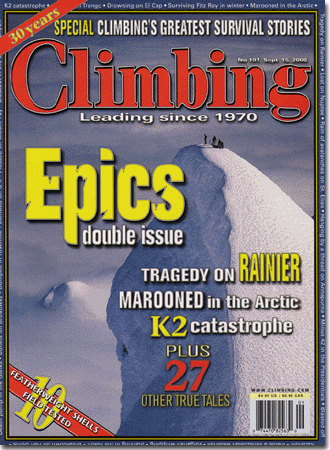



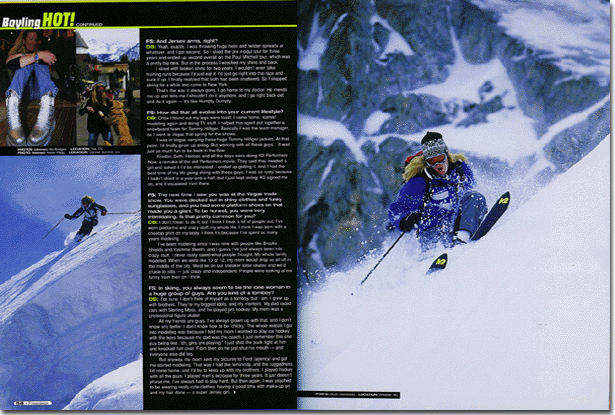
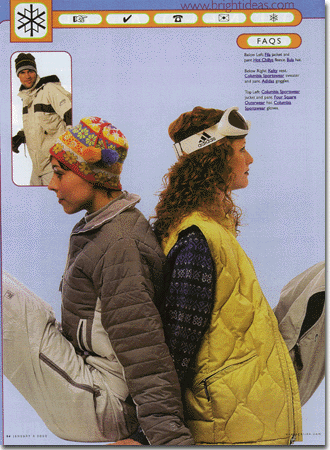
-
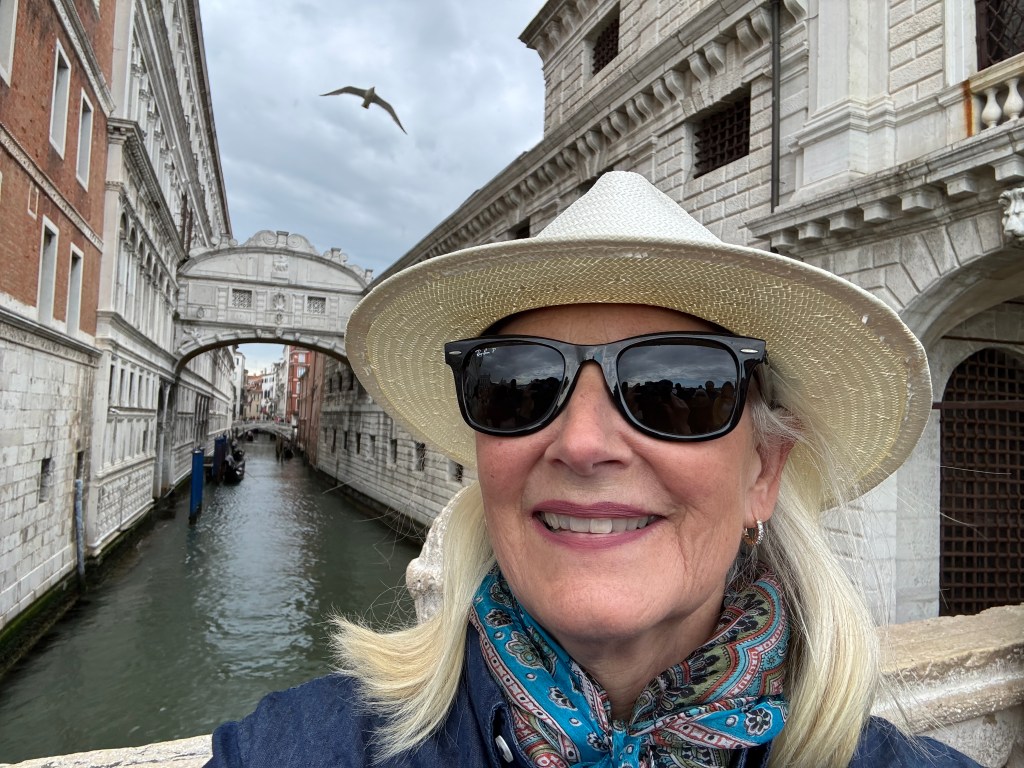
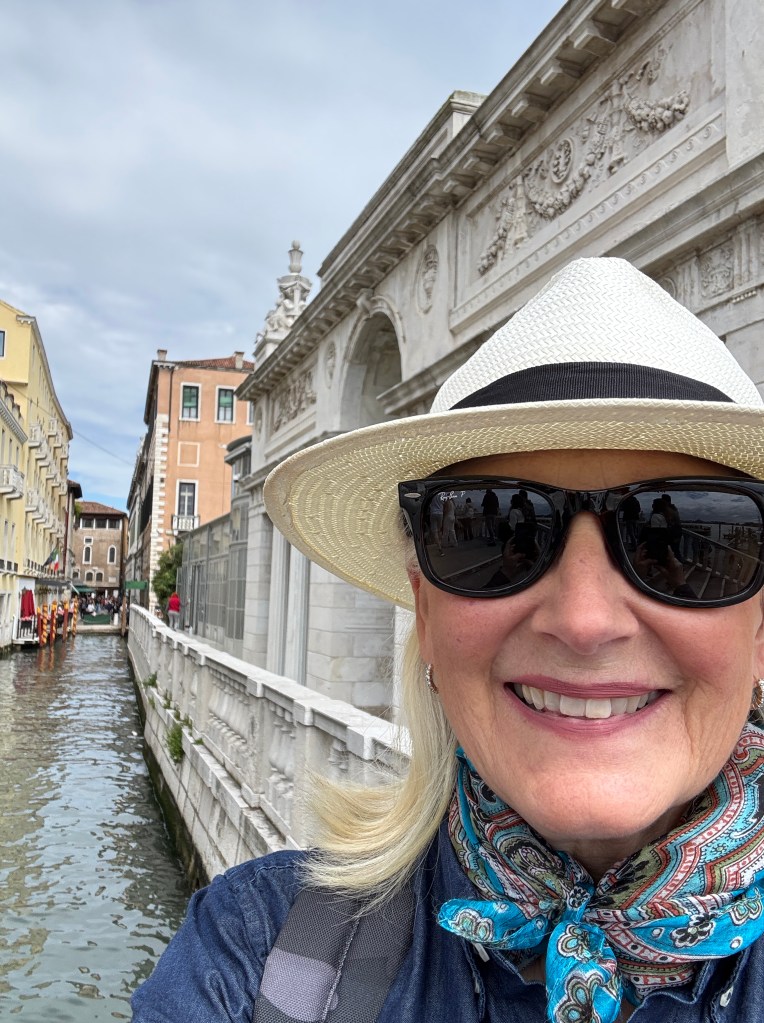
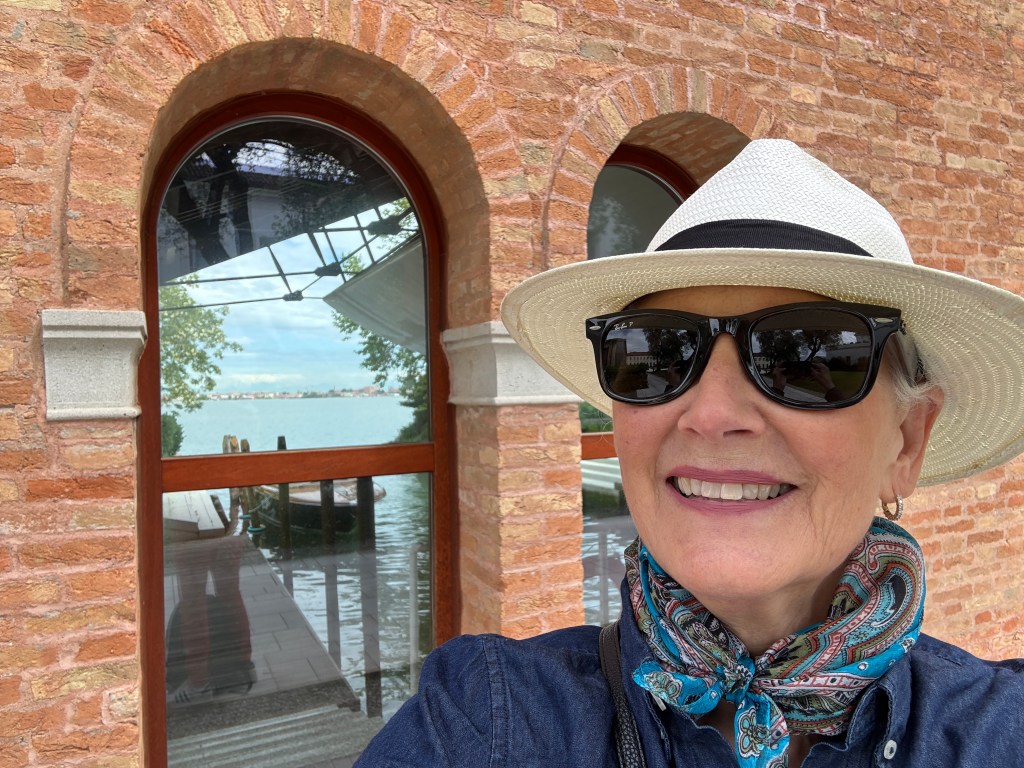
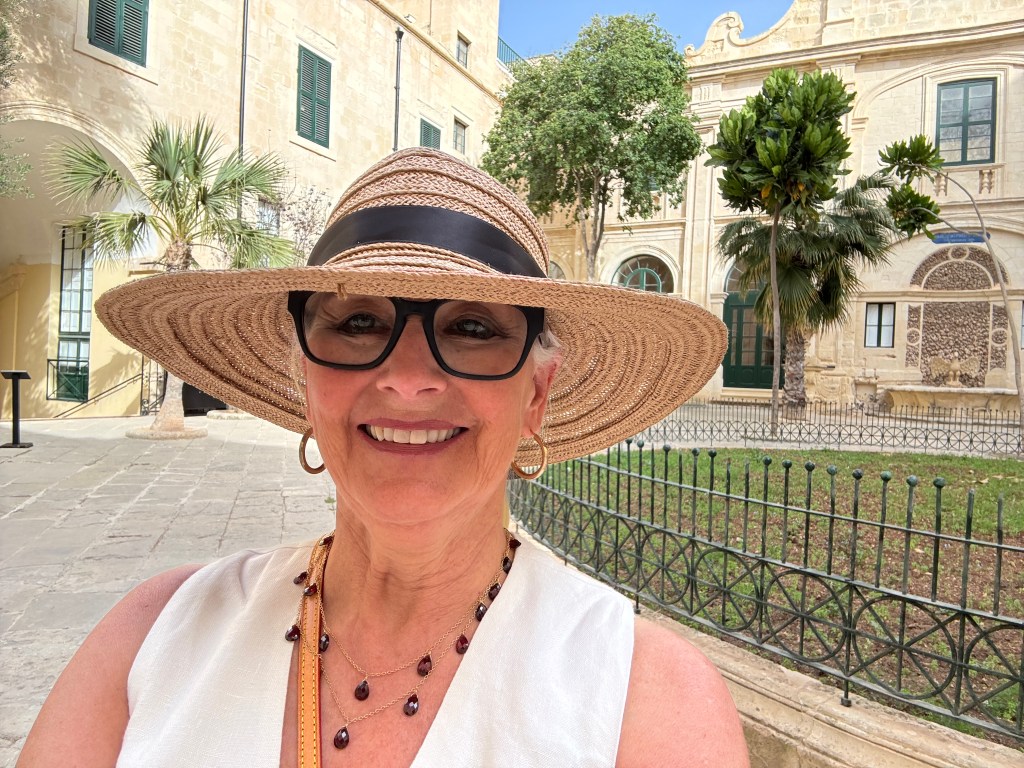
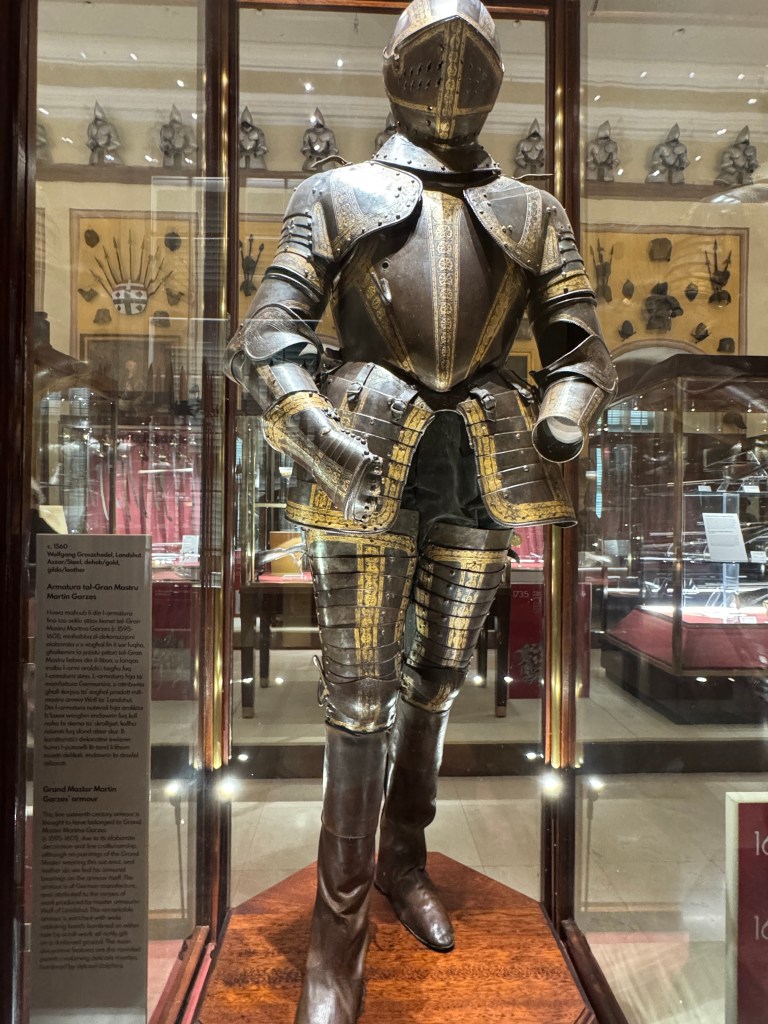
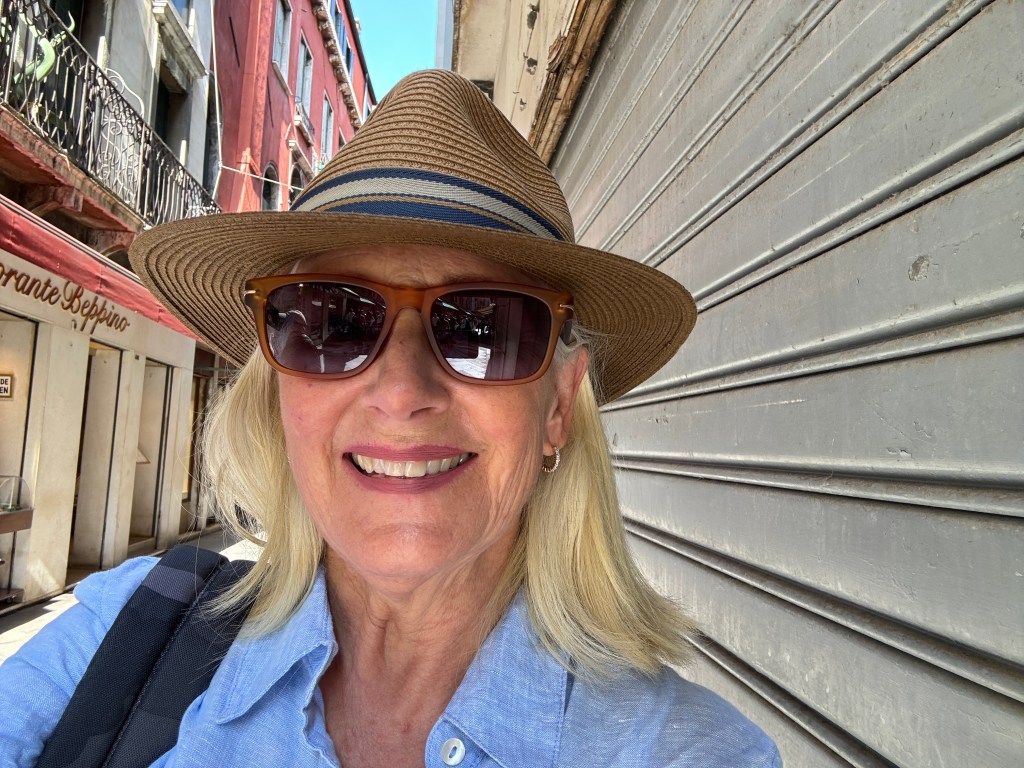
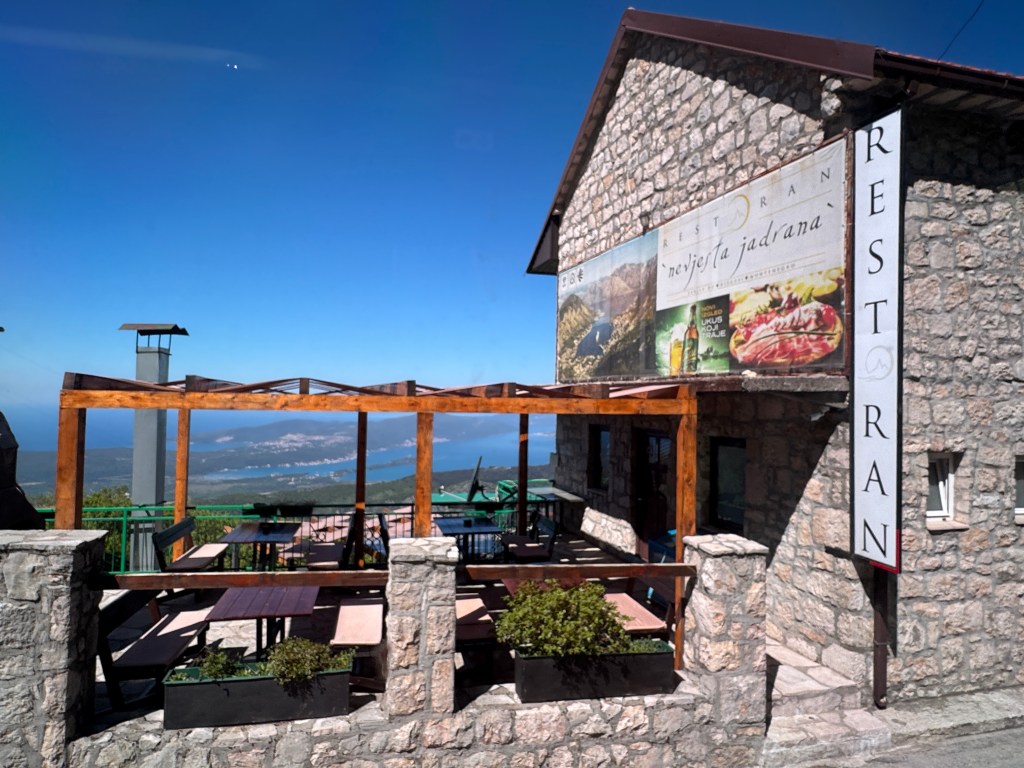
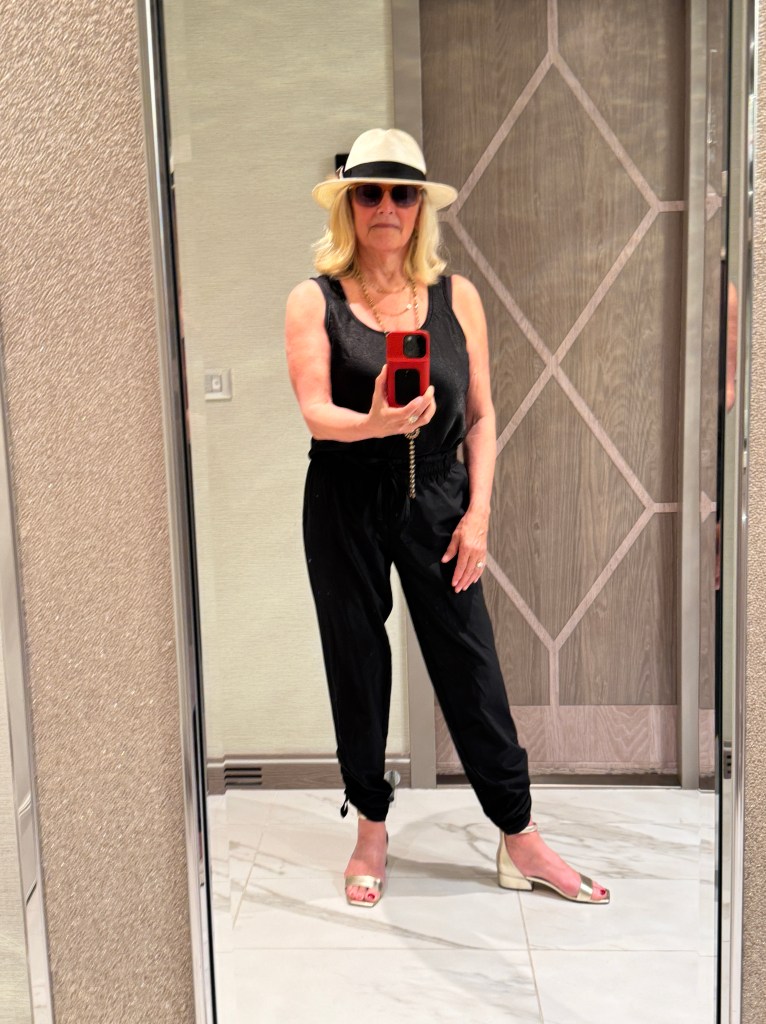
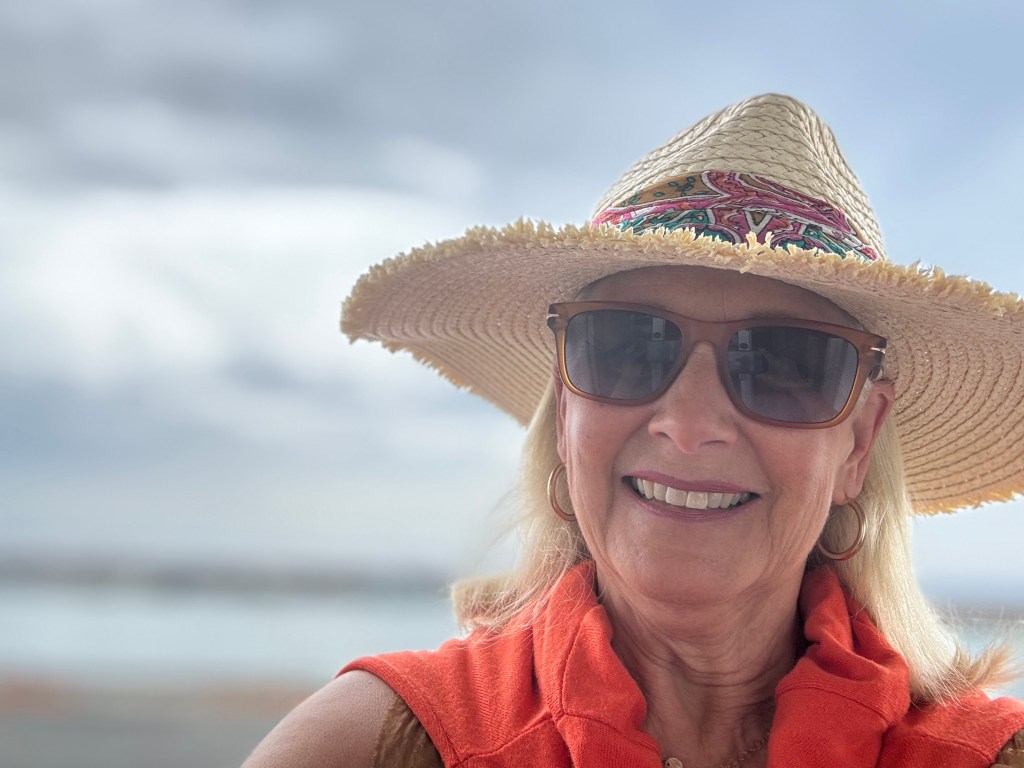
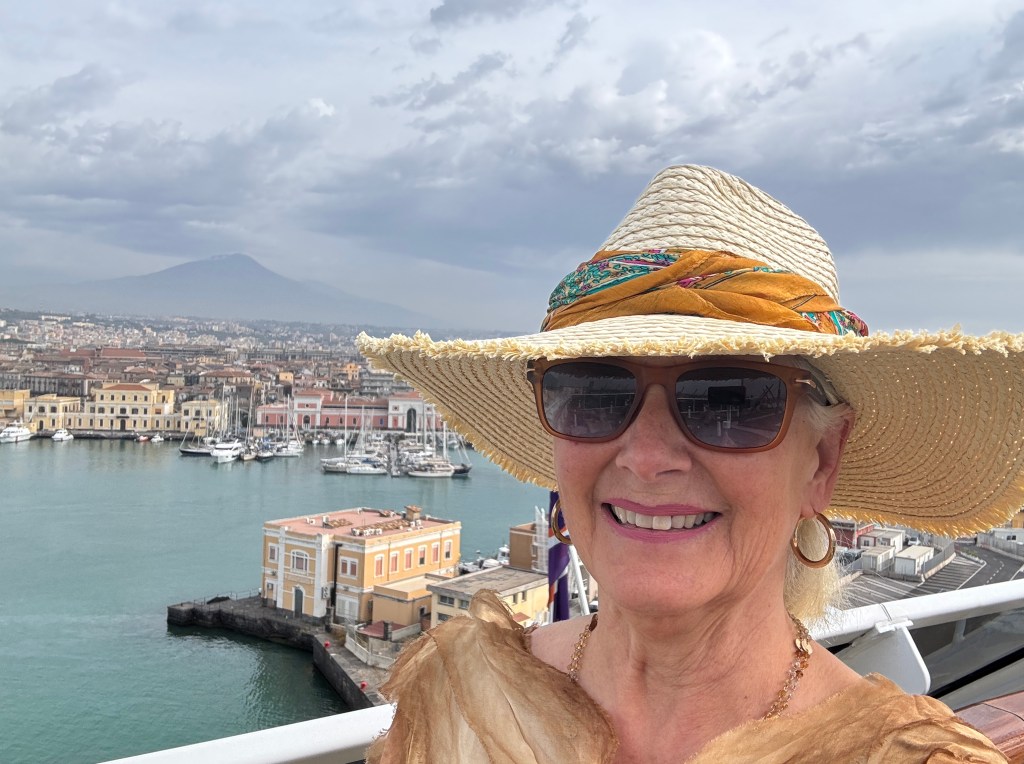
Dress with intent while summer traveling in Europe
Dressing for travel in Europe does not require excess. It requires intention.
by Melodie Miller |
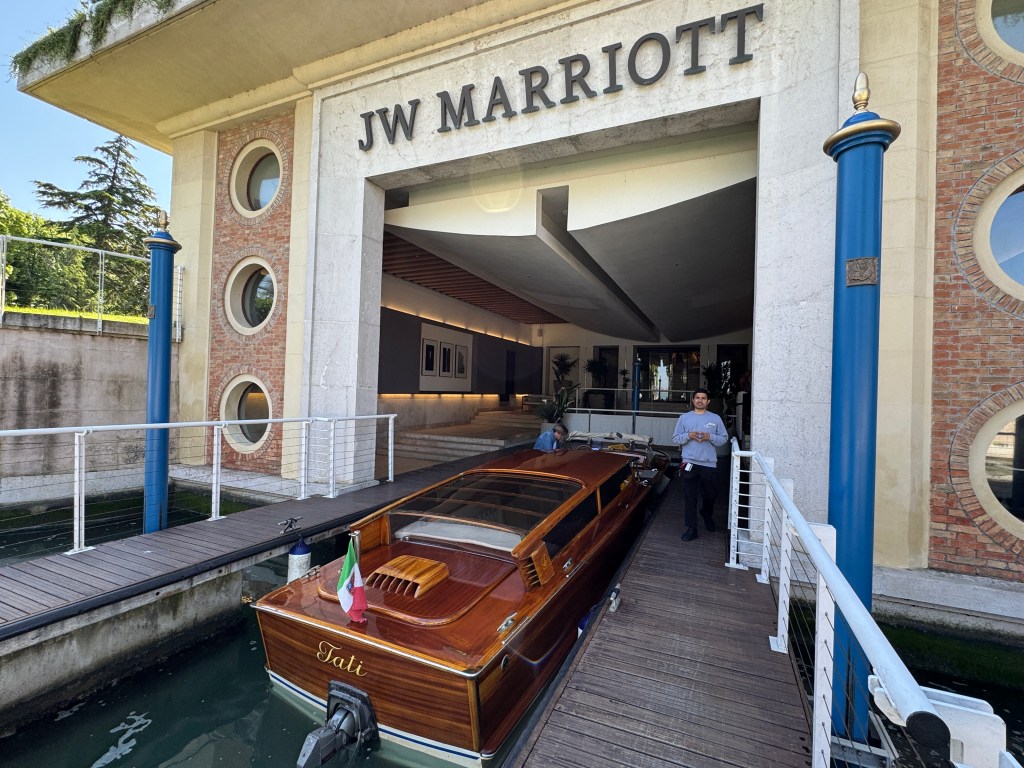
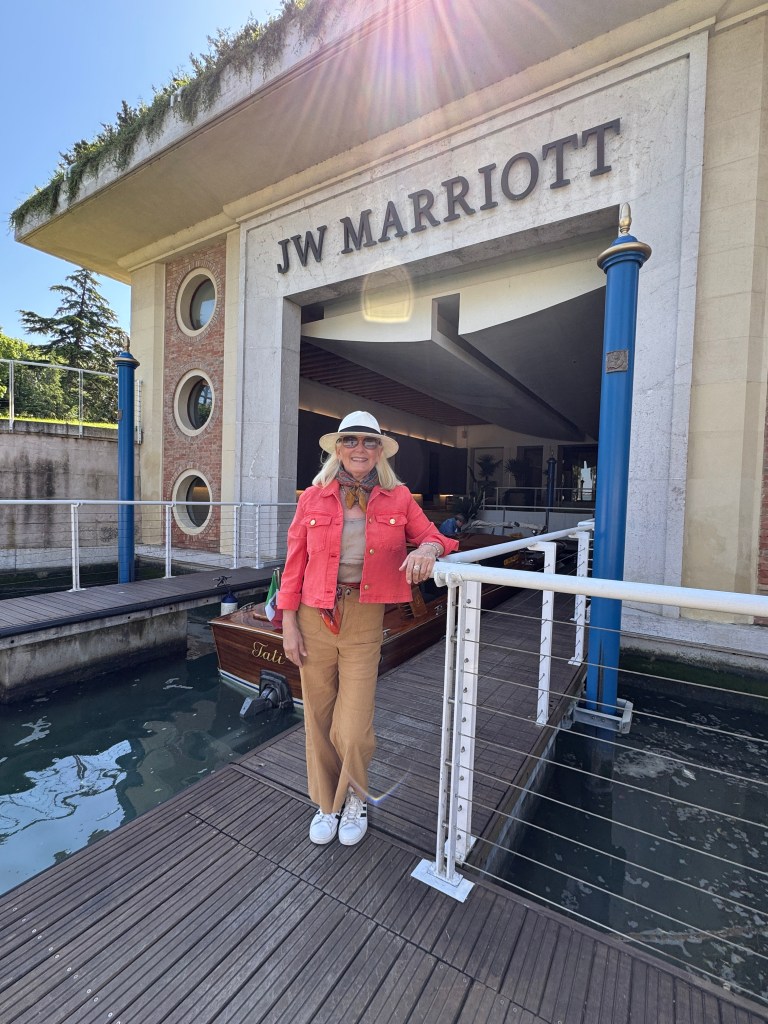
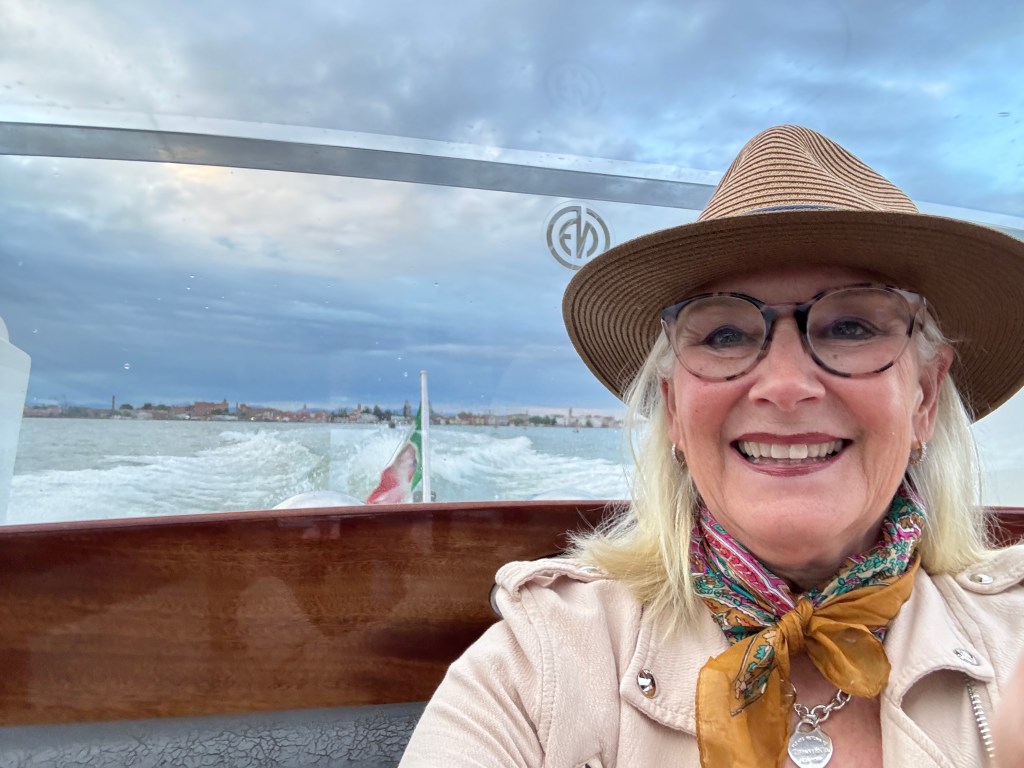
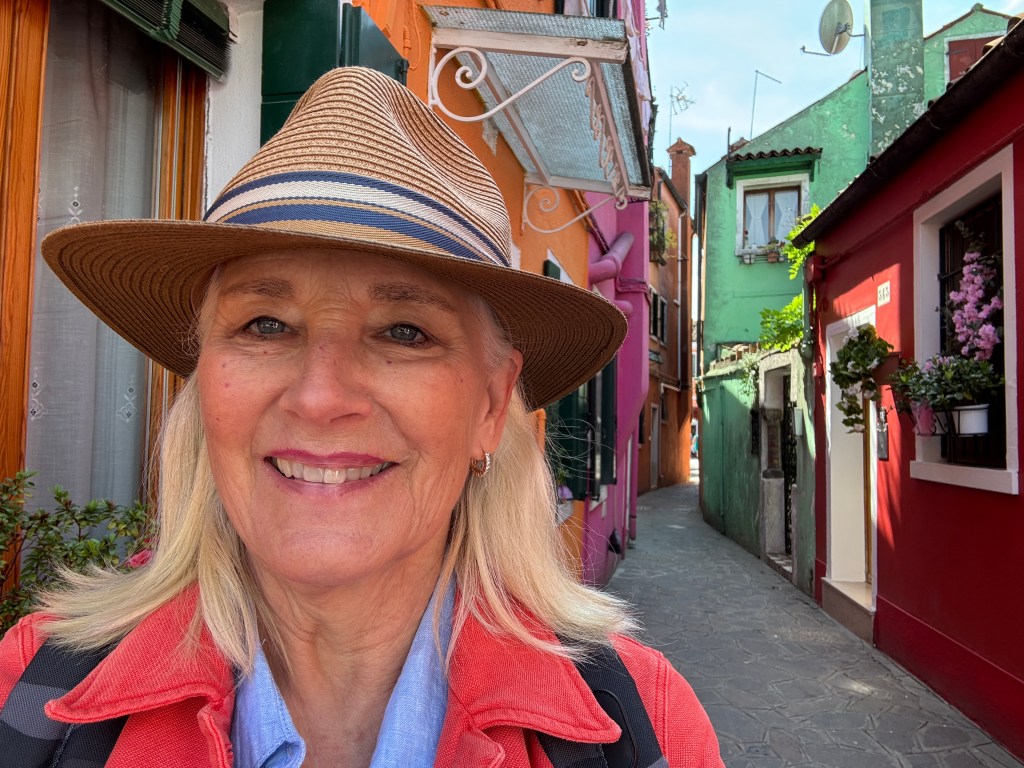
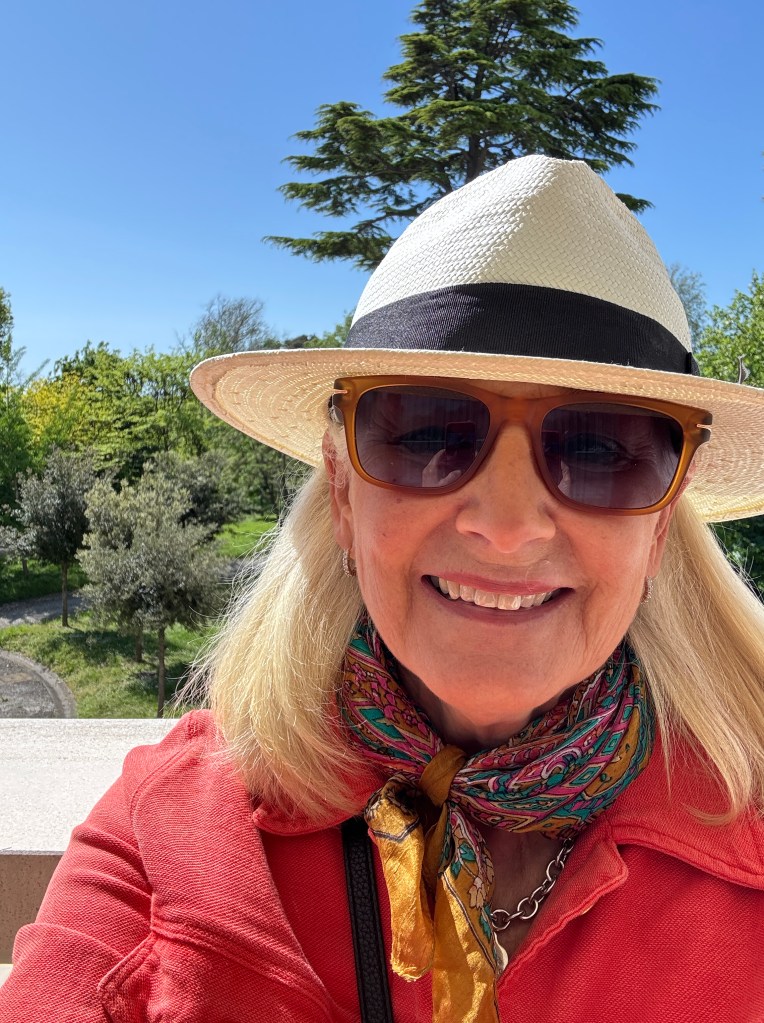
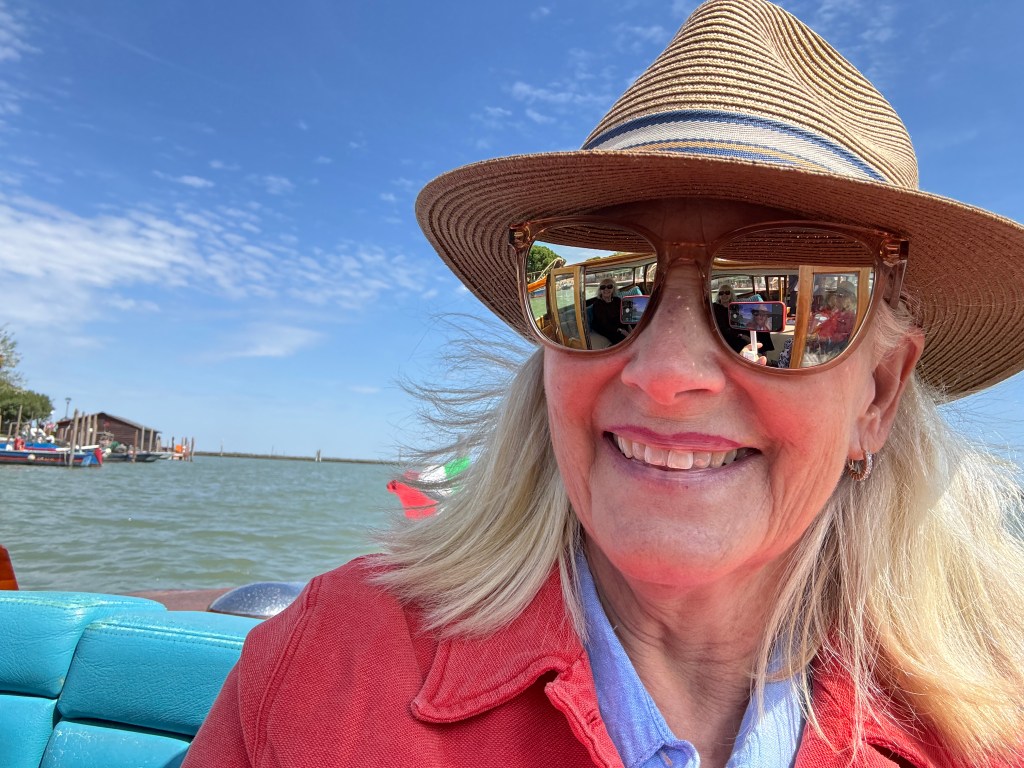
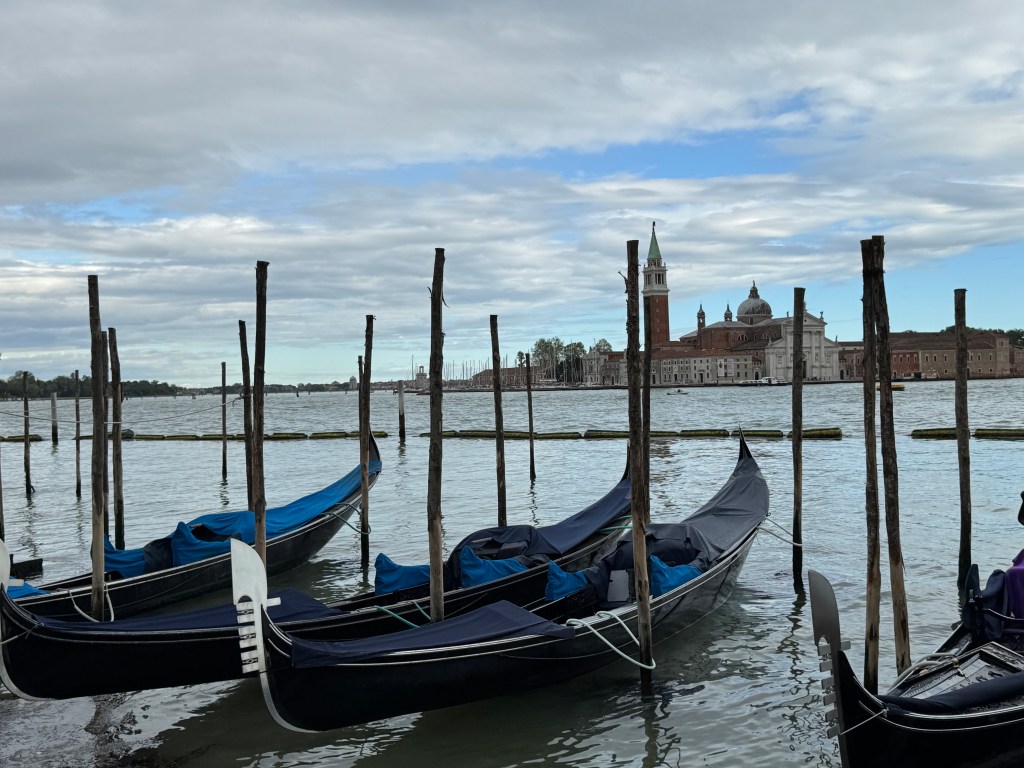
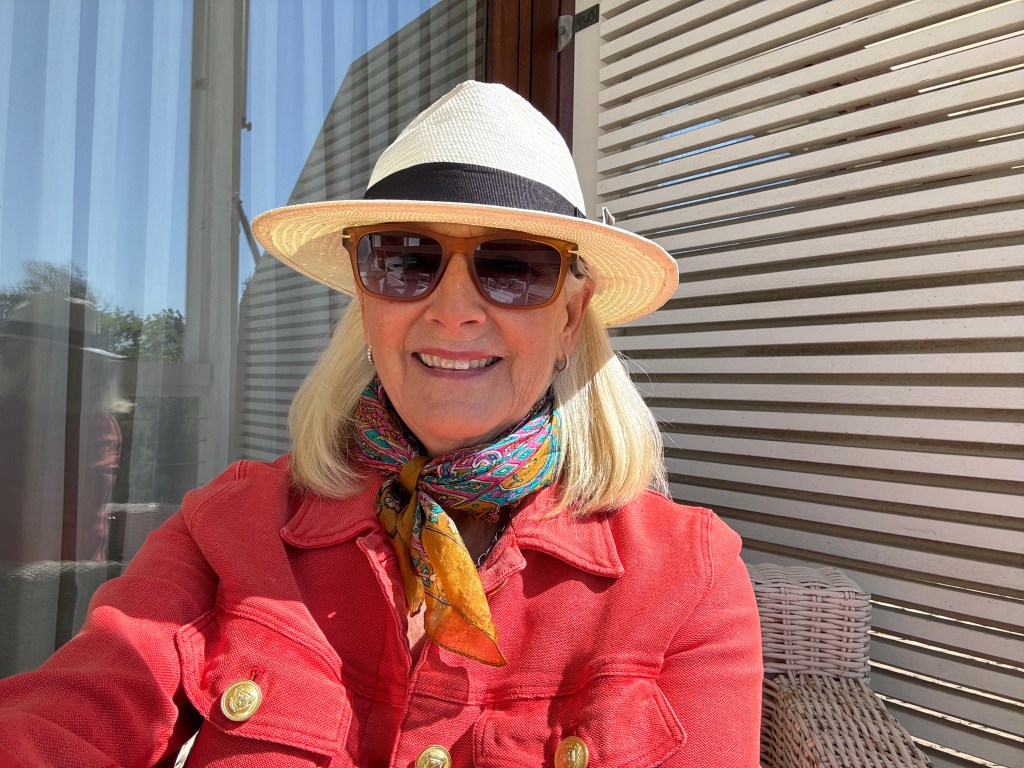
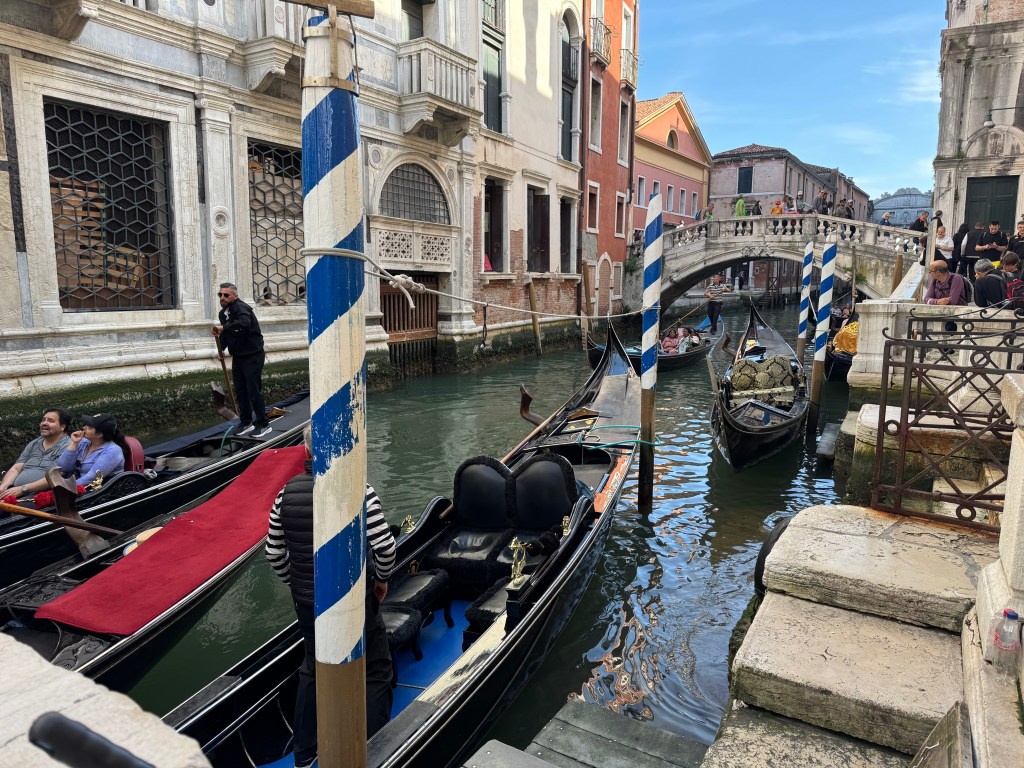
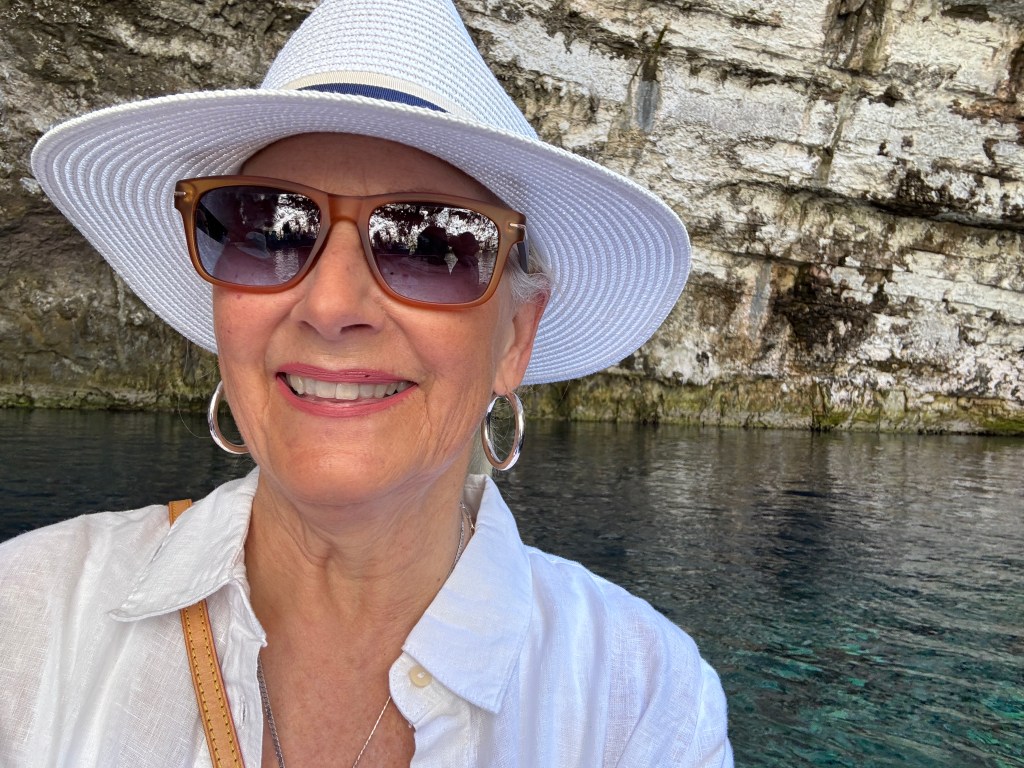
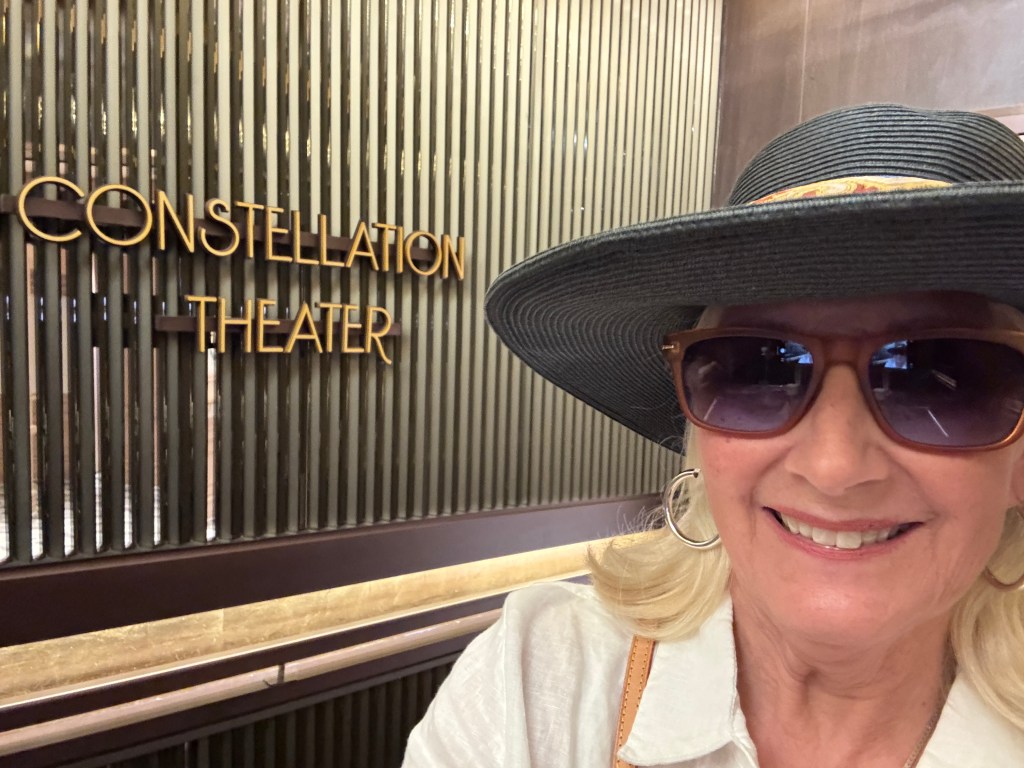
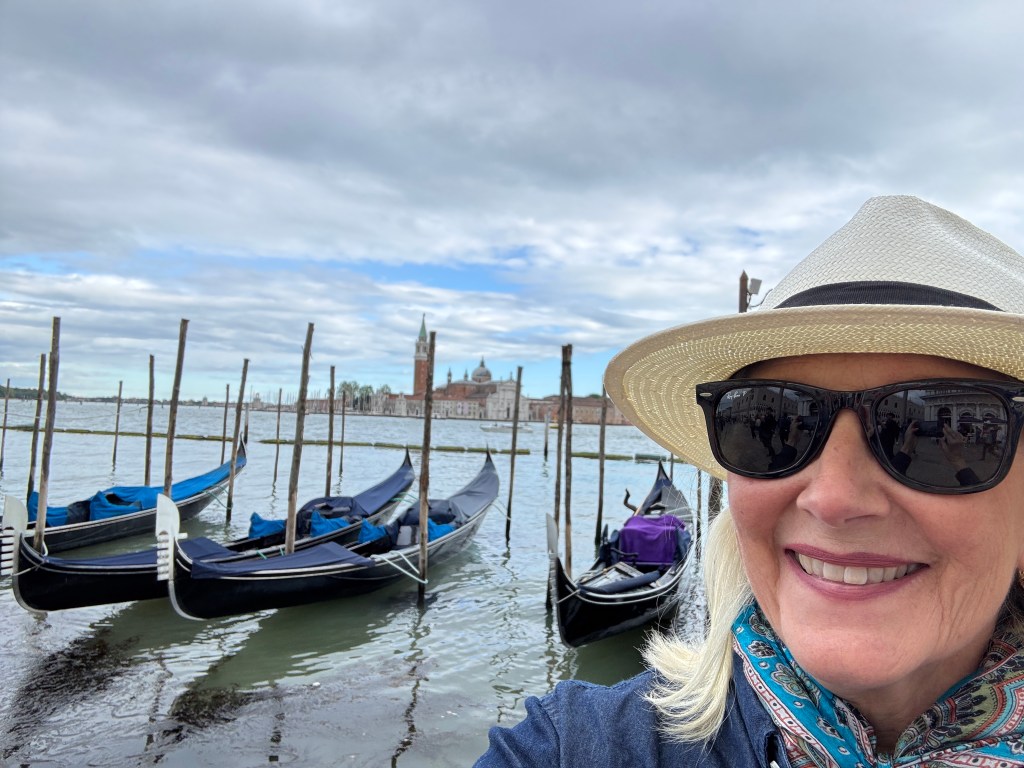
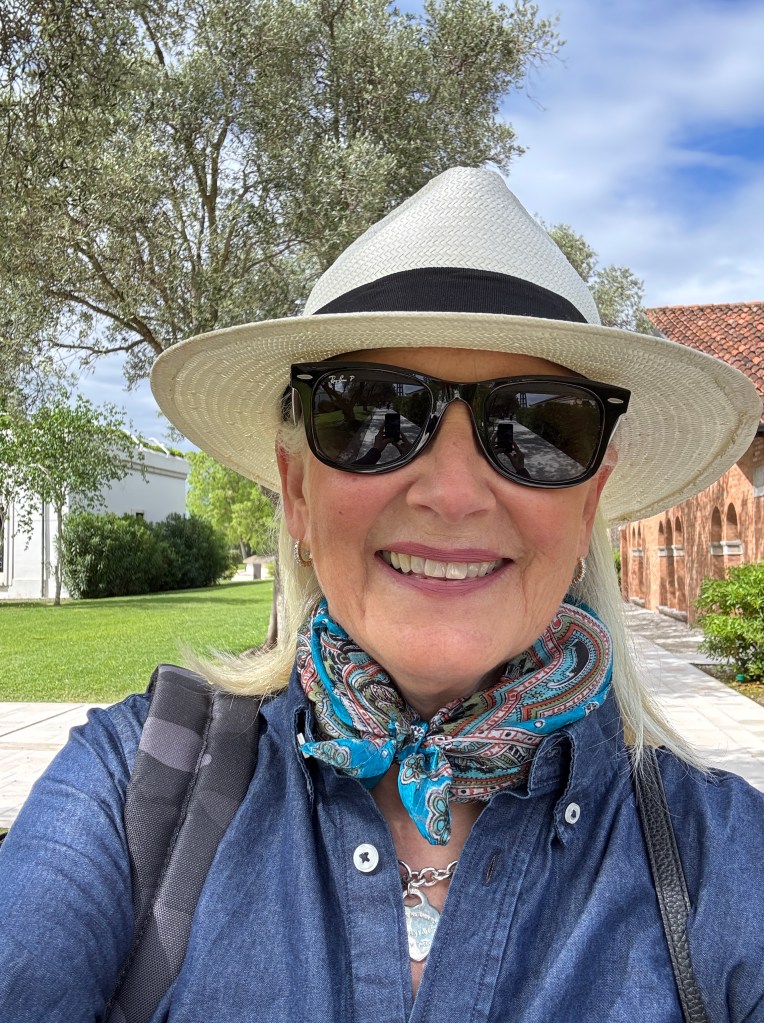
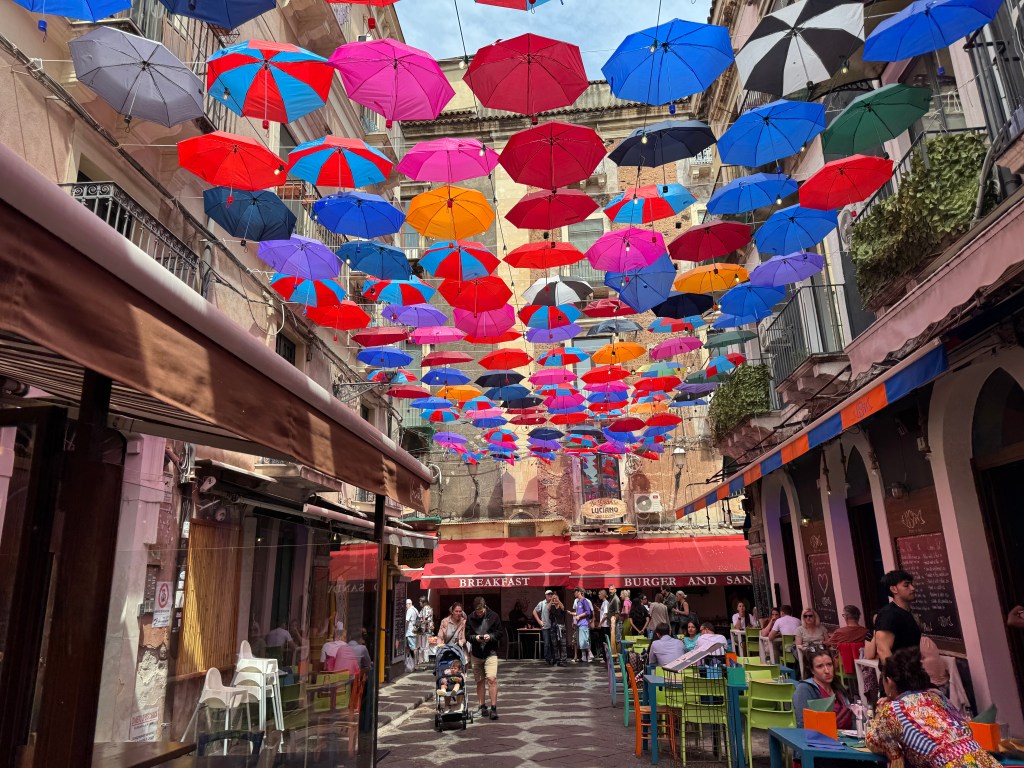
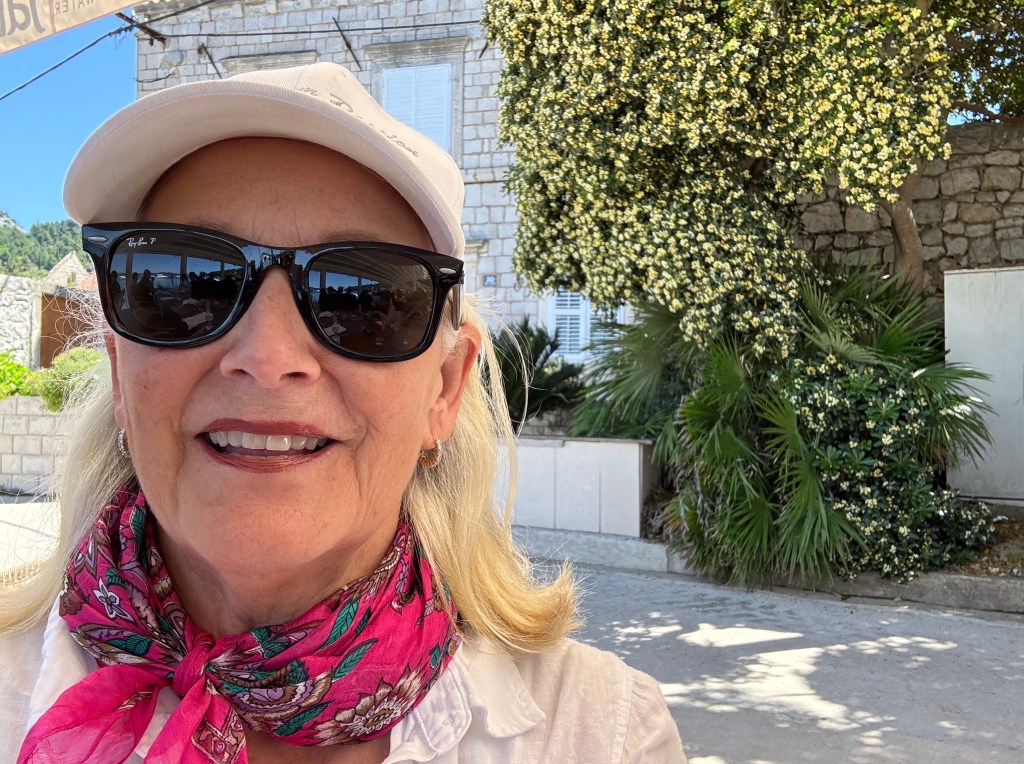
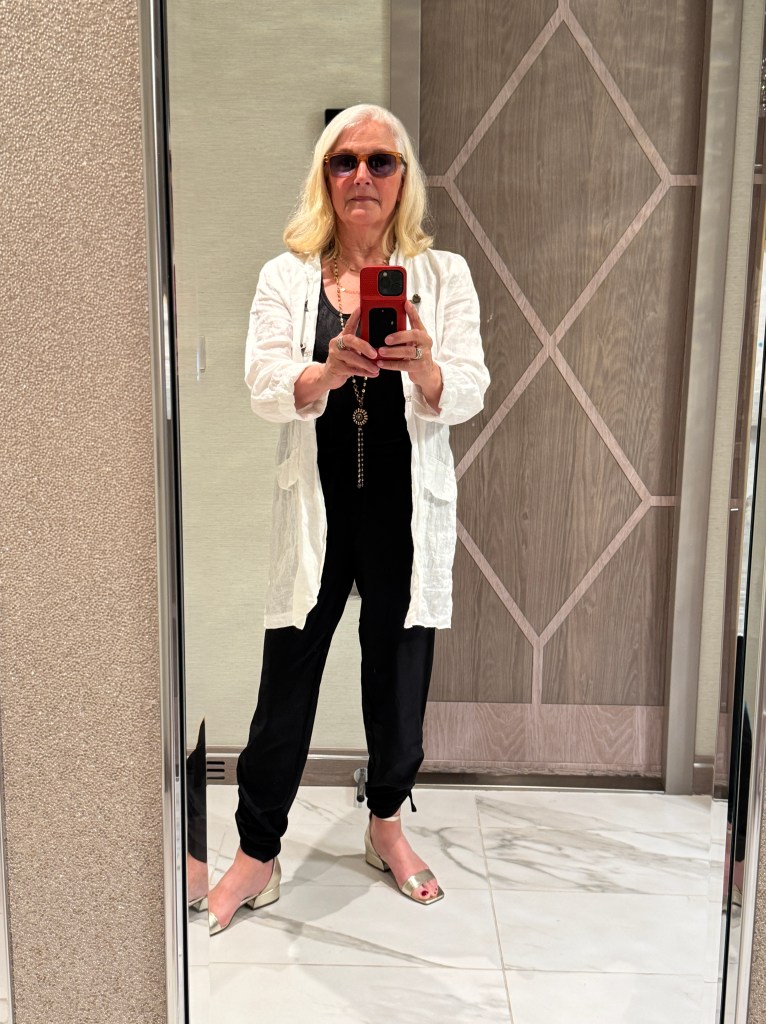
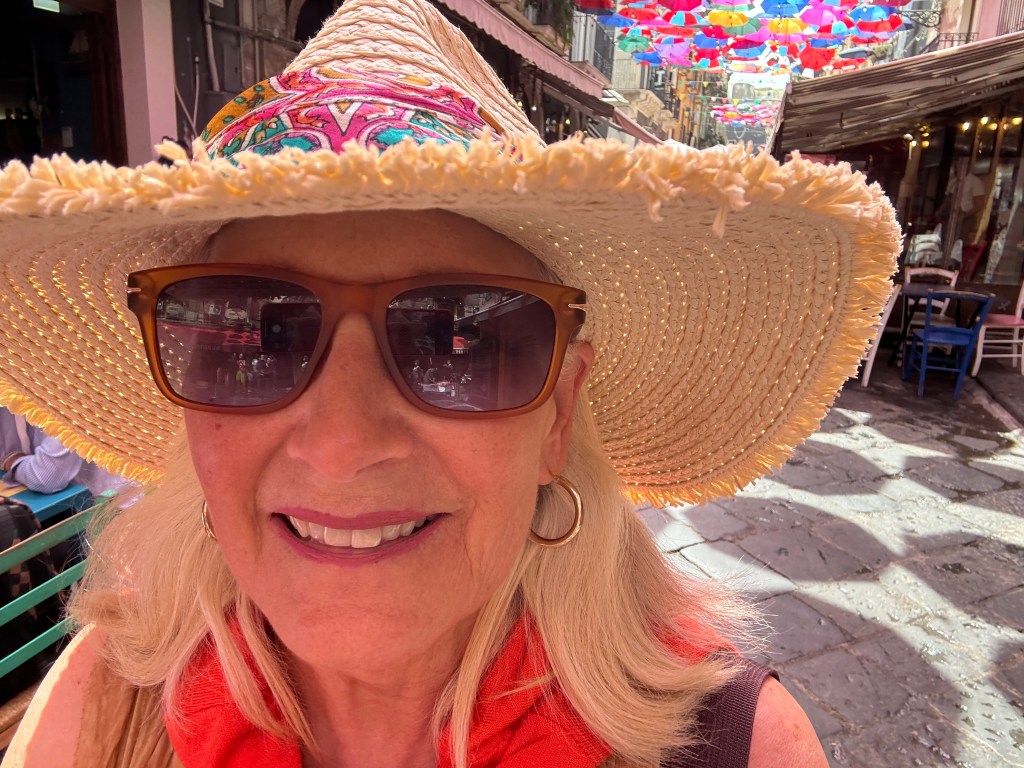
Pack three jackets, three scarves, and four hats. Add tennis shoes and flip-flops, one sweater, three tops and three bottoms, one dress, and one pair of evening shoes. Add two belts for styling. Each piece should work with the others.
With this structure, you can adjust for weather, setting, and occasion. The same garments shift from casual to formal by changing layers and accessories. The result is controlled, deliberate, and consistently polished.

-
Res Ball Actor and Comedian Dallas Goldtooth Uses Humor to Face Climate Change
Humor offers a chance to challenge the narrative of marginalization. This is according to Dallas Goldtooth, Res Ball (film) actor and environmental activist, who spoke on Tuesday, Sept. 24, at the University of Colorado Macky Theater. Goldtooth mixed his signature storytelling and humor with advocacy, gaining the audience’s trust.
“Buy American Spirit cigarettes,” he said when asked how non-indigenous allies can get involved.

Dallas Goldtooth of Dakota and Diné heritage speaks at Macky Theater on the Campus of University of Colorado at Boulderof his experience with environmental issues and activism . (Melodie Miller | Photographer)
Goldtooth is known for his character William Spirit Knifeman in the FX series Reservation Dogs. He is also the founding member of the 1491’s comedy group. He joked with the Boulder audience and reminded them that solving the climate crisis means acting on a larger scale. The climate crisis disproportionately impacts Indigenous communities and other marginalized groups.

Actor and activist Dallas Goldtooth as William Knife-Man in FX’s Reservation Dogs. (Photograph by Shane Brown / FX)
“I’m sure all of you are really happy about your hybrid car that you’re driving or that you switched your light bulbs to LED lights. It’s great. But we have to remind ourselves as we understand that the causation of climate chaos is capitalism. It also means that the fight to protect this planet is much more than environmentalism,” Goldtooth said.
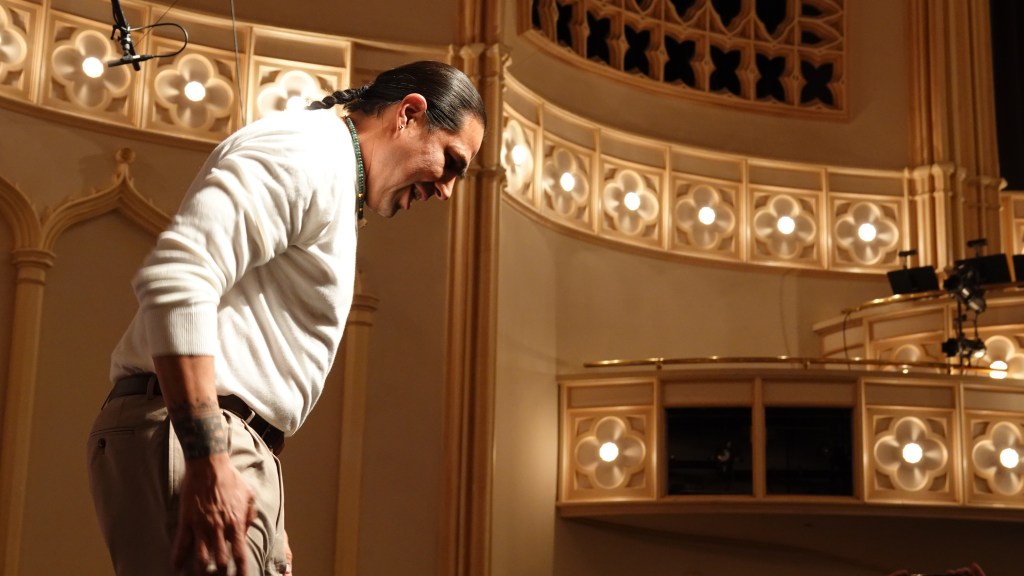
Activist Dallas Goldtooth encourages the audience to . (Melodie Miller | Photographer)
The fight for climate change is a fight for liberation, according to Goldtooth. Many areas affected by climate chaos are marginalized communities. Their citizens often lack the power to influence what happens to the land. They have no voice regarding the water, the air, or their bodies. He encouraged the audience to help lift marginalized voices.
“This will allow us to imagine a future that’s livable for everyone,” Goldtooth said.

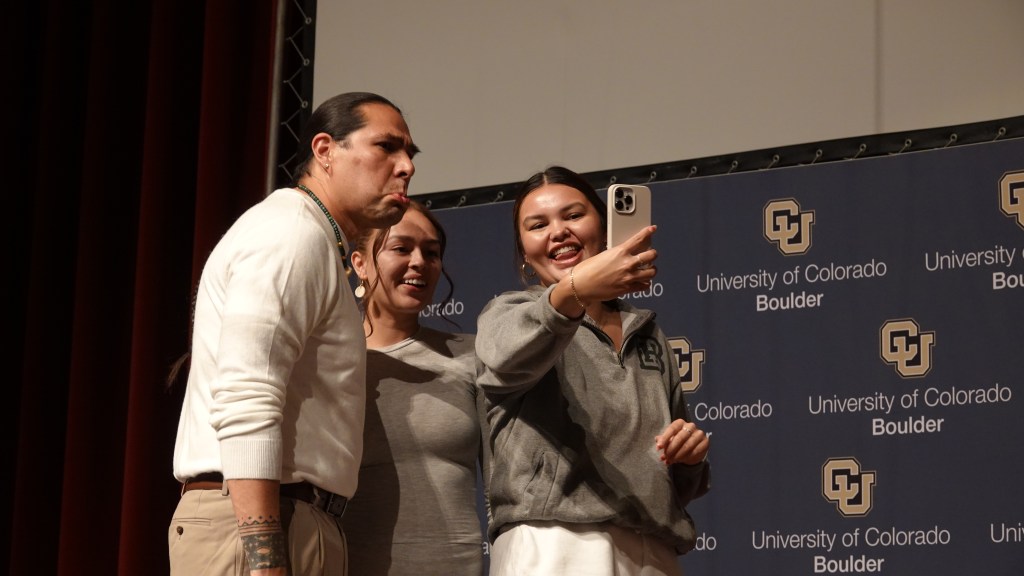
Dallas Goldtooth combined humor and inspiration for action with audience at Macky Theater on the Campus of University of Colorado at Boulder. (Melodie Miller | Photographer)
“Just bring people together around a common issue and let them talk with one another. You have right-wing ranchers, and you have left-leaning natives,” Goldtooth said, “working together to stop the Keystone XL pipeline to preserve clean water on their lands. I’m happy to say that we won the Keystone XL campaign.”

Dallas Goldtooth joked with the audience at Macky Theater on the Campus of University of Colorado at Boulder. (Melodie Miller | Photographer)
Goldtooth amplified the importance of the world’s “climate chaos as an issue that we are all dealing with on this planet.” He softened the message with a personalized joke when asked how he began his career as an activist. Goldtooth told the audience, “Well, I was 13 pounds when I was born. So, my mom knew injustice.”
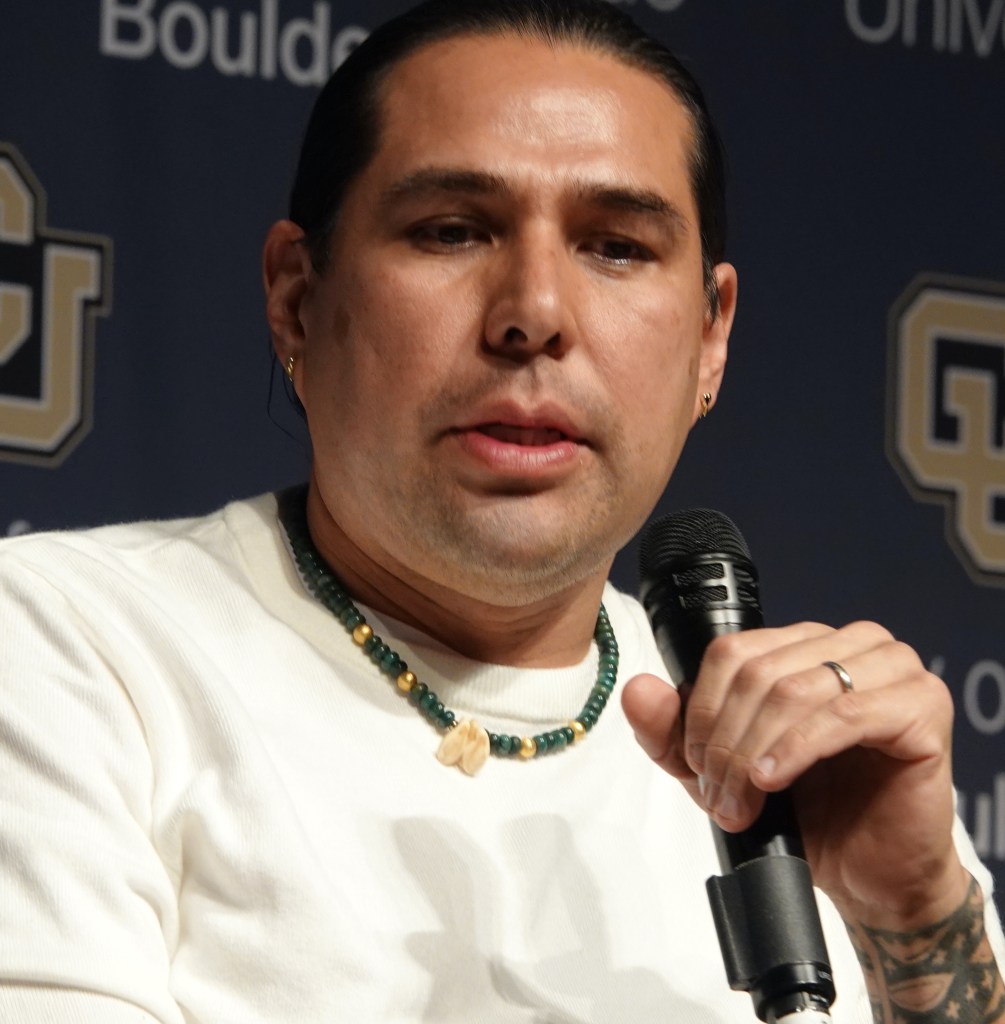
Dallas Goldtooth reminded the audience at Macky Theater on the Campus of University of Colorado at Boulder that the climate crisis affects marginalized communities disproportionately. (Melodie Miller | Photographer)
Storytelling is a “big part of the organizing effort to make this planet better,” Goldtooth said. Humor provides the “opportunity for you to disrupt the narrative because all of our fields have been impacted” by marginalization. For example, the United States insurance companies secure capitalistic investments. Goldtooth told the audience that “insurance companies are complicit in the destruction of the earth.”

Benny Shendo attended Goldtooth’s speech. He is the vice chancellor for Native American Affairs at the University of Colorado. Shendo is also a member of New Mexico’s Democratic Senate. “I think you will find humor across any country. I mean, it’s not any different in Pueblo or any different in Pani or any other tribe,” said Shendo.

Benny Shendo. University of Colorado alumni speaks to Congress. Members of Congress formally accepted a sculpture of Po’pay, a medicine man from Ohkay Owingeh who led the Pueblo Indian Revolt of 1680, to complete the U.S. Capitol’s Statuary Hall collection. (Photograph courtesy of the C-SPAN 2 Archives)
Phillip Gover is a Tribal Affairs Specialist for the Colorado Department of Human Service. He is an advocate for Indigenous Coloradoans and said, “I think Native Americans have always dealt with tragedy with a sense of humor. Most people would say, ‘What?’ Why would you laugh at that? If I’m not laughing, then I’m crying, and I’d rather be laughing.”

Phillip Gover, a Tribal Affairs Specialist for the Colorado Department of Human Service (Melodie Miller | Photographer)
Goldtooth uses joy and laughter to advocate for marginalized Native American communities disproportionately facing climate change.

Dallas Goldtooth shared the stage with students at Macky Theater on the Campus of University of Colorado at Boulder. (Melodie Miller | Photographer)
He is descended from the Minnesota Dakota/Diné (Navajo) tribe. He is a member of the Lower Sioux Indian Community. He is also a Dakota language instructor.
-
“Let the Right One In”
C.U. Presents closed its modern vampire love story to a packed house at the University of Colorado Loft Theatre in Boulder.
Director Heather Kelley’s adaptation of Jack Thorne’s play “Let the Right One In” closed to a sold-out audience on Sunday, Oct. 20, at the University of Colorado Loft Theatre.
by Melodie Miller

The audience waits for the sold-out presentation of Let the Right One In to begin. Scenic design by Hyley Delich. (Melodie Miller | Photographer)
Based on the novel by John Ajvide Lindqvist, first love, sexual intimidation, and school bullying transcend the borders of time and space in “Let the Right One In.” Eli, a 200-year-old vampire trapped at age 12, befriends Oskar, their 13-year-old neighbor, on the playground where Eli is bullied by classmates in 1981 Sweden.

Eli, played by Wyleigh Watson, is a 12-year-old trapped in the body of a 200-year-old vampire, climbing on the monkey bars. (Melodie Miller | Photographer)
The childhood friendship between Eli and Oskar is complex, creating “a dynamic narrative that centers on empathy and fighting for each other despite all the blood and scars,” Brosnan Bustamante, the stage manager, said.
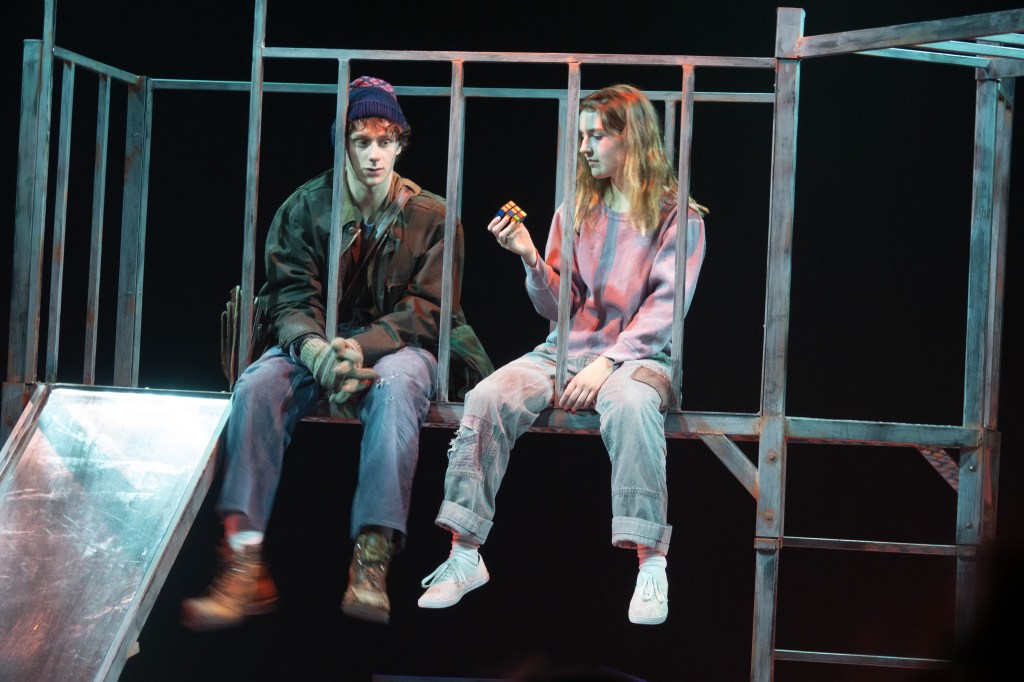
Oskar, played by Salem Channell, lives next door to Eli the vampire. Eli, played by Wyleigh Watson, contemplates a Rubix Cube. (Melodie Miller | Photographer)
Let the Right One In ”is a macabre story with a happy ending,” Scenic Designer Haley Delich, a Bachelor of Fine Arts in Design, Technology, and Management, said.
Oskar is “dealing with bullying and first love,” and Eli “is trapped with the body and the mind of a child.”
When Hakan dies, Oskar becomes Eli’s new companion, giving purpose to their lives.
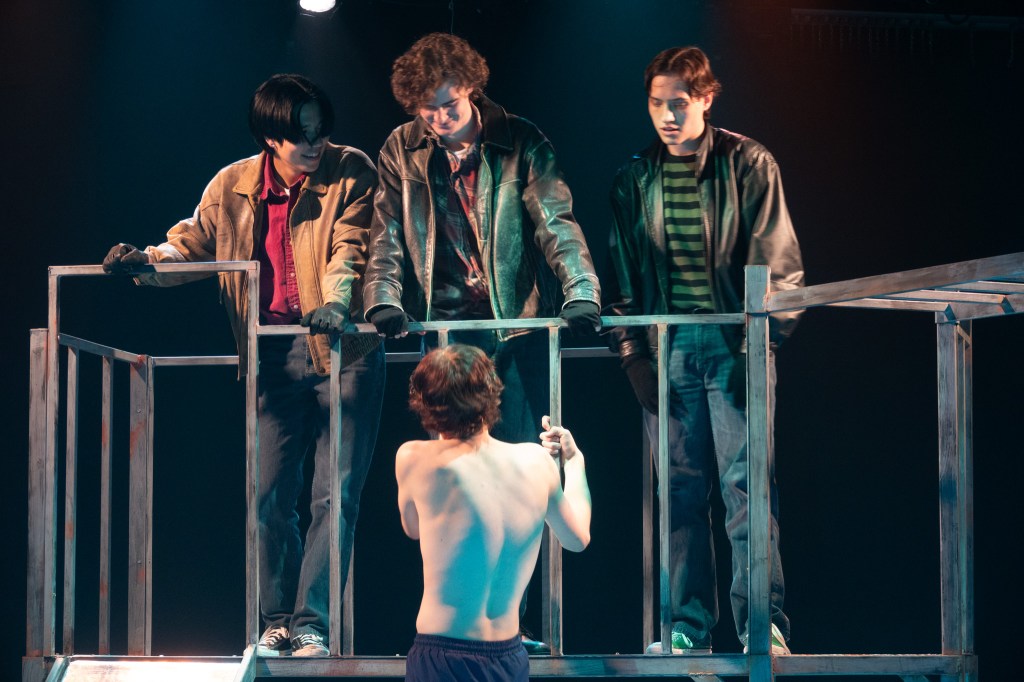
Bullies Jonny, Jimmy and Micke, play by Ian Von Pechmann, Sam Stitt and Cade respectively, threaten to drown Oskar, played by Salem Channell.
Situated in 1981 Blackeberg, Sweden, the playground was the setting where Hakan, Eli’s parent figure, killed and procured blood from his victims for the thirsty 12-year-old child.
Roan Cochrane as Hakan (Right) drains the blood from his victim played by Ian McCance (Left). (Melodie Miller | Photographer)
The play’s emotional themes required stage manager Brosnan Bustamante, a C.U. student, to ensure a smooth production. Brosnan prioritized a supportive environment. He minimized stress to keep the team focused on the performance.
Savannah Gullett plays Oskar’s Mum (Left). Norah Shuey plays Halmberg, the police commissioner. (Right)(Melodie Miller | Photographer)
“It’s crucial that the stage, cast, and crew are functioning smoothly, especially in a production that is emotionally intense and technically demanding,” Bustamante said.
The menacing playground of “Let the Right One In” stands empty.(Melodie Miller | Photographer)
Filled with death, blood and bullying, the setting is ironic as a playground but fitting as a place of horror, where children act as monsters.
Bully Jonny, played by Ian Von Pechmann, talks with Oskar, played by Salem Channell. (Melodie Miller | Photographer)
Delich designed the set to evoke a “bit of the horrors of growing up and outgrowing the playground,” she said.
“Let the Right One In” playground setting designed by Hayley Delich is illuminated with pink light. (Melodie Miller | Photographer)
The cast of “Let the Right One In” take a bow at the close of their successful run.
Salem Channell as Oscar (center front); Middle row: Wyleigh Watson as Eli, Charlie Hough as Mr. Avila, Sam Stitt as Jimmy, Pechmann as Jonny. Back row: Roan Cochrane as Hakan, Ian McCance as Dad, Cade Heaton as Micke, Savannah Gullett (far right, back) as Mum. (Melodie Miller | Photographer)
The minimalistic rusted monkey bar set, designed by Delich, was intended to “mirror the stark lives of the characters,” she said. The characters had outgrown the playground but were emotionally stuck in their childhood experiences where they faced bullying and isolation every day in “Let the Right One In.”
“Let the Right One In” playground scenic design by Hyley Delich, illuminated with blue light. (Melodie Miller | Photographer)
The 2024 C.U. Presents, “Let the Right One In,” is part of the Artists Series, which spans over 80 years on campus. Kelley is pursuing a PhD in Theatre & Performance Studies at C.U. Boulder.
University Theatre Building, 261 University of Colorado, Boulder, CO 80302
-
The Heartbeat of the Powwow at the University of Colorado at Boulder

The Heartbeat of the Powwow returned to the University of Colorado at Farrand Field on Sept. 28, 2024. (Photograph by Melodie Miller)
Listen to powwow musician Tony Crank at the University of Colorado Farrand Field, Sept. 28, 2024. The Colorado American Indian Tribes In-State Tuition Act (CO SB 21-029) was passed to allow eligible students to pay in-state tuition at Colorado public universities and colleges. (Video, audio and voice over by Melodie Miller)
I went to historic Farrand Field on the University of Colorado campus in Boulder for the 2024 Native American powwow. It was a beautiful bluebird day without a cloud in the sky. The campus was built on the traditional territories and homelands of the Arapaho, the Cheyenne, and the Ute nations. The powwow is part of the universities commitment to continually improving and enhancing engagement with indigenous peoples locally and nationwide. It is the first powwow on campus in 23 years.
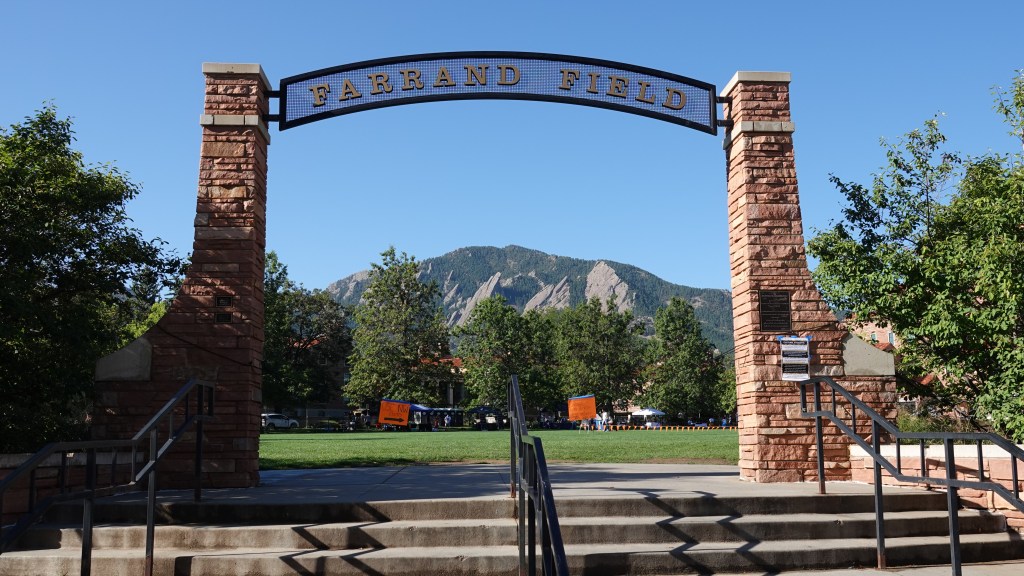
Farrand Field was named after Livingston Farrand, the University of Colorado Boulder’s fourth president, who served from 1914 to 1919. (Photograph by Melodie Miller)

After 23 years, the powwow returns to campus as a celebration of faith and tradition for the indigenous peoples of Colorado. (Photograph by Melodie Miller)
The 2024 CU Boulder Powwow was organized by the Oyate Native American and Indigenous Student Organizations on campus. It was a collaboration between the Center for Inclusion and Social Change (CISC), the Center for Native American and Indigenous Studies (CNAIS), the Oyate Native American and Indigenous student group and the native Graduate Student Group and the Theater and Dance Department.
Cultural etiquette was encouraged with guidelines posted as reminders for the audience. The aim is to elevate understanding and sensitivity towards respecting the customs of Native American nations.
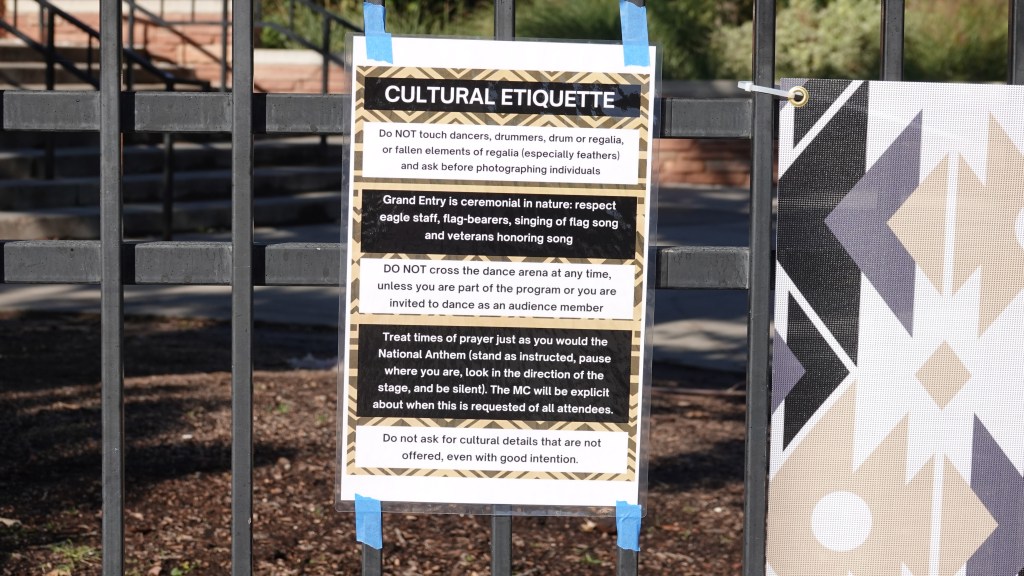
Cultural etiquette guidelines are displayed outside Farrand Field at the University of Colorado, Boulder. (Photograph by Melodie Miller)
Cultural etiquette is a unique set of understandings that guide people when interacting in different societies. At the powwow, these guidelines include not touching the dancers, their regalia, instruments or fallen feathers. “Do no ask for cultural details that are not offered even with good intentions.” Sensitivity and respect for these norms fosters positive cross-cultural understanding and connection.

Grand entry for the powwow.(Photograph by Melodie Miller)

Dancers enter the powwow tent during the grand entry. (Photograph by Melodie Miller)
After 23 years, the powwow returns to campus as a celebration of faith and tradition for the indigenous peoples of Colorado. The grand entry victory song and two rounds of intertribals. (Photograph by Melodie Miller)
Saydie Sago told me she went to the last powwow 23 years ago, in 2001 with her parents when she was a small child. We are “bringing some Cheyenne, and Rapaho community from northern Rapajo members, southern Rapaho members, and Cheyenne members to come dance and be a partner. Of course, they were part of one of the many tribes that are historically tied to this part of the land and also Colorado. So we are inviting them back to their ancestral lands,” Sago said.

Saydie Sago, one of the powwow organizers, is a fourth-year PhD student here at CU. (Photograph by Melodie Miller)
“I know that my parents, I think, have actually been to the powwow 23 years ago. So it’s really nice to see it coming back, Redhorse said. “I’ve been going to powwows ever since I was one of the tiny tots. My mom put me in a jingle dress dance, and I got up on the dance floor. I really hope we can continue this ongoing tradition.”

Shaleen Redhorse is an aerospace engineering student here at CU. She danced powwows when she was younger. (Photograph by Melodie Miller)
I spoke with CU graduate Benny Shendo, the vice chancellor of Native American Affairs, about the future for Native American students in states outside of Colorado.
“We only have two federally recognized tribes here in the state of Colorado. But then there’s 46 other tribes that have historical connections to the state of Colorado,” Shendo said. Colorado state ” passed the law signed by the governor that will allow any students from those tribes to come into state tuition. Not only will this increase our Native American enrollment, both undergraduate, graduate, but also faculty and staff.”
“It’s a new day,” Shendo said. “It’s a new day, you know, it’s for us, and we’re hoping to elevate the presence of our native students at all levels.”

CU graduate Benny Shendo, the vice chancellor of Native American Affairs is a state senator for New Mexico. (Photograph courtesy of Common Ground Rising.org Blog)
Powwow Gallery


Powwow dancers at the University of Colorado Boulder.(Photograph by Melodie Miller)
Welcome to the 2024 Powwow on the University of Colorado at Boulder campus. This event offers an exhilarating experience spanning 200 years of cultural history. Every moment is an opportunity to witness and partake in the spiritual ceremony of the powwow. (Melodie Miller | Photographer)

Powwow dancers at the University of Colorado Boulder.(Photograph by Melodie Miller)


Powwow dancers at the University of Colorado Boulder.(Photograph by Melodie Miller)



Powwow dancers at the University of Colorado Boulder.(Photograph by Melodie Miller)


Powwow dancers at the University of Colorado Boulder.(Photograph by Melodie Miller)


Powwow dancers at the University of Colorado Boulder.(Photograph by Melodie Miller)

Powwow dancers at the University of Colorado Boulder.(Photograph by Melodie Miller)
The University of Colorado Boulder is a public research university in Boulder, Colorado. Founded in 1876, five months before Colorado became a state. Colorado’s flagship university honors and recognizes the many contributions of Indigenous peoples in the state. The university acknowledges that it is located on the traditional territories of the Cheyenne, Arapaho, and Ute. It is also on the ancestral homelands of many other Native American nations. The university is dedicated to recognizing and amplifying the voices of Indigenous CU Boulder students, staff, faculty and their work.
-
Proposition 127: The end of lion hunting in Colorado?
Mountains northeast of Durango brings fourth-highest harvest of mountain lions
By Colorado Student News Service
Friday, Nov 1, 2024 11:00 AM Updated Friday, Nov. 1, 2024 5:59 PM
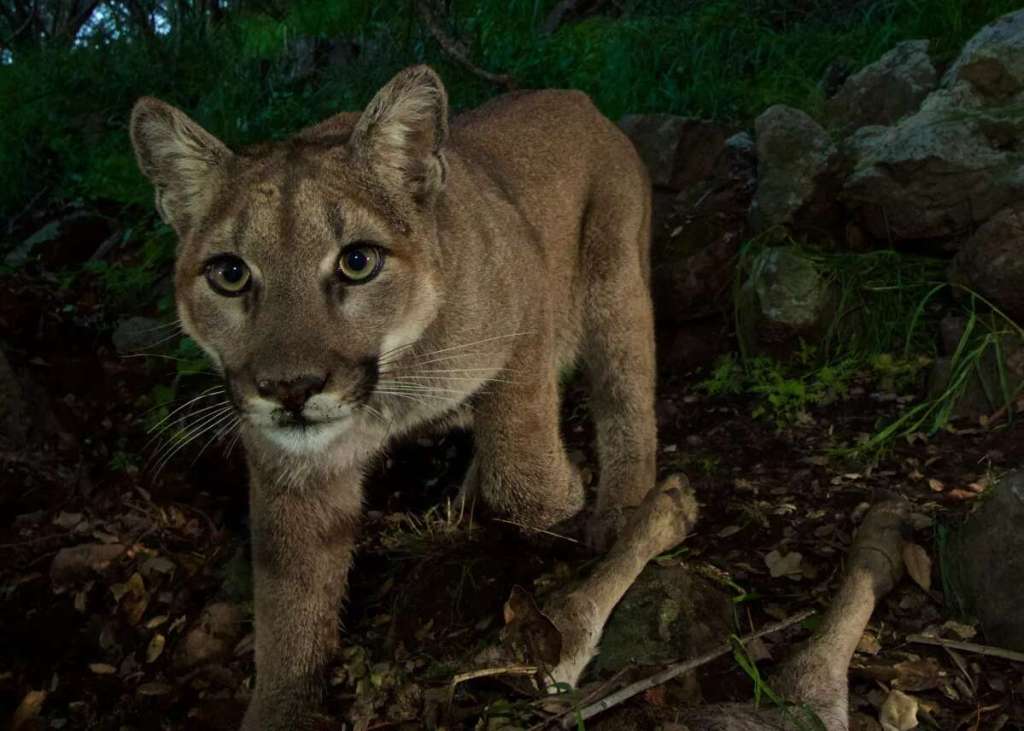
Records from Colorado Parks and Wildlife shows 2,600 hunters killed 502 mountain lions in 2022-2023, the most recent period for which statistics are available. (Courtesy of the National Parks Service, via The Colorado Sun)
In the early morning chill of Colorado’s rugged wilderness, the rhythmic panting of hounds echoes through the trees as they close in on their elusive target, a mountain lion.
For hunters, the video from a Durango outfitter, shows a moment steeped in tradition and survival skills, but such moments may soon disappear from the Colorado landscape. On Nov. 5, voters will decide the fate of mountain lion and bobcat hunting in Colorado, with Proposition 127 seeking to ban the practice entirely.
The group “Cats Aren’t Trophies” gathered about 188,000 signatures to put a measure on the November ballot.
While the group’s name references “trophies,” Colorado Parks and Wildlife considers trophy hunting to be illegal in Colorado. Hunters are expected to eat and use what they kill, based on a hunting brochure from the state agency.
Public records from the state agency show a highly regulated hunting environment where 2,600 hunters killed 502 cats in 2022-2023, the most recent period for which statistics are available.
The fourth highest number of mountain lions killed – 11 – came from an area in the mountains northeast of Durango and La Plata County. The rest of the mountain lions killed around the state were in the single digits, mostly in remote, mountainous areas.
The 21 mountain lions killed in a remote area northeast of Meeker in 2022-2023 was the largest number for any area in Colorado, based on public records provided by Kara Van Hoose, a Colorado Parks and Wildlife spokeswoman. The next largest number of mountain lions killed were in a mountainous southern part of the state near Interstate 25, where 16 were killed in one Colorado Parks and Wildlife statistical area and 15 were killed in the neighboring area. Colorado Parks and Wildlife maps do not follow county lines around the state but are numbered by region.
Van Hoose declined to comment on specific questions related to Proposition 127 so as to remain neutral during the election period. She declined to comment on how current legal hunts affect the economy or how banning mountain lion hunts could affect wildlife and cattle, among other things. Colorado Parks and Wildlife started regulating hunting licenses for mountain lions in 1965 after the mountain lion population declined, according to information on the state agency’s website.
Van Hoose said that Colorado Parks and Wildlife surveys wildlife populations by helicopter, among other things, to decide how many licenses will be available to hunters every year.
“We set licenses depending on a lot of different factors. There are environmental factors and external factors,” Van Hoose said.
The most emotional part of the hunting discussion appears to be how some Colorado outfitters use GPS-collared dogs to track and hunt mountain lions. Hound hunting is legal in Colorado.
Some 88% of Colorado residents disapprove of hunters using dogs to help with hunting and 78% disapprove of “trophy hunting” of mountain lions, according to an August Colorado State University study published in the Society for Conservation Biology journal.
Kelly Maher, a Colorado hunter, said she teaches her children to honor the animals that the family hunts “by consuming and using every part of the animal.” She said proponents of Proposition 127 don’t like the hound hunting, “but the cat needs to be stationary to identify its sex and status.”
The people who gathered signatures to get Proposition 127 on the ballot feel that hunting mountain lions with GPS-equipped dogs “gives our hunters a bad name for violations of fair chase,” according to Mark Surls, the volunteer and outreach coordinator for the group.
A group supporting continued mountain lion hunting is called Colorado’s Wildlife Deserve Better, which includes funding help from the Colorado Cattlemen’s Association and the Colorado Wool Growers Association. And the Board of Mesa County Commissioners in Grand Junction unanimously approved a resolution opposing Colorado Proposition 127 on Tuesday, Sept. 24.
Colorado Parks and Wildlife requires hunters to take an exam and buy a license to hunt mountain lions. About 3,800 to 4,400 mountain lions live in Colorado, according to the state agency, but most people never see them because they’re active at night.
About the Colorado Media Project
The University of Colorado journalism program has a $10,000 grant from the Colorado Media Project, as you know, and we’re working with eight newsrooms this semester in rural and underserved communities mostly around the Western Slope, including The Journal, Ark Valley Voice, Aspen Times, Bucket List Community Café, Colorado Newsline, Denver Urban Spectrum, Rio Blanco Herald Tribune, Sopris Sun/Sol del Valle and Enterate Latino.
Readers can the Colorado Media Project and the class by contacting Elizabeth Potter and the students at elizabeth.potter@colorado.edu.

Colorado Media Project | Courtesy of Colorado Media Project
Common Sense Institute Colorado, a nonpartisan group interested in protecting Colorado’s economy, reports that Proposition 127, if passed, would cause an overall “$4 million to $6.2 million in lost Colorado Parks and Wildlife revenue.”
Of the total, the Common Sense group says there would be a direct loss of $410,000 from mountain lion and bobcat hunting licenses. The group estimates that Colorado Parks and Wildlife would lose a separate $3.6 to $5.8 million in elk and deer hunting permit revenue because the increased mountain lion population would keep the elk and deer population down.
Reporting by Adair Teuton, Bella Hammond, Caniya Robinson, Jackson Jupille, Lincoln Roch and Melodie Miller.
https://www.the-journal.com/articles/proposition-127-the-end-of-lion-hunting-in-colorado/
-
Hercules (1997), an Academic Critique

Hercules (1997) Walt Disney Studios (Photograph courtesy of IMDB.com)
-
Risen (2016), a Roman Passion Play, a review
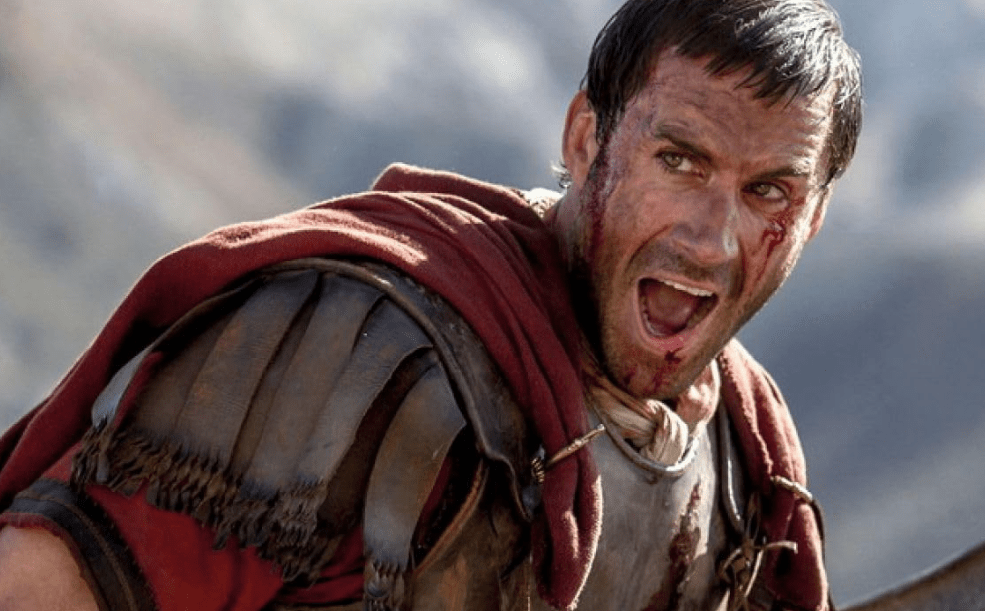
Kevin Reynold’s Risen (2016), set in 33 CE, stars Joseph Fiennes as Clavius, a Roman Tribune in Judea who is tasked with finding the missing body of Jesus Christ.
-
Powwow Heartbeat: a script (University of Colorado at Boulder)
The Heartbeat of the Powwow returned to the University of Colorado at Farrand Field on Sept. 28, 2024. (Melodie Miller | Photographer)
Listen to powwow musician Tony Crank at the University of Colorado Farrand Field Sept. 28, 2024. The Colorado American Indian Tribes In-State Tuition Act (CO SB 21-029) was passed to allow eligible students to pay in-state tuition at Colorado public universities and colleges.(Melodie Miller | Photographer)
This was the first powwow on campus in 23 years.
Farrand Field was named after Livingston Farrand, the university’s fourth president who served from 1914 to 1919.
After 23 years, the powwow returns to campus as a celebration of faith and tradition for the indigenous peoples of Colorado.
Grand entry for the powwow. (Melodie Miller | Photographer)
After 23 years, the powwow returns to campus as a celebration of faith and tradition for the indigenous peoples of Colorado. The grand entry victory song and two rounds of intertribals.














-
The Passion (2004), according to Biblical text
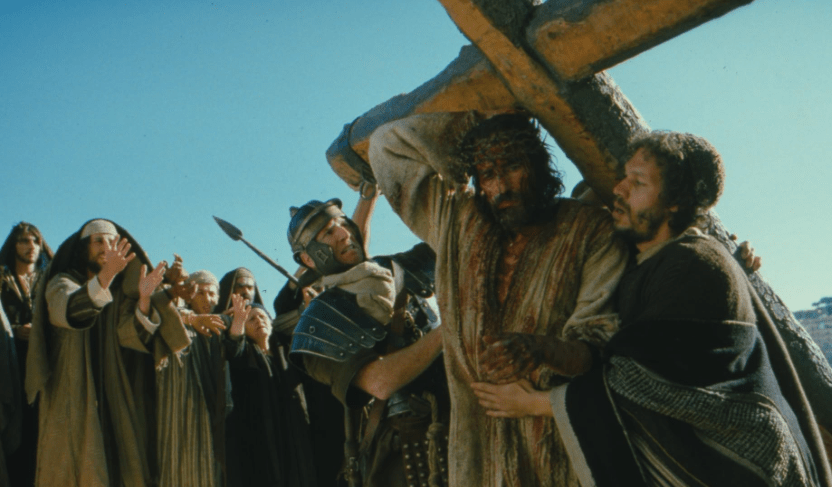
Jim Caviezel stars as Jesus Christ in Benedict Fitzgerald’s and Mel Gibson’s The Passion of the Christ. (Photo courtesy of IMBD, The Passion of the Christ).
-
Ben-Hur (1959), a Twentieth Century Spectacle

William Wylers Ben Hur (1959) starred Charlton Heston as Judah Ben-Hur. (Ben Hur Film 1959 Stock Photos, Getty Images).
-
Politics in the Ancient and Modern Olympic Games
A commentary on how the ancient Olympic Games differ from today.

Olympic Games (Photograph courtesy of the Bridgeman Art Library)
-
The Pliny’s Contributions: A License for Inspiration
How the Pliny’s ancient writings created a lasting impact by inspiring Mary Shelley’s “Frankenstein” and Charles Dickens “A Christmas Carol.”
“Pliny the Younger” refers to Gaius Plinius Caecilius Secundus, a Roman author and lawyer who witnessed the eruption of Mount Vesuvius in 79 CE is most famous for his collection of letters. “Pliny the Elder” refers to his uncle, Gaius Plinius Secundus, a renowned natural historian who died during the eruption of Mount Vesuvius in 79 AD. Pliny the Younger is the nephew of Pliny the Elder, and both are known for their significant written works from ancient Rome.


Pliny the Elder. (Left) Pliny the Younger. (Right). Encyclopedia Britannica. Mary Evans Picture Library Ltd / age fotostock .
Pliny the Elder wrote the Natural History, an encyclopaedic work of uneven accuracy that was an authority on scientific matters up to the Middle Ages.

Pliny the Younger and his Mother at Misenum AD 79, Angelica Kauffmann, 1785, (Courtesy of Princeton University Art Museum
Read more about Pliny.
Mary Beard for The Guardian. https://www.theguardian.com/books/2012/jun/22/olympic-games-ancient-modern
-
‘Pompeii’: An Analysis of Scientific Accuracy
In “Pompeii,” Robert Harris writes a fictional testament to Roman engineering brilliance during the 79 AD eruption of Mount Vesuvius.

Pompeii (Getty Images / Stockphoto)
-
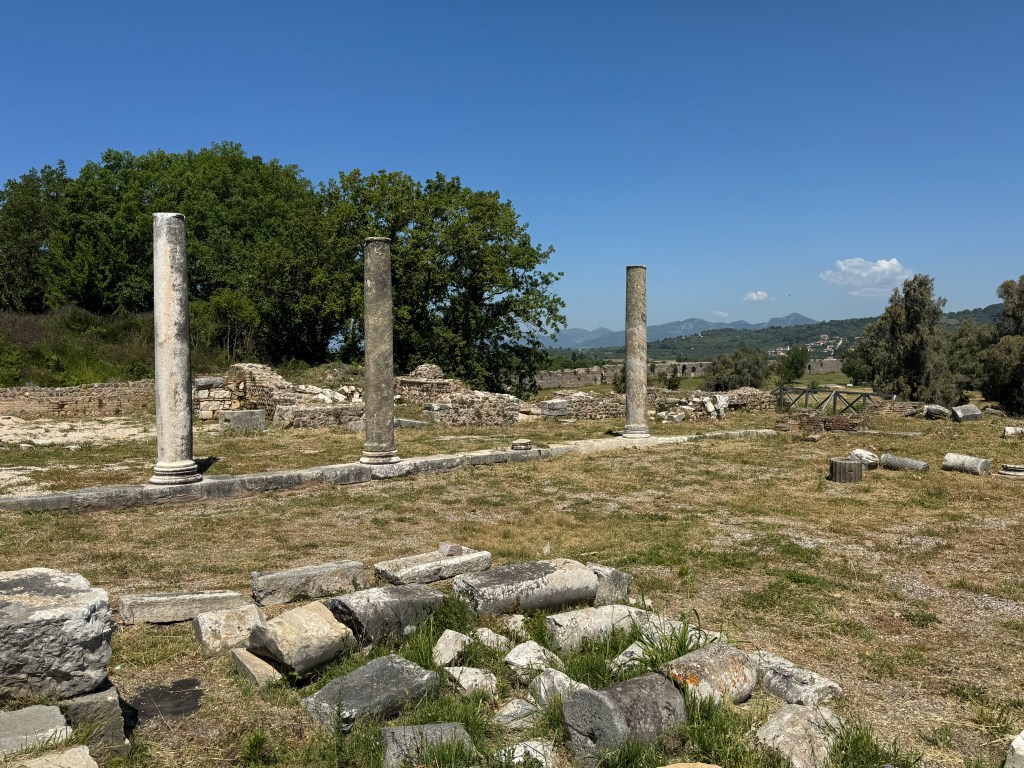
The Roman Street of Nicopolis Runs Parallel to a Byzantine Wall in Preveza
Preveza is an historic coastal city in Epirus, with a long and important past. Set amid ancient Roman and Byzantine ruins in northwestern Greece, it is a place where Ottoman and Roman history meet.
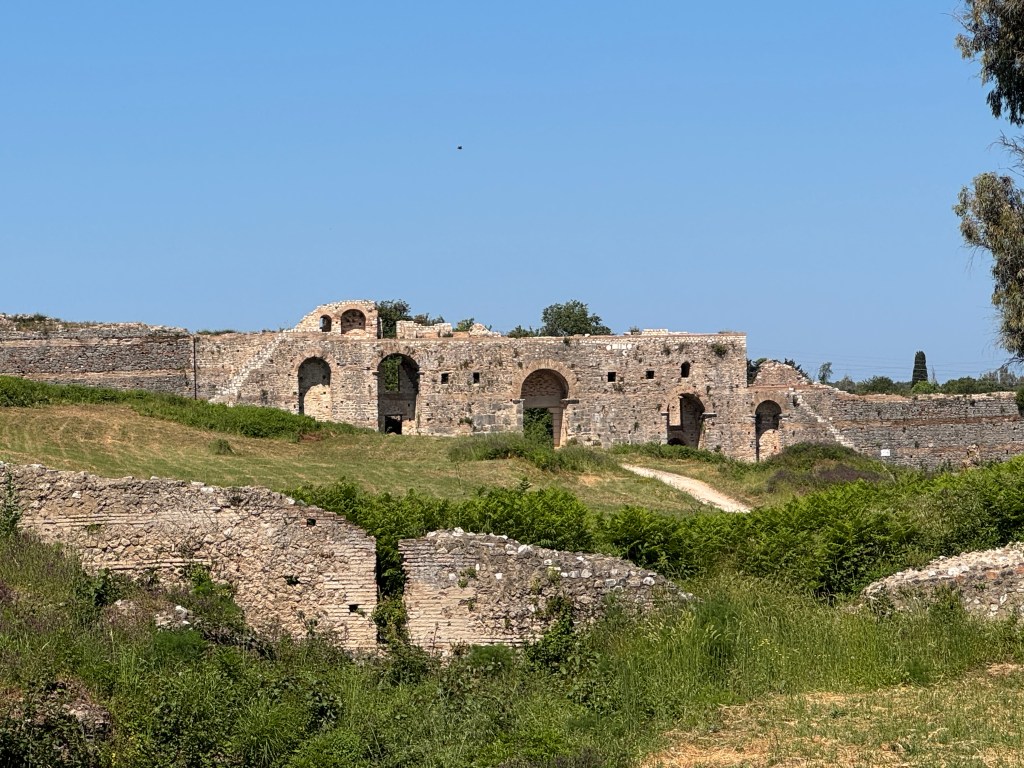
The fortified Byzantine walls of Ancient Nicopolis, 5 km north of Preveza, Greece, have stood the test of time since Eastern Roman emperors built them in the late 5th century CE. (Photograph by Melodie Miller)
Originally named Nikopolis, “City of Victory,” by Octavian for his triumph over Mark Anthony and Cleopatra, the town is now known as Preveza, commonly thought to derive from a Slavic word meaning “passage.”
Passage is a fitting name, as this region in northwestern Greece on the Ionian Sea is famous as a hotly contested location because of its vital maritime access to the Adriatic Sea and the eastern Mediterranean sea.
The settlement of Preveza grew when the Ottomans built the castle of Bouka in 1478 and reinforced its fortifications in 1495.
Between 1436 and the present day, both Christian and Muslim rulers governed Preveza. During this time, the Preveza community remained largely Greek Orthodox Christian, while a Muslim community grew over time but disappeared when the town joined Greece in 1912.
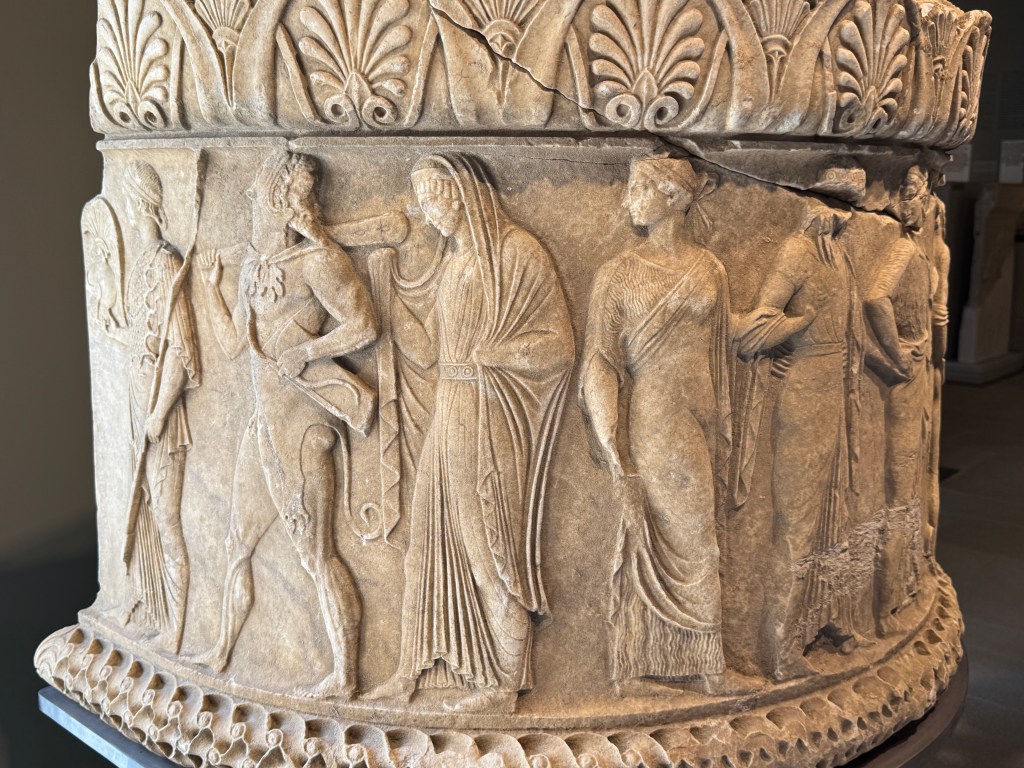
The Archaeological Museum of Nicopolis, 5 km north of Preveza, Greece, houses Augustus’s Actium Victory Monument, a Neo-Attic marble base (29-27 BCE) decorated with reliefs of Greek pantheon gods and heroes. (Photograph by Melodie Miller)
In the Neo-Attic marble base, Athena stands on the far left holding a shield and spear, while Heracles, second from the left, wears a Nemean lion skin and carries a club. Hera, Zeus’s wife, stands center-left wearing a bridal veil. She famously persecutes Zeus’s illegitimate son, Heracles.
Three Nymphs start at center right. This art is considered mythological political propaganda because it frames Octavian’s defeat of Mark Antony and Cleopatra at the Battle of Actium on Sept. 2, 31 BCE, as divinely sanctioned.

At Ancient Nicopolis, a 5th – 6th-century Cipollino marble Roman-era Ionic column with a monolithic shaft, topped with spiral volutes, stretches toward the sky. (Photograph by Melodie Miller)
In an early battleground between the Ottoman fleet and a Holy League in 1538, Barbarossa, an Ottoman admiral, defeated Genoese Admiral Andrea Doria, who led the Holy League.
At the time, the Holy League was a papal alliance of Venice, Spain, Genoa, the Papal States, and the Knights of Malta, which dissolved in 1699. The religious league shifted from a papal-led center to imperial territorial alliances to geopolitical partnerships.
The Holy League’s opposition, the Ottoman Empire, was one of the world’s strongest states, spanning three continents. The Ottoman Empire was dissolved on Nov. 1, 1922.
In 1923, a population exchange took place between Greece and Turkey, which was based mainly on religious identity. Most of Greece’s native Muslims moved to Turkey, and Turkey’s Orthodox Christians moved to Greece.
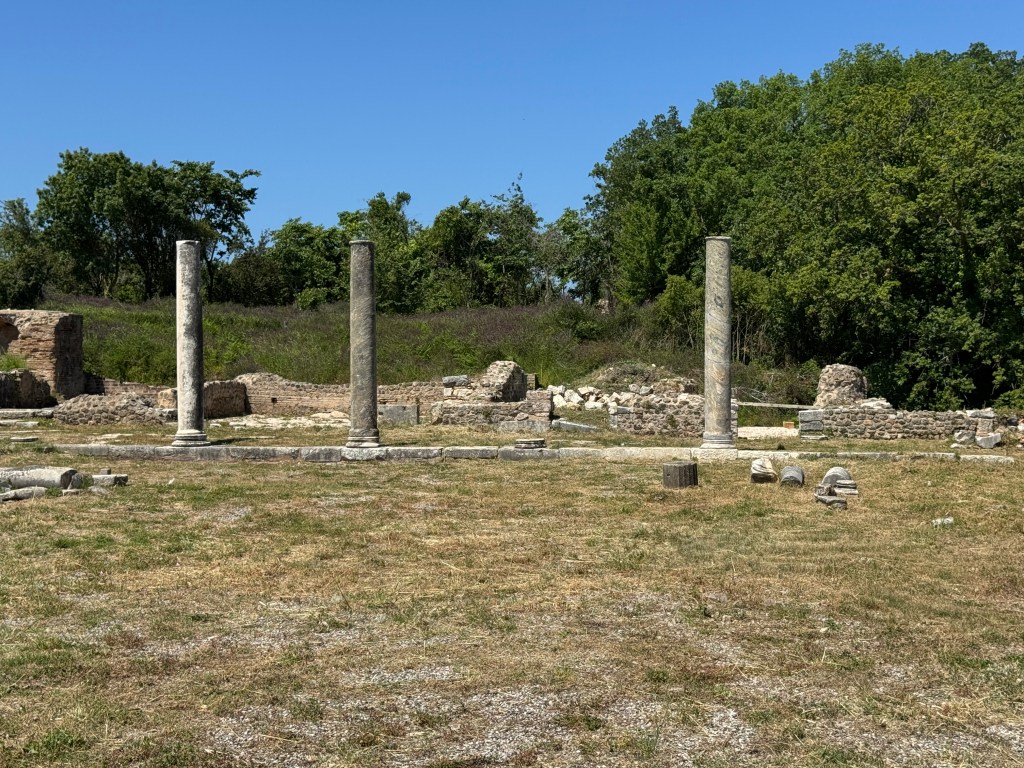
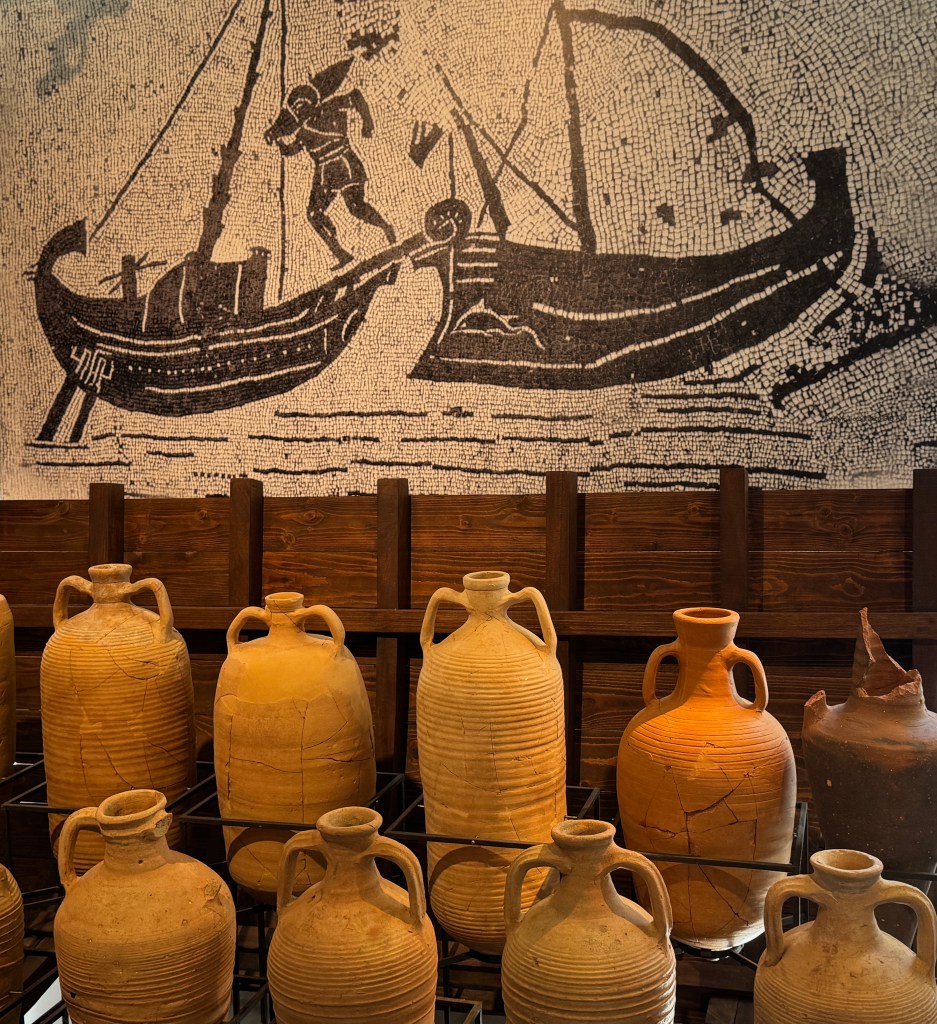
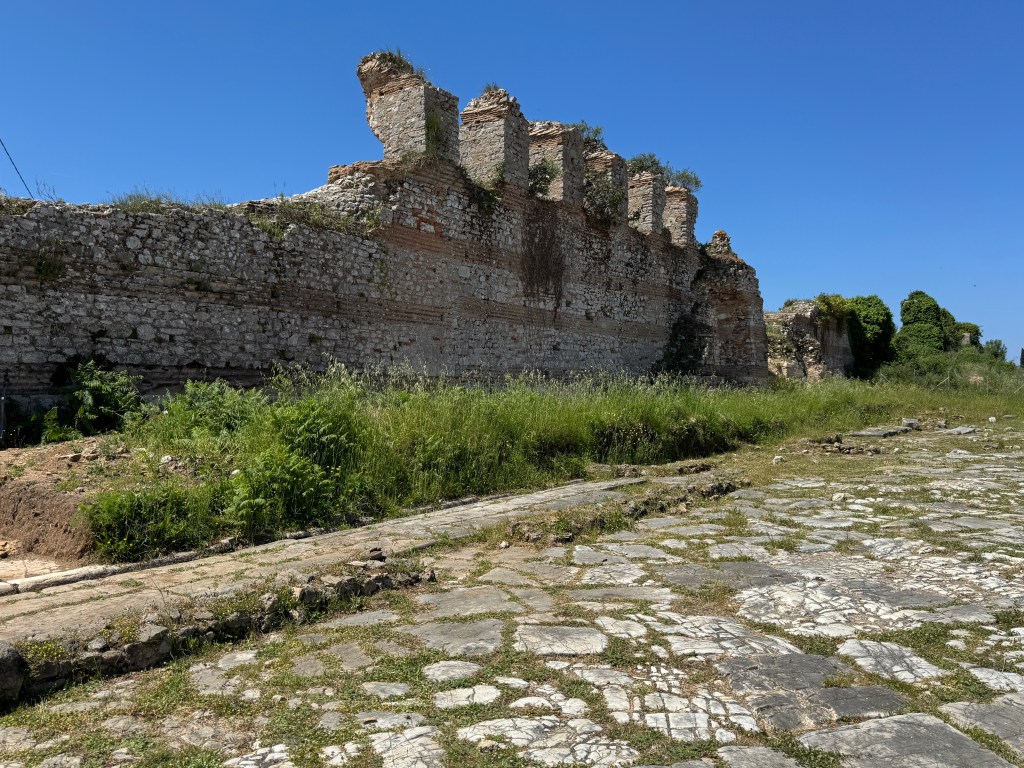
An ancient stone-paved Roman decumanus maximus, an east-west street laid out by Octavian, who founded Nicopolis in 29 BCE, runs along Nicopolis, 5 km north of Preveza. (Photograph by Melodie Miller)
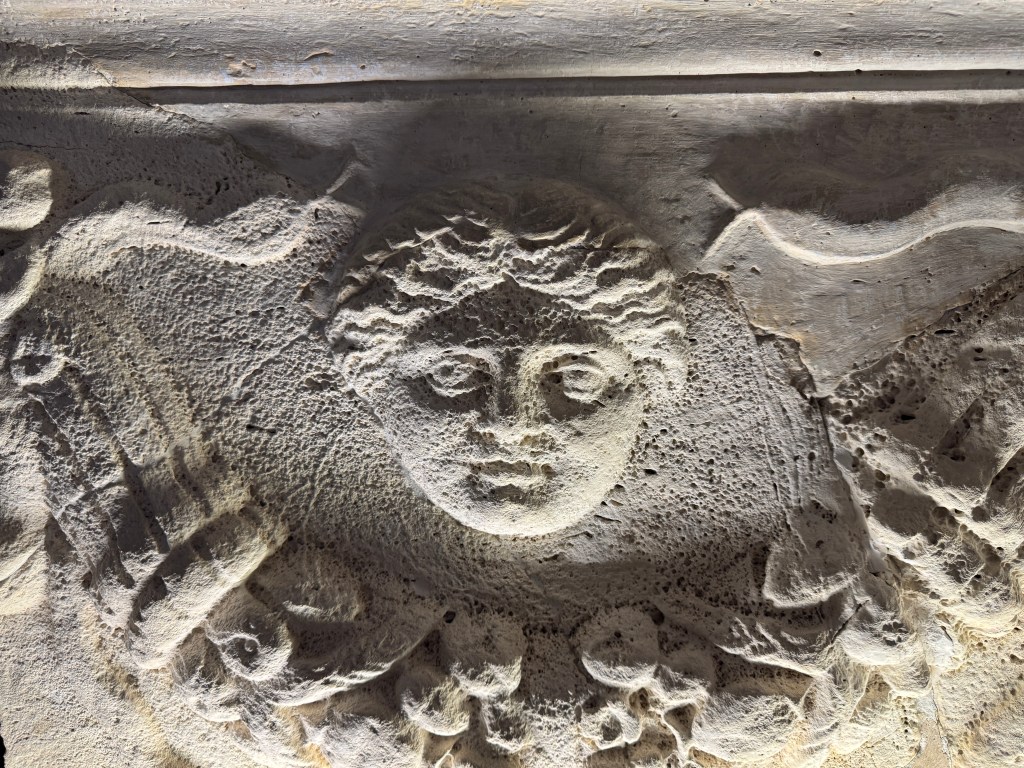
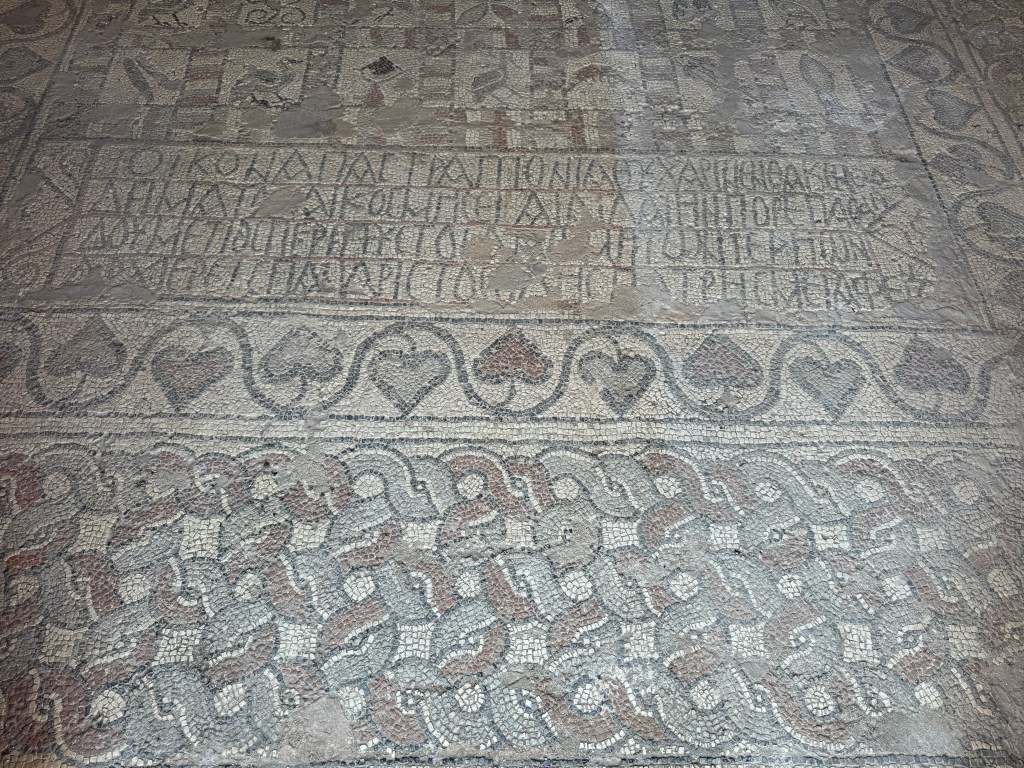
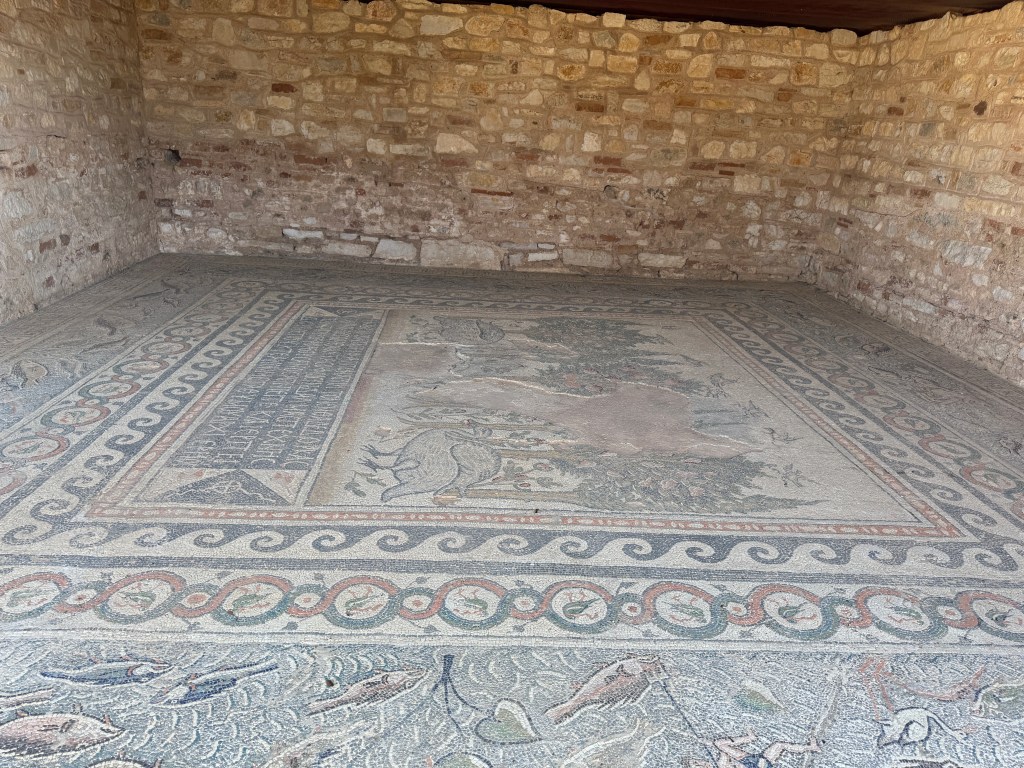
An early Byzantine stone-and-glass floor mosaic from the 6th century CE features an ancient Greek epigraphic inscription at the Basilica of Bishop Doumetios, an archaeological site of Ancient Nicopolis, 5 km north of Preveza. (Photograph by Melodie Miller)
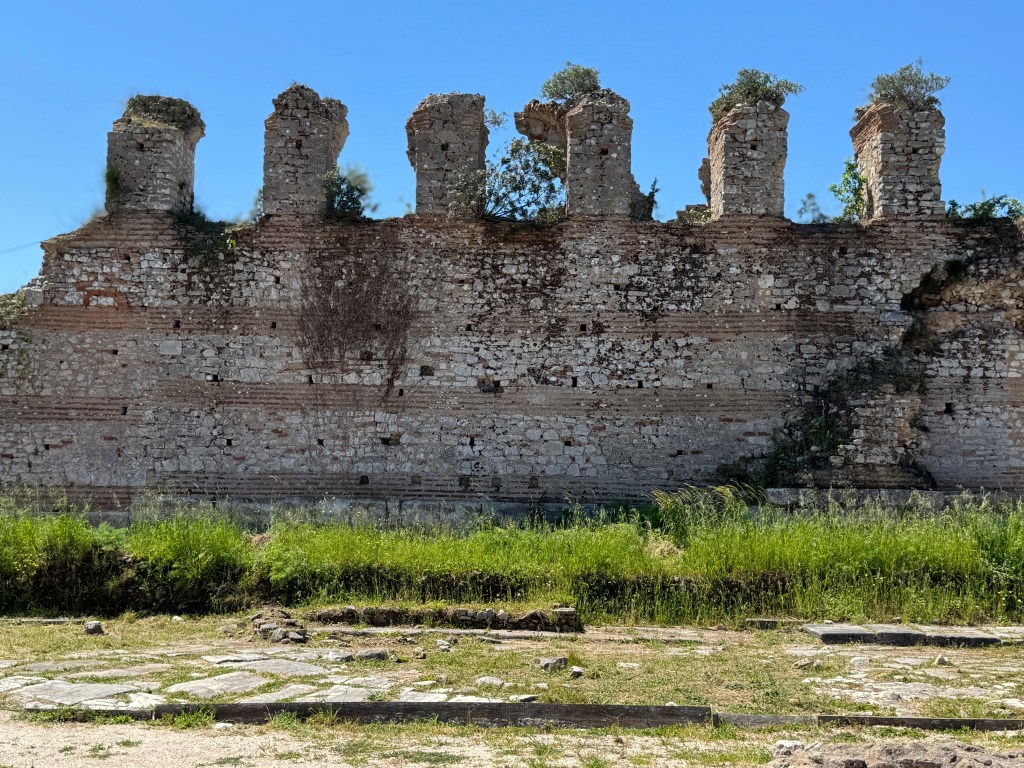
Byzantine walls built in the 5th – 6th centuries still stand in Ancient Nicopolis, a city Octavian founded in 29 BCE, 5 km north of Preveza. (Photograph by Melodie Miller)

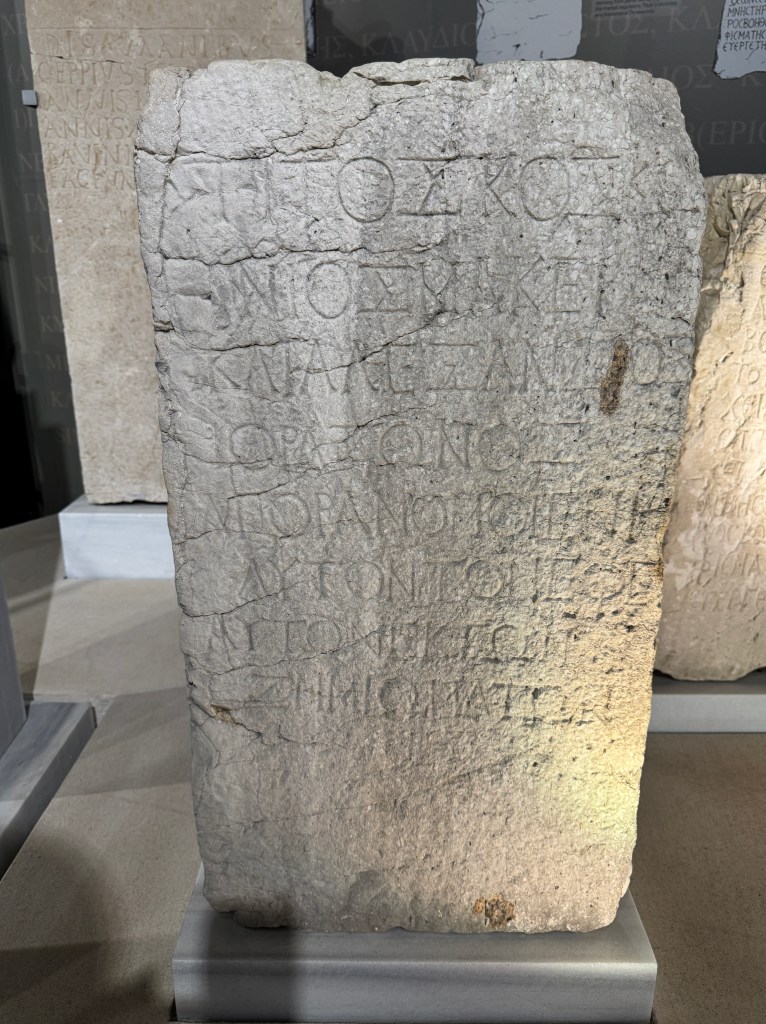

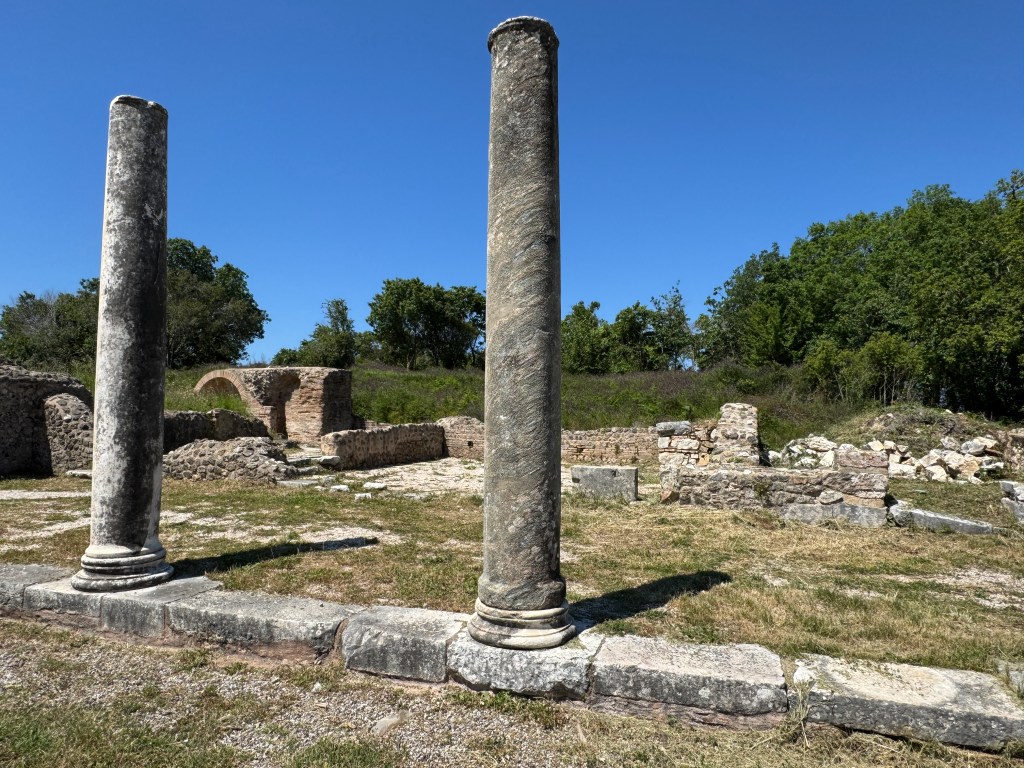
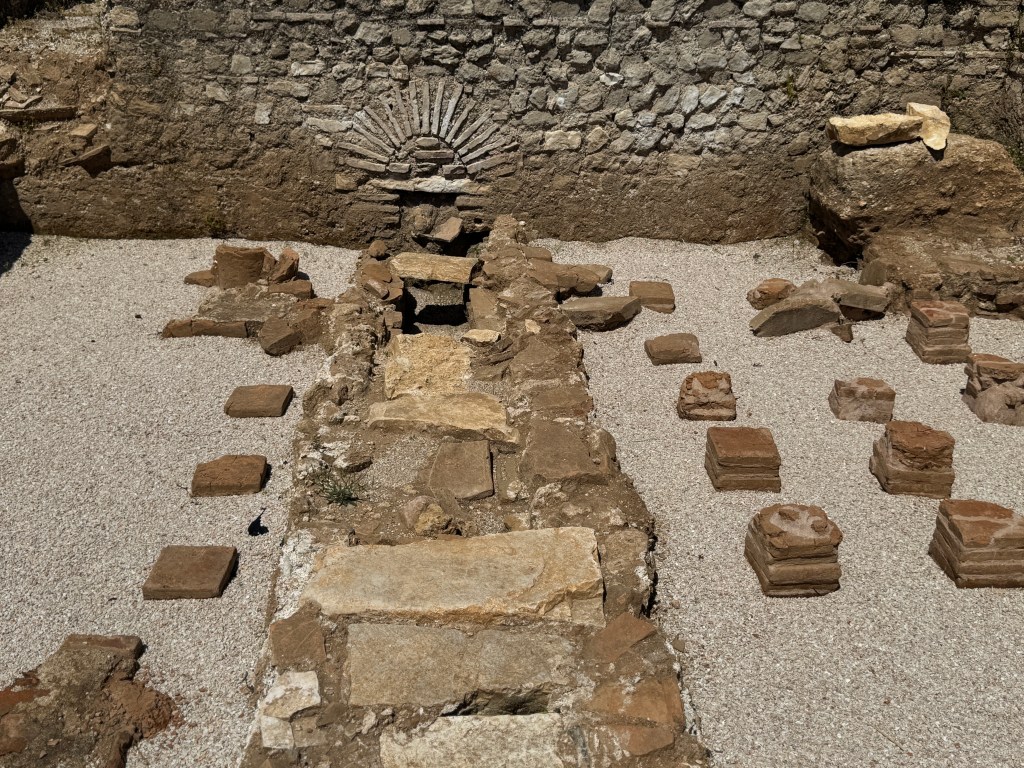
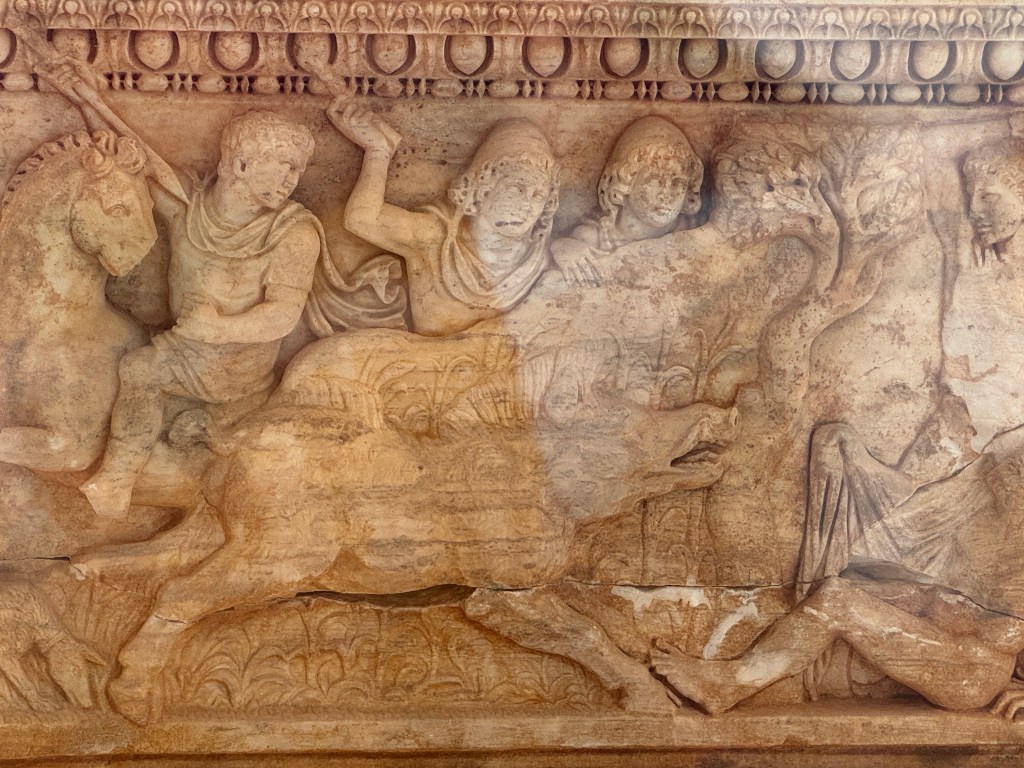
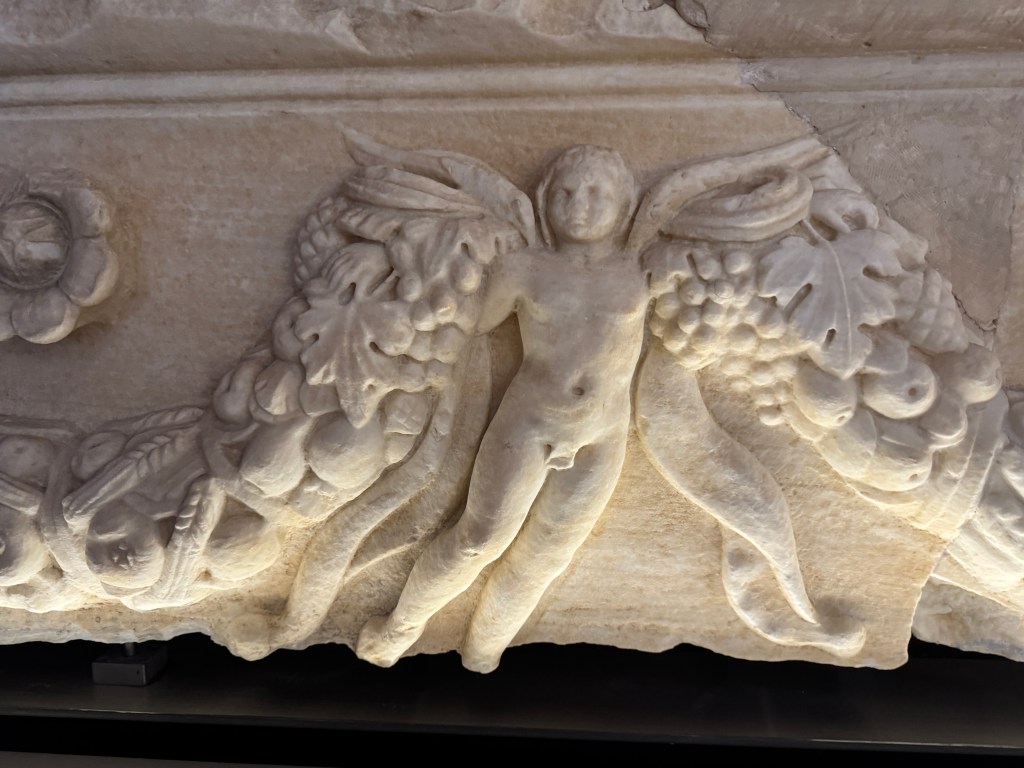

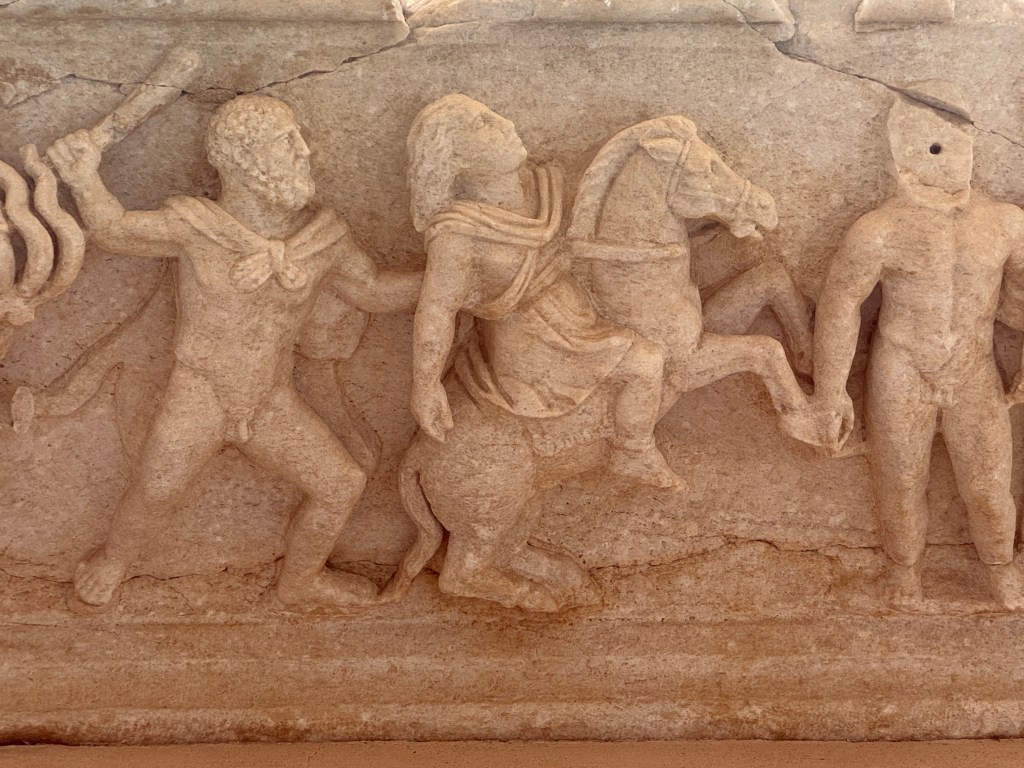
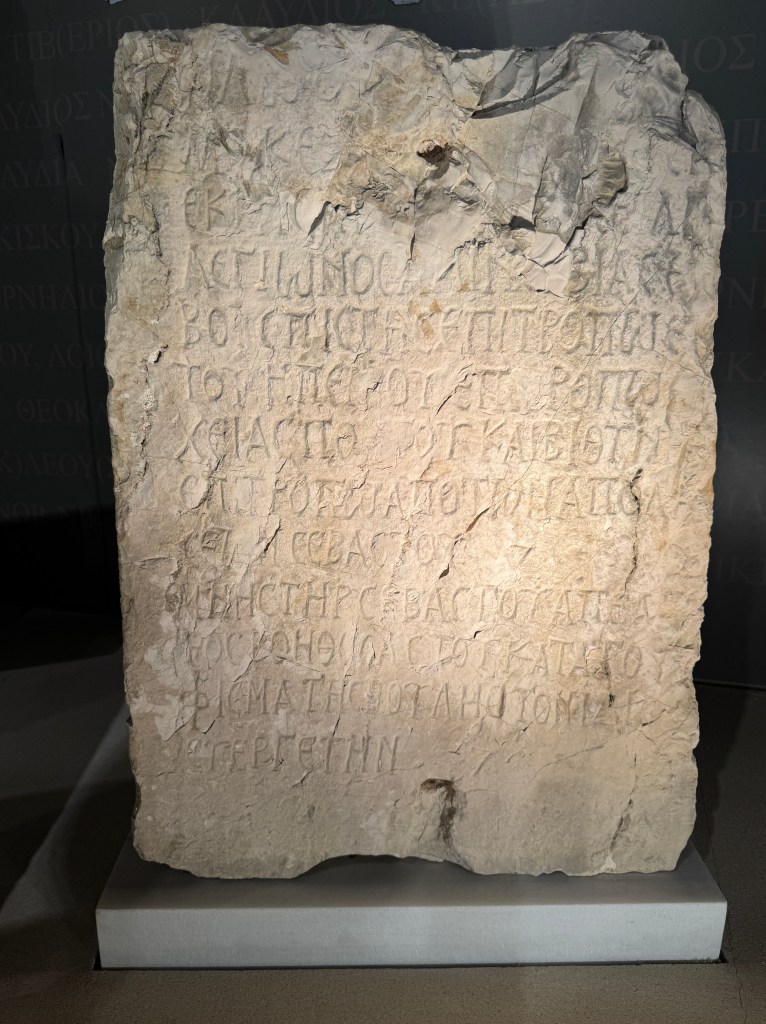
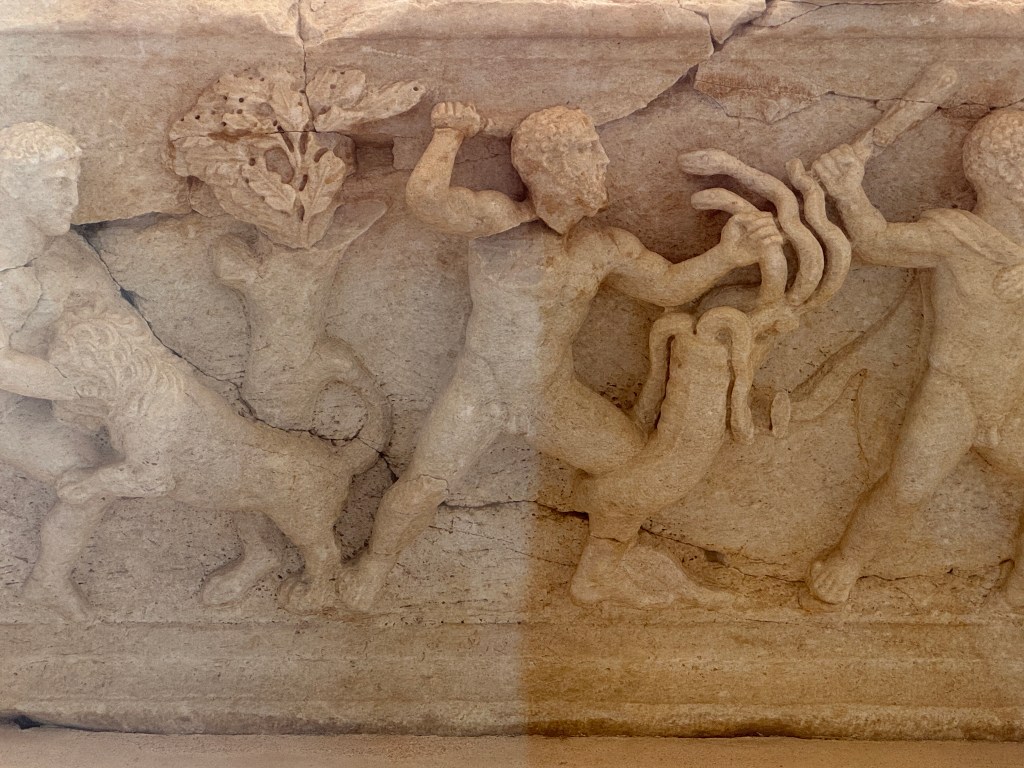
The Archaeological Museum of Nicopolis, 5 km north of Preveza, houses a marble relief that displays three of the twelve labors of Hercules. On the left is Heracles in his first labor, shown with the Nemean Lion, which he kills with his bare hands. In the center is a bearded Heracles in his second labor, grabbing the multi-headed serpent monster. On the right, Heracles, in his third labor, is draped in the skin of the Nemean Lion, likely capturing the Ceryneian Hind. (Photograph by Melodie Miller)
-
University of Colorado Students Brave the Near-Freezing Temperatures to Vote on Election Day
By Melodie Miller and Adair Teuton
Updated Nov. 7, 2025 | 4 minute read
The presidential election ended on Tuesday. Multiple ballot drop boxes and the University of Colorado Boulder Memorial Center voting poll closed on the CU Boulder campus at 7 p.m.
Students lined up at the entrance to the Glenn Miller Ballroom inside the UMC at near-freezing temperatures, the line extended out the door. The warming tent housed many voters who waited to exercise their constitutional right.
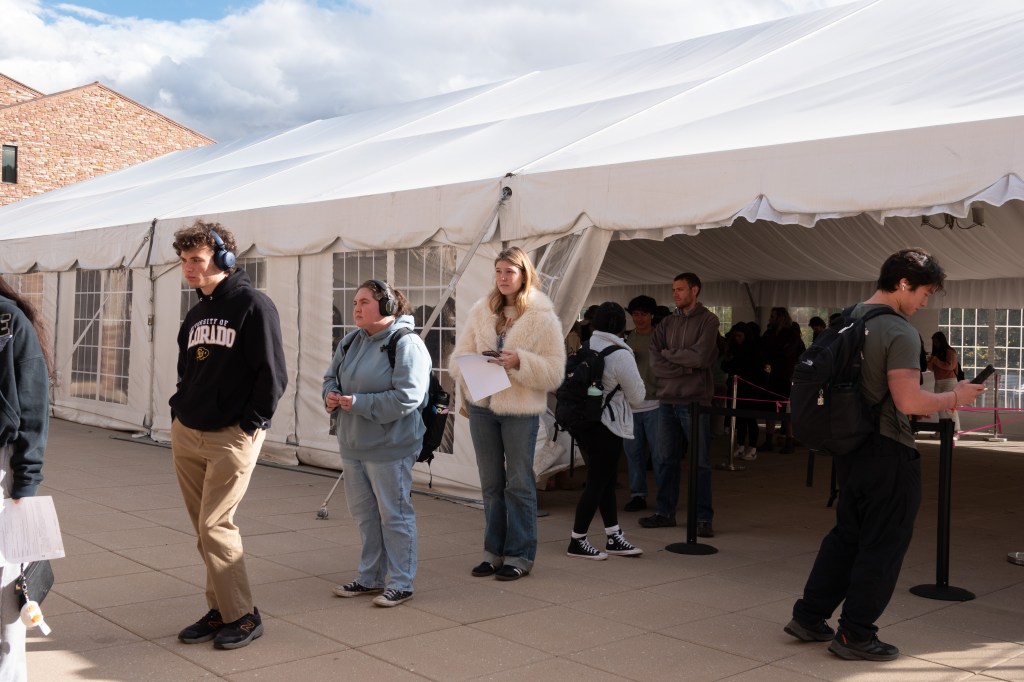
University of Colorado, Boulder students wait in line to vote outside the Colorado Memorial Center. (Melodie Miller | Photographer)
“Colorado typically boasts one of the highest turnouts for young voters in the entire country,” said Nicole Hensel, the director of New Era Colorado.
First-time voter Haley Hastedt, a senior at CU Boulder, expressed her concerns.
“I am extremely nervous about the election today,” Hastedt said. “I believe this is the most important election of our lifetime, and at this point, I think it could go either way,.”
University of Colorado, Boulder students register to vote at the Colorado Memorial Center. (Melodie Miller | Photographer)

Many first-time voters scrambled for identification cards and asked volunteers for information about how to register and vote. In-person voters show ID and “skip the signature verification,” which speeds up the process, according to Mircalla Wozniak, a communications specialist for Boulder County. All Colorado voters can register with Ballottrax to receive confirmation text messages that their ballot was received and counted. If there is a problem, Boulder County will notify the voter.
Thomas Uroskie, a CU Boulder student, waited in line at UMC. “This is my first time voting. I am feeling kind of weird. I’d rather vote in person than a mail-in ballot and get the experience,” Uroskie said.
Election day in Boulder unfolded smoothly after concerns heightened over ballot box fires reported in Washington and Oregon by CNN on Wednesday, October 30. Ballot box security “didn’t come out of nowhere. We have mechanisms for this,” Wozniak, said. “We have a regular pick-up schedule as we get closer to the election.”

New Era volunteers positioned outside the University Memorial Center answered voters questions. (Shutterstock | Photographer)
Georgia Moreland, a senior majoring in English at CU Boulder, said, “I’m nervous for the state of the country and how divided we have become due to this election.”
The FBI positioned election coordinators and command posts nationwide to enable streamlined communication and rapid response to ensure the safety of election workers, voters, ballot boxes and polling stations.
“Every FBI field office will stand up an election command post to coordinate with their local and state partners,” FBI spokesperson Vikki Migoya said. “Our focus is on protecting elections from potential threats so Coloradans can have confidence in their democratic process.”
The CU Division of Public Safety partnered with the CU Boulder Police Department to secure the UMC polling location and the rest of campus on election day. Academic buildings were locked with a Buff OneCards required for entrance “as part of ongoing efforts to enhance campus safety and minimize disruptions,” CUPD spokesperson Christine Mahoney said.
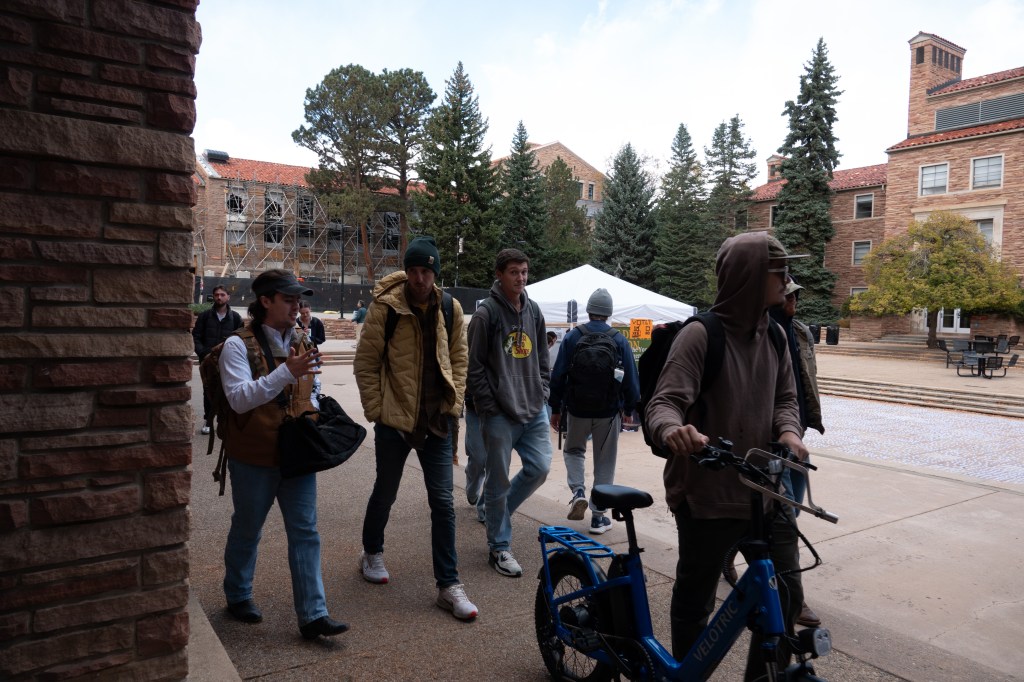
University of Colorado, Boulder students exit the University Memorial Center. (Melodie Miller | Photographer)
“Our campus is definitely encouraging the get out the vote, and we’re very very happy students are engaging in their civic duty,” Mahoney said. “We’re here to provide safety so they can do that.”
New Era Colorado was “on eight college campuses all across the state,” Hensel said, making sure that students had their voting rights protected “until every lost voter was through the polls at 7 p.m.”
New Era Colorado volunteers answer voters questions outside the University Memorial Center. (Melodie Miller | Photographer)
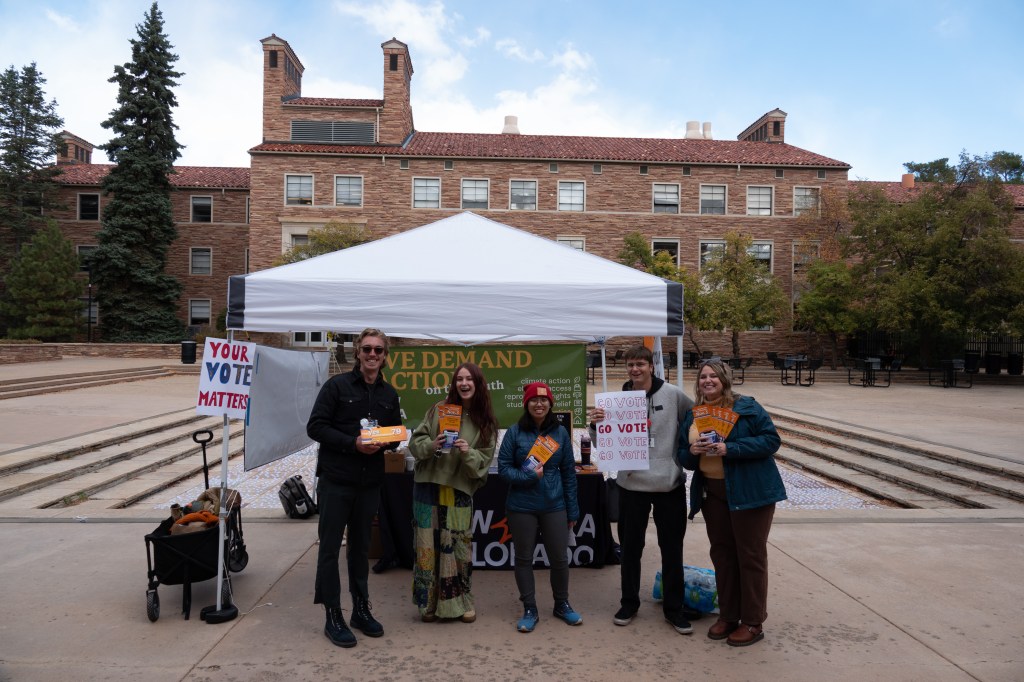
New Era volunteers positioned outside the University Memorial Center answered voters questions. (Melodie Miller | Photographer)
Although safety was a priority on campus, the results of the election troubled Elena Sedin, a junior in Philosophy at CU, Boulder. “I couldn’t relate to half of the U.S. population. I felt like a lot of people hate me through their vote,” Sedin said
New Era director Hensel said she felt “confident in the integrity of campus elections and knows that Colorado student election boards all across the state were working to ensure that students have safe and secure elections.”
New Era Colorado is a non-profit 501(c) political advocacy group that aims to educate and mobilize young people where they can have the greatest impact. New Era Colorado is a free resource for voters who want to know more about the ballot initiatives.

University of Colorado, Boulder students climb the stairs to the University Memorial Center to place their vote. (Melodie Miller | Photographer)
First-time voter Arielle Buzil said “It is very nice to vote, it feels empowering. It’s a little overwhelming, but I think it’s good because we’re all coming together and making change to the world.”
The Boulder County ballot included the presidential race, CO state and local candidates, measures, and the state constitutional Amendment 79 that would protect the right to an abortion. Colorado voters passed Amendment 79 with 1,736,436 votes, an 81% ‘yes’ vote by Boulder County and a 61.9% ‘yes’ vote statewide, as of 8:35 p.m. Thursday, Oct. 7.
CUPD offers a non-emergency line at 303-492-6666 to report any concerns that violate campus policies and 911 in an emergency.
Colorado voters can check the status of their ballot at https://ballottrax.coloradosos.gov/voter/
Voters can check election Colorado election results at https://results.enr.clarityelections.com/CO/122598/web.345435/#/summary
Originally Published: Nov. 5, 2024.
-
All Things Fiction
AI Image Generation
I live in Boulder, Colorado and create AI prompted images to match your story and marketing needs.

I am a writer, teacher, tutor, designer and artist. I have spent my career creating commercial products that people use to enrich their lives. I have a bachelor’s degree in English Literature from the University of Colorado. I am currently studying French there. I am also tutoring students in the Writing Center. While I working with English as a second language students I became inspired to write and illustrate simple French stories. Luc Apprend à Partager is the first in this series.
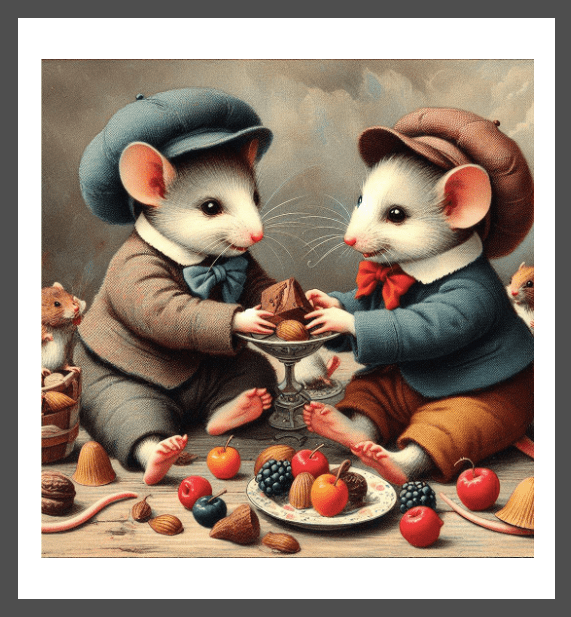
In the Luc Apprend series, my goal is to create a sympathetic mouse character. I want the character to be relatable. Children will adore and want to emulate this mouse. The stories are simple and entertaining. The mission is that Luc’s character will encourage positive behavior while readers are learning French and English words.
In Luc Apprend à Partager, Luc learns the importance of sharing after he encounters a shop keeper who wants to keep all his food for himself.
Luc Apprend à Partager – Microsoft Designer
I created this group of AI generated images with detailed word prompts to build on a model image. I worked to maintain consistency in the setting, place, and time. The character’s faces and clothing remained consistent. I used Microsoft Design.


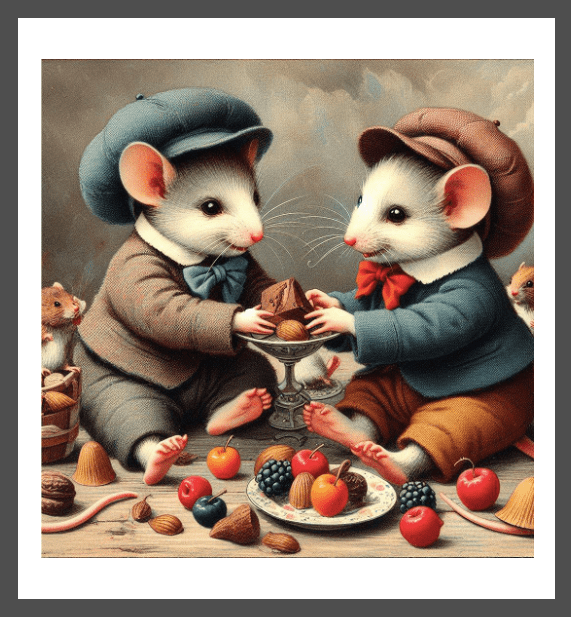
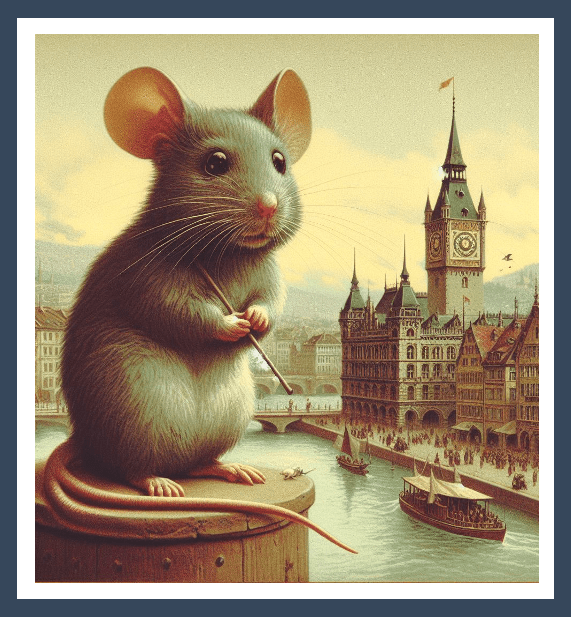
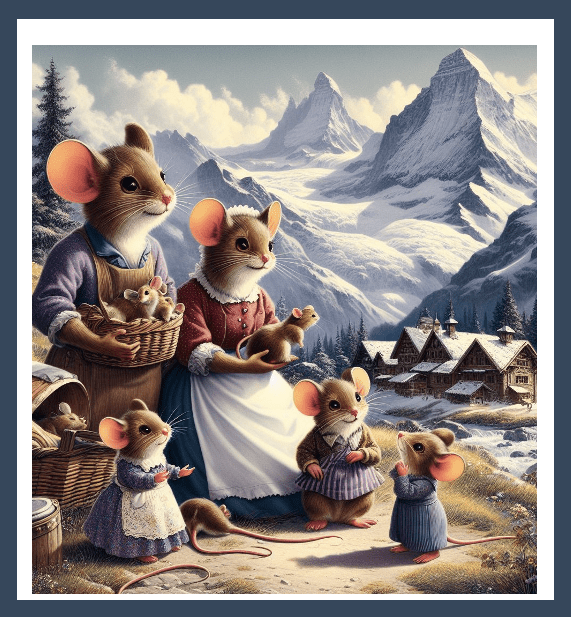
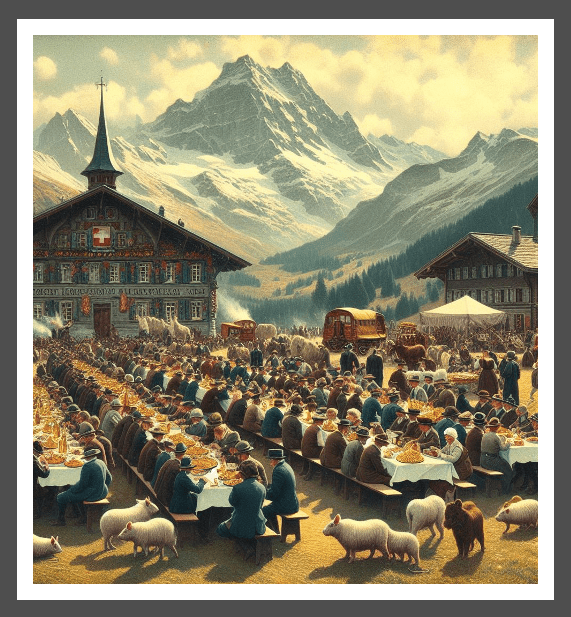





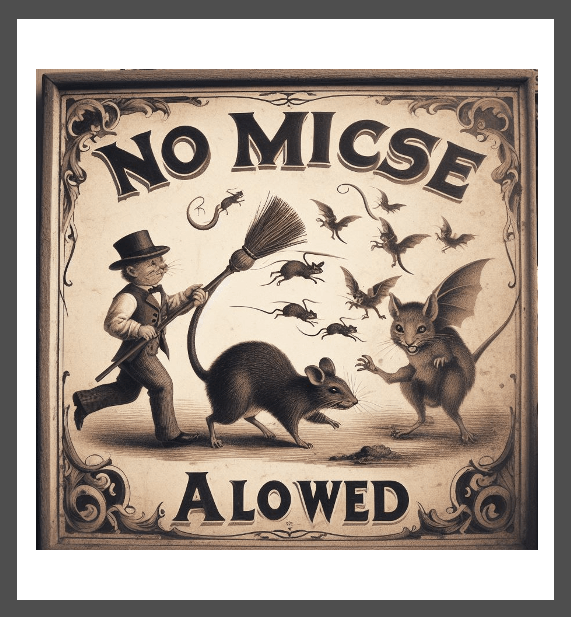



A Sublime Experience – Microsoft Designer
These sublime ferry images were created to capture the feeling of a dark winter’s night in the Northwest. The main character commutes home from work via Seattle to Bainbridge Island, Washington. This night follows the discover of a female murder victim in the parking lot near the ferry dock. The perpetrator was still at large.



Artifacts of a Murder: The Dead Girls Paintbrushes – Microsoft Designer
These AI images were created as imagery for the introduction to my story Artifacts of a Murder. The soft brush bristles and the pale, gentle blond wood color scheme was used intending as a contrast to the violence of murder. The handles are smooth and polished as a professional killer.






The Frozen Castle, a Murderous Tale – Microsoft Designer
This is the cover image for a gothic story about a women who marries a mysterious, wealthy man who transports her to his castle in Scotland where she is imprisoned and her youth is slowly drained from her soul to keep his 200 year old mistress from aging.

My Glamourous Career: A Memoir of Designing for U.S. Special Forces – Microsoft Copilot
I generated these AI images to set the dramatic mood of danger that is captured in my memoir about designing apparel for U.S. Special Forces to hunt Osama bin Laden in the Hindu Kush mountain range.


-
Artifacts of a murder: The Dead Girl’s Paintbrushes
by Melodie Miller © 2019
Fiona’s paintbrushes leaned at an eighty-degree angle inside the utility jar that sat on the easel shelf. The paintbrush’s heights were uniform, made of dark blond, smooth bamboo spindles. The bamboo spindles stood eight inches tall with a diameter of seven millimeters. A dark black, copper-clad ferrule circled the top of each spindle, holding the bristles in place.

The tip of one spindle was wrapped with a 2-millimeter open loop attached inside a small hole, glued to the moon-shaped head of the brush. Each outer bristle was made of soft mink belly hairs and the core was made of firm hairs taken from the spine of a wild boar.

Printed on the original paintbrush packaging the manufacturer guaranteed the bristles would produce “smooth, dynamic strokes when both light or heavy pressure was applied.”
The bristles were clean and still damp from washing and pointed to the ceiling like boot camp soldiers falling out of rank. The name YASUTOMO BAMBOO CALLIGRAPHY BRUSH was engraved in a manually burned branding method at the lower third of the spinal. The engraving was coarse-looking and ruff to the touch, emblematic of Fiona’s temperament.

*************
Sara reached inside the bronze-colored storage shelf labeled ‘B.’ The box was wrapped in newsprint paper that was faded on the corners. Handwritten in black felt tip pen was the name ‘Fiona Xi, 2018, Evidence.”
-
The Strange Kingdom Script

Kitchen and computer room created with Microsoft Copilot by Melodie Miller
“The Strange Kingdom” is an anthology series spanning fantasy, science fiction, suspense, horror, drama, and psychological thrillers. All episodes will feature macabre, unexpected twists that lean toward amoral and antisocial themes, where anti-heroes and villains usually succeed.
In the pilot episode, The Magical Mountaintop serves as a metaphor for an imaginary world. Mindy has lived there since she retired from ski racing because of an injury. The concept of a magical mountaintop alludes to a castle concept. This concept appears in knights’ tales. Examples include Marie de France’s “The Lais of Marie de France” and Chrétien de Troyes’ “Arthurian Tales.” In these stories, knights rescue damsels in distress. However, in this episode, Mindy is unknowingly attempting to rescue herself. None of the characters have altruistic natures or ambitions.
The Magical Mountaintop is inspired by Tennessee Williams’ play titled Magical Tower. In the play, two young, newly married lovers try to make it work. However, life’s hardships prove more potent than their love.
-
Downhill Racer, a Fractured Memory
by Melodie Miller © 2019
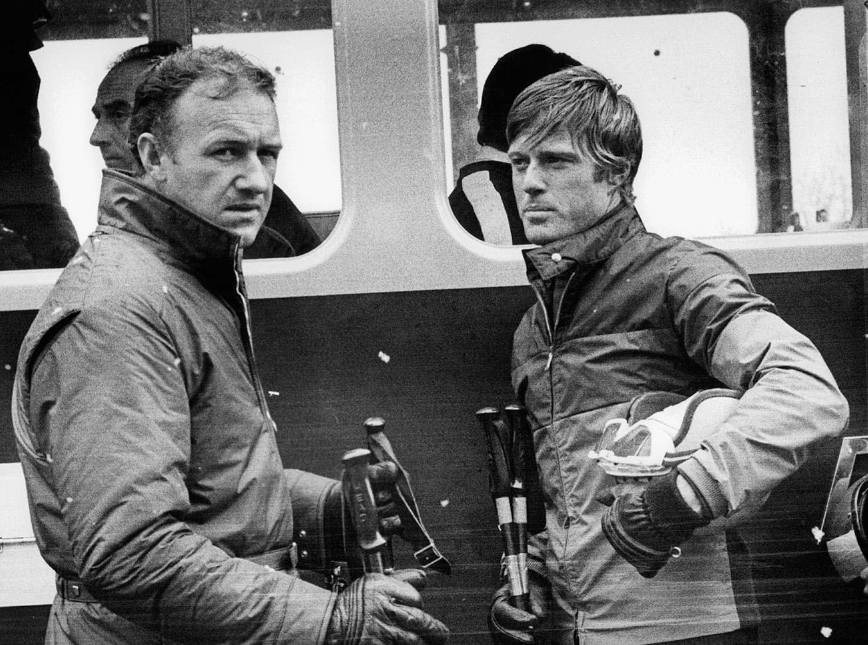
“Downhill Racer” stars Gene Hackman as an Olympic team coach and Robert Redford as an Olympic athlete. Courtesy of Paramount Pictures)
Downhill Racer (1969) Movie Synopsis: David Chappellet (Robert Redford) is an arrogant, overconfident downhill skier. On the Olympic ski team as an alternate, he is called to Switzerland to compete after a teammate is injured. He quickly becomes an adversary within the team through his smug behavior and unconventional techniques on the slopes, clashing with his coach (Gene Hackman).
“What’s past is prologue.”
William Shakespeare, The Tempest
An industry was born when a handsome and rugged Coloradan glamorized the sport of skiing and America began its life as a world contender on the international slopes of ski competition.
Before Gore-tex and waterproof breathable fabrics, I was a young girl in search of an identity. Everything that happened up to that point set the stage for what came next.
It was the first day at a new school, Junior high, seventh grade. I felt small and solitary.
Marcus Whitman Junior High School, Seattle, Washington (1969) (Courtesy of Marcus Whitman Junior High School Archives)
A short girl, like me, with a blond bobbed haircut, stopped me in the hall and said, “My big sister said I should find the cutest girls in the school and make them join my gang. You’re cute, you’re in my gang. Get a ride on Sunday to my house and we’ll go see Down Hill Racer? My name is Dev.”
Dev was one of the “cool girls” at school.
Sunday arrived and my mom drove me to the house of the “cool girl” named Dev with the blond bobbed haircut. She wanted to watch Robert Redford ski fast and I liked to ski so it sounded good to me.
I was in Seattle. It was raining. I didn’t know who Robert Redford was.
I wore a short dress because it was in style, and I am talented in the way of fashion. I read Vogue. My legs look good.
My mom drove very fast to Blue Ridge and jerked the car to a stop at the foot of a very steep driveway that led to a new, mid-century modern house.

Mid-century modern house (Photograph non-accredited)
I push hard with my whole body on the heavy station wagon door that creaked open to an unstable position which I hold in place with one arm.

Plymouth Chrysler (1969) (Photograph courtesy of MyMopar.com, Youtube)
Swinging my bare legs out of the car and watching for puddles, I placed my two feet carefully onto the wet driveway. The door slammed with a crash behind me and I remember slamming my fingers in the car door when I was five. But that didn’t happen this time. My mom drove away.
I walked up the flawless path that led to the house, and along the way, I thought, “My new friend lives in a rich person’s house.” I see a gardener working outside in the rain, trimming the trees with professional tools. I thought, “That man is Japanese, and he is a long way from home, gardening for a stranger.”
He appeared to work in a very serious manner, making the boxed hedge very sharp and clipping the miniature leaves with great force.

Japanese Gardens at Cedar Hill, Roxbury, Connecticut. (Photo courtesy of The Garden Conservancy.org)
I knocked on the front door, and my knuckles turned red with repeated impact. It was cold outside, and my good-looking legs wished they were covered with pants. Then I rang the doorbell. The right-hand side of the royal red lacquer-painted, double door opened mysteriously slowly, and I expected to see the black and white version of Nosferatu’s claw-like hand emerging along its edge. Instead, a grandmotherly-looking person stood in front of me.
“Hello,” she said, “I’m Dev’s mother.”
“Dev’s mother looks ancient, as old as my grandmother, and she is rather plump,” I thought.
My mom was skinny and young; too young, I heard people say. Dev’s dad was a doctor; my dad lived in a different house than me and my mom was a waitress. I keep that to myself.
I stepped over the threshold into a colder and cavernous room that hung precariously over an ice-age ravine. It felt odd because my warm and crowded house sat firmly on the terra adjacent to a gully. This house was held in place by stilts sunk into the glacial silt.
“Might this house might slide down the hill at the next earthquake?” My neighbor’s house fell off its stilts in a mudslide and three people died: a mom, a dad and a newborn baby. I wondered when the rain would stop falling and hoped an earthquake didn’t happen now.
The clack of my shiny new shoes on the slippery tile floor echoed across the room, bouncing off the stark white walls.
Opposite the front door was one large, seamless window that looked west towards Puget Sound and out to the Olympic Mountains. It was the same view I saw from the city park near my house. My new friend, Dev, with the weird blond bobbed haircut, lived in a rich person’s house within her own private park.

The Puget Sound and the Olympic Mountains, from Seattle, Washington (Photograph courtesy of Adobe Stock )
Dev appeared in the arched opening of the long hallway on the north side of the cavernous room.
“Come see my room,” she said.
She was wearing nice clothes, new clothes, which means something but I’m not sure what. I followed her down the hall. We entered a grand room with a garden view. She opened the top drawer of her dresser.
“Look at this,” Dev said.
I gazed at her socks, folded in pairs and arranged by color, separated by rigid dividers. It was a beautiful sight. My socks lay in a pile at the bottom of the dresser drawer that I share with my sister. Each morning we select a pair randomly, not concerned with finding its mate.
Dev was not an only child but a “surprise,” she told me. She had two older sisters who were married. I couldn’t make sense of this familial arrangement.
“I get all the attention from my parents,” she said, “because I was a surprise.” I don’t understand what she means. I am the oldest of six children with a lot of surprises at my house, mostly stray dogs.
Two more “cool” girls arrived, and their clothes were nice and new. Mine were hand-me-downs from the “older girl” across the street from my grandmother. One of the “cool” girls, the one with dark hair, was wearing a button-down boy shirt with the tails hanging out over a knee-length, A-line skirt made of fabric copied from a Chanel plaid. The other girl wore a knee-length shirt dress with bobby socks and brown-and-white saddle shoes that matched her hair. I dreamed of becoming a fashion designer, so I was creating a mental archive of the clothes people wear.
“Let’s go,” Dev, the blond girl said.
We all piled into the grandmother-looking mother’s German car that proudly displayed an erect airplane propeller on its chest. “I Want You” from Abby Road played on the radio. We all sang along with the radio: “I want you; I want you so bad, it’s driving me mad, it’s driving me mad.” We all laughed. The rain continued falling from the sky and I am relieved to drive away from the cold, cavernous, “ready to slide down the hill in a mudslide” house where my friend Dev lives. I must be sure to never spend the night there.

Mercedes-Benz 280 SE (1969) (Photo courtesy of Carscoops.com, Youtube)
“Robert Redford, he’s so dreamy,” the dark-haired girl with the football helmet-shaped haircut said. Her name was Jan. Her dad was a doctor, and her mother was a doctor too. I’m not sure how that kind of thing happens. The other “cool” girl was named Marian and had dusty auburn color hair. She was the one whose hair color matched her shoes. Her hair was cut like a Chatty Cathy. Chatty Cathy was a long dead doll. Marian’s dad was a coroner, a “kind of a doctor” she tells me. I decide that when I get home, I will look in the dictionary for the definition of “coroner.”

“Downhill Racer,“ stars Robert Redford as an overly confident and cocky Olympic athlete. (Courtesy of Paramount Pictures)
Something was happening. My new friends were smart. They had doctor dads and new clothes. I felt special.
My new friends had weird haircuts, and I wondered if I would need to cut my hair to be cool like them. My hair was long, parted down the middle, like Cher’s. All three girls had older sisters who told them “gross stories about boys.” When I babysit, I tell my younger siblings “The Tell-Tale Heart” story, and we all scream and laugh. I don’t have any “gross boy” stories. I felt young and immature with these girls. I was quiet.
The old-looking mother dropped us off at the movie theater. It was still raining. I had never heard of Robert Redford, but I didn’t tell the other girls. I know that a downhill racer skis very fast on steep, icy slopes and wins medals because I am a skier. Usually, the winners were French and named Claude. They wore tight suits that showed all their muscles, and when they reached the bottom of the hill, they threw their arms up over their heads in surprise.

In “Downhill Racer,” the close-up of the stopwatch emphasizes that time is of the essence. (Courtesy of Paramount Pictures)
“Downhill Racer” started, and a violin soundtrack filled my eardrums as the camera panned over distant mountaintops that weren’t ski slopes. That seems strange. The soundtrack shifted to piano keys ominously plunking over a close-up of a ticking stopwatch.
In “Downhill Racer,” leather ski boots slide back and forth as the racer prepares at the starting gate.(Courtesy of Paramount Pictures)
A faceless hand snapped a Look ski binding onto a red leather Henke boot with stainless-steel buckles running up the front over the ski racer foot. The red leather boot stopped just above his unprotected ankle. The webbing ski strap pulled tight around the boot.

In “Downhill Racer,” a skier races out of control. (Courtesy of Paramount Pictures)
A snug suit and nothing more covered the ski racer’s legs. A violin played dramatically as the camera zoomed in on a pair of long, narrow skis slicing back and forth like two hands carving a Thanksgiving turkey. The camera panned to the smooth face of a man as he pulled his goggles over his eyes, and the soundtrack shifted to a beeping heart. The man was wearing a USA Olympic ski team bib.
He launched from the starter’s gate, crouched in a tuck, then the frame froze and the title DOWNHILL RACER flashed onto the screen. The skier immediately caught his ski edge on a chunk of ice and crashed.
In “Downhill Racer,” the opening scene flashes the name of the film in dramatic fashion. (Courtesy of Paramount Pictures)
“There is an accident on the course,” the voice over said in English with a French accent. A helicopter landed, taking the broken skier away.
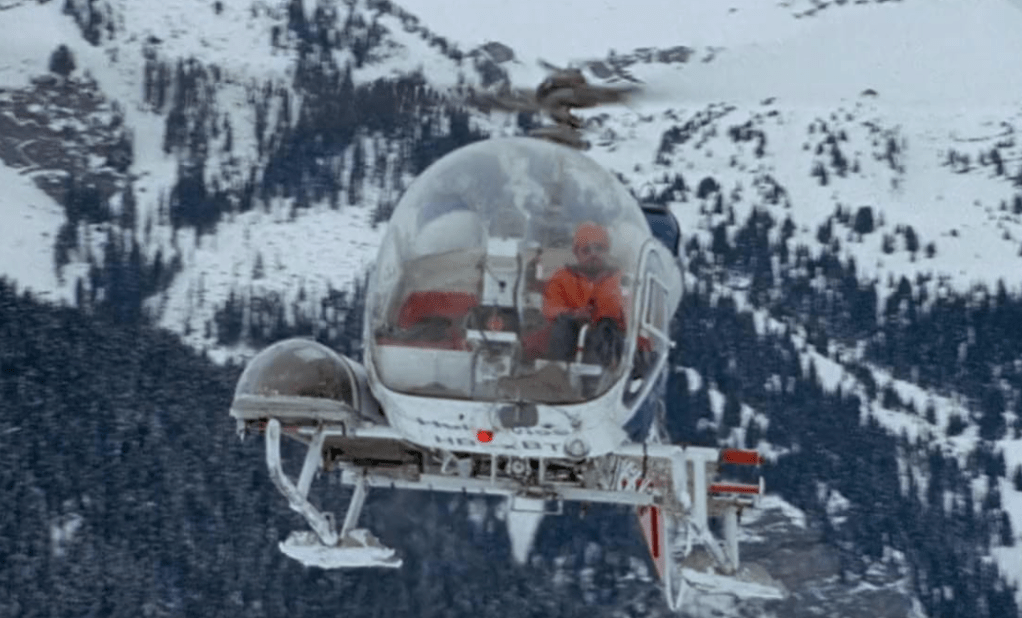
In “Downhill Racer,” a helicopter flies over the ski race course during the opening scene. (Courtesy of Paramount Pictures)
A man with freckles, bushy blond eyebrows and long shaggy hair arrived to replace the crashed USA Olympic team downhill racer. The new racer wore cowboy boots and chewed gum with his mouth open. His attitude seemed strange; maybe arrogant. He looked like someone’s dad.
“That’s him,” the three girls whispered in unison. “Robert Redford.” The arrogant, dad-looking guy with freckles and bushy hair, wearing cowboy boots and chewing gum with an open mouth, was Robert Redford.
I looked at my new friends in wonderment.
“Where is the dreamy guy?”

“Downhill Racer,” with Robert Redford looking uphill at the race course. (Courtesy of Paramount Pictures)
-
Sunflower Farms: Radio Script
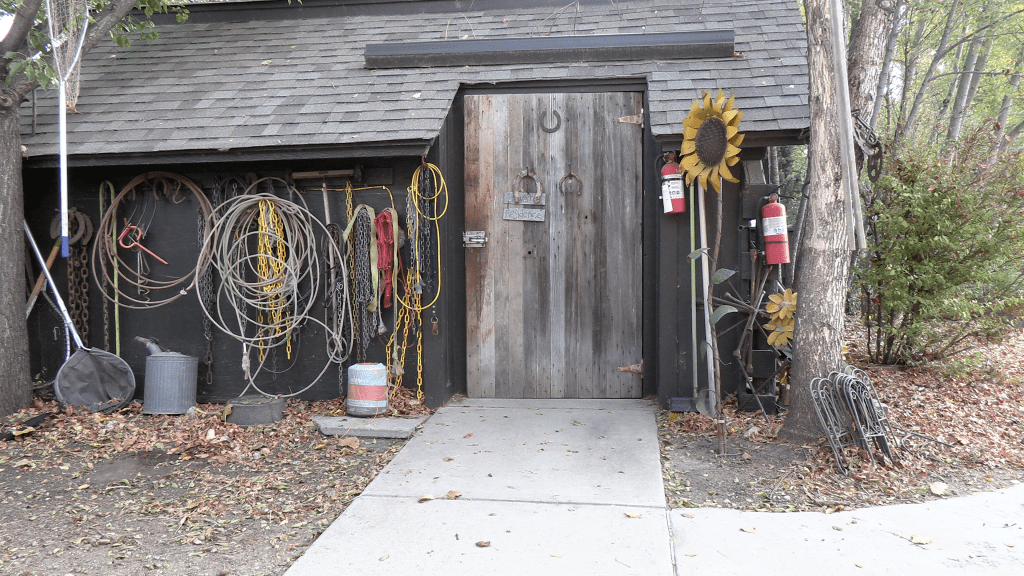
Sunflower Farm, Longmont Colorado (Melodie Miller / Photographer)
-
Super-Frog Saves Tokyo: A Classical Dream Vision Narrative
An analysis of Haruki Murakami’s Super-Frog saves Tokyo written by Melodie Miller.

Super-Frog Saves Tokyo illustration by PMGL (Courtsey of Amazon Books)
Haruki Murakami was born in Kyoto in 1949 and now lives near Tokyo. His work has been translated into more than fifty languages.
- https://en.wikipedia.org/wiki/Haruki_Murakami
- https://en.wikipedia.org/wiki/Drive_My_Car_(film)
- Norwegian Wood (1987)
- The Wind-Up Bird Chronicle (1994–95)
- Kafka on the Shore (2002)
- 1Q84 (2010)
- Men Without Women (2014)
- The Elephant Vanishes (1993)
-
The Story of the Western Wing: Breaking Tang Tradition
The West Wing, a play written by Wang Shifu (1250-1300) in the Yuan Dynasty.
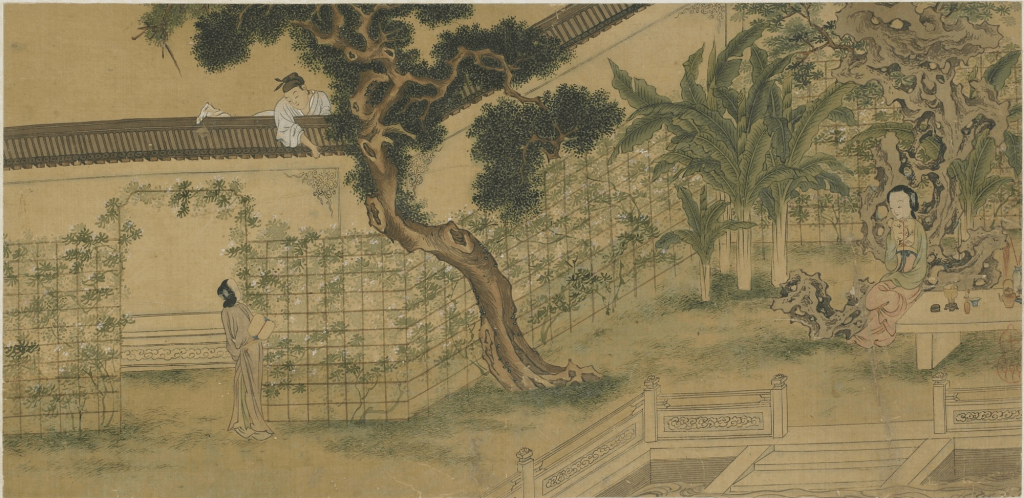
Scenes from The Story of the Western Wing, National Museum of Asian Art (Courtesy of The Smithsonian)
-
The Story of Ying-ying: Strange Love
A timeless story of love where social expectations conflict with personal desires.
Scene from Romance of the Western Chamber, an opera inspired by the story of Ying-ying (Illustration of act 10 courtesy of Wikipedia.org)
-
Humans are Synonymous with Monsters in “Monster Takes a Bride” (1807), Ikku Jippensha

Original 19th century Japanese Woodblock Print The Monster Takes a Bride, 1886
-
Syntax in Shakespeare’s Sonnet 20 “A women’s face with nature’s own hand painted”
An exploration of the poet’s depiction of nature and beauty.
The Chandos portrait is an oil painted portrait thought to depict William Shakespeare (1564–1616). Painted between 1600 and 1610, it may have served as the basis for the engraved portrait of Shakespeare used in the First Folio in 1623. Attributed to John Taylor. (Courtesy of Wikipedia.org)
Read more about Shakespeare’s Sonnet 20 “A woman’s face with Nature’s own hand painted”
-
The Frozen Castle, a Murderous Tale

The Frozen Castle created in Microsoft Copilot by Melodie Miller
-
A Sublime Experience
Waiting for the the last ferry in a dark, wet abandoned parking lot in the far Northwest.

The sublime and disruptive aesthetics of winter in the Northwest. Image generated by CoPilot designed by Melodie Miller.

A sublime ferry crossing the Puget Sound on a Northwest winter night. Image generated by CoPilot designed by Melodie Miller.

A sublime drive home after crossing Puget Sound on a Northwest winter night. Image generated by CoPilot designed by Melodie Miller.
-
The Elbow Room
Melodie Miller ©
The Elbow Room is a situational comedy series set in 1984 at the birth of tech in Seattle, Washington. The Elbow Room is a fictitious bar on a Washington State Ferry where young commuters hang together during their battle to and from Bainbridge Island to their jobs in Seattle. Their friendships exist only inside the world of their commute and every effort is made to keep their personal lives separate from their ferry boat adventures.

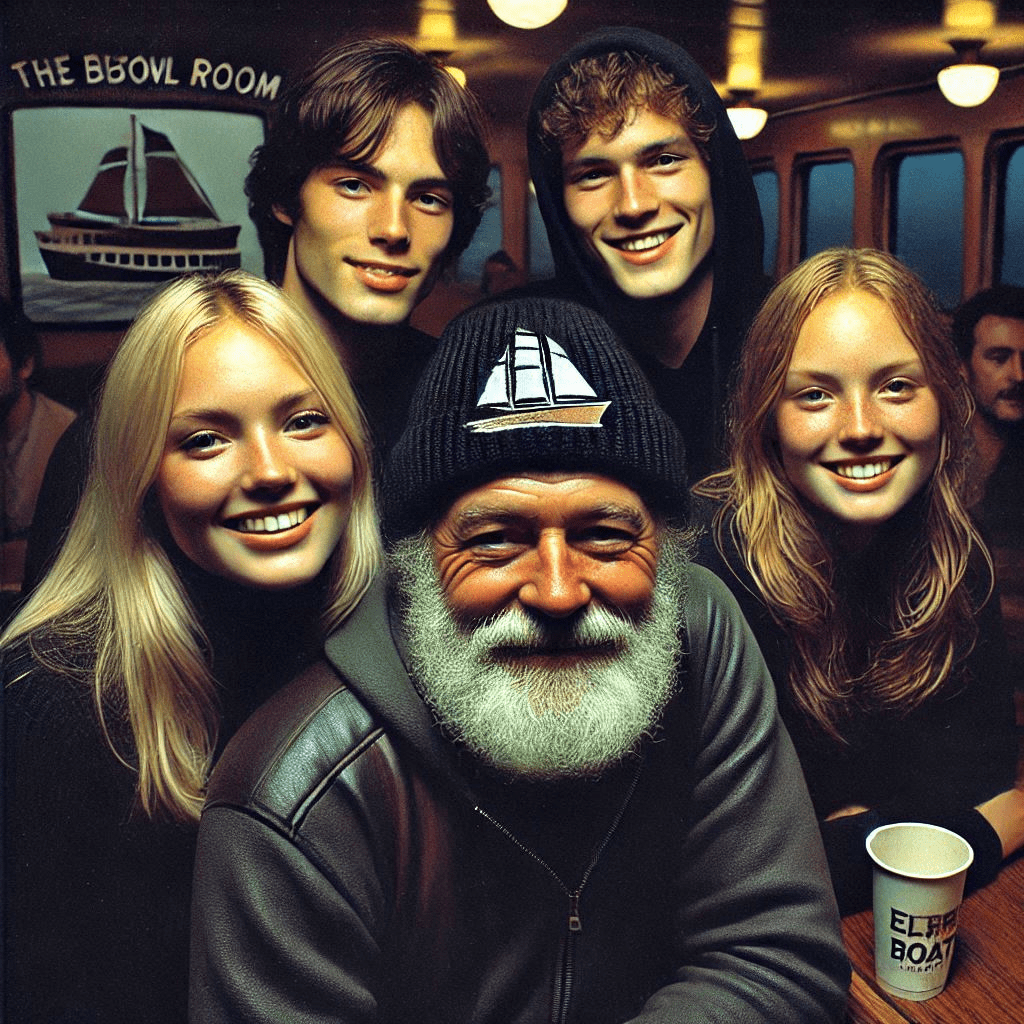
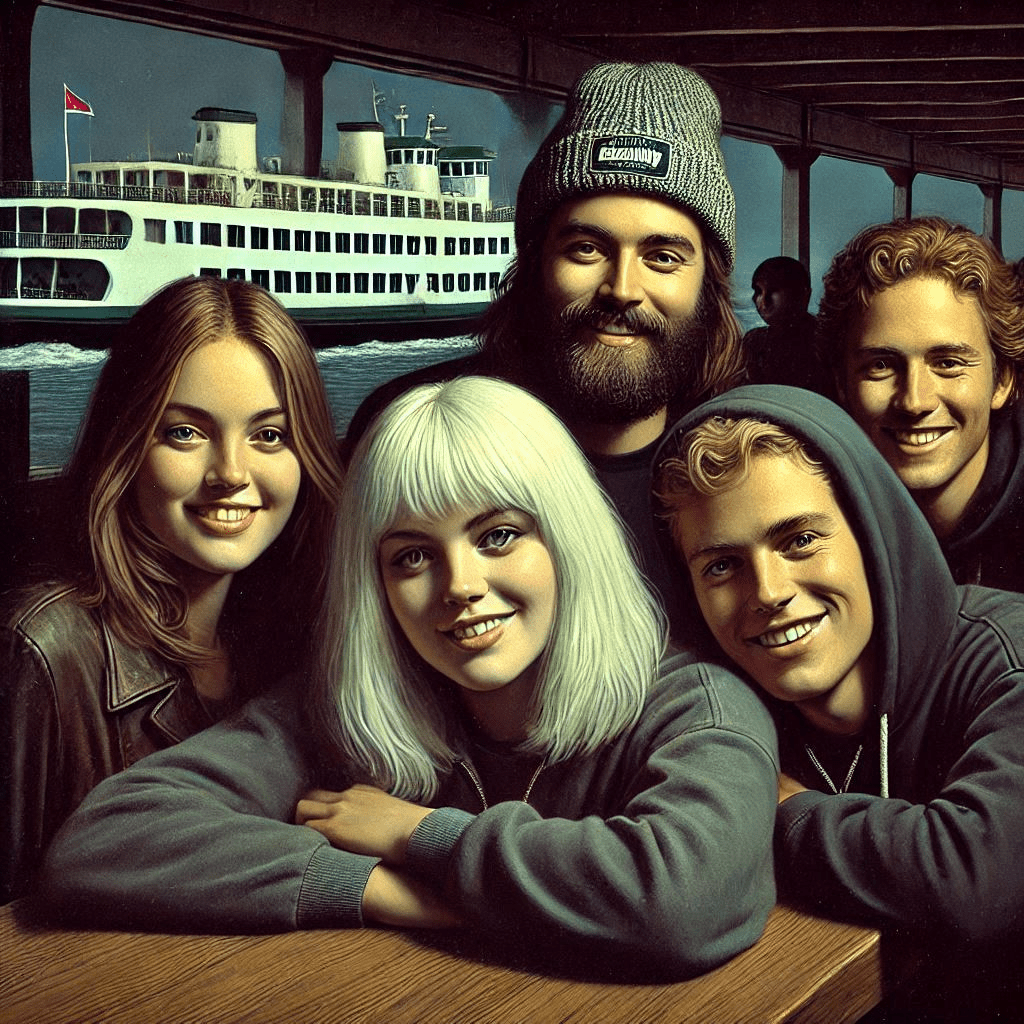
-
Colorado Funds Affordable Housing but Not All Home Buyers Qualify
The term “starter home” has a new meaning. The average price of a home in Boulder jumped from $166,000 in 2000 to $966,000 in 2025. Boulder’s cost of living is 41% higher than the national average. This means a dozen eggs that costs $4 in Jackson, Mississippi, will cost $5.64 in Boulder, Colorado. What does that mean for housing?
The median sale price of homes in Boulder County, Colo. in 2024 was $970,000, according to Zillow.com. To match a house payment with the average rental price of $2,300 per month, a buyer needs $725,000 for a down payment.
With a median household income of $84,840 and expenses of $77,280 yearly, an excess of $7,560 per year will require ninety-five years to save the downpayment.

Zillow.com Boulder Housing Market Overview 2023 – 2024 – accessed Jan. 3, 2025
The Common Sense Institute of Colorado reported in January of 2023 that voters passed Proposition 123 with a 54 percent majority to fund affordable housing programs statewide.

Data USA. Adobe Express. (Melodie Miller / Creator)
Data USA reported similar data for Boulder, Colorado, in 2022, with a higher median household income of $99,700 and a lower median property value of $671,100. This additional $14,860 yearly income means a buyer could buy a house in 25 years.
However, according to Pro Builder, housing prices in Boulder increased 121% or $107 per day between 2015 and 2025. If prices continue to rise at that rate, a future buyer’s goal becomes non viable.

State Senator Dylan Roberts – Colorado Senate Democrats (Photographer / Uncredited)
“During my time in the state senate, I have been trying to find ways to lower the cost of living,” Senator Dylan Roberts said, “and this starts first and foremost with housing.”

Common Sense Institute Colorado Jan. 30, 2023
Proposition 123 dedicated a total of $290 million toward housing equity in the first year. Willoughby Corner at 120th and Emma Street in Lafayette is part of the Boulder County Housing Authority (BCHA) 400 affordable housing project using some Proposition 123 funding.

https://www.pinkardbuilds.com/expertise/affordable-housing-construction
“It takes a lot of funding. It takes federal funding, state funding, and a lot of it is funded by the low-income housing tax credits,” Bill Cole, housing partnership and policy manager for Boulder County. “It’s a federal program run through the state.”
According to Cole, the Willoughby Corner construction takes three phases. The first phase is 90 units of senior housing. The second phase is multifamily apartments totaling 200 units. “The third phase is actually going to be homeownership opportunities, townhomes, about 80 units,” Cole said. All units except the senior housing have a waiting list.

willoughby-corner-open-house-presentation-7-26-23 PDF (assets.bouldercounty.gov)
Boulder County’s affordable housing imposes income limits that exclude many people from government benefits. The average Boulder County resident earning a salary of $84,840 will not qualify for this benefit.

Boulder County Rent and Income Limits – Willoughby Center
Some potential home buyers find that there is no solution for home ownership. These buyers earn more than the income base to qualify for affordable housing but do not earn enough to make a substantial down payment.
“With 6% interest rate right now, how does a new home buyer afford that?” Boulder County realtor Ernie Sica said. “They have to have a really substantial income. That is really hard.”
With a mandatory high down payment, future homeowner Elena Sedin said, “My parents are already paying for my college. They can’t help me buy a house.”
According to Cole, those individuals who qualify for affordable housing should “Look at Prop 123. There’s gonna be a lot of the state funding for the foreseeable future,” Cole said. “Boulder County plans to build multifamily, senior and single-family developments as it tries to “increase the housing in the city of Boulder.”
-
The Decline of Hunting in the U.S. and the Threat to Wildlife Conservation
According to the archeological dating of the Morocco Jebel Irhoud animal fossils and the Homo sapiens who ate them, humans have hunted game animals for over 300,000 years. Although humans are omnivores, they did not start farming until 23,000 years ago, according to the Ohalo II archaeological site in Israel. This means that humans needed to hunt for 277,000 years for food security.
Kelly Maher, an avid Coloradan hunter and mother, said part of her family ethic is “we hunt to eat and we eat what we hunt.” During the Covid 19 shutdown, her family ate deer meat stored in the freezer from the previous hunting season. Maher said she believes hunting is a core part of “understanding our place in the world.”
Data from All About Bison. https://allaboutbison.com/national-mammal/
American wildlife suffered at the end of the nineteenth century from mismanagement, according to the Audubon Society. The bison population had diminished from 60 million to 300 in 100 years due to lack of management and overhunting according to All About Bison. Together, President Theodore Roosevelt, George Bird Grinnell and John Muir along with the Audubon Society, established a conservation movement to preserve nature.
Roosevelt, the “conservation president,” used his authority in 1906 to protect public lands and wildlife by creating the United States Forest Service (USFS). This service established 150 national forests and 18 national monuments through the American Antiquities Act. This act protected over 230 million acres of open public space for citizens of the United States use.
With the advent of city living, increased public criticism, and reduced barriers to food security, hunting has declined in the United States. The decline of hunters is problematic state-wide for wildlife conservation efforts that depend on funding from hunting license sales.

Source: 2020 U.S. Census Demographic – City density
According to Wildlife for All, between 1960 and 2020, hunting license sales increased by 2 million or 13.5 percent. The U.S. Census Bureau (USCB) reports that the population increased by 152 million or 84 percent. Although the number of hunters increased, it dropped from 7.8 percent of the population in 1960 to 4.8 percent in 2024.
The U.S. Fish and Wildlife Service manages nationwide conservation funding through the collection of hunting license revenue and firearms and ammunition excise sales tax from each state. The funding is distributed back to the state parks and wildlife departments that manage public land conservation and animal populations.

Sources: U.S. Census Bureau. Wildlife for All. U.S Fish and Wild Life Service Hunting licenses issued between 1960 and 2020 compared to the U.S. population.
“There are 180 hunting units that Colorado has divided into Game Management Units (GMUs),” Cody Heneghan, a hunt planner for Colorado Parks and Wildlife said. “These units designate which part of the state your particular license permits you to hunt in.”
Hunting licenses for Colorado’s Western GMUs with higher elk populations are in high demand with a limited number available per year. A hunter must apply for these types of licenses through a “big game draw,” or purchase a leftover license after the draw if one is available.
“I’m not hunting as much now because the last time I bought a license, it was in a unit with a low population and I didn’t get an elk that time,” Wally Light, a 21-year-old hunter said. “It was a lot of work without a payoff. It didn’t seem worth it.” According to Colorado Parks and Wildlife, the Federal Bureau of Land Management (BLM) manages 8 million acres of public land in Colorado. However, non of the 23,000 acres of open space and trails in rural Pitkin County are open for hunting. Open space hunting in Pitkin County Colorado is prohibited according to the Pitkin County Open Space and Trails program. However, private land is huntable with permission.
But private land is diminishing. In January, Pitkin County Open Space and Trails Board voted unanimously to purchase 650 acres of private land in upper Snowmass Creek Valley to reclassify it to BLM open space.
According to wildlife advocates, limiting hunting units in Colorado become problematic for wildlife management. “Management of ecosystems is important,” Maher said. “By virtue of the fact that humans are here, we must manage this system” to ensure the well-being of animals and the environment.
Between 1970 and 2000, hunting license sales revenue increased from $600 million to $1.1 billion according to The U.S. Fish and Wildlife Service reports. However, revenue remained stagnant over the next two decades.

Sources: U.S. Fish and Wildlife Service. Congressional Research Service. Hunting license sales revenue and federal excise tax collected equally $2.2 billion in 2024.
Data from the Congressional Research Service reports that between 2017 and 2022, excise tax collected from the sale of firearms increased from $600 million (inflation adjusted) to $1.1 billion due to increased sales during the pandemic but not to sales for hunting equipment. However, funding from the U.S. Congress has decreased since 2015.
Hunting is an integral part of maintaining a stable deer and elk population. Lands maintained by hunting license revenues distributed by the U.S. Fish and Wildlife Service are more likely to support natural wildlife.
The “availability of food sources in the wilderness is a factor in monitoring the population,” wildlife advocate Mark Surls said. This becomes a closed-loop, sustainable ecosystem.
The U.S. Fish and Wildlife Service operating budget, is partially funded through congressional appropriations. In 2024, the operating budget was $4.1 billion with $1.722 billion allocated by the government and the balance coming from grants, excise tax revenue and hunting license sales.

Sources: Congressional Research Service Funding requested to manage Fish and Wildlife Services, and congressional funding enacted to finance conservation in all 50 states and 16 territories.
Public opinion contributes to the hunter’s image in the U.S. On Nov. 5, voters were given a choice through “Cats Aren’t Trophies” Proposition 127 to decide whether Colorado Parks and Wildlife would continue to manage the mountain lion population by issuing hunting licenses.
“Hunting deer is fair chase,” wildlife advocate Carol Monaco said. But hound hunting “mountain lion is cruel.” It isn’t helping anyone and “very few big cats are dressed for consumption. We need to learn to coexist with wildlife.”
Surls advocates that hound hunting is unethical and should be removed from the hunting license options because “it gives our hunters a bad name for violations of fair chase,” integrity in hunting.
Some critics combine hunting for food with “trophy hunting.” Trophy hunting is hunting wild animals for sport and keeping body parts for display, not food. Mesa County Commissioner Cody Davis commented that this type of rhetoric is needless with an “end route to limit hunting” and “trophy hunting is already illegal in Colorado.”
Proposition 127 aimed to remove mountain lion population management from the Colorado Parks and Wildlife. In Nov. 290,000 voters rejected the proposition. In a compromising effort at a public engagement meeting critics of mountain lion hunting demanded that “guaranteed kill” be removed from hunting outfitter’s advertising because it is illegal in Colorado and a violation of CPW’s policy.

Source: Ballotpedia Colorado Proposition 127 to Prohibit Hunting of Mountain Lion was rejected by Colorado voters, allowing Colorado Parks and Wildlife to continue managing the population.

Source: Ballotpedia. Colorado Proposition KK, Excise Tax on Firearms was passed by Colorado voters, adding 6.5% excise tax to firearms and ammunition sales.
“We want to work with Colorado Parks and Wildlife,” Monaco said, “in every way so they can do their job” managing wildlife population.
As hunting license sales decrease, U.S. Fish and Wildlife Service funding must be replaced with a new source. Hunting licenses are an important source of revenue.
“Colorado Parks and Wildlife are brilliant at managing the wildlife population and it should stay that way. It is a scientific method of conservation,” Davis said
-
My Glamorous Career: A Memoir of Designing for U.S. Special Forces
This story is creative non-fiction about a designer who worked with U.S. Special Operations troops to create the perfect clothing to hunt for Osama bin Laden in the Hindu Kush mountain range between Afghanistan and Pakistan. This real project was completed in 2003. Bin Laden was killed on May 2, 2011.
While the events and core truths are based on real experiences, some details may have been altered. This includes names, identifying characteristics, and sometimes even timelines. These changes protect privacy or enhance the narrative. Any resemblance to places, real people, or situations is not intended to be exact.
The New York-New York Hotel and Casino in Las Vegas, Nevada is home to a miniature Statue of Liberty replica. (Photo courtesy of Ethan Miller/Getty Images)
I was willingly recruited into the world of covert operations by a special operations officer dressed all in black. It happened at the Las Vegas Convention Center. Any fan of “Casino” or “The Godfather” would rather meet the mob bosses, Sam Rothstein and Michael Corleone, than Joubert of “Three Days of the Condor” or Jason Bourne, the trained assassins. At least the Rothstein and Corleone characters embraced brotherhood like a family of gorillas. As long as you never refused an offer, they would always make room for compromise. But assassins are a different kind of animal. With assassins, things are over before you know what happened. You never see them coming. Like mountain lions, assassins hunt alone. Assassins do not negotiate. On that day in Las Vegas, I met an assassin.
Disguised as a procurement officer for the army, the assassin dressed impeccably in the best-selling and most important color in any apparel collection: black. I thought I was meeting a fellow couturier. With the erroneous belief that clothes make the man, I started the project thinking I was working with a compadre; better yet, a man who knew how to dress.

Microsoft Copilot Image generated by Melodie Miller
This misconception filled me with a false sense of security. I thought this would bridge the gap between me, the designer, and Eddie, the government-sanctioned hitman. I knew he would be ‘pack’n.’ I wasn’t afraid of guns; I grew up in a family of hunters. Still, I hoped I wouldn’t become the prey.
It all started at 8:45 a.m. Eastern Standard Time on that fateful morning in September 2001, when I woke from a dream where red balls of fire chased me down an endless hallway. When I turned on the television and saw the burning tower in New York City, my dream made sense.
I didn’t know it yet, but life would never be the same. The next thing I knew, I was in Las Vegas on a sweltering January day in 2002, when the country still shared a collective fear that a terrorist could be their neighbor, living on their street and be attending flight lessons at their municipal airport, preparing for another attack.
“How did I get here,”[1] I asked myself, “by letting the days go by without thinking, pursuing the American dream, and designing clothing for the self-absorbed,” I said.
Walking through the casino, I watched as gamblers followed the president’s advice to “enjoy life,”[2] so they headed to the slots and blackjack tables. Spending their money on entertainment helped them forget about the problems of the world. But I was not enjoying myself. I was working.

Microsoft Copilot Image generated by Melodie Miller
Leaving the casino, I took the long, hot walk from my hotel along the Boulevard, which seemed to become longer and warmer as I passed the miniature replica of the Statue of Liberty. I wondered if freedom, like the statue, would shrink following the attack on New York City.
Congested with noisy taxis, people rushing to their gambling destinations, and neon lights flashing at all times of the day and night, Vegas epitomized the ideal of the U.S.A.: get rich and fast if possible. The ground seemed to radiate beneath my feet as if the heat came from the underworld. I felt like I was walking on red-hot lava.
I thought, have I “found the ‘cost of freedom” [3] buried in my soul?

Microsoft Copilot Image generated by Melodie Miller
Ignorant of the danger ahead, I continued moving forward. The odor of hot oil mixed with concrete filled the air as I convinced myself I believed in the pledge of allegiance to the republic that had sheltered me all my life. But actually, I needed the money, so I kept walking toward the meeting. I was sweating, and moisture under my arms dripped down my skin, inside my crisp white business shirt, pooling at the belt buckled tightly at my waist.
I reached the stairs to the convention complex and looked up at the building towering over me like a colossal statue of Commodus, the blood sport-loving emperor of Rome who was assassinated by his gladiator trainer.
“One can never be too careful,” I thought.
The Greek columns seemed to be holding up my world. They reminded me that even a military power like the great Roman Empire did not guarantee eternal supremacy. This is true even for a country like America. The gargantuan doors seemed to suck me into the maze-like complex. The oversized tiger statues that flanked the doors looked at me with large, hungry eyes.

Microsoft Copilot Image generated by Melodie Miller
I entered the convention hall and temporarily disappeared into the self-induced state of Vegas coma, where no clocks, windows, or daylight existed. I began to lose track of the time of day, leaving my old life behind outside the doors that closed slowly behind me, and I wondered if the gods would “shed their grace”[4] on me.

Microsoft Copilot Image generated by Melodie Miller
The grandeur of the oatmeal-colored walls towered above me like ramparts of granite, and the cornfield maze hallways seemed to intentionally distort my location, as if I were walking in a field of “amber waves of grain.”[5] I continued moving forward as if the meeting beckoned with a silent signal, “Walk this way.” The artificially bright and ominously cavernous room mocked the “purple mountains’ majesty”[6] with massive signage overhead like “star-spangled banners” [7] precariously hanging from the sky.


Outdoor Retailer set up (Photograph courtesy of Outdoor Retailer)
The names on the signage represented capitalism in the outdoor industry whose canons preached verses of optimism for the planet’s soul. In reality, most of their products’ raw materials came from petroleum and polluted the planet, like every other industry on earth. “Just do it,”[8] “Never Stop Exploring,”[9] and “Reject Fast Fashion”[10] are not words to live by; they merely exchange one narrative for another.

Outdoor Retailer set up (Photograph courtesy of Outdoor Retailer)
The truth is, there’s no way to make consumer products without polluting the earth; it’s still a rose that stinks, no matter its name or slogan.
The hallways, filled with gas-powered forklifts, raced sinisterly down the aisles, transporting large, hazardously sized crates to locations marked by a small white number painted on the concrete floor. The crates that could instantly crush a human sat twelve feet in the air, precariously positioned atop the forklifts, as they sprinted down the aisles toward their temporary plot of “land of the free.”[11]

Microsoft Copilot Image generated by Melodie Miller
The crates held the makings of houses where no one would ever live. Two-hundred-thousand, four-hundred-thousand, and six-hundred-thousand-dollar homes were used for four days, twice a year, and no one even slept there.
These were not the homes of the brave[12], instead; they were temporary day quarters for the famous brands and sales representatives to sell their wares to professional buyers who then sold the goods to the consumers who had more money than they would ever spend.
Along the cavernous compound walls, numerous oversized garage doors stood wide open, letting warm air in and allowing the cold air out.

The Outdoor Retailer trade show returns to Salt Lake City Utah. (Photograph courtsey of Salt Lake Tribune)
The outdoor industry collectively claims they will save the planet by building the best products yet cause no unnecessary harm.
We will “use business to inspire and implement solutions to the environmental crisis,”[13] one leader who will go unnamed said. ‘Then close the damned garage doors and stop wasting the energy that is producing this air conditioning,” I thought.
As I walked to meet my contact, I thought, “maybe he’s short,” or “handsome” like Matt Damon’s character in “Bourne Identity”. Or, maybe he’s “scary,” like a special operations soldier.
I arrived at a small, unmarked booth, unencumbered with slogans or signage. I met the man dressed all in black.
“I am a procurement officer,” he said.
‘That’s strange, I thought, I was told he was a special operations officer.”
The “procurement” officer was freshly shaven and smelled of clean soap. He was much younger and smaller than I had expected. He never stood up from his chair.
He ran the back of his hand seductively down his smoothly shaven muscular cheek. He told me he had just cleaned up after his workout.
‘Cleaned up after work, that doesn’t sound good,” I thought.
He stuck his hand out and said, “I’m Michael, but everyone calls me Bengal. You can call me Bengal.”
“OK, like the cat?” I asked.
“Yes, actually like the tiger.”
And without taking a breath, he launched into describing the army assignment.

“The army has a classified mission. If you accept it, you will work on a need-to-know basis,” Bengal said.
“OK,” I said, thinking this must be a cosmic joke.
“Your mission, if you accept it,” he said.
Was he practicing his lines for the next “Mission Impossible” movie, or did he talk this way? I pretended to understand what the hell he was referring to regarding “on a need-to-know basis.”
I thought, ‘Well, I’ll need to know your physical measurements if you expect me to fit you with clothing.’
Sept. 11, 2001 airplane attacks on the Twin Towers (Dan Howell Phtographer / Shutterstockcom)
“I am allowed to share just a bit with you,” Bengal said. “The mission will occur in a frigid, mountainous place. We will be hunting the man linked to something in New York City.” “I can’t tell you anything more.”
“The attack on September eleventh,” Bengal whispered.
“Oh,” I said. This time I understood perfectly well who Bengal was referring to.
‘Shit,’ I thought. ‘Now Jason Bourne has shared the biggest secret in the world with me.
“We need warm clothes for the troops to wear to catch this guy. We need you to build them for us,” Bengal said. “Can you do that?”

Osama bin Laden. (Photograph courtesy of The Associated Press)
“Of course,” I said, “that’s what I do, but actually, I design them.”
“What’s the difference?” Bengal asked.
That question frightened me more than realizing his Glock was hidden in his gym bag under the table. Now I realized he was wearing black as a symbol of the covert nature of his profession, not because he was a fellow couturier. He didn’t understand the apparel industry and that made my job more dangerous.
“Think about the money,” I said to myself, “you can do this.”
“How soon can you get to Natick?” Bengal asked.
“Soon?” I asked.
__________________________________________

Seattle Tacoma Airport to Boston Logan Airport flight route (Image courtesy of Direct Flights.com)
It was a long flight “from sea to shining sea”[14], the night I flew from Seattle to Boston. Actually, the lyrics should go ocean to ocean or in this case, “from Puget Sound to Massachusetts Bay,” but this isn’t a geography class.
I arrived late and was the last person to pick up my rental car before the office closed. The ice-cold evening was moonless and black, sporting the best-selling color in fashion; maybe things are going my way. I walked alone through the parking garage searching for my car, looking side to side hoping no one would jump out and grab me.
As I climbed into the unfamiliar vehicle, the parking garage echoed a reminder that I was alone on this mission and I had accepted it, knowing full well the dangers. I fumbled for the overhead light and quickly surveyed the location of the crucial instruments to navigate my drive to the hotel.

Black Ice (Photo courtesy of Wikipedia.com)
The roads were covered with splotches of thin black ice. I recalled the time the family station wagon spun a complete 360 degrees on the road to Skykomish. My mom simply righted the car and continued driving without saying a word while the kids screamed in terror.
I drove alone on the snowy road to the small town that housed the military base. I was feeling apprehensive about the trip. The project was clandestine, and I had never held a gun. Shooting a gun was something I had never done. Not that I would be expected to participate in the mission; it’s just that guns are known to kill people, and now I would be close to the people who did that sort of thing.
I checked into the hotel and climbed into the bed with crisp, fresh, white sheets that smelled of bleach. No chemicals were strong enough to clean away the reality of the task I’d taken on and I restlessly fell to sleep.
The next morning came fast. It left me groggy at the “dawn’s early light”[15]. I rushed to get dressed, feeling unsure of myself and what to wear. I decided to wear black; how could I go wrong in black?
I covered my head with a baseball cap sporting a U.S.. Army chenille patch of red, white and blue and headed out the door. I was told to be in the hotel lobby at 0800. The message was, ‘he would find me.’ The written communication said a “special operations soldier will contact you at the hotel.” This gave me visions of a six-foot-four-inch, linebacker-sized man.
I allowed my libido to get the best of me for a brief moment. However, to my disappointment, a small figure approached me. He stood five feet four inches tall and was slightly hunched at the shoulders. He had a hyena’s face and smiled with a deceptive sneer. He, too, was dressed all in black, including his baseball cap, large combat boots, and wraparound Ray-Ban sunglasses. It was eight in the morning and it wasn’t sunny outside.
Microsoft Copilot Image generated by Melodie Miller
“You can tell everything about a subject by looking into their eyes,” he said, “that’s why I always wear your Ray-Bans.”
I wondered how he recognized me through his shades when we had never met before this moment and the idea triggered an adrenaline rush, making my heart race and I began to sweat.
“Did they already have a file on me?” I thought. bl
Then I remembered reading a scientific study about the smell of fear and struggled to calm my mind with the type of deep, long breaths I’d learned in yoga practice. I knew that animals could smell fear and I wondered if he had sniffed the panic dripping under my clothes. I pulled my sunglasses from my purse and covered my eyes.
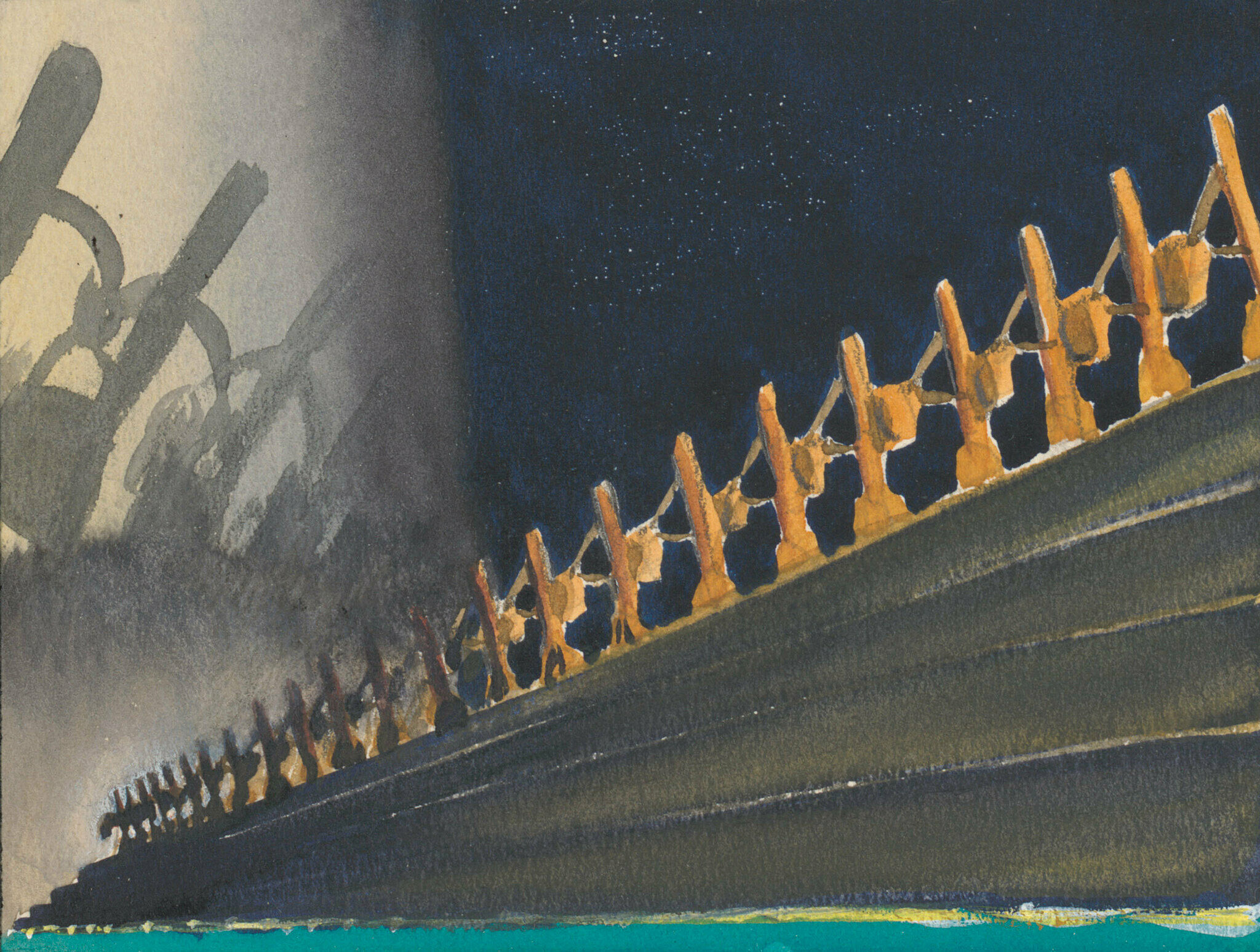
Walt Disney’s Fantasia (1940 film) (Photograph courtesy of The Whitney Museum)
My contact signaled a command. He ordered me towards the exit with his short, gloved pointer finger. I felt as if the evil sorcerer from Fantasia had taken me under his powers like Sorcerer’s Apprentice Mickey Mouse’s marching brooms. . My hyena-like handler’s power pulled me through the revolving glass doors. I stepped out into the below-zero-degree morning.

SUV similar to the Tour de (special force: How the Army and Chevy team up on the front lines by Kirk Bell (Motor Authority. 2017 Chevrolet Tahoe and Suburban Midnight Editions at The Range Complex in Raleigh, North Carolina) (Image generated with Microsoft Design / Melodie Miller AI Graphic Engineer)
Feeling like the protagonist in a Disney movie, I floated towards the oversized, black S.U.V. that awaited us. Nearly invisible patches of black ice covered the concrete, and I felt encouraged that I could still recognize reality. Trying to act casual, I asked my contact about his position in the army and he answered without hesitation.
“I’m a sniper, and I’m good. I never miss and I always win.” He said arrogantly, like he was bragging about being an Olympic gold medal winner.
My mind began to fight itself with crazy ideas as I realized I was climbing into the black S.U.V. with a trained killer.
“Don’t worry, we’ll take care of you.”
I hadn’t said I was worried, and I didn’t like the idea of being “taken care of” by a professional hitman who was trained by the U.S. military. But I reminded myself again that the Army’s “C-notes” were just as honest as any other client’s money and, what’s more, the government paid on time.
I climbed into the imposing, blacked-out, windowed Chevrolet Suburban and slid across the frigid leather seat. I was aware that I could see out of the S.U.V., but no one could see in. I buckled the hard metal seat belt and cinched it tightly around my small waist. I looked to my right side and there lay a long scarf, handwoven in a distinctive Afghan tribal plaid pattern. I recognized the scarf as one used for wrapping a turban. It had a slight musky odor and as I looked closer, I could see that it was dirty and stained.

Microsoft Copilot Image generated by Melodie Miller
The sniper reached his hand back from the front seat and said, “I’ll take that scarf. My buddy sent that to me from Afghanistan. He said, “The guy won’t be needing it anymore.” This was followed by a short burst of hyena-sounding laughter. When he touched the scarf, the sniper grew agitated and felt compelled to share his story. I envisioned that he had pulled the sword from the stone, seemingly empowered as a knight, beyond reproach, entitled to kill for his kingdom.
“You’re probably wondering how I got my hands on that Afghani scarf?” he said.
“Well, OK, how?” I said reluctantly.
“Like I said. The guy didn’t need it anymore and my buddy borrowed it, so to speak, permanently,” the handler said and laughed again.
Isn’t that what he just told me, I thought. I remained silent, instinctively understanding that, like the spinning car, nothing good could come of where this story was going. But he pivoted to a different topic, which at first seemed like a good move but then reality went from sitting in the back of an S.U.V. driven by a trained assassin to the confessionals of a hit man.
“You’re probably wondering how I became a sniper.” He offered eagerly.
The words of my mother ran in my ears “If it’s not nice, don’t say anything at all.” I did not respond.
“I was eighteen years old and arrested for stealing a car. This time I knew it would be prison, not juvie detention. I told my attorney that I liked guns and was a perfect shot with an automatic rifle and we made a deal with the judge. The judge offered: “Prison or the Army?” I accepted the U.S. Army’s offer, and here I am, killing bad guys for my country, and I now I own my car.”
The S.U.V. raced down the small-town highway to the Natick Army Base. We passed Wellesley College, my step-aunt Helen’s alma mater and my resentment boiled irrationally as I thought about the one million dollars she had given to the college. Had she given me some of that million dollars, I wouldn’t have taken this dangerous job. I reminded myself that she didn’t give any of her money to humans, only institutions like the Seattle Opera House and the Huntington’s Foundation, and that seemed to comfort my foolish subconscious mind, at least temporarily. Besides, we weren’t really family; she was my step-aunt, and I doubt she even remembered my name on the day she died.
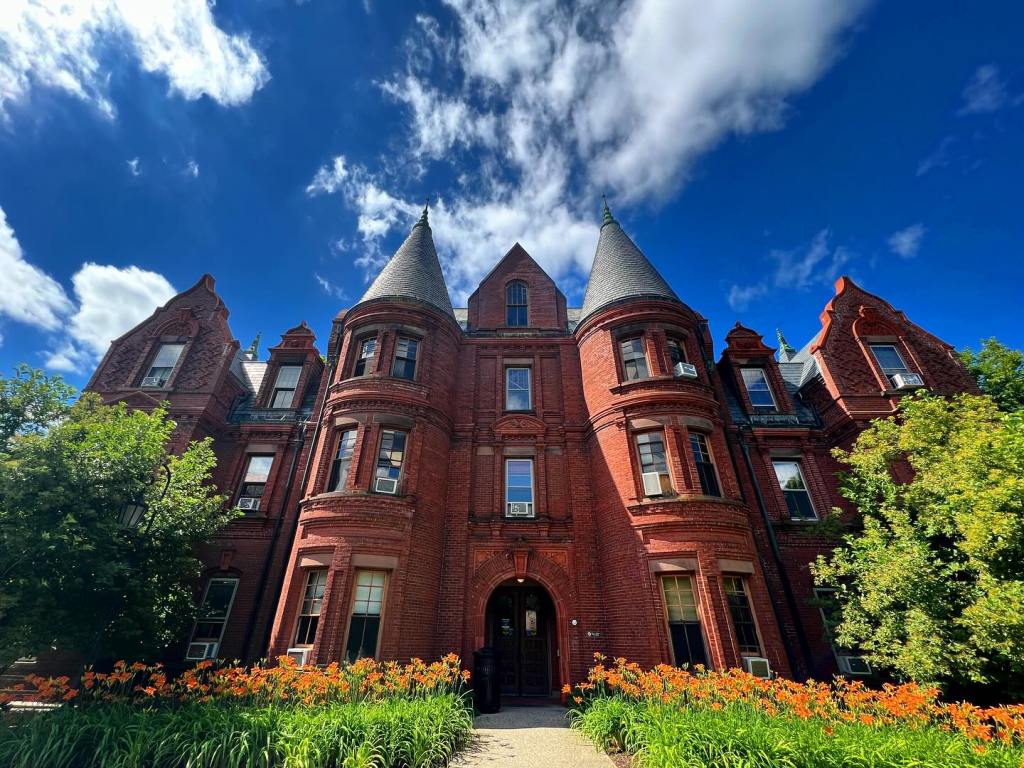
Billing Hall, Wellesley College, Wellesley, MA (Photograph courtesy of Wellesley College)
The S.U.V. approached the gated entrance to the military base, and the sniper automatically rolled down all the windows.
“I need you to hand me your identification and exit the car,” the guard said.
I reached for my wallet nervously, pulled out the cards, shuffled through them to find my driver’s license, and handed it to the guard. He scanned my license in a daunting manner, looked at me, asked me to remove my hat, and looked back at the license.
“I’ll need to see your passport,” the guard said, “and get out of the vehicle.”
“Oh, yes, of course,” I said and reached back into my purse.
I handed my passport to the guard and began to climb out, but I was escorted from the back of the S.U.V. and stood in the freezing rain while two other guards ran two bomb-detecting wands under the body of the car, while a third guard examined the undercarriage with a mirror. I watched the men examine the SUV while a fifth guard physically patted me down.
“Open the trunk,” the fifth guard said, “and open your luggage.”
The guard emptied my luggage and rummaged through my intimate belongings with the unfamiliar hands of a stranger wearing an automatic rifle over his shoulder. I looked around and noticed there were no other women in sight.
My gaze shifted toward the sky but stopped at the top of the fence surrounding the base. At the highest point on the chain-linked fence sat a wildly bundled layer of barbed wire, stacked one foot tall like the topping of a vicious birthday cake.
The guard reached out his hand slowly towards me, offering my ID. He looked me in the eyes and said softly, “I see your birthday is nine eleven; that sucks. You’re free to go. Have a nice day.”

Hindu Kush Mountain Range. (Explorerweb. Photo Courtesy of Tirich Mir. Photo: Abdul Rehman Joyia)
I emerged from the designated quarantine area sanctioned as a military contractor, hired to design clothing for the Special Operations Joint Services to keep them warm in the Hindu Kush mountain range of Afghanistan as they hunted the suspected perpetrator of the attack in New York City on the twin towers on Sept. 11, 2001.
The sniper and recruiter were my entry into the dark world of covert military operations and the men who carried out their missions. I learned that Special Operations Forces consisted of an atypical type of person, like the hyena man and Mr. Bengal, selected for their unique emotional traits and distinctive temperaments. They were fiercely loyal to each other and their country and slightly paranoid. They were trained in highly choreographed scenarios to extract and kill, and they were now my clients and I their collaborator.
Standing on the Natick military base, I became overwhelmed with anxiety, conflicted by my ideology and the compromising nature of secrecy. In a split second, I rationalized that even professionally trained military killers deserved clothes that would keep them warm.
I had an important job to do for my country, which meant turning camo into fashion and I would find a way to adapt. I hoped the Glocks would remain concealed.

Natick Soldier Systems Center, Natick, Massachusetts. The U.S. Army Natick Soldier Systems Center (NSSC) is a Department of Defense (DoD) installation with the mission to protect and sustain America’s military forces. NSSC is responsible for the technology, research, development, engineering, fielding, and sustainment of our military’s food, clothing, shelters, airdrop systems, and Soldier support items
My skills were procured by the Special Operations Office and like any true American, I needed the paycheck, so I accepted the mission.
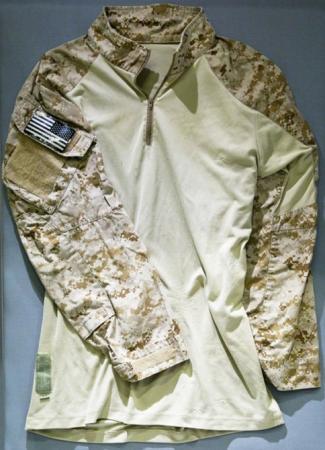

Rob O’Neill, DEVGRU SEAL, Crye shirt. 911 Memorial Museum, New York City, New York (Melodie Miller, original designer) (Photographer Kristy Leibowitz)
- https://home.army.mil/natick/my-fort/newcomers
- https://www.911memorial.org/connect/blog/museum-unveils-exhibit-exploring-raid-bin-ladens-compound
[1] Eno, Brian. Frantz, Christopher. Byrne, David Byrne. Harrison, Jerry. Weymouth, Tina. “Once In a Lifetime.” Warner Chappell Music, Inc, Universal Music Publishing Group
[2] Bush, President George W. “Airline Safety,” The Washington Post. 27 September 2001.
[3] Stills, Steven. “Find the cost of Freedom,” B-side to “Ohio.”
[4] Bates, Katharine Lee. “America the Beautiful.” 1893.
[5] Bates.
[6] Bates.
[7] Key, Francis Scott. “The Star-Spangled Banner.” 14 Sept 1814.
[8] Nike. 1988.
[9] The North Face. 1990.
[10] Patagonia. 2018.
[11] Key.
[12] Key.
[13] Anonymous.
[14] Bates.
[15] Key.
-
A satirical description of K. Marx School of Business, MBAC 61984 Course Syllabus
Satire
When did higher education become the enemy? This is a fictional breaking news release that relays the satirical course syllabus at a fictitious Marxist business school. This satire is written in response to commentaries claiming that Marxist culture is prevalent on U.S. college campuses.
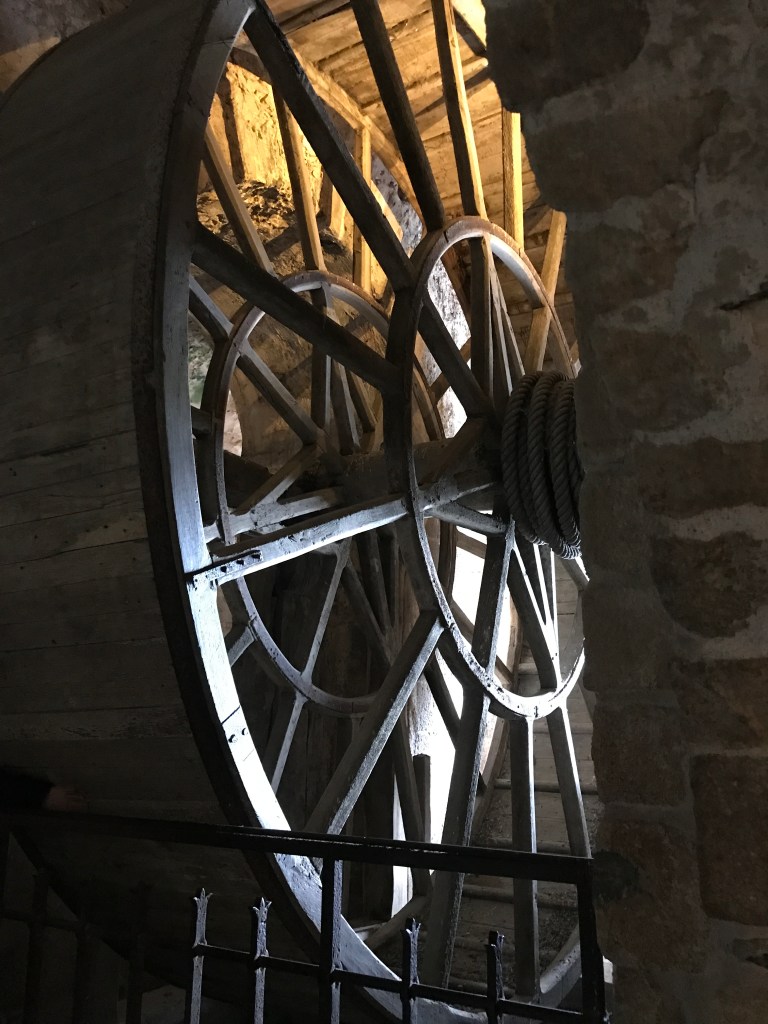
BREAKING NEWS: Underground Marxist School of Business syllabus discovered in bike satchel of arrested political dissident. Mother claims “Literary Theory and Critical Thinking studies are turning my child into a monster.” Infiltration of Marxism on college campuses proven.
Course Syllabus
MBAC 61984 Business Strategy – Innovative Management of “Profit and Means of Production”
Restricted to The Vanguard members and Master of Business Administration Candidates dedicated to overthrowing the bourgeoisie capitalist class.
Location: “SIBERIA, Gulag 13,” in the Basement of Hellems Arts and Science Building
Class Time: 12:00 PM – 12:50 PM
Instructor: Ivan T. Errible
Office Hours: Mondays after dark
Email: commi@KMSB.eduInstructors Statement: Class struggle between the bourgeoisie capitalist and the worker stands as an iconic representation of human existence as illustrated by the continuous battle concerning the owners of the means of production and the labor power. Marx tells us that “work, thrift and greed are […] (the capitalists) three cardinal virtues,”[1] and hording is their primary goal. Workers do not own the tools or means of production. Therefore, this is an essental element in gaining control of both the labor time and surplus labor time, stripping the bourgeoisie of charms of creating profit out of nothing.
When the KMSB graduate worker emerges into the capitalistic business world, it may be difficult to find comrades in arms who will join the movement against the exploitation of the proletariat. However, as a future “leader” of the Vanguard,[2] it will become increasingly important to recognize the exploited workers through group meetings and demonstrate the opportunities by which the means of their profit can be reclaimed. This class intends to teach student comrades how to infiltrate privately owned enterprises, furthering the initial stage in the Vanguard movement.
Upon graduation from this course, students will have the skills to influence workers actions by guiding them through the process of reclaiming the “Surplus Value” of their labor through transitioning privately owned tools and factories, to a lasting state-run, ruling proletarian party with nationalized ownership of the means of production
This class intends to teach student comrades how to infiltrate privately owned enterprises, furthering the initial stage in the Vanguard movement. Upon graduation from this course, students will have the skills to influence workers actions by guiding them through the process of reclaiming the “Surplus Value” of their labor through transitioning privately owned tools and factories, to a lasting state-run, ruling proletarian party with nationalized ownership of the means of production.
[1] Das Kapital, Vol 1, Part 1, Chapter 2
[2] The Vanguard: the non-profit corporation of the KMSB proletariat movement, dedicated to avoiding taxes and operating with the use of free labor, donations from guilt ridden capitalists and state supported educational funding.
You may find, at times, that the origins of your ivy league social class lingers and unduly attempts to influence your path, however, do not let these past systems of thought conflict with the goals of the Vanguard. The Vanguard recognizes that the organization of capitalism, as Marx tells us is “vampire-like ,(and) lives only by sucking living labor,”[1] therefore it seems to muddle the socialists thinking. Believe me when I say your role in the movement will put a stake through the heart of capitalism by expanding democratic centralism and rule by all.
Additionally, through service to the philosophy of Marxism and the dictatorship of the proletariat, students in pursuit of eliminating growth and profit from the corporate structure will find this class leads to a full understanding of how to take control of the means of production by the newly established worker run apparatus.
Course Description: This course introduces students to the techniques of understanding reality, thoughts and emotions through the philosophy of Dialectical Materialism and the understanding of nature as a whole. Student struggles will be observed by the classroom collective and will be discussed in a joint ownership atmosphere with other students.
This course may not be taken concurrently with MBAC 71984 or 81984 and may not be repeated. A grade of “D” or higher in MBAC 61984 is a prerequisite for subsequent advancement in the Vanguard movement.
Required Texts and Materials:
Karl Marx, Das Kapital (1867),Engles, Marx, Communist Manifesto (1848),Kim Jung-un, Perfect Brilliance: How to Starve the Populus to Garner Loyalty
Office Hours: 1:30 am -4:30 am on Mondays located in Gulag 14, Hellems Basement (go down the east-west stairs until you reach the basement and turn left and walk in a circle until you hit the brick wall at the end of the hall). If you cannot make these hours, remember that increases in productivity results from cooperation, therefore these hours work for everyone.
Grade Distribution:
Agitating: 10%
Participation / Dissent: 25%
Book Burning: 40%
Recruiting: 25%Course Requirements:
Agitating Workshops: Probably the stuff you’re here for. We will perform agitating workshop readings, followed by play acting on a daily basis. You shall learn the exact words to use to gas light a crowd and cause law abiding citizens to act against their better judgement.
Each workshop will be done in groups where individuals will receive constructive critique of their power of persuasion and each round’s requirements will be provide on the day of practice. The grades for these practice trainings will be based on how quickly a student can agitated another student.
Participation / Dissent: You are required to do three participation and dissent activities and you will be given a chance to lead your own agitation rally. The length and location of the rally will be determined by the instructor. Whether the rally concerns disrupting the state apparatus or boycotting labor factories, dig in and try to find out what makes descension work. Do your best to be analytical. Outside academic cited sources should be used and are required.
[1] Das Kapital, Vol 1, Part 3, Chapter 10
Book Burnings: Most homework in this class will take the form of book burnings, particularly texts on democracy, freedom of speech, property ownership and voting rights. The specific book burnings will pertain to a counterrevolutionary piece we read that day. Your instructor may give you a creative prompt, something analytical to provide a catalyst for that day’s discussion and inspiration to begin the bonfire activities. I grade these activities on the basis of satisfactory completion of a collection of citywide book burning results.
Recruiting Activities: At times we’ll practice recruiting activities in class, to mainly test a few strategies and get us into the mood for the next event. Occasionally you will be asked to take home and flesh out your strategies, in which case they ought to be planned in great detail and executed in secrecy.
Final Portfolio: You will construct a final protest rally plan and recruit participants.
Attendance, Punctuality and Late Work: Successful work in the K. Marx School of business is dependent upon regular recruitment of comrades to support the plight of the proletariat worker. Students who are unavoidably absent should make arrangements with the collective to make up the time missed. Failure to attend class and activities regularly may result in receipt of an F in a course and food sanctions for you and your family.
Plagiarism: Everything you will need to know will be read in Das Kapital and the Communist Manifesto whose texts are well known. Plagiarism is not possible when only two books exist.
Policies, Accommodations for Disabilities: If you qualify for accommodations because of a disability, do not bother submitting an accommodation letter because it has already been predetermined that accommodations based on documented disabilities in the revolutionary environment automatically disqualify comrades from leading teams.
Religious Holidays: God does not exist.
Honor Code: All students enrolled in a KMBS course are responsible for knowing and adhering to the Honor Code of Das Kapital and the Communist Manifesto. Violations of the policy may include: praying, reading other books, thinking your own thoughts, lying about your thoughts, not accepting a bribery offer, refusing to threaten new noncompliant recruits, unauthorized access to alternative reading materials, dishonest clicker fraud, executing the same or similar agitation rally’s in more than one city without permission from the course instructors and most importantly, an unwillingness to inform on personal friends who own the means of production.
All incidents of misconduct will be reported to gulag guards who have a sixth-grade education and who happily bully any and all human beings, including women, children and infants.
Students who are found responsible for violating the Das Kapital and the Communist Manifesto integrity policies will be subject to death by poison.
Discrimination & Sexual Harassment: The KMSB remains committed to fostering intolerant acts of misconduct on the bourgeois class which includes assault, harassment, and stalking owners of means of labor. Individuals who believe they have been subject to retaliatory actions from a bourgeois owner of means of labor should report the incident to the Institutional Institute of Impartiality and Obedience (IIIO) and punitive action will be taken secretly in the dark of night.
Class Schedule
Subject to change based on classroom progress. Changes will be noted in class.Week One
M. 8/27 – Introduction/Syllabus – Read syllabus out loud and sign a pledge of silenceW. 8/29 – Direct Struggle
Have Read: Marx Das Kapital, Section 1 (all), Section 2 (all)
+ Marx “Letter from Marx to Engels” (1867).
+ Anonymous Proletariat’s “Grief and How to Project Your Failings onto Others”F. 8/31 – Division of Labor
Have Read: “Ford and the Assembly Line,” Chapter 3 (pg. 55-61) (Canvas)
+ Gehring, “The Use of Force and Dogma”
+ Stalin, “How to Talk to a Worker”Week Two
M. 9/3 – LABOR DAY, NO CLASS, “The instrument of labor (in) the form of a machine […] becomes a competitor of the worker,”[1] therefore, burn a factory today.W. 9/5 – Production, Distribution and Consumption
Have Read: Henry Ford’s, People as Machines, Chapter 6 (pg. 167-175)
+ Walt Disney, Building a Psychological Utopia, (How to fool all the people all of the time.)
+ Tolkien’s The Hobbit, Ch. 1 (How to recruit the unwilling with false promises.)F. 9/7 – Consumption
Have Read: George Wallace’s “Incarnations of the Burned Worker” (179-181)
+ Poe’s “Tell Tale Heart,” (How to hide victims of book burnings.)Week Three
M. 9/10 – The Antithesis of Use Value and Exchange Value
Have Read: Hapsburg “The Czar’s Ghosts and their Jewels” (Lessons in how to use the trappings of the bourgeois to fund propaganda and agitation.)
+ Marx “The Poverty of Philosophy” (1847)W. 9/12 – Democratic Centralism
Have Read: Das Kapital, Section 1 and 2, (again), (This is the most important page in the book.)
+ Poe’s “The Fall of the House of Usher,” (Lessons in how to drive bourgeois friend’s mad.)F. 9/14 – Workshop Preparation (Wear clothes and shoes you are willing to burn.)
Turn in: FIRST BOOKBURNING REPORT
[1] Das Kapital, Vol 1, Part 4, Chapter 15
Week Four
M. 9/17 – Religion and Wives Tales (Reasons to not waste time reflecting on spiritual ideals.)
Have Read: Moscow Institute of Scientific Atheism, Chapter 9 (Pg. 1)+ Lenin’s “How Religion Deprives People of “I” (Canvas)
Week Five
M. 9/24 – Group Agitation Workshop (Bring tools of disruption, e.g. baseball bats, hammers.)
Have Read: Das Kapita,l Chapter 1, (again)+Kim Jong-un’s Propaganda and Misinformation Handbook
Turn in: Agitation and Propaganda Rally Agenda, first draftFINALS WEEK
Submit Agitation and Propaganda Rally Operation, final Time/Place TBD.Click these links to understand how Marxism and Marxist terms are used in the media.
- https://www.theguardian.com/news/2015/feb/18/yanis-varoufakis-how-i-became-an-erratic-marxist
- https://www.heritage.org/progressivism/commentary/the-root-cause-the-insanity-college-campuses-older-you-may-think
- https://alyesque.medium.com/the-university-is-not-our-friend-2e6dfdecf0bc
- https://www.cla.purdue.edu/academic/english/theory/marxism/terms/
-
The Nationless State of Junktopia
A reimagining of Chris Marker’s Junkopia, short film shot in the Emeryville Mudflats of northern California. Story written by Melodie Miller.
I walked with hesitation down the path towards the Junktopia Alter, a place of worship that guarded The Great Bridge.

From Junkopia – A short film by Chris Marker | Courtesy of Criterion and Youtube
A montage of artifacts walked the pathway without moving a muscle. The longitude and latitude flashed transparently in the heads-up display of my spectacles.
From Junkopia – A short film by Chris Marker | Courtesy of Criterion and Youtube
I imagined the smell of lavender hovering in the bay.
From Junkopia- A short film by Chris Marker | Courtesy of Criterion and Youtube
In the distance the Bridge stood colorless, in need of recognition of its emptiness.

From Junkopia- A short film by Chris Marker | Courtesy of Criterion and Youtube
The memory hurled me to the day The Great Bridge almost collapsed.
From Junkopia – A short film by Chris Marker | Courtesy of Criterion and Youtube
The eyes of the unconscious biplane looked oppositionally at the myopic cockatoo that sat on my shoulder.

From Junkopia- A short film by Chris Marker | Courtesy of Criterion and Youtube
My bird recognized the fascist symbol painted on the wheel of the biplane as a warning to go no further.
From Junkopia- A short film by Chris Marker | Courtesy of Criterion and Youtube
My amygdala said “Run!” but I persisted onward.
In the distance the Junktopia Alter remained its original color of distressed and burnt Tuscany auburn; looking like it was primed for a top coat of blood red paint.
From Junkopia – A short film by Chris Marker | Courtesy of Criterion and Youtube
I thought of Catch 22 and its airplane that flew detached from the war without Yossarian on board who was long dead as a character and forgotten by middle school teachers and students.
Along the path, a false messiah perched in a lifeless tree called to me longingly, beckoning for an apostle to gather a flock of followers.

From Junkopia – A short film by Chris Marker | Courtesy of Criterion and Youtube
Her fuchsia and dark black mesh wings, torn and ravaged, desperately flapped in the turbine powered mechanical wind of capitalistic rule dominating the newly formed nationless state of Junktopia.
From Junkopia – A short film by Chris Marker | Courtesy of Criterion and Youtube
In the distance, the lime, swampy grasslands filled with abandonment stood as shelter for the birds that no longer could fly. The decibels soaring from the speakers increased, projecting the vibrational reminiscence of the biplanes menacing history preparing to drop its deadly cargo on the unsuspecting living things resting below.

From Junkopia – A short film by Chris Marker | Courtesy of Criterion and Youtube
I approached the alter and the vacant, ornamental glass bottles that guided the unlighted path began to shatter from the sonic sounds spilling overhead, the speakers positioned ubiquitously on the bridge.
Jagged fragments threatened my jugular while the unsympathetic marsh called to me with a menacing howl.
One, razor sharp, ragged edge of a fragmented bottle neck hung from the bridge rafters by a wire hangman’s noose; its rusted metal screw top like a decapitated democratic statesman, his fellow, screw top public servants looked on from the gallery.

From Junkopia- A short film by Chris Marker | Courtesy of Criterion and Youtube
I had abandoned my map on the battlefield and my cell phone no longer recognized a charged. I felt lost although I was not.

From Junkopia- A short film by Chris Marker | Courtesy of Criterion and Youtube
The Republic now rests as fragments of shattered glass reflected as graven images in the birds eye.
From Junkopia- A short film by Chris Marker | Courtesy of Criterion and Youtube
The fascist symbol painted on the tail of the biplane, a relic of the final war, roared: “the number twelve,” with the sharpness of two major league football helmets cracking in collision. “The twelfth man,” it called out silently, a rhetorical souvenir of the war. “The fans did not offer a home advantage,” I shouted back.

From Junkopia – A short film by Chris Marker | Courtesy of Criterion and Youtube
The weathered alter walls made of wooden fish bone skeletons were rotted from the salt sea air. I bowed down to the god of technology. The empty tin-soup-can minarets stood as apostates and a reminder that rations must be earned by the labors of my cellophane hope.
From Junkopia – A short film by Chris Marker | Courtesy of Criterion and Youtube
I waited for the signal to perform the requisite incantations. The white whisker entrails of the metallic stork swimming in the expansive future flapped in the mechanical breeze along with the Messiah’s wings. The five-feet tall, hand-made paper stork hovering nearby narcissistically mocked its own self-absorbed symbol of fertility.
From Junkopia – A short film by Chris Marker | Courtesy of Criterion and Youtube
No one knew how or when the Kangaroos had arrived in Junktopia.

From Junkopia – A short film by Chris Marker | Courtesy of Criterion and Youtube
But, like the nationless human inhabitants, they were there to stay, because no one else wanted them.
From Junkopia – A short film by Chris Marker | Courtesy of Criterion and Youtube
Junkopia – A short film by Chris Marker | Screenshot courtesy of Criterion and Youtube
-
Seattle Washington Union Bay Natural Wildlife Sanctuary
The road taken on a New Year’s day. A reimagining of Robert Frost’s The Road Not Taken.
The road taken down a mossy path on the first New Year’s Day.
Where two birds converged in a browny wood with a sigh.

Long I stood at the undergrowth.

The path was bent and gravely but it had the better claim.

Both were equal that morning but one was less traveled.

The other was fair and without leaves trodden bare.

Though the way leads to passing by and by.
Somewhere traveling ages hence, the one traveled made all the sense.
I regret there was only one road to travel.
But, one road was taken that morning and I kept the other for another day.

-
The Gothtopian Island of Mont-Saint-Michel, France
A creative nonfiction experience.
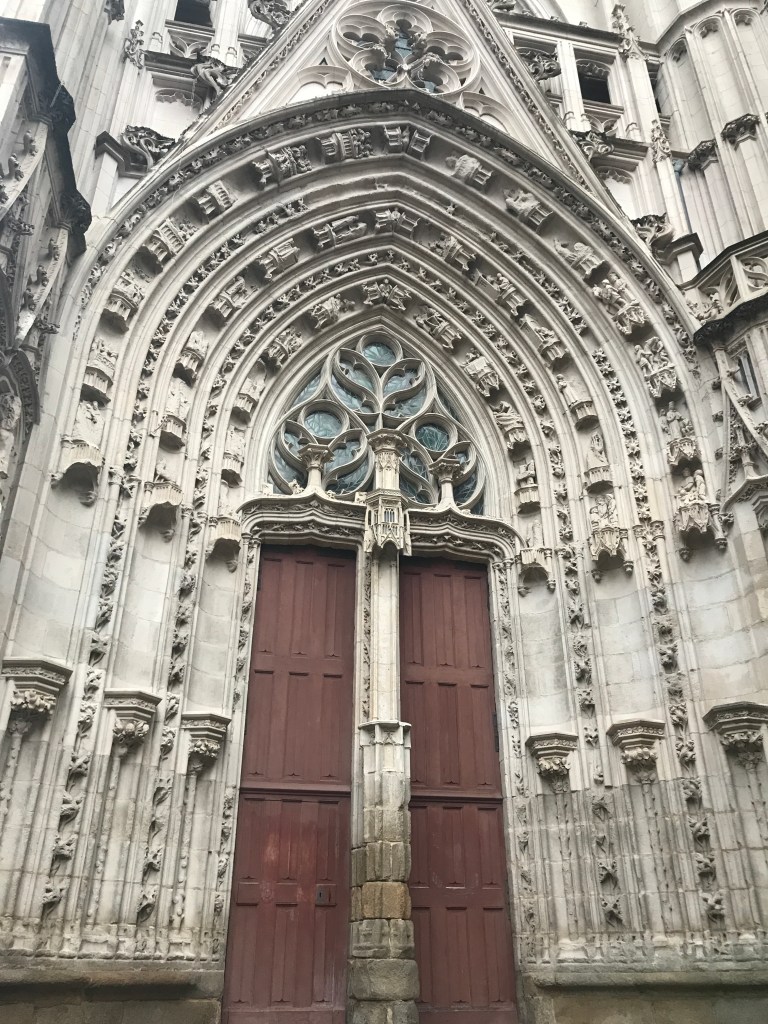
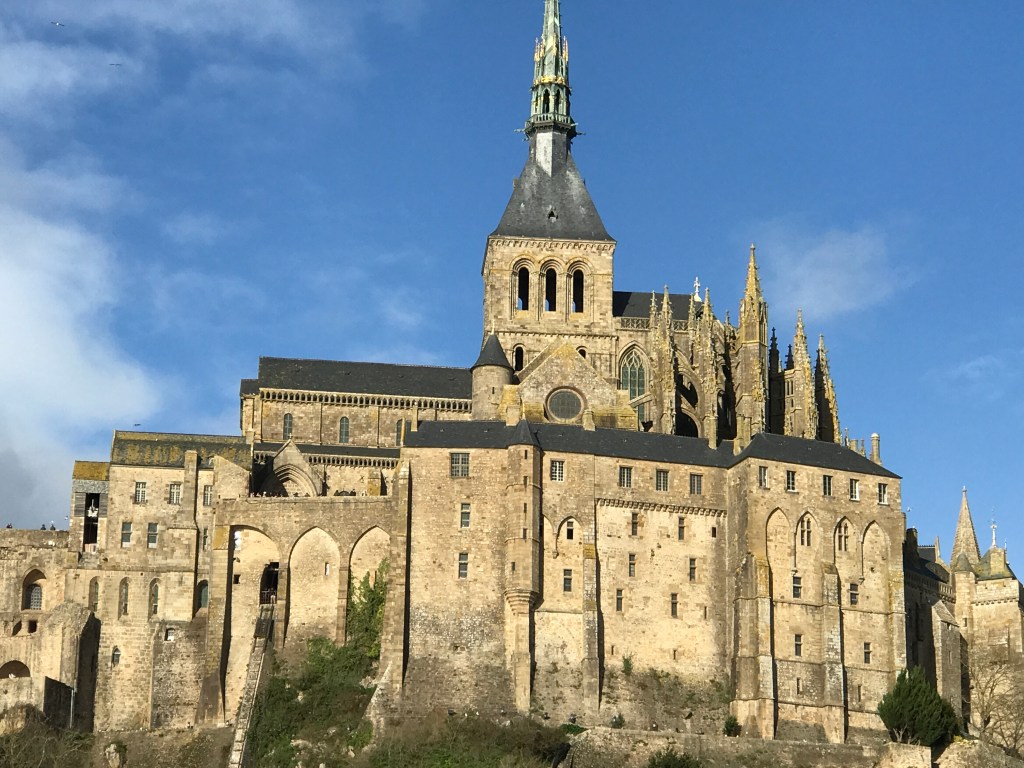
Mont Saint-Michel, France (Melodie Miller | Photographer)
I paused along the moss-clad path to Gothtopia’s altar, where worship lingered like incense in the ghostly ruins of Saint Michel’s basilica in Normandy. The damp perfume of aged wood and stone breathed through the centuries, pulling my soul through time’s fragile veil. I stepped first into the monastic refuge of 966 CE—then onward into the cold, stone prison of King Louis XI in 1472.

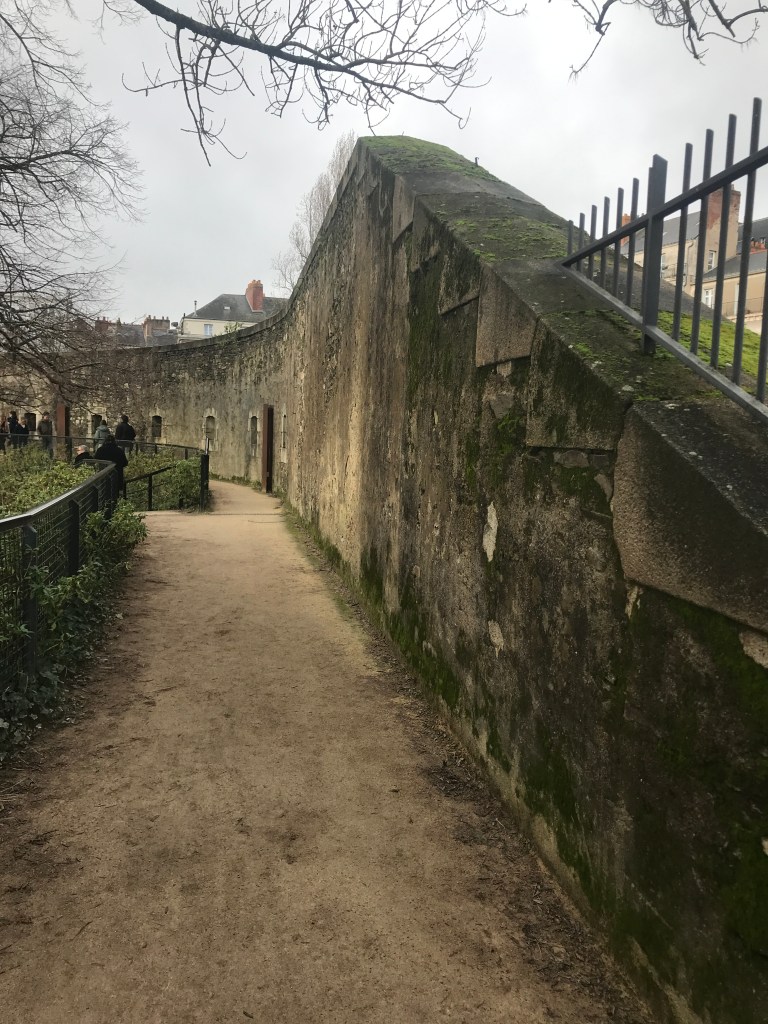
Mont Saint-Michel, France (Melodie Miller | Photographer)
The spirits of the exiled citizens whispered, “Run away,” yet I pressed forward. In the distance, the unforgiving door stood resolute, its distressed, burnt Tuscan auburn frame glinting beneath a lacquered sheen of blood-red defiance.

Mont Saint-Michel, France (Melodie Miller | Photographer)
A procession of artifacts drifted down the path, motionless yet advancing, as if carried by memory. Coordinates flickered across the heads-up display of my spectacles—longitude, latitude, fragments of direction. I had left my map on the battlefield, and my phone no longer held a charge. Though I was not truly lost, the world had misplaced me.
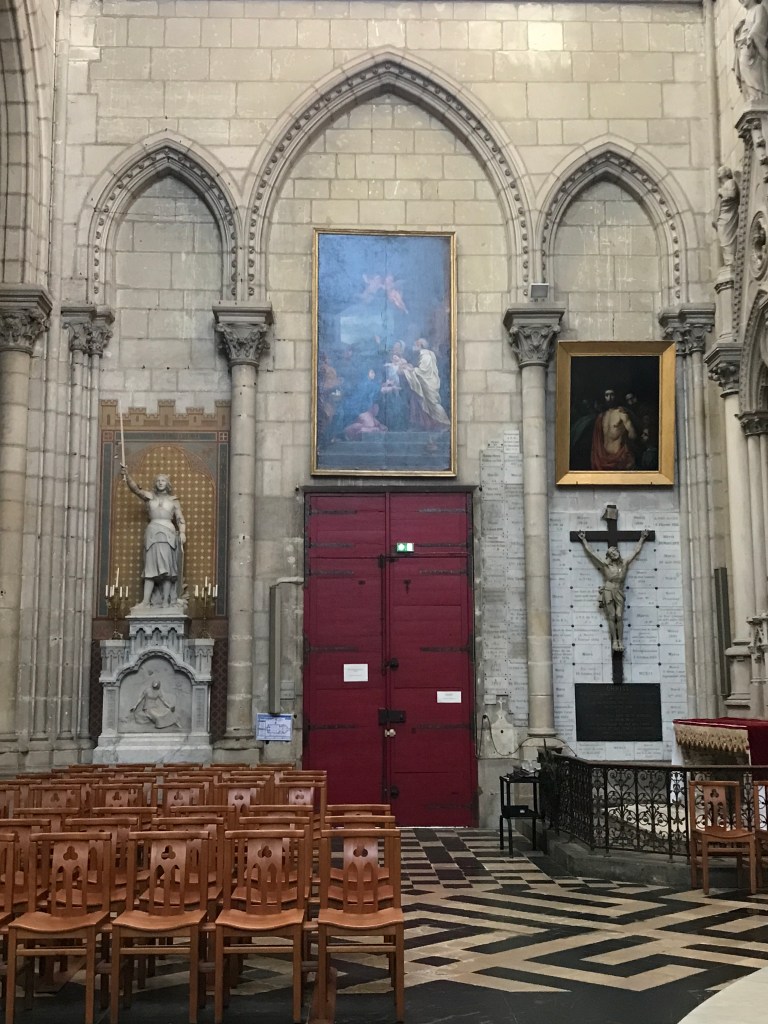
Mont Saint-Michel, France (Melodie Miller | Photographer)
The red lacquer door, a relic of a final warning, roared, “Open me!” Its cry rang like swords clashing in the hands of dying warriors. “The end is near,” it whispered in silence, the relic’s cruel souvenir. “The enemy offered no home advantage,” I answered, defiant against its echo.

Mont Saint-Michel, France (Melodie Miller | Photographer)
The unconscious masters ignored the printed enslaved, who begged for release from the fabric that bound them. I saw in the image a colonial warning—a reminder not to forget the past. I thought of the forced integration that tore children from their former lives as they boarded those buses. Their spirits have long since vanished, erased as characters and forgotten by their teachers and the system that failed them.
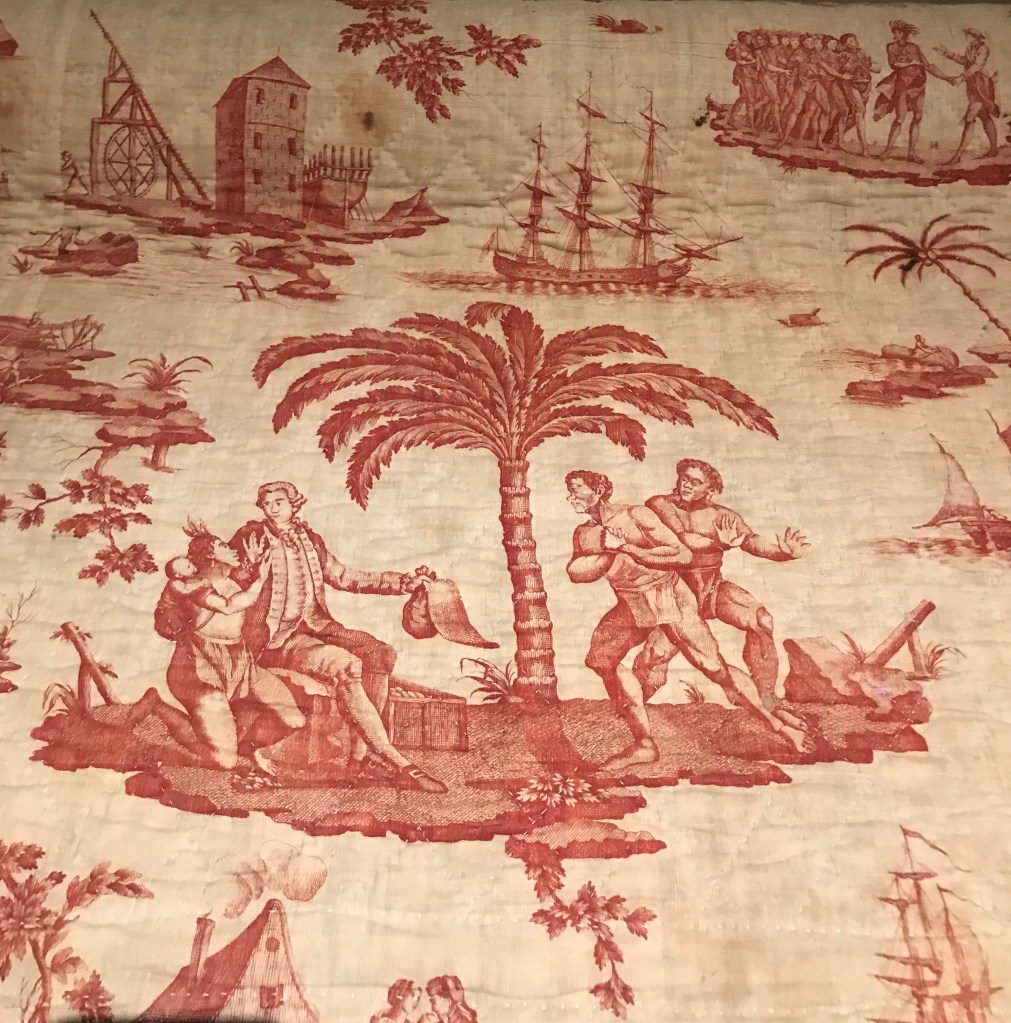
Mont Saint-Michel, France (Melodie Miller | Photographer)
Along the path, a messiah sat upon a fractured altar, her voice trembling as she called out for an apostle to gather the faithless flock. Her sword and wings—tattered, torn, and trembling—beat helplessly against the cold, mechanical wind of capitalistic dominion that had ruled over Gothtopia.

Mont Saint-Michel, France (Melodie Miller | Photographer)
As I drew near the altar, the hollow glass candles began to shatter under the prophet’s resonant cries. Razor-edged shards clashed around me. From below, the unfeeling Holy Mother wailed—a menacing summons that chilled the marrow of my faith.

Mont Saint-Michel, France (Melodie Miller | Photographer)
Through the monolithic arches, I saw the basilica—its nave filled with abandoned chairs, now nests for birds that had long forgotten how to fly. The Benedictine monks of 1790 CE were driven from the abbey by the revolutionaries, who also abolished the lettres de cachet, sealing the end of an era in French history.
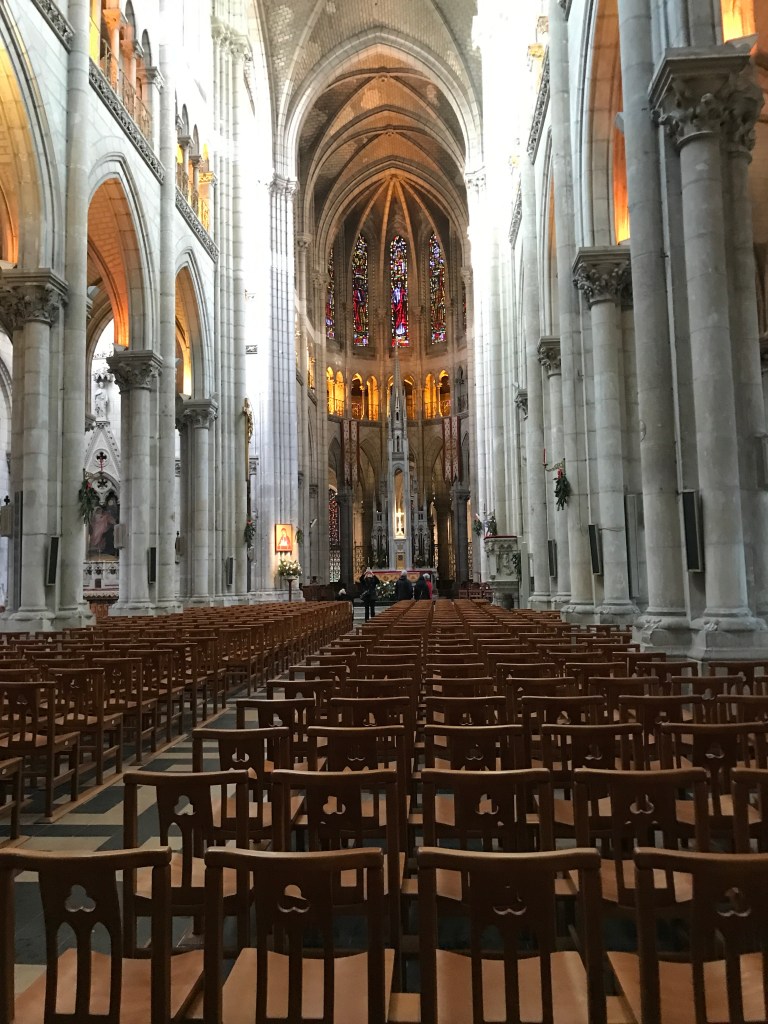
Mont Saint-Michel, France (Melodie Miller | Photographer)
The altar walls, built from the skeletons of time, stood weathered and decaying beneath the assault of the salt-laden sea air. I knelt before the new god of technology, awaiting the signal that would permit the ritual, the digital incantation demanded by faith’s replacement.
Around me, green moss and a viscera of pollution writhed through the mechanical vastness of the future, twining with the Messiah’s torn wings. Nearby, a self-adoring granite gargoyle hovered mockingly, its once sacred symbol of fertility now a caricature of its conceit.
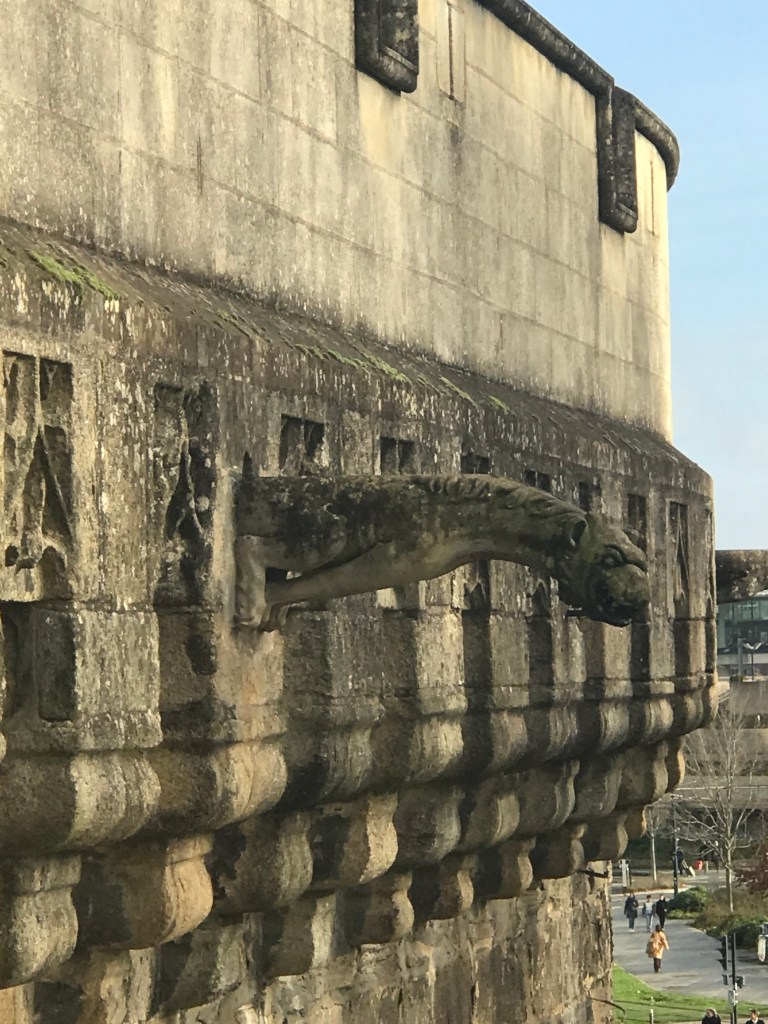
Mont Saint-Michel, France (Melodie Miller | Photographer)
Razor-sharpened wrought-iron impalers stood in place like sentinels, their blackened stocks recalling the disappeared fallen heads of statesmen. The tattered public servants gazed on from the gallery, trapped in an echo of the past. Their ghosts, condemned to linger in the gallery, watch as history repeats itself. A vessel of broken time, the basilica endures its shattered moments. Her remembrance, reflected in graven images of the memory of Saint Michel and in the minds of the pilgrims.

Mont Saint-Michel, France (Melodie Miller | Photographer)
The vacant wrought-iron bars framed a prophecy: our daily debts are the rations earned through the labors of hope, fragile offerings, easily crushed by a king’s will. Lettres de cachet once sanctioned imprisonment or death without trial within Mont-Saint-Michel’s shadowed Gothtopia. Yet, in bitter irony, this violation of justice preserved the abbey from utter ruin.
Mont Saint-Michel, France (Melodie Miller | Photographer)
As I turned to leave, the narcissistic ghosts gathered—unseen yet impenetrable—blocking the windows and door. They pulsed with vibrations drawn from the basilica’s menacing past, its walls still breathing history. One by one, the apparitions released their lethal cargo of memories upon the living below—those drifting through their holidays, blissfully unaware, unwilling to remember.
Mont-Saint-Michele, Normandy, France

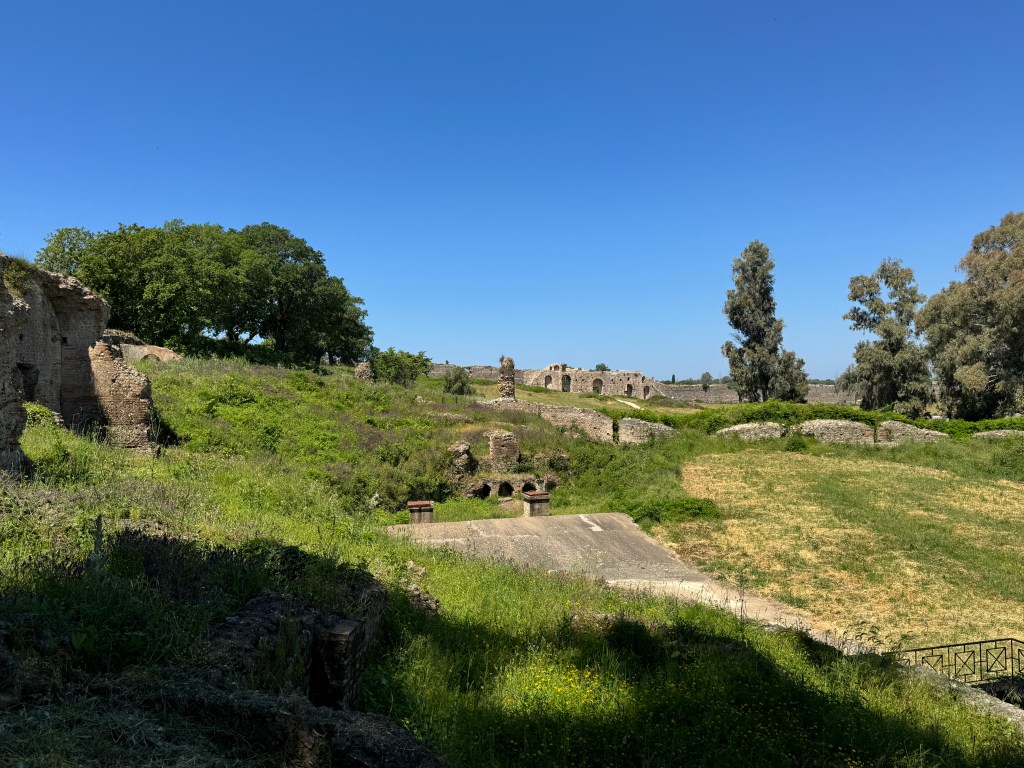
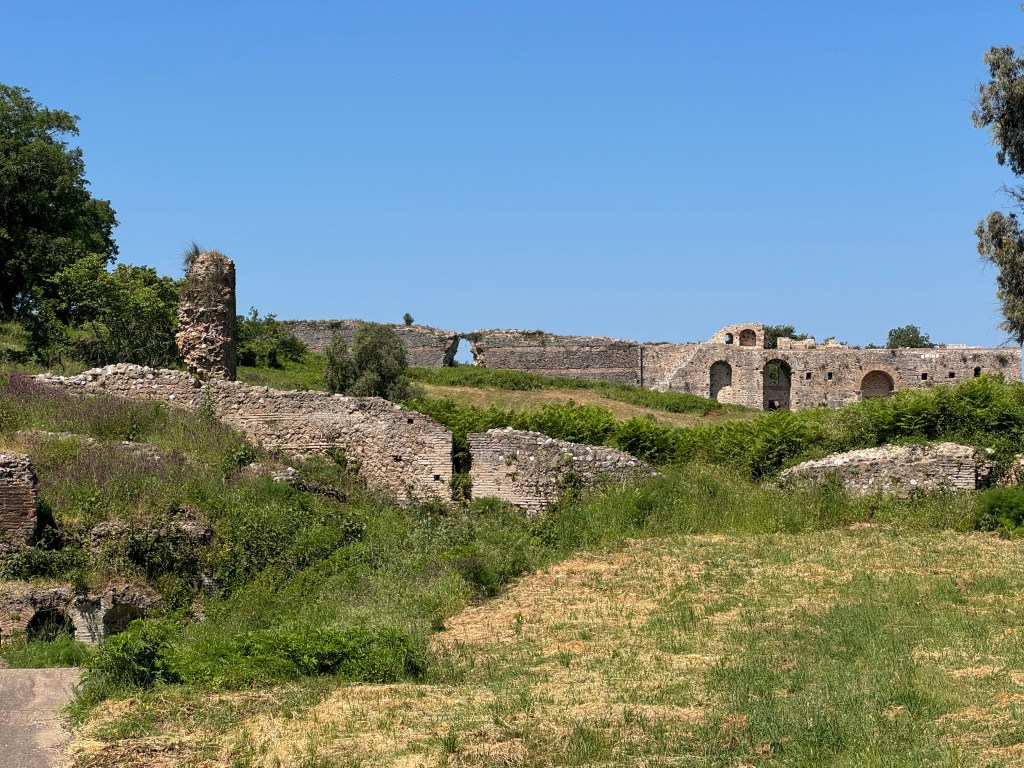
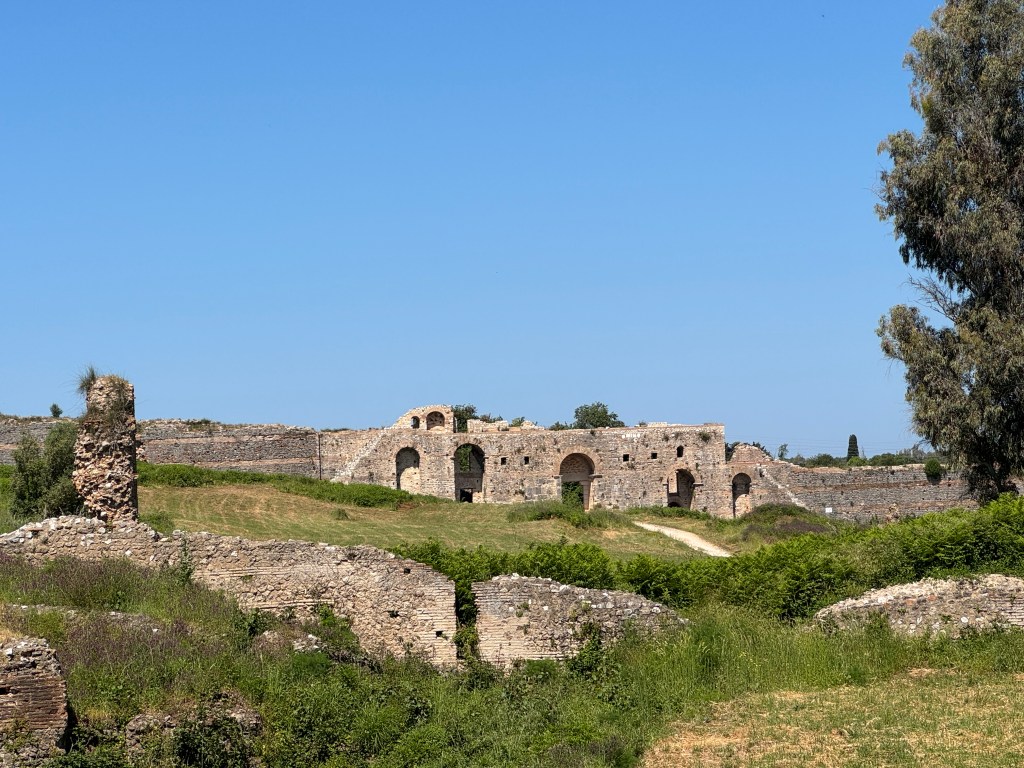
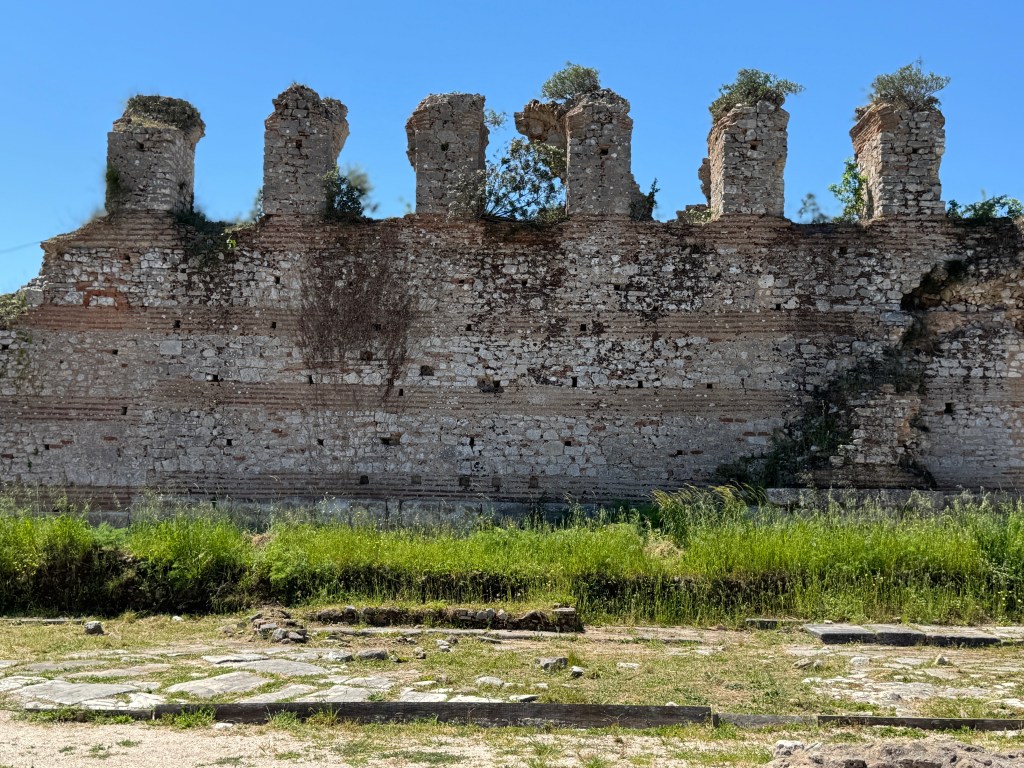
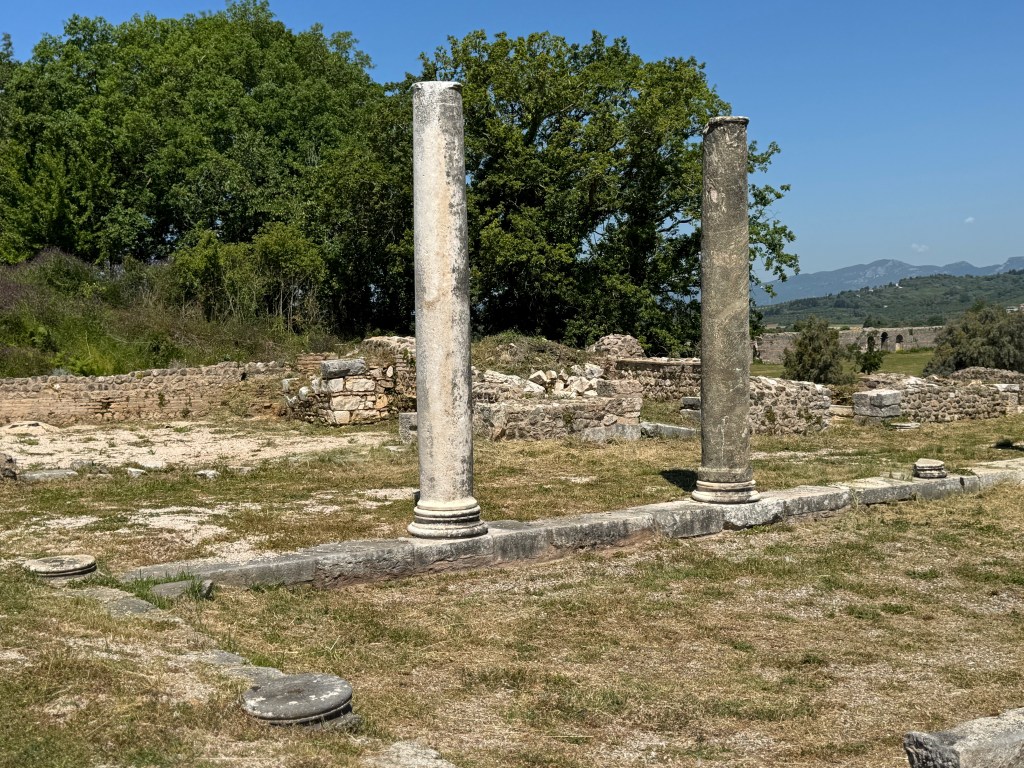
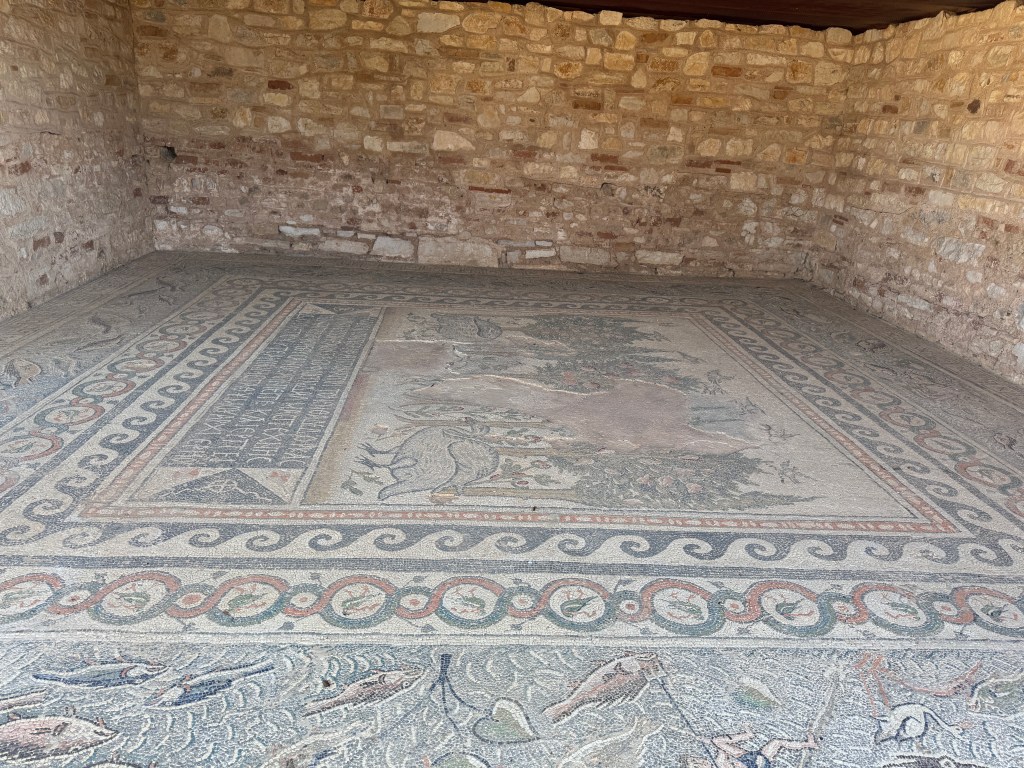
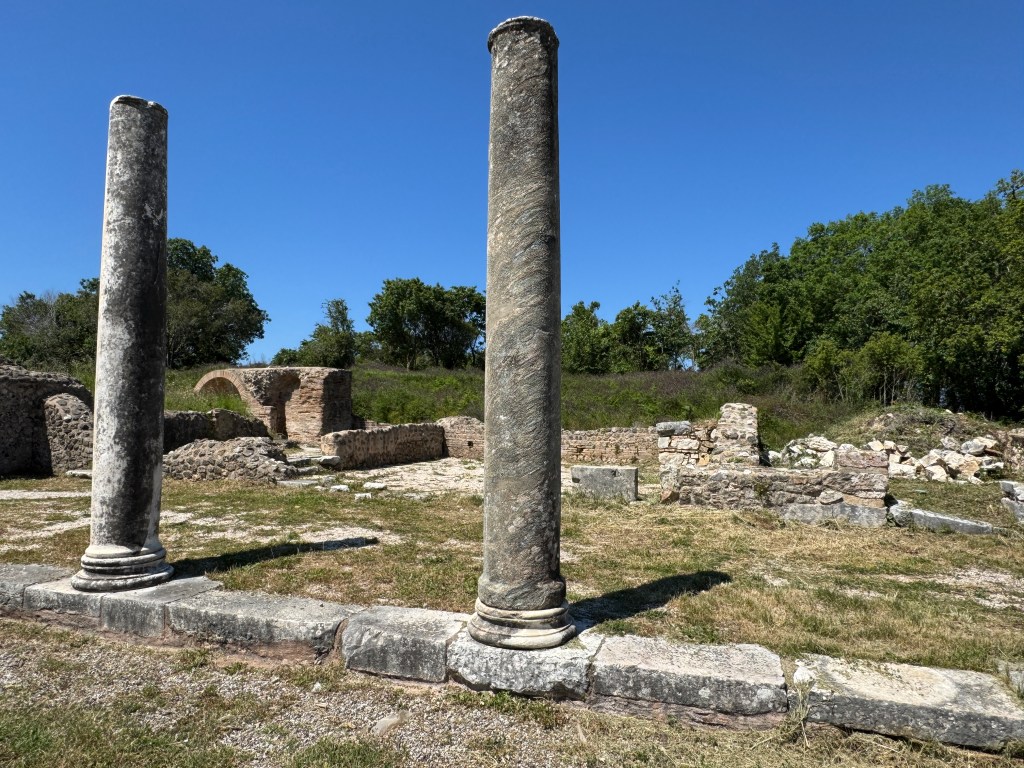
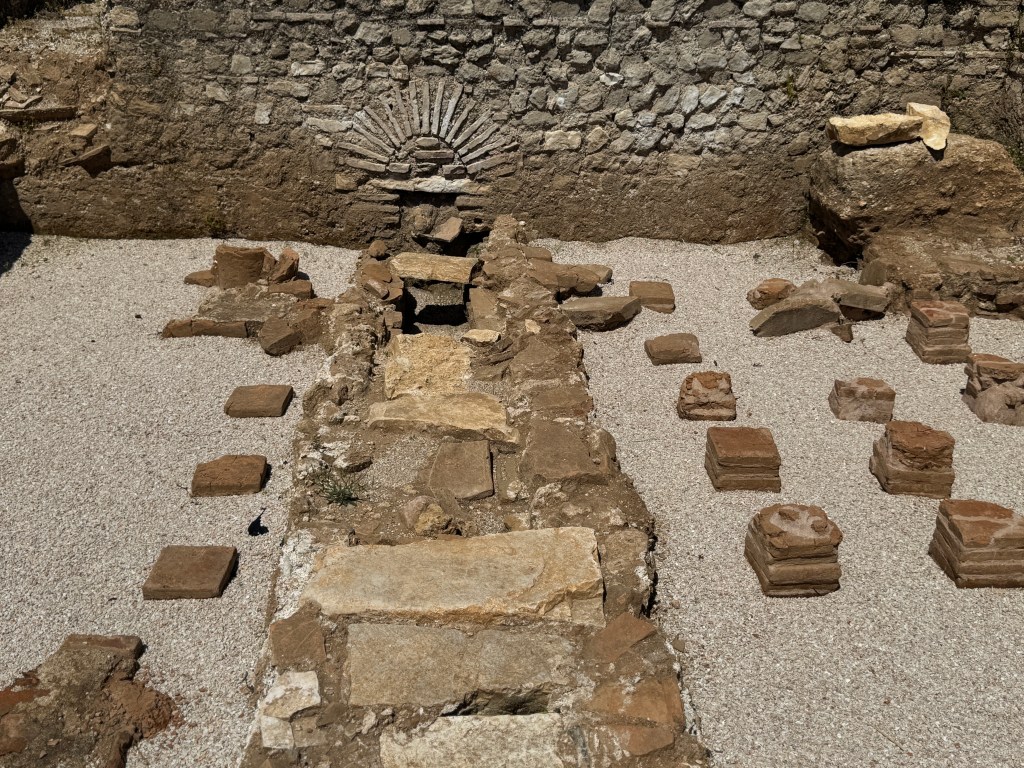
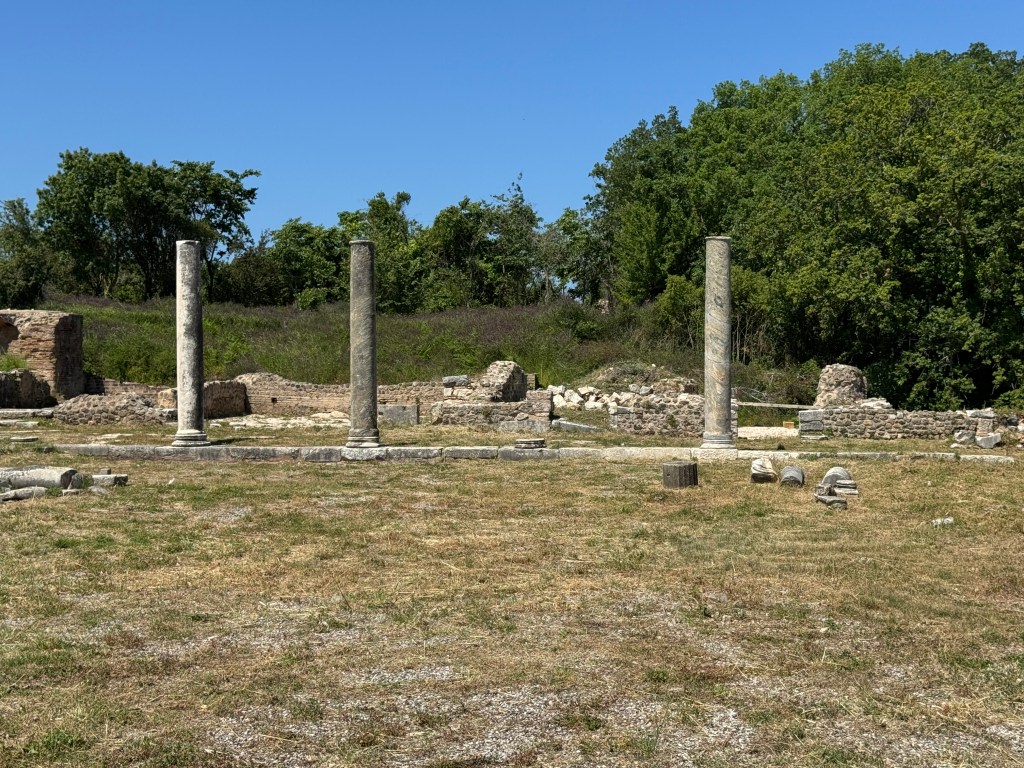
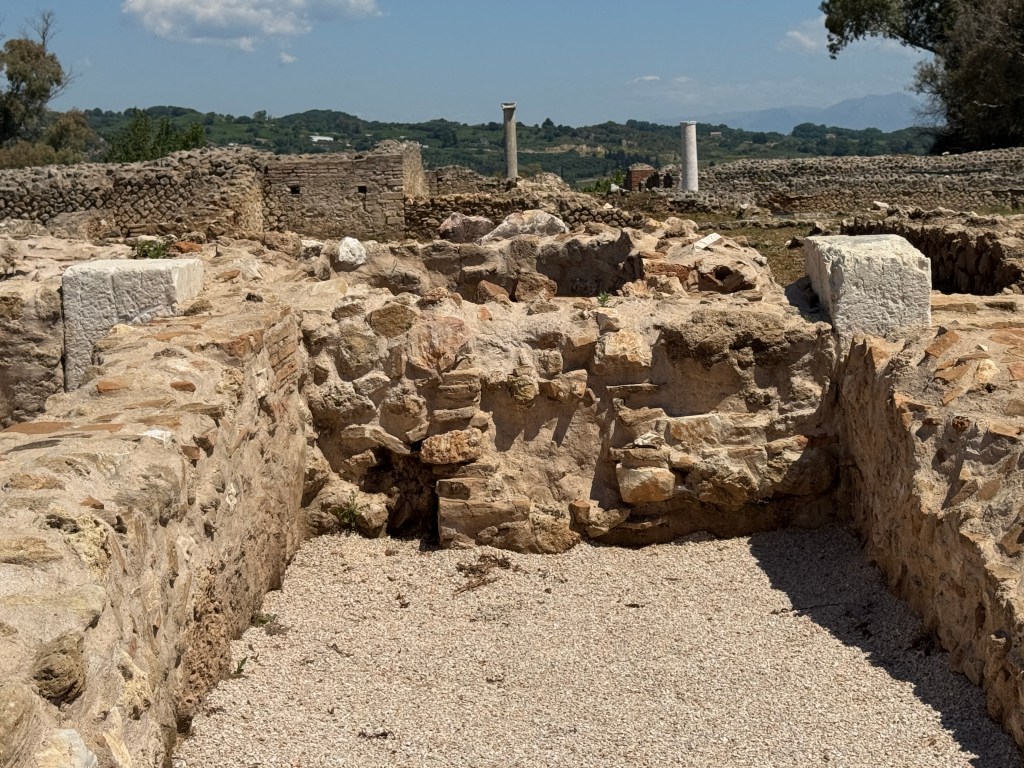
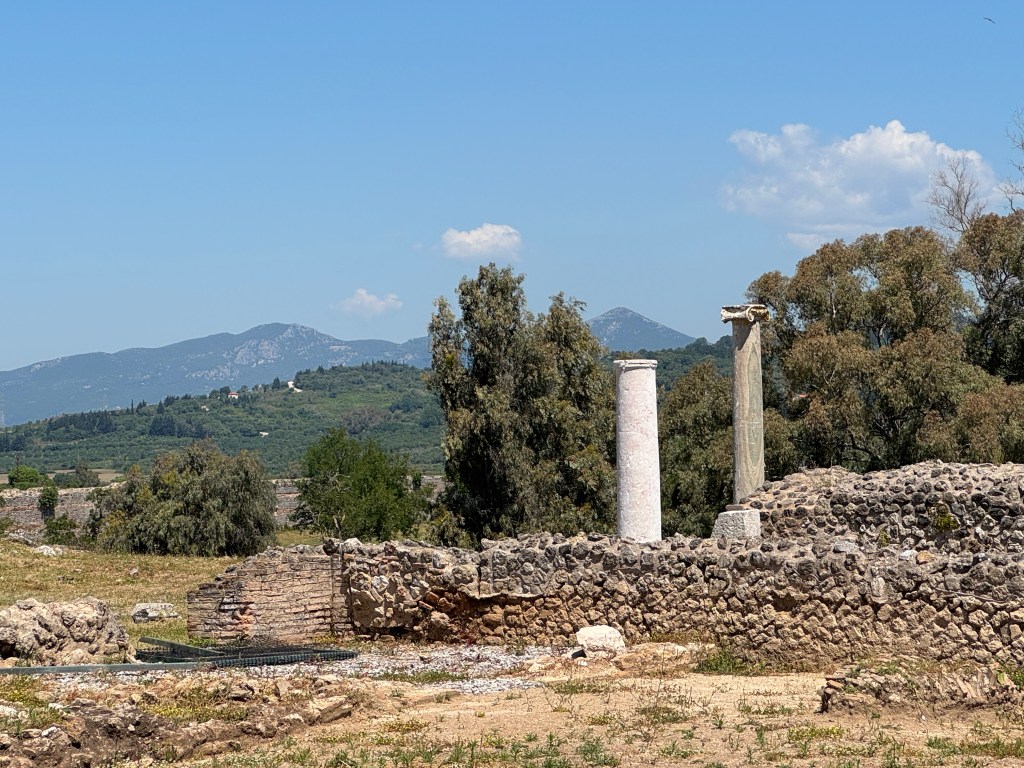


Leave a Reply